
PMP-130 · Lesson 9 of 12 · 25 min
Estimating costs
Cost estimates predict the monetary resources needed to complete the project's work. They underpin the business case, the budget, funding requests, contract negotiations and later performance measurement. This lesson covers types of cost, the classes of estimate and their accuracy ranges, the estimating techniques applied to cost, cost of quality and life-cycle cost, how to handle escalation, currency and contingency in estimates, vendor bid analysis, and how to document the basis of estimates. Lesson 10 then turns estimates into a budget and cost baseline.
What goes into a cost estimate
A complete estimate covers every resource in the WBS: labour, materials, equipment, services, facilities, information technology and special categories such as permits, insurance, contingency and financing costs where relevant. A frequent failure is an estimate that captures the obvious items, such as construction and equipment, but misses staff time, training, temporary storage, project management, testing, decommissioning or transition.
| Distinction | Meaning | Project Compass example |
|---|---|---|
| Direct cost | Attributable directly to the project's work | Construction contract, kiosks, RFID tags |
| Indirect cost | Shared overhead allocated to the project | A share of the library's IT security team and finance office |
| Fixed cost | Does not vary with quantity of work | Architect's fixed design fee; permit fee |
| Variable cost | Varies with quantity | Tags and temporary staff hours, which vary with the number of items |
| Sunk cost | Already spent and unrecoverable | The feasibility study completed last year |
| Opportunity cost | Value of the best alternative forgone | Benefits of upgrading another branch with the same money |
Sunk costs should not influence decisions about the future; only future costs and benefits matter. If the feasibility study cost $40,000 and new information shows the project is no longer worthwhile, the $40,000 is not a reason to continue. Opportunity cost appears in project selection: choosing project A over B forgoes B's benefits.
Indirect costs are handled according to organizational policy. Some organizations include them in project budgets through an overhead rate; others leave them in departmental budgets. The estimate should say which approach is used so that comparisons with other projects are fair.
Classes of estimate and accuracy ranges
Estimates become more accurate as the project progresses and more is known. Early estimates are wide ranges; later ones are narrow. PMI's guidance has long described a rough order of magnitude (ROM) estimate during initiation as having a range of about −25 % to +75 %, and a definitive estimate later in planning as about −5 % to +10 %. Other organizations use their own classes; for example, cost engineering bodies publish five-class systems for construction and process industries with ranges that narrow from class 5 to class 1. What matters is that estimates are presented with their range and confidence, not as single exact numbers.
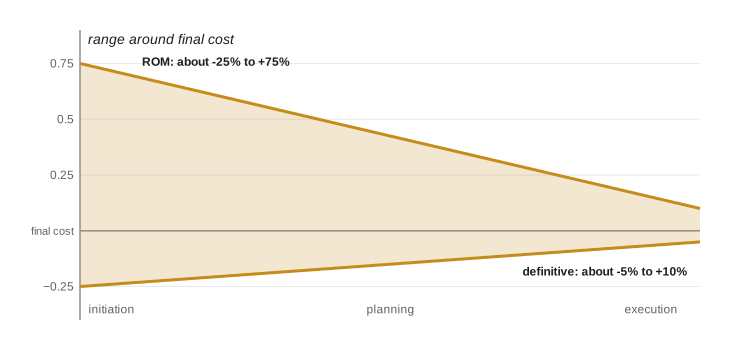
The asymmetry of the ranges reflects reality: costs are more likely to be underestimated than overestimated, because missing items and risks add cost, and few things come in much cheaper than expected. When a sponsor latches onto the low end of a ROM range, the project manager should remind them that the range exists and explain what will narrow it.
Estimating techniques applied to cost
The techniques from lesson 6 apply equally to cost. Analogous estimating scales a previous project's cost. Parametric estimating multiplies a unit rate by a quantity, such as cost per square metre or cost per tag. Bottom-up estimating sums detailed estimates for each work package or activity. Three-point estimating gives an expected cost and a range.
# Cost estimates for the Project Compass fit-out (invented rates)
area_m2 = 1150                          # leased floor area
ft2 = area_m2 * 10.7639
# Parametric: unit cost from three recent branch fit-outs, adjusted for timing
history = [(980, 560_000, 2023), (1400, 812_000, 2024), (760, 455_000, 2025)]
for a, cost, yr in history:
    print(f"{yr}: ${cost / a:,.0f} per m2  (${cost / a / 10.7639:,.0f} per ft2)")
escalate = 0.04                          # assumed construction escalation per year
units = [cost / a * (1 + escalate) ** (2027 - yr) for a, cost, yr in history]
unit = sum(units) / len(units)
param = unit * area_m2
print(f"Escalated average: ${unit:,.0f} per m2")
print(f"Parametric estimate: ${param:,.0f}")

# Analogous: one similar branch, scaled by area, from the 2024 project
analog = 812_000 * (area_m2 / 1400) * (1 + escalate) ** 3
print(f"Analogous estimate:  ${analog:,.0f}")

# Bottom-up: sum of trade package estimates
packages = {"Demolition": 48_000, "Electrical and data": 162_000, "HVAC": 141_000,
            "Finishes": 188_000, "Doors and hardware": 37_000, "General conditions": 114_000}
bottom = sum(packages.values())
print(f"Bottom-up estimate:  ${bottom:,.0f}")

for name, (lo, hi) in {"ROM": (-0.25, 0.75), "Definitive": (-0.05, 0.10)}.items():
print(f"{name} range on ${bottom:,.0f}: ${bottom * (1 + lo):,.0f} to ${bottom * (1 + hi):,.0f}")2023: $571 per m2 ($53 per ft2) 2024: $580 per m2 ($54 per ft2) 2025: $599 per m2 ($56 per ft2) Escalated average: $656 per m2 Parametric estimate: $754,572 Analogous estimate: $750,284 Bottom-up estimate: $690,000 ROM range on $690,000: $517,500 to $1,207,500 Definitive range on $690,000: $655,500 to $759,000
The parametric estimate uses three recent branch fit-outs. Each project's cost per square metre is escalated to 2027 at an assumed 4 % a year, and the average escalated rate of about $656 is applied to the 1,150 square metres, giving about $755,000. The analogous estimate scales the most similar previous project by area and escalation, giving about $750,000. The bottom-up estimate, built from trade package estimates by the cost consultant, is $690,000. Bottom-up is lower here, which is not unusual when a detailed design removes allowances that cruder methods include. The project manager should ask why: perhaps this unit needs less demolition than the others, or perhaps the bottom-up estimate has missed something, such as signage, permits or a contingency allowance. Comparing techniques is a useful check.
The script also prints rates per square foot, because some furniture and flooring suppliers still quote that way (1 square metre is about 10.76 square feet).
The ROM and definitive ranges in the output show why the estimate class matters. A ROM of $690,000 could mean anything from about $518,000 to $1.2 million. A definitive estimate, based on final drawings and contractor quotes, narrows the range to about $656,000 to $759,000.
Cost of quality and life-cycle cost
Cost of quality (COQ) includes the costs of conformance (prevention and appraisal, such as training, design reviews and testing) and the costs of nonconformance (internal and external failure, such as rework, warranty and damage to reputation). Spending on prevention usually reduces failure costs, and estimates should include enough for quality activities such as kiosk acceptance testing and accessibility audits. PMP-131 covers COQ in depth.
Life-cycle costing considers costs over the whole life of the product, not just the project. The project budget covers acquisition, but decisions made during the project affect operating and maintenance costs for years. The RFID decision in lesson 3 was justified partly on life-cycle grounds: higher initial cost, lower staff time for inventory and holds. Projects that minimize their own cost by choosing cheap materials can leave operations with higher costs, which is a governance concern for the sponsor.
Escalation, currency and timing
Projects that run over a year or more, or that buy internationally, need to account for changes in prices and exchange rates. Escalation allows for price increases between the estimate date and when the money is spent. Construction cost indices, wage agreements and supplier price lists inform the rate. Currency risk arises when costs are in a foreign currency; the estimate should state the exchange rate assumed and whether the risk is hedged. Estimates should always be dated and state their currency and price base.
In Project Compass, kiosk hardware is priced in US dollars by the supplier. The estimate converts at an assumed rate and records it as an assumption, with a contingency allowance for exchange rate movement. Sales taxes are handled according to the library's tax status: the estimate states whether amounts include GST or HST and any provincial sales tax, and whether the library can recover them.
Vendor bid analysis and estimates for contracted work
For work that will be contracted, cost estimates may come from requests for quotation or proposals. Vendor bid analysis compares bids with each other and with the project's own independent estimate. A bid far below the independent estimate may signal a misunderstanding of scope or an intention to recover margin through change orders; a bid far above may signal risk the bidder sees that the project does not. The independent estimate is therefore valuable even when the work will be bought. PMP-131 covers procurement and contract types, which affect how much cost risk the project retains.
Contingency in estimates
Contingency is an amount added to an estimate to cover identified risks that may or may not occur (known-unknowns). It is different from management reserve, which covers unidentified risks (unknown-unknowns) and sits outside the cost baseline, as lesson 10 explains. Contingency can be estimated as a percentage, as a fixed amount, from three-point estimates, or, best, from quantitative risk analysis such as expected monetary value or Monte Carlo simulation. Hiding contingency inside each line item makes it invisible and tends to get spent; holding it explicitly makes it manageable.
Worked problem
Spotting missing costs
A draft estimate for Project Compass includes design, construction, furniture, kiosks, gates, tags, app development and training. The total is $2.05 million. What might be missing?
Show solution
- Walk through the WBS: project management (1.1, 1.2) is not in the list.
- Check transition work: the collection move and opening events (5.2, 5.3) are missing.
- Check other categories: permits, temporary storage, encoding station rental, app store fees, accessibility audit, insurance and escalation.
- Check contingency: no allowance for identified risks such as hazardous materials in the ceiling.
Answer: Project management, transition work, several smaller direct costs and contingency are missing. Using the WBS as a checklist prevents these omissions; the complete work package total is $2.32 million before contingency.
Basis of estimates and estimating ethics
Each estimate should be supported by a basis of estimates that explains how it was developed, the assumptions made, known constraints, the range of possible results and the confidence level. When a sponsor questions an estimate, the conversation should be about the assumptions: area, unit rates, escalation, exclusions. A documented basis makes that possible and protects the project manager when actual costs differ.
The PMI Code of Ethics and Professional Conduct, discussed in PMP-121, applies directly to estimates. Deliberately lowballing a cost to get a project approved, or inflating it to create a hidden cushion, are both forms of dishonesty. The honest approach is to give the best estimate with its range and assumptions, and to raise any pressure to change it with the sponsor openly.
Estimating staff time and other easily missed costs
Internal staff time is often left out of project estimates because the staff are already on the payroll. Whether to include it depends on organizational policy, but leaving it out hides a real cost and makes projects look cheaper than they are. For Project Compass, the library includes the time of its own collections staff, IT analyst and trainer at a loaded hourly rate, because those people are diverted from other work and some of their duties are backfilled with temporary staff. The estimate states the rate and the hours so that the board can see the full cost of the project, not only the cash paid to suppliers.
Other commonly missed costs include temporary storage and handling of the collection during the move, insurance during construction, utility connections, signage, opening events, data migration and the first year of software licences and support. A checklist built from previous projects' actual costs is one of the most useful organizational process assets an estimator can have.
Common mistakes
MistakePresenting an early estimate as a single exact number.
InsteadState the estimate class, range and confidence.
MistakeLetting sunk costs drive decisions about continuing.
InsteadBase decisions on future costs and benefits only.
MistakeEstimating only the obvious direct costs.
InsteadUse the WBS and resource breakdown structure as checklists to cover all costs.
MistakeIgnoring escalation and currency for long or international projects.
InsteadDate the estimate, state the price base and allow for escalation and exchange rates.
MistakeBurying contingency in line items.
InsteadHold contingency explicitly and link it to identified risks.
Summary and key terms
- Estimates should cover all resources: labour, materials, equipment, services, facilities and allowances.
- Know direct, indirect, fixed, variable, sunk and opportunity costs; sunk costs are irrelevant to future decisions.
- ROM estimates are wide (about −25 % to +75 %); definitive estimates are narrow (about −5 % to +10 %).
- Analogous, parametric, bottom-up and three-point techniques apply to cost; compare them as a check.
- Consider cost of quality and life-cycle cost, not just project cost.
- Account for escalation, currency, taxes and timing; date every estimate.
- Hold contingency explicitly and document the basis of estimates honestly.
- Cost estimate
- A quantitative assessment of the likely costs of resources required to complete the project.
- Direct cost
- A cost directly attributable to the project's work.
- Indirect cost
- A shared overhead cost allocated to the project.
- Sunk cost
- A cost already incurred that cannot be recovered.
- Opportunity cost
- The value of the best alternative given up when making a choice.
- Rough order of magnitude estimate
- An early, low-accuracy estimate, typically about −25 % to +75 %.
- Definitive estimate
- A detailed estimate, typically about −5 % to +10 %.
- Escalation
- An allowance for price increases over time.
- Life-cycle cost
- The total cost of ownership over a product's life, including operation and disposal.
- Vendor bid analysis
- Comparing supplier bids with each other and with an independent estimate.
Practice problems
Work each problem on paper first, then reveal the answer to check.
A ROM estimate is $400,000. What is the range using −25 % to +75 %?
Show answer
$300,000 to $700,000.
A definitive estimate is $400,000. Range using −5 % to +10 %?
Show answer
$380,000 to $440,000.
Classify the architect's fixed fee.
Show answer
A fixed, direct cost.
A study cost $40,000 last year. Should it affect whether to continue?
Show answer
No; it is a sunk cost.
Unit rate $650 per square metre, area 900 square metres. Parametric estimate?
Show answer
$585,000.
A $500,000 cost two years from now at 3 % annual escalation?
Show answer
$500,000 × 1.03² ≈ $530,450.
A bid is 40 % below the independent estimate. What should you check?
Show answer
Whether the bidder understood the scope and how it plans to make a margin.
What is the difference between contingency and management reserve?
Show answer
Contingency covers identified risks and is in the cost baseline; management reserve covers unidentified risks and is outside it.
Give one example of a cost of conformance.
Show answer
For example, kiosk acceptance testing or training.
Why might a bottom-up estimate differ from a parametric one?
Show answer
Detailed design removes or adds items that average unit rates include or miss; differences should be investigated.
Lesson quiz · 5 questions
Score 60% or more to complete this lesson.
Create a free account to save your progress, take quizzes and earn a certificate.