
ROB-220 · Lesson 10 of 12 · 31 min
Fluid, soft and compliant actuators
Electric motors with gearboxes are the default robot actuator, but they are not the only option, and for some jobs not the best. Excavators, forestry machines and some of the most dynamic humanoid robots use hydraulics for their enormous force in a compact package. Factory grippers and end effectors run on compressed air because it is cheap, clean and naturally springy. Soft robots made of silicone inflate and bend to grasp fragile fruit. And a new generation of legged and collaborative robots deliberately puts springs into their electric actuators, or removes most of the gearing, so that they can feel and absorb forces. This lesson surveys these alternatives and the reasons for choosing them.
Hydraulic actuators
A hydraulic actuator converts fluid pressure into force. A pump, driven by an engine or electric motor, pressurizes oil to typically 10 to 35 MPa (about 1,500 to 5,000 psi), and valves meter it into cylinders or hydraulic motors. The force of a cylinder is the pressure times the piston area, and its speed is the flow rate divided by that area.
Because the pressure is so high, a cylinder a few centimetres in diameter produces tens of kilonewtons, giving hydraulic systems the highest force and power density of any common actuator, measured at the actuator itself. The fluid is nearly incompressible, so hydraulic joints are stiff, and they tolerate shock loads well. Servo valves and proportional valves allow precise force and position control at high bandwidth, which is why hydraulics has powered flight simulators, heavy manipulators and famous dynamic humanoids.
Worked problem
Sizing a hydraulic cylinder
A forestry crane cylinder must push 40 kN at a system pressure of 20 MPa and extend at 0.15 m/s. What bore diameter is needed, and what pump flow and hydraulic power?
Show solution
- Area: \( A = F/p = 40\,000/20 \times 10^6 = 2.0 \times 10^{-3} \) m².
- Diameter: \( d = \sqrt{4A/\pi} = \sqrt{4 \times 0.002/\pi} = 0.0505 \) m, about 50 mm.
- Flow: \( Q = vA = 0.15 \times 0.002 = 3.0 \times 10^{-4} \) m³/s \( = 18 \) L/min. Power: \( pQ = 20 \times 10^6 \times 3 \times 10^{-4} = 6.0 \) kW.
Answer: A bore of about 50 mm, a flow of 18 L/min and 6 kW of hydraulic power, before allowing for losses. The same force from an electric motor would need a large gearbox or a ball screw.
Hydraulics has serious drawbacks for most robots. The system needs a pump, reservoir, filters, accumulators, coolers and hoses, which make it heavy and complex overall, even if the actuator is small. Throttling flow through valves wastes energy as heat, so overall efficiency is often well under 50 %. Leaks are messy and an environmental hazard, high-pressure fluid jets can inject oil through skin, a serious medical emergency, and the noise is considerable. For these reasons, even the best-known hydraulic humanoid research programme moved to electric actuation in 2024, while hydraulics remains dominant in construction, mining, forestry and agricultural machines, increasingly with electrohydraulic and autonomous control.
Pneumatic actuators
Pneumatic actuators use compressed air, typically at around 0.6 MPa (6 bar, about 90 psi) from a factory supply. The same equations apply, but the low pressure means much larger cylinders for the same force, and the compressibility of air makes pneumatic actuators springy and hard to position precisely between their end stops. That is not always a disadvantage. Most pneumatic actuators in robotics are used bang-bang, driving fully between two positions, which is perfect for grippers, clamps and part ejectors: they are cheap, fast, light, tolerant of stalling and overload, and safe in wet or explosive environments. Vacuum generators driven by compressed air power the suction cups that handle most boxes in logistics.
Worked problem
Gripper force from a pneumatic cylinder
A parallel gripper is driven by a cylinder with a 20 mm bore at 0.6 MPa gauge pressure. What force does the piston produce on the extending stroke? On the retracting stroke the 8 mm rod occupies part of the area; what force results?
Show solution
- Extending: \( A = \pi(0.010)^2 = 3.14 \times 10^{-4} \) m²; \( F = 0.6 \times 10^6 \times 3.14 \times 10^{-4} = 188 \) N.
- Retracting: annulus area \( \pi(0.010^2 - 0.004^2) = 2.64 \times 10^{-4} \) m²; \( F = 158 \) N.
- Friction in the seals typically removes another 5 to 10 %.
Answer: About 188 N extending and 158 N retracting, before seal friction. The difference matters when a gripper must hold a part with the rod side pressurized.
Compressed air is also an expensive form of energy: the compressor's electrical input is many times the useful mechanical work delivered at the cylinder, and leaks in factory air systems commonly waste a substantial share of the compressed air produced. Many manufacturers now offer electric grippers as drop-in replacements for pneumatic ones for this reason, and because electric grippers can control force and position.
| Actuator | Force density | Precision | Efficiency | Typical robot use |
|---|---|---|---|---|
| Electric motor + gearbox | Medium to high | High | High (70–90 %) | Arm joints, wheels, most robots |
| Hydraulic | Very high at the actuator | High with servo valves | Low to medium | Heavy machinery, large manipulators |
| Pneumatic | Medium | Low between end stops | Low overall | Grippers, clamps, suction |
| Soft pneumatic | Low | Low | Low | Delicate grasping, wearables |
| Series elastic | Medium | High force control | High | Legged robots, cobots, exoskeletons |
| Quasi-direct drive | Medium | High, backdrivable | High | Dynamic legged robots |
Soft actuators
Soft robotics builds actuators from compliant materials such as silicone rubber, fabric and elastomers. The most common is the pneumatic network actuator: a silicone finger with a series of internal chambers on one side and a stiffer, inextensible layer on the other. Inflating the chambers makes them expand, and because one side cannot stretch, the finger bends. Fibre-reinforced versions twist or extend instead. Other soft actuators use vacuum to collapse a structure, granular jamming to switch between soft and stiff, shape-memory alloys that contract when heated, electroactive polymers or hydraulically amplified electrostatic actuators.
Soft grippers conform to irregular shapes without precise sensing or planning, and they are inherently gentle, which is why they are used to pick fruit, bakery products and fish. Their limitations are low force, slow response, difficulty modelling and controlling their shape, and limited durability. They complement rather than replace rigid actuators.
Series elastic actuators
A series elastic actuator (SEA) deliberately places a spring of known stiffness k between a conventional geared motor and the load. Measuring the spring's deflection \( \Delta x \), with encoders on both sides as in the dual-encoder joint of lesson 2, gives the force directly through Hooke's law.
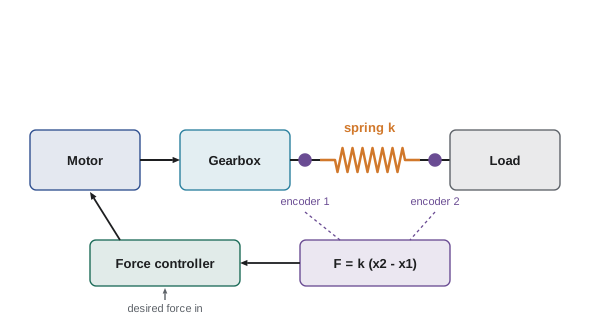
The spring turns a hard-to-control force problem into an easy-to-measure position problem, and it brings further benefits. It filters shock loads, protecting the gearbox when a leg lands or an arm bumps into something. It lowers the actuator's output impedance, so the joint feels soft to a person and absorbs collisions. And it can store and return energy, as tendons do in running animals. The price is reduced force-control bandwidth: the softer the spring, the better the force resolution and shock tolerance, but the slower the actuator can change force, because the motor must wind the spring up through a larger angle. Designers choose stiffness to balance these effects.
Worked problem
Force resolution of a series elastic actuator
A rotary SEA has a torsional spring of 300 N·m/rad and 19-bit absolute encoders on both sides of the spring. What is the torque resolution? How much does the spring deflect at a continuous torque of 40 N·m?
Show solution
- Encoder resolution: \( 2\pi/2^{19} = 1.20 \times 10^{-5} \) rad. The difference of two readings has about that resolution.
- Torque resolution: \( 300 \times 1.20 \times 10^{-5} = 0.0036 \) N·m.
- Deflection at 40 N·m: \( 40/300 = 0.133 \) rad \( = 7.6° \).
Answer: Torque resolution of about 0.004 N·m, excellent for force control, but the spring twists 7.6° at the continuous torque, so position control must account for the deflection and force changes cannot be faster than the motor can wind the spring.
Variable stiffness actuators go a step further, using a second motor to adjust the effective spring stiffness so that the joint can be stiff for precise positioning and soft for safe interaction or explosive motion.
Quasi-direct-drive actuators
Another route to force-sensitive, robust actuators is to remove most of the gearbox. A quasi-direct-drive (QDD) actuator pairs a large-diameter, high-torque brushless motor with a low-ratio transmission, typically 6:1 to 10:1 in a single planetary stage. With so little gearing, reflected inertia and friction are small (lesson 9), so the joint is highly backdrivable and transparent: the motor current is a good estimate of joint torque, and external forces can be felt without a separate torque sensor. The actuator absorbs landing impacts without damage and can be controlled at high bandwidth. This design, popularized by the MIT Cheetah robots, now appears in most commercial quadrupeds and many humanoids.
The trade-off is mass and heat. Without high gear reduction, the motor itself must produce a large torque, which demands a large diameter and high current, so QDD actuators are heavier for a given continuous torque and need good thermal design. A direct-drive actuator, with no gearbox at all, is the limit case, used in some high-performance motion stages and robot base joints where precision and smoothness matter more than mass.
Worked problem
Torque estimate in a quasi-direct-drive leg
A QDD knee uses a motor with \( k_t = 0.095 \) N·m/A behind a 9:1 planetary gearbox with 95 % efficiency. During landing the motor current spikes to 40 A. Estimate the joint torque. With a rotor inertia of \( 2.5 \times 10^{-4} \) kg·m², what inertia does the rotor add at the knee?
Show solution
- Joint torque: \( 0.95 \times 9 \times 0.095 \times 40 = 32.5 \) N·m.
- Reflected inertia: \( 81 \times 2.5 \times 10^{-4} = 0.020 \) kg·m².
- For comparison, the same rotor behind a 100:1 gearbox would add 2.5 kg·m².
Answer: About 32 N·m, estimated from current alone, and only 0.02 kg·m² of reflected rotor inertia, roughly a hundred times less than with a 100:1 gearbox. That is why QDD legs can sense and absorb impacts.
Choosing an actuator
Actuator selection starts from the task: the forces and speeds required, how precisely they must be controlled, whether the robot must interact safely with people or the environment, the power source available and the environment itself. Electric motors with gearboxes suit most precise, repeatable tasks. Hydraulics suits very high forces on machines that already carry a hydraulic system. Pneumatics suits cheap, fast, binary motions where factory air exists. Soft actuators suit delicate, variable objects. Series elastic and quasi-direct-drive designs suit robots that must feel, absorb and control forces. The capstone in lesson 12 works through the sizing calculations for one such choice.
Common mistakes
MistakeComparing hydraulic force density at the cylinder without counting the pump, hoses and reservoir.
InsteadCompare whole-system mass, efficiency and complexity, not just the actuator.
MistakeUsing a pneumatic cylinder for precise mid-stroke positioning.
InsteadAir compressibility makes this hard; use pneumatics between end stops, or choose an electric or servo-pneumatic actuator.
MistakeTreating compressed air as free energy.
InsteadCompression and leaks waste much of the input energy; account for compressor power and consider electric grippers.
MistakeMaking a series elastic spring as soft as possible.
InsteadSofter springs improve force resolution and shock tolerance but reduce force bandwidth; choose stiffness to balance them.
MistakeIgnoring heat in quasi-direct-drive designs.
InsteadLow gearing demands high motor torque and current; check continuous thermal limits carefully.
Summary and key terms
- Hydraulic actuators give very high force and stiffness from \( F = pA \), at the cost of system mass, leaks, noise and low efficiency.
- Pneumatic actuators are cheap, fast and robust for end-to-end motions and suction, but springy and energy-hungry.
- Soft actuators bend or grip by inflating compliant chambers and handle delicate, irregular objects gently.
- Series elastic actuators measure force from spring deflection, absorb shocks and lower impedance, at reduced force bandwidth.
- Variable stiffness actuators adjust their spring rate for different tasks.
- Quasi-direct-drive actuators use large motors and low ratios for backdrivability and current-based torque sensing.
- Actuator choice follows from force, speed, precision, interaction, power source and environment.
- Hydraulic actuator
- An actuator driven by pressurized liquid, usually oil.
- Servo valve
- A valve that meters fluid flow precisely in proportion to an electrical command.
- Pneumatic actuator
- An actuator driven by compressed air.
- Bang-bang actuation
- Driving an actuator fully between two end positions.
- Soft actuator
- An actuator made of compliant materials that deforms to produce motion.
- Series elastic actuator
- An actuator with a spring between the transmission and the load, used to measure and control force.
- Output impedance
- How strongly an actuator resists motion imposed from its output.
- Variable stiffness actuator
- An actuator whose effective spring stiffness can be adjusted.
- Quasi-direct drive
- An actuator with a high-torque motor and a low gear ratio, typically under about 10:1.
- Direct drive
- An actuator with no transmission between motor and load.
Practice problems
Work each problem on paper first, then reveal the answer to check.
A 40 mm-bore hydraulic cylinder runs at 15 MPa. What force does it produce?
Show answer
\( 15 \times 10^6 \times \pi \times 0.02^2 \approx 18.8 \) kN.
What flow extends a cylinder of area \( 10^{-3} \) m² at 0.2 m/s?
Show answer
\( 2 \times 10^{-4} \) m³/s, or 12 L/min.
What hydraulic power is delivered at 25 MPa and 20 L/min?
Show answer
\( 25 \times 10^6 \times 3.33 \times 10^{-4} \approx 8.3 \) kW.
Why is a pneumatic gripper safe to stall against a part?
Show answer
Air compresses and the force is limited by pressure, so stalling does not overload it.
A 32 mm-bore pneumatic cylinder runs at 0.5 MPa. What is its extending force?
Show answer
\( 0.5 \times 10^6 \times \pi \times 0.016^2 \approx 402 \) N.
Why does a soft pneumatic finger bend rather than simply grow longer?
Show answer
An inextensible layer on one side stops that side stretching, so expansion of the chambers curls the finger.
An SEA spring of 5,000 N/m deflects 4 mm. What is the force?
Show answer
20 N.
Give one advantage and one disadvantage of a softer SEA spring.
Show answer
Better force resolution and shock absorption; lower force bandwidth.
A QDD actuator has N = 6 and \( J_m = 3 \times 10^{-4} \) kg·m². What is the reflected inertia?
Show answer
\( 36 \times 3 \times 10^{-4} = 0.0108 \) kg·m².
Which actuator family suits an excavator arm, and why?
Show answer
Hydraulics, for very high force and power density on a machine that already carries an engine-driven pump.
Lesson quiz · 5 questions
Score 60% or more to complete this lesson.
Create a free account to save your progress, take quizzes and earn a certificate.