
ROB-220 · Lesson 9 of 12 · 31 min
Gearing and transmissions
Electric motors are happiest spinning fast with modest torque, while robot joints and wheels need high torque at modest speed. A transmission bridges that gap. Choosing it is one of the most consequential decisions in robot design, because the gear ratio and gearbox type shape the robot's strength, speed, precision, efficiency, backdrivability and how it behaves when it hits something. This lesson develops the basic relationships, introduces reflected inertia and the optimal gear ratio, and compares the gearbox types found in robots: spur and planetary gears, harmonic drives, cycloidal drives, belts, ball screws and capstan drives.
The ideal gear ratio
A gear train with ratio N reduces speed by N and, ideally, multiplies torque by N. Real gearboxes lose some power to friction, described by an efficiency \( \eta \) between 0 and 1.
Gear reduction does three useful things at once. It lets a small, light motor produce a large joint torque. It keeps the motor in its efficient, cool, high-speed region, because the motor current needed for a given joint torque falls by N. And it multiplies the resolution of a motor-side encoder by N (lesson 2). The costs are friction, backlash, added mass and, as we shall see, a large increase in the inertia the joint presents to the outside world.
Worked problem
Choosing a ratio for a joint
A robot elbow must deliver 30 N·m continuously at up to 60 rpm. A candidate brushless motor has a continuous torque of 0.40 N·m and a maximum speed of 6,000 rpm. Which range of gear ratios works if the gearbox efficiency is 80 %?
Show solution
- Torque requirement: \( \eta N \tau_m \geq 30 \), so \( N \geq 30/(0.80 \times 0.40) = 93.8 \).
- Speed requirement: \( 6000/N \geq 60 \), so \( N \leq 100 \).
- Any ratio from about 94 to 100 satisfies both; a standard 100:1 harmonic drive would leave no speed margin, so a slightly faster motor or a lower ratio with a stronger motor might be preferred.
Answer: Ratios of roughly 94:1 to 100:1 meet both requirements, with little margin. In practice designers iterate between motor and gearbox catalogues until both torque and speed have comfortable margins.
Reflected inertia
A gearbox changes not only torque and speed but also how heavy the motor's rotor feels from the output side. The motor's rotor inertia \( J_m \), seen from the joint, is multiplied by the square of the ratio. Equivalently, the load inertia \( J_L \) seen from the motor is divided by \( N^2 \).
This squared factor has big consequences. With a 100:1 gearbox, a tiny rotor of \( 5 \times 10^{-5} \) kg·m² appears at the joint as 0.5 kg·m², often larger than the inertia of the arm link itself. A highly geared joint therefore feels heavy when pushed and delivers a hard impact in a collision, since the spinning rotor's kinetic energy must be absorbed. It is also hard to backdrive, that is, to move from the output side, because the person pushing must accelerate the reflected rotor inertia and overcome the gearbox friction multiplied by the ratio. These are exactly the properties that matter when robots work near people, and why collaborative and legged robots use low ratios, joint torque sensing or elastic elements (lesson 10).
Worked problem
Reflected inertia of a geared joint
A motor with rotor inertia \( 4.0 \times 10^{-5} \) kg·m² drives a link with inertia 0.20 kg·m² about the joint. Compare the total inertia at the joint for gear ratios of 10, 50 and 160.
Show solution
- N = 10: \( 0.20 + 100 \times 4 \times 10^{-5} = 0.20 + 0.004 = 0.204 \) kg·m².
- N = 50: \( 0.20 + 2500 \times 4 \times 10^{-5} = 0.20 + 0.10 = 0.30 \) kg·m².
- N = 160: \( 0.20 + 25\,600 \times 4 \times 10^{-5} = 0.20 + 1.02 = 1.22 \) kg·m².
Answer: The reflected rotor adds only 2 % at 10:1, half again at 50:1, but five times the link inertia at 160:1. At high ratios the motor rotor, not the arm, dominates how the joint feels and how hard it hits.
The optimal ratio for acceleration
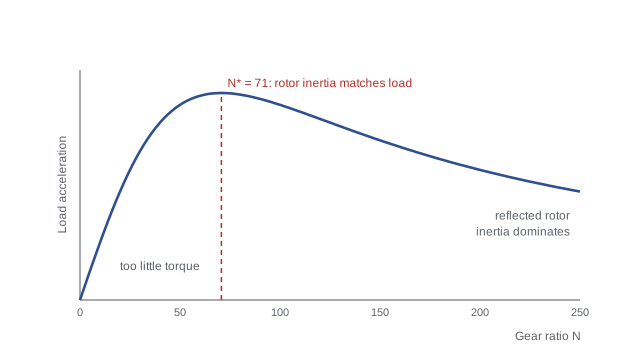
If the goal is to accelerate a pure inertial load as quickly as possible with a given motor torque, there is a best ratio. The load acceleration is \( \alpha_L = N\tau_m/(J_L + N^2 J_m) \). Differentiating with respect to N and setting the result to zero gives the inertia-matching ratio, at which the reflected rotor inertia equals the load inertia.
Worked problem
The inertia-matched ratio
For the motor and link above (\( J_m = 4.0 \times 10^{-5} \), \( J_L = 0.20 \) kg·m²) with a peak motor torque of 1.2 N·m, find the inertia-matching ratio and the maximum load acceleration. Compare with a ratio of 160.
Show solution
- \( N^{*} = \sqrt{0.20/4 \times 10^{-5}} = \sqrt{5000} = 70.7 \).
- \( \alpha_{\max} = 1.2/(2\sqrt{0.20 \times 4 \times 10^{-5}}) = 1.2/(2 \times 0.002828) = 212 \) rad/s².
- At N = 160: \( \alpha = 160 \times 1.2/(0.20 + 1.024) = 192/1.224 = 157 \) rad/s².
Answer: About 71:1 gives the fastest acceleration, about 212 rad/s², while 160:1 gives only about 157 rad/s² despite its larger torque. Real designs also weigh static torque against gravity, top speed and efficiency, so the chosen ratio is often higher than the inertia match.
Gearbox types
Spur and helical gear trains are simple and efficient (about 95 to 98 % per stage) but need several stages for large ratios, and each stage adds backlash, the small free play between meshing teeth. Planetary gearboxes arrange a sun gear, several planet gears and an outer ring gear coaxially; they are compact, efficient (about 90 to 97 % per stage), carry high torque and offer 3:1 to 10:1 per stage. Quality planetary gearboxes have backlash of a few arcminutes, and they are the standard choice for mobile robot wheels, low-ratio legged robot joints and many industrial axes.
Harmonic drives (strain-wave gears) use an elliptical wave generator to flex a thin toothed cup, the flexspline, inside a rigid circular spline with two more teeth. Each revolution of the wave generator moves the flexspline by two teeth, giving ratios of 30:1 to 160:1 in a single compact, light stage with essentially zero backlash. They are the classic choice for robot arm joints, collaborative robots and space manipulators. Their disadvantages are torsional compliance (the flexspline twists under load), modest efficiency that falls at low temperatures and light loads, a periodic error at twice the input frequency, and poor backdrivability.
Cycloidal drives, and the related RV reducers used in large industrial robots, roll a lobed disc around a ring of pins. They give high ratios, very high stiffness and excellent shock-load capacity, at the cost of size and mass, which makes them the usual choice for the base and shoulder joints of heavy industrial arms. Other transmissions complete the toolkit: timing belts move the motor away from the joint and reduce inertia at the distal end; ball screws convert rotation to precise linear motion with high efficiency; lead screws are cheaper and can be self-locking; worm gears give high single-stage ratios and are self-locking but inefficient; and capstan or cable drives, as in some research and haptic arms, give zero backlash and excellent backdrivability.
| Transmission | Ratio per stage | Backlash | Efficiency | Typical use |
|---|---|---|---|---|
| Spur / helical | 2–6 | Moderate | 95–98 % | Simple drives, hobby servos |
| Planetary | 3–10 | Low (arcminutes) | 90–97 % | Wheels, legged robots, industrial axes |
| Harmonic (strain wave) | 30–160 | Near zero | 60–85 % | Arm joints, cobots, space arms |
| Cycloidal / RV | 30–200 | Very low | 80–90 % | Heavy industrial robot joints |
| Ball screw | Lead per turn | Low (preloaded) | 90 %+ | Linear stages, actuators |
| Worm gear | 10–100 | Moderate | 40–85 % | Self-locking lifts, positioners |
| Capstan / cable | 5–20 | Zero | 95 %+ | Haptic devices, research arms |
Backlash, compliance and their effects
Backlash causes a dead band when motion reverses: the motor turns but the output does not move until the teeth re-engage. In a position loop closed on a motor-side encoder, backlash produces positioning error; closed on a load-side encoder, it can produce limit-cycle oscillation as the controller hunts across the gap. Compliance, the elastic twist of gears, shafts and links under load, lowers the natural frequency of the joint and limits how aggressive the control loops can be. Stiffness \( k \) and the load inertia set the natural frequency \( \omega_n = \sqrt{k/J} \), and controllers generally need to keep their bandwidth well below it.
Worked problem
Positioning error from backlash and compliance
A joint with a 0.80 m link uses a gearbox with 3 arcminutes of backlash and a torsional stiffness of \( 2.0 \times 10^4 \) N·m/rad. The link holds a payload producing 25 N·m of torque. What tool-position errors do the backlash and the elastic twist cause?
Show solution
- Backlash: 3 arcminutes \( = 3/60° = 0.05° = 8.7 \times 10^{-4} \) rad; at 0.80 m: \( 0.70 \) mm.
- Twist: \( 25/2.0 \times 10^4 = 1.25 \times 10^{-3} \) rad; at 0.80 m: \( 1.0 \) mm.
- Together they can approach 1.7 mm, invisible to a motor-side encoder.
Answer: About 0.7 mm from backlash and 1.0 mm from elastic twist at the tool. Load-side encoders, preloaded gears and stiffer transmissions reduce them; robot calibration can compensate the predictable part.
Efficiency also has a direction. Some transmissions, such as most worm gears and fine-pitch lead screws, are self-locking: the load cannot drive the motor backwards. This is useful for holding a load with the power off, but it means the joint cannot be pushed by a person and absorbs collisions badly. Robots that need a holding function without self-locking use spring-applied brakes that engage when power is removed, a feature found in almost every industrial arm joint.
import numpy as np
Jm, JL, tau_m = 4.0e-5, 0.20, 1.2        # rotor and load inertia (kg*m^2), peak motor torque (N*m)
for N in (10, 30, 50, 70.7, 100, 160):
    alpha = N * tau_m / (JL + N**2 * Jm)
    share = N**2 * Jm / (JL + N**2 * Jm)
    print(f"N = {N:6.1f}   load accel = {alpha:6.1f} rad/s^2   rotor share of inertia = {100*share:4.1f} %")
print(f"inertia-matching ratio N* = {np.sqrt(JL/Jm):.1f}")N = 10.0 load accel = 58.8 rad/s^2 rotor share of inertia = 2.0 % N = 30.0 load accel = 152.5 rad/s^2 rotor share of inertia = 15.3 % N = 50.0 load accel = 200.0 rad/s^2 rotor share of inertia = 33.3 % N = 70.7 load accel = 212.1 rad/s^2 rotor share of inertia = 50.0 % N = 100.0 load accel = 200.0 rad/s^2 rotor share of inertia = 66.7 % N = 160.0 load accel = 156.9 rad/s^2 rotor share of inertia = 83.7 % inertia-matching ratio N* = 70.7
Common mistakes
MistakeChoosing the highest gear ratio to get the most acceleration.
InsteadReflected rotor inertia grows with N²; acceleration of an inertial load peaks near \( N^{*} = \sqrt{J_L/J_m} \).
MistakeForgetting gearbox efficiency when calculating output torque.
InsteadMultiply by \( \eta \), which may be 60–85 % for harmonic drives and lower in the cold.
MistakeIgnoring backlash when closing a loop on a load-side encoder.
InsteadBacklash can cause limit cycles; use preloaded or zero-backlash transmissions and appropriate control.
MistakeAssuming a highly geared joint is safe to push or hand-guide.
InsteadHigh ratios make joints hard to backdrive and amplify impact; use torque sensing or low ratios near people.
MistakeRelying on a self-locking worm gear as a safety brake.
InsteadSelf-locking can fail with vibration and wear; use a rated, spring-applied brake for holding loads safely.
Summary and key terms
- A gear ratio N divides speed by N and multiplies torque by \( \eta N \).
- Gearing lets small motors run cool and fast and multiplies motor-side encoder resolution.
- Rotor inertia appears at the joint multiplied by N², dominating at high ratios and making joints hard to backdrive.
- The inertia-matching ratio \( N^{*} = \sqrt{J_L/J_m} \) maximizes the acceleration of a pure inertial load.
- Planetary, harmonic, cycloidal, belt, screw, worm and capstan transmissions trade ratio, backlash, stiffness, efficiency and size.
- Backlash and compliance cause positioning errors and limit control bandwidth through \( \omega_n = \sqrt{k/J} \).
- Self-locking transmissions hold loads but resist backdriving; spring-applied brakes are the safe holding method.
- Gear ratio
- The ratio of input speed to output speed of a transmission.
- Reflected inertia
- An inertia as it appears through a transmission, scaled by the square of the ratio.
- Backdrivability
- How easily a joint can be moved by forces applied at its output.
- Inertia matching
- Choosing a ratio so reflected motor inertia equals load inertia.
- Backlash
- Free play between meshing parts that causes a dead band on reversal.
- Planetary gearbox
- A coaxial gearbox with sun, planet and ring gears.
- Harmonic drive
- A strain-wave gear with a flexible spline, giving high ratio and near-zero backlash.
- Cycloidal drive
- A reducer in which a lobed disc rolls around pins, giving high stiffness.
- Torsional stiffness
- Torque required per radian of twist in a transmission.
- Self-locking
- A transmission that the load cannot drive backwards.
Practice problems
Work each problem on paper first, then reveal the answer to check.
A motor at 3,000 rpm and 0.5 N·m drives a 50:1 gearbox with 90 % efficiency. What are the output speed and torque?
Show answer
60 rpm and 22.5 N·m.
A rotor of \( 10^{-4} \) kg·m² is behind a 30:1 gearbox. What inertia does it add at the output?
Show answer
\( 900 \times 10^{-4} = 0.09 \) kg·m².
What is the inertia-matching ratio for \( J_L = 0.5 \) and \( J_m = 5 \times 10^{-5} \) kg·m²?
Show answer
100.
A harmonic drive's circular spline has 202 teeth and its flexspline 200. What is the ratio with the circular spline fixed?
Show answer
\( 200/(202 - 200) = 100 \).
Convert 1 arcminute to radians.
Show answer
\( 2.91 \times 10^{-4} \) rad.
A joint has stiffness \( 10^4 \) N·m/rad and load inertia 1 kg·m². What is its natural frequency in hertz?
Show answer
\( \sqrt{10^4}/(2\pi) \approx 15.9 \) Hz.
Which gearbox type is usual for heavy industrial robot base joints?
Show answer
Cycloidal or RV reducers.
Why do quadruped robots often use planetary gearboxes of about 6:1 to 10:1?
Show answer
Low ratios keep joints backdrivable, impact-tolerant and able to sense force through motor current.
Give one advantage and one disadvantage of a self-locking worm gear.
Show answer
Holds load without power; cannot be backdriven and is inefficient.
A ball screw has a 5 mm lead. How far does the nut move per motor revolution?
Show answer
5 mm.
Lesson quiz · 5 questions
Score 60% or more to complete this lesson.
Create a free account to save your progress, take quizzes and earn a certificate.