
SLS-101 · Lesson 12 of 12 · 20 min
Case study: a salesperson's first month
▶ Video coming soon A video version of this lesson is on the way.
On the first Friday of October 2026, Darnell and Bev, who had known each other since Darnell's own years on the Juniper & Pine floor, met for coffee to compare notes on their new hires. Both had started a new salesperson in the last week of August. Both had given the same advice: learn first, listen more than you talk. And both had asked their new hire to write a one-page review of the first month: what they had done, what they had learned, the numbers, and what they would do next. This final lesson works through those two reviews. Together they draw on every idea in the course.
Maya's first month at Ridgeline
Maya spent her first week almost entirely learning. She sat with Grace to understand the CRM, joined Owen's inside team for a morning of calls, rode along on two of Farida's account reviews, and spent a full day with the service technicians who installed and repaired printers and meeting-room equipment. That day changed how she sold. She learned what installations really involved, how long they took and what customers complained about, knowledge that would have saved her the Halverson Law deal had she had it earlier (lesson 5).
From week two she took first meetings booked by Owen's team and called a list of former customers whose contracts were ending in the next year. For each meeting she filled in Darnell's preparation form, set a primary and minimum objective, and planned her questions (lesson 6). She opened each business meeting with an upfront agreement (lesson 7) and spent most of each meeting in discovery, listening for where the customer was in their journey (lesson 3).
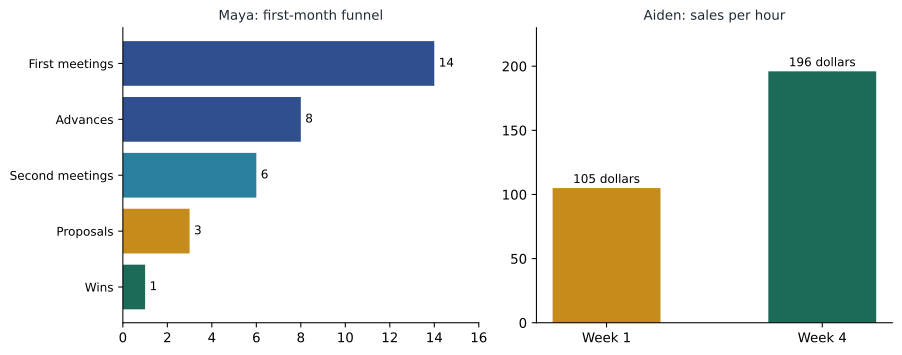
Her activity and results over the four weeks are shown below.
| Stage | Count | Conversion from the stage before |
|---|---|---|
| First meetings held | 14 | n/a |
| Meetings that ended in an advance | 8 | 8 of 14, about 57 in 100 |
| Site visits or second meetings held | 6 | 6 of 8, 75 in 100 |
| Proposals presented | 3 | 3 of 6, 50 in 100 |
| Deals won | 1 | 1 of 3, about 33 in 100 |
Her one win was Northfield Family Clinic: a five-year managed print contract at 395 dollars a month and a RoomFlow subscription for the clinic's three shared rooms at 89 dollars a month, signed by Dr. Anand after a thirty-minute meeting that Janet arranged (lesson 8). Maya had raised the clinic's old delivery complaint herself in the first meeting, answered the bookkeeper's concern about the contract term with a clear explanation of the early-exit terms, and arranged a call with another clinic using managed print to address Dr. Anand's privacy worry (lesson 9). The furniture for the clinic's expansion next door was still under discussion, scheduled for a decision in January.
The coaching conversations
After reading the reviews, Darnell and Bev each held a coaching conversation with their new hire. Both used the same simple structure: ask the seller what went well, ask what they would do differently, add one or two observations of their own, and agree on specific goals. Darnell told Maya that her discovery was already among the best on the team, and that her one priority for month two was converting more first meetings into advances. Bev told Aiden that his questions about the whole room were exactly right, and that his next step was to learn the appliance line well enough to cover Carl's department on his days off.
Neither manager talked much about the numbers on their own. Darnell pointed out that one win in a first month is normal for a B2B seller, and that the eight advances mattered more because they showed what the next two months would bring. Bev noted that Aiden's sales per hour had nearly doubled but cared just as much that his returns were low and that two customers had asked for him by name. Good coaching looks at results and at how they were achieved, because the habits produce the results over time.
Both new hires also received a reminder that selling is learned. Neither had arrived knowing how to open a conversation, explore an objection or ask for commitment. They learned by preparing, trying, reviewing and trying again, which is the same cycle this program follows.
What comes next in the program
This course is the first of ten shared first-year courses. SLS-110 looks more deeply at how buyers decide, and SLS-120 develops the conversation skills behind discovery and rapport. SLS-130 covers customer service and the post-sale experience, SLS-140 the CRM and other sales technology, and SLS-150 the law and ethics of selling. The business courses alongside them cover business mathematics, communication and marketing. In the second year, the B2B track follows Maya into prospecting, consultative discovery, proposals, negotiation, analytics, key accounts, inside sales and value selling. The retail track follows Aiden into floor selling and clienteling, visual merchandising, store operations, retail math, omnichannel selling, high-ticket sales and loyalty marketing. Both tracks share negotiation and sales leadership and end with a capstone.
Each later course will return to the foundations introduced here: value, trust, preparation, opening, closing, objections and follow-up. Those are not separate skills to be learned once and set aside. They are the parts of every sale, from the first one to the thousandth.
Worked problem
Valuing Maya's first win
Northfield's managed print contract is 395 dollars a month for 60 months, and the RoomFlow subscription is 89 dollars a month on a one-year term that renews annually. Maya's commission plan counts first-year revenue toward her quota. What first-year revenue does the deal add to her quota, and what is the total contract value of the print agreement?
Show solution
- First-year revenue from each part:
- \[395 \times 12 = 4{,}740 \text{ dollars}\]
- \[89 \times 12 = 1{,}068 \text{ dollars}\]
- \[4{,}740 + 1{,}068 = 5{,}808 \text{ dollars}\]
- Total contract value of the five-year print agreement:
- \[395 \times 60 = 23{,}700 \text{ dollars}\]
- Maya's 5 per cent commission on first-year revenue:
- \[0.05 \times 5{,}808 = 290.40 \text{ dollars}\]
Answer: The deal adds 5,808 dollars of first-year revenue toward Maya's 600,000-dollar quota, earning 290.40 dollars of commission, and the print agreement alone is worth 23,700 dollars over five years. The small first-year figure is why lesson 10 matters: most of the value lies in renewals, the expansion and referrals, all of which depend on the follow-up Maya does now.
In her review, Maya wrote that the hardest adjustment from retail was patience. "On the floor I could see a customer go from looking to buying in an hour. Here, the clinic took five weeks, and that was fast." She also noted her weak spot: of her six meetings that did not end in an advance, four ended with "send me some information", which she had accepted as progress. She would set clearer advance objectives and ask for them before leaving.
Aiden's first month at Juniper & Pine
Aiden's month looked very different. He worked 132 hours across the décor and small furniture section, with Saturday shifts helping in large furniture. He completed the store's product training on the twenty best-selling sofas and mattresses, learned the point-of-sale system and delivery booking, and sat in on Bev's morning huddles. In week one he made the mistakes of most new associates: opening with "Can I help you?" (lesson 7), answering price objections by walking customers to cheaper models (lesson 9), and failing to ask for the sale when the signals were obvious (lesson 8). By week three he had changed all three habits.
| Measure | Week 1 | Week 4 |
|---|---|---|
| Hours on the floor | 30 | 35 |
| Sales (dollars) | 3,150 | 6,860 |
| Transactions | 21 | 28 |
| Items sold | 27 | 50 |
| Sales per hour (dollars) | 105.00 | 196.00 |
| Average transaction value (dollars) | 150.00 | 245.00 |
| Units per transaction | 1.29 | 1.79 |
The rise in average transaction value and units per transaction came mainly from two changes. Aiden began asking customers about the whole room rather than the single item ("What's the rest of the room like?"), which led naturally to suggesting cushions, a throw or a lamp that completed what they were building. And he stopped discounting on his own initiative, asking Bev only when a customer was ready to buy and a small concession would close the sale. Bev checked that the add-ons were genuine: her review of his week-four returns found only one item returned, a cushion in the wrong shade.
Worked problem
Checking Aiden's numbers
Using the week-4 figures, confirm the sales per hour, average transaction value and units per transaction, and calculate how much more Aiden sold per hour than in week 1.
Show solution
- Sales per hour is sales divided by hours.
- \[6{,}860 \div 35 = 196.00 \text{ dollars}\]
- Average transaction value is sales divided by transactions.
- \[6{,}860 \div 28 = 245.00 \text{ dollars}\]
- Units per transaction is items divided by transactions.
- \[50 \div 28 \approx 1.79\]
- Change in sales per hour from week 1:
- \[3{,}150 \div 30 = 105.00 \text{ dollars}\]
- \[196.00 - 105.00 = 91.00 \text{ dollars more per hour}\]
Answer: The table is correct: 196.00 dollars an hour, 245.00 dollars per transaction and about 1.79 units per transaction in week 4, an increase of 91 dollars an hour over week 1. Most of the gain came from bigger, more complete sales rather than more transactions.
In his review, Aiden wrote that the biggest surprise was how much customers appreciated being asked about their homes. "I thought asking questions would annoy people. It's the opposite. They like it, and they buy more because what they buy works." He set three goals for month two: start a client book like Carl's, learn the appliance line so he could cover that department, and follow up with every customer whose furniture was delivered.
What the two months have in common
Darnell and Bev agreed that their new hires had learned the same lessons in different settings.
- Value comes from understanding the customer (lesson 4). Maya's win came from discovering what the clinic's printer problems really cost; Aiden's larger sales came from asking about the whole room.
- Trust is built from small promises (lesson 5). Maya's honest recovery at Halverson Law and her early answer to Northfield's delivery concern both paid off.
- Preparation and openings shape everything that follows (lessons 6 and 7).
- Asking for commitment is part of serving the customer (lesson 8). Both had to learn to ask.
- Objections are information (lesson 9). Both stopped answering the words and started exploring the concern.
- The sale is the start of the relationship (lessons 10 and 11). The value of Maya's win lies mostly in renewals and the expansion; Aiden's client book will supply next year's sales.
A plan for the next sixty days
Both reviews ended with a plan. A common structure for new sellers is the 30-60-90-day plan, which sets goals for learning, relationships and results over a new hire's first three months. Maya's plan for days 31 to 90 is shown below.
| Period | Learning | Relationships | Results |
|---|---|---|---|
| Days 31 to 60 | Finish RoomFlow product certification; shadow two furniture design consultations | Meet the five largest prospects in her territory; quarterly check-in with Northfield | At least 16 first meetings; advances from 10; 4 proposals |
| Days 61 to 90 | Learn the video-conferencing line in depth; review lost deals with Darnell | Ask Northfield for one referral after the first service review | Two more wins; Northfield expansion proposal ready for January |
The plan is ambitious but specific, and every goal can be checked. That is the point. Selling rewards people who know exactly what they are trying to do next, and who keep doing it after the first month's excitement has worn off. The courses that follow build each skill in this course into a full subject of its own.
Common mistakes
MistakeJudging a B2B seller's first month only by deals won.
InsteadLook at the whole funnel: meetings, advances, proposals and wins, and at the habits behind them.
MistakeRaising average transaction value by pushing add-ons.
InsteadAdd-ons should complete what the customer is trying to achieve; check returns and satisfaction.
MistakeMeasuring a long contract only by its first-year revenue.
InsteadTotal contract value, renewals and lifetime value show the real worth of a deal.
MistakeEnding the first month without a written plan.
InsteadSet specific learning, relationship and result goals for the next sixty days.
Summary and key terms
- A new seller's first month should balance learning and selling.
- In B2B, results are best read through the whole funnel, from first meetings to advances, proposals and wins, with attention to where prospects stall.
- A first B2B win may add little first-year revenue but carry much greater total contract value and lifetime value.
- In retail, sales per hour, average transaction value and units per transaction show progress; genuine add-ons that complete a customer's purchase raise them.
- Both settings reward understanding the customer, building trust through small promises, preparing, asking for commitment, exploring objections and following up.
- A 30-60-90-day plan sets checkable goals for learning, relationships and results.
- Funnel
- The sequence of stages from first contact to sale, with the number of prospects at each.
- Total contract value
- The full value of a contract over its whole term.
- 30-60-90-day plan
- A plan setting learning, relationship and result goals for a new hire's first three months.
- Units per transaction
- Items sold divided by the number of transactions.
- Client book
- A seller's record of past customers and their needs, used for follow-up and repeat sales.
Practice problems
Work each problem on paper first, then reveal the answer to check.
Of 20 first meetings, 12 end in an advance. What is the conversion rate?
Show answer
12 ÷ 20 = 0.6, or 60 in 100.
A three-year contract is worth 250 dollars a month. What is its first-year revenue and total contract value?
Show answer
First-year revenue 250 × 12 = 3,000 dollars; total contract value 250 × 36 = 9,000 dollars.
What weak spot did Maya identify in her first month, and how will she fix it?
Show answer
Too many meetings ended in continuations such as "send me some information"; she will set clear advance objectives and ask for them before leaving.
Lesson quiz · 5 questions
Score 60% or more to complete this lesson.
Create a free account to save your progress, take quizzes and earn a certificate.