
SLS-101 · Lesson 2 of 12 · 18 min
Sales roles and careers
▶ Video coming soon A video version of this lesson is on the way.
In her second week, Maya asked Darnell for an organization chart of the Ridgeline sales team. He drew it on the whiteboard in his office instead. At the top was Rob Kowalski, the vice-president of sales. Under him sat Darnell, as regional sales manager, and Grace Liu, the sales operations analyst. Under Darnell were six field account executives, including Maya, and four inside sales representatives led by Owen Pelletier. Off to one side were two account managers, including Farida Haddad, who looked after the largest existing customers. "Fourteen people," Darnell said, "and nine different jobs. Every one of them is a sales job, and every one of them needs different skills."
Across the road at Juniper & Pine Home, Aiden's world had a different shape: a store manager, two department managers, a visual merchandising lead, an operations and loss prevention lead, an e-commerce coordinator, and around thirty sales associates on full-time and part-time shifts, some paid hourly and some on commission. This lesson surveys the main sales roles in both kinds of business, what they do, how they connect, and how people move between them over a career.
Roles in B2B sales teams
B2B sales work is usually divided along the buyer's journey, so that different people handle finding customers, winning them and growing them. The names vary between companies, but the jobs are recognizable everywhere.
| Role | Main job | Typical measures |
|---|---|---|
| Sales development representative (SDR) or business development representative (BDR) | Finds and qualifies new prospects, books first meetings | Calls and emails, conversations, meetings booked |
| Inside sales representative | Sells by phone, video and online, often to smaller customers | Pipeline created, deals closed, revenue |
| Field account executive (AE) | Wins new customers through meetings, demonstrations and proposals | New revenue, win rate, pipeline |
| Account manager | Keeps and grows existing customers | Renewals, growth within accounts, retention |
| Sales engineer or solutions consultant | Gives technical advice, designs solutions, runs demonstrations | Deals supported, technical wins |
| Sales operations analyst | Runs the CRM, reports, territories and forecasts | Data quality, forecast accuracy, report delivery |
| Sales manager | Hires, coaches and leads a team, owns the team's number | Team revenue, quota attainment, staff retention |
At Ridgeline, Owen's inside team calls schools, clinics and offices that have downloaded a RoomFlow brochure or whose printer leases are coming up for renewal. When a conversation shows a real need and a budget, Owen books a meeting for an account executive. Maya then runs the sale: discovery, a site visit, a proposal and the negotiation. Once a customer signs, a large account is handed to Farida for long-term care, while smaller customers stay with the account executive who won them. Grace keeps all of this visible in the CRM, so that Darnell and Rob can see what is coming and where deals get stuck.
Handoffs are where customers most often get lost. A prospect who explained her problem carefully to Owen will be annoyed if Maya asks the same questions as if they had never spoken. A customer who trusted Maya may feel abandoned if Farida appears without an introduction. Good teams treat handoffs as a step of the sale in their own right: written notes in the CRM, a short joint call, and a clear explanation to the customer of who will look after them from now on.
Roles in retail selling
Retail roles are organized around the store and its departments rather than the buyer's journey, because most retail customers move from browsing to buying in a single visit.
| Role | Main job | Typical measures |
|---|---|---|
| Sales associate | Greets and helps customers on the floor, makes sales, keeps the department ready | Sales per hour, average transaction value, add-on rate |
| Commission salesperson | Sells higher-value products such as appliances, furniture or vehicles | Sales volume, margin, protection plan attachment |
| Cashier or front-end associate | Completes payments, returns and exchanges | Accuracy, speed, customer satisfaction |
| Visual merchandiser | Designs displays, signage and layouts that help products sell | Sales of featured products, compliance with layout plans |
| Department manager or supervisor | Schedules, coaches and leads a department | Department sales, margin, staff performance |
| Store manager | Runs the whole store: people, sales, stock, safety and costs | Store sales and profit, shrink, customer experience |
At Juniper & Pine, Carl Jensen is the store's top commission salesperson. He sells appliances and mattresses and earns most of his income from commission, which means he has every reason to build a client book of past customers who come back and send friends. Aiden began as an hourly associate in décor and small furniture, with a small bonus for protection plans, and he moves between departments when the floor is busy. Noura Saleh, the visual merchandising lead, decides how each section looks, and Tessa Yellowbird runs the website and the store's email and social media, which means more and more customers arrive having already chosen a product online.
The wider world of sales jobs
Sales work extends well beyond these two companies. Some of the most common paths are listed below. Each draws on the same foundations but adds specialist knowledge.
- Technical and industrial sales: selling equipment, chemicals, software or engineering services, often by people with technical training.
- Medical and pharmaceutical sales: calling on clinics, hospitals and pharmacies, under strict rules on what representatives may say about products.
- Financial services and insurance sales: advisers and agents who must be licensed in their province before they can sell many products.
- Real estate: agents who are licensed by a regulator and paid mainly by commission on completed sales.
- Automotive sales: dealership salespeople who handle trade-ins, financing and add-on products as well as the vehicle.
- Software and subscription sales: SDRs, account executives and customer success managers selling recurring subscriptions, where renewals matter as much as the first sale.
- Wholesale and distribution: representatives who sell to retailers, contractors or other businesses, often covering a geographic territory.
Many of these fields are regulated. Before a person can sell insurance, securities or real estate, for example, they must usually pass a licensing exam and work under a licensed firm. This course does not prepare you for those licences, but the selling skills it teaches apply in each of them.
How sales careers develop
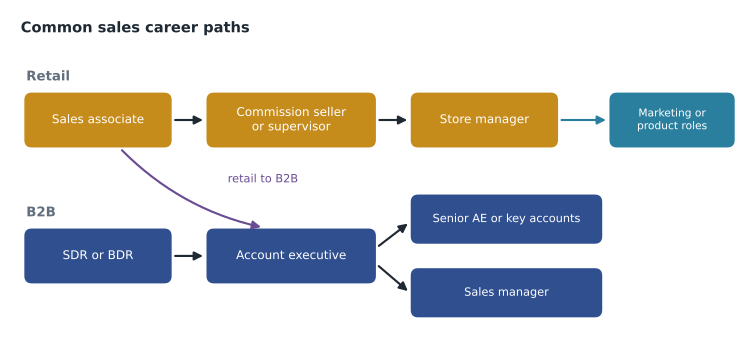
Sales offers unusually fast feedback on performance, which is one reason careers can move quickly. A common path in B2B runs from SDR to account executive within one to three years, then either into larger accounts and more complex deals or into management. Retail paths often run from sales associate to commission salesperson or department supervisor, then to assistant and store manager. People also move sideways: from retail into B2B, as Maya did, from sales into marketing or product roles, and from sales into running their own business. Pay rises with the complexity of what is sold. Job Bank's 2023 to 2024 figures show a median of 16.00 dollars an hour for retail salespersons in Saskatchewan and 33.65 dollars an hour for non-technical wholesale sales representatives.
What sales employers look for
Job postings for sales roles mention products and industries, but the qualities employers actually screen for are remarkably consistent. Darnell interviewed Maya for about an hour and spent most of it on four things.
- Curiosity: does the candidate ask good questions and want to understand how a customer's business works?
- Resilience: can they hear no many times a week without losing energy or becoming defensive?
- Organization: can they keep track of dozens of conversations, follow-ups and promises without letting any drop?
- Integrity: will they tell a customer the truth when the truth costs a sale?
Product knowledge can be taught in weeks, and industry knowledge in months. Those four qualities take much longer to develop, which is why Darnell hired an appliance salesperson to sell office technology. Maya had already shown, in three years of retail, that she listened, kept going after bad days, kept her client book in order and did not oversell.
Getting a first sales job
Most people enter sales in one of three ways: from a customer-facing job such as retail, hospitality or call-centre work; from a technical or industry job, such as a technician who moves into selling the equipment they used to repair; or straight from school into an SDR or associate role. Each brings different strengths. Retail and hospitality workers usually already know how to read customers and stay calm under pressure. Technical people bring credibility with buyers who know the product. New graduates bring energy and are often the fastest to learn the CRM and digital tools.
Sales interviews often include a test of selling itself. Darnell asked Maya to sell him a RoomFlow subscription with ten minutes' notice and a one-page brochure. He was not looking for polish. He wanted to see whether she would ask about his situation before describing the product, whether she would admit what she did not know, and whether she would ask for a next step at the end. Maya asked four questions before mentioning a single feature, and that was most of the reason she got the job. Some employers also arrange a ride-along, in which the candidate spends half a day with a current seller, partly to test fit and partly so the candidate sees the real job.
A typical week is also worth understanding before accepting a job. An SDR spends most of the day on calls and email, with targets for conversations and meetings booked. A field account executive splits the week between meetings, travel, proposal writing and CRM updates, often with a team meeting on Monday and pipeline review on Friday. A retail associate works shifts that include evenings and weekends, the store's busiest times, and spends time between customers restocking, tidying and learning products. None of these is better than the others; they suit different people.
Worked problem
Comparing two job offers
Aiden is offered a commission position in appliances. Offer A pays 17.00 dollars an hour for 37.5 hours a week with no commission. Offer B pays a base of 14.50 dollars an hour for the same hours plus 2 per cent commission on sales. Carl tells him a new appliance salesperson typically sells about 9,000 dollars a week. Which offer pays more each week at that level, and at what weekly sales would the two be equal?
Show solution
- Offer A pays the same every week.
- \[17.00 \times 37.5 = 637.50 \text{ dollars}\]
- Offer B pays a base plus commission.
- \[14.50 \times 37.5 = 543.75 \text{ dollars}\]
- \[0.02 \times 9{,}000 = 180.00 \text{ dollars}\]
- \[543.75 + 180.00 = 723.75 \text{ dollars}\]
- To find the break-even level of sales, set the commission equal to the difference in base pay.
- \[637.50 - 543.75 = 93.75 \text{ dollars}\]
- \[93.75 \div 0.02 = 4{,}687.50 \text{ dollars of weekly sales}\]
Answer: At 9,000 dollars of weekly sales, Offer B pays 723.75 dollars against 637.50 dollars for Offer A, or 86.25 dollars more. The two offers are equal at 4,687.50 dollars of sales a week. Offer B rewards Aiden if he sells above that level, but in a slow week it pays less, so he should also ask how sales vary through the year.
Comparing offers this way, with a break-even point, is a habit worth keeping. Lesson 11 returns to how sales jobs are paid, including draws, bonuses and quotas.
Common mistakes
MistakeThinking every sales job is the same.
InsteadSales roles differ widely: finding customers, winning them, growing them, supporting them technically and running the data are separate jobs with different measures.
MistakeTreating a handoff between colleagues as an administrative task.
InsteadHandoffs are a step of the sale; the customer should never have to repeat themselves or wonder who is looking after them.
MistakeAssuming you need industry experience to start in sales.
InsteadEmployers often hire for curiosity, resilience, organization and integrity, and teach the products.
MistakeComparing pay offers on the base rate alone.
InsteadWork out total pay at realistic sales levels and the break-even point between offers.
Summary and key terms
- B2B sales teams usually divide work along the buyer's journey: SDRs and BDRs find and qualify prospects, account executives win new customers, account managers keep and grow existing ones, sales engineers give technical support, sales operations runs the data, and sales managers lead the team.
- Retail roles are organized around the store: associates, commission salespeople, cashiers, visual merchandisers, department managers and store managers.
- Handoffs between roles must be managed so customers do not have to repeat themselves.
- Many sales fields, such as insurance, securities and real estate, require a licence.
- Sales careers can move quickly, and pay generally rises with the complexity of what is sold.
- Employers look for curiosity, resilience, organization and integrity.
- SDR or BDR
- A sales development or business development representative who finds and qualifies prospects and books meetings.
- Account executive
- A salesperson responsible for winning new customers.
- Account manager
- A salesperson responsible for keeping and growing existing customers.
- Sales engineer
- A technical specialist who designs solutions and supports demonstrations.
- Sales operations
- The function that runs the CRM, reports, territories and forecasts.
- Commission
- Pay calculated as a share of sales or margin.
- Handoff
- Passing a customer from one person or team to another.
Practice problems
Work each problem on paper first, then reveal the answer to check.
Name the role at Ridgeline that books meetings and the role that keeps the largest existing customers.
Show answer
Inside sales representatives (SDRs) such as Owen's team book meetings; account managers such as Farida keep the largest existing customers.
A job pays 15.00 dollars an hour plus 3 per cent commission for 40 hours. Another pays 18.00 dollars an hour. At what weekly sales are they equal?
Show answer
The base difference is (18.00 − 15.00) × 40 = 120 dollars; 120 ÷ 0.03 = 4,000 dollars of weekly sales.
Why might an employer hire someone from retail to sell office technology?
Show answer
Because curiosity, resilience, organization and integrity are harder to teach than product knowledge, and retail experience can show all four.
Lesson quiz · 5 questions
Score 60% or more to complete this lesson.
Create a free account to save your progress, take quizzes and earn a certificate.