
SLS-101 · Lesson 3 of 12 · 18 min
The buyer's journey and the sales process
▶ Video coming soon A video version of this lesson is on the way.
Maya's first real opportunity arrived on a Tuesday in mid-September. Owen's inside team had spoken to Janet Morrow, the office manager at Northfield Family Clinic, whose waiting room chairs were worn, whose two printers broke down weekly, and whose staff spent too long juggling a paper booking sheet for the clinic's three shared rooms. Maya's instinct, honed on the furniture floor, was to arrive the next day with a catalogue and a quote. Darnell stopped her. "Where is she in her decision?" he asked. Maya admitted she did not know. "Then that is the first thing to find out," he said. "A quote is the answer to a question she may not be asking yet."
This lesson sets out two maps that every seller needs: the buyer's journey, which describes how customers move from noticing a problem to buying and living with the result, and the sales process, which describes what the seller does at each point. Selling goes well when the two line up and badly when the seller runs ahead of the buyer.
The buyer's journey
The buyer's journey is the sequence of stages a customer passes through on the way to a purchase. Different authors draw it with different numbers of stages, but most versions include the same ideas.
| Stage | What the buyer is doing | Questions in the buyer's mind |
|---|---|---|
| Awareness | Noticing a problem or opportunity | Is something wrong? Is it worth fixing? |
| Consideration | Defining the problem and exploring kinds of solution | What are my options? What would good look like? |
| Evaluation | Comparing specific products and suppliers | Which one fits best? Whom do I trust? |
| Decision | Choosing, negotiating and committing | Is this the right price and the right time? What could go wrong? |
| Post-purchase | Using the product, judging the decision | Did I choose well? Will they look after me? |
In a store, a customer may pass through all five stages in an hour. A couple walks into Juniper & Pine because their old mattress hurts their backs (awareness), learns from Aiden that firmness and support differ (consideration), lies on three models (evaluation), chooses one with free delivery (decision), and either sleeps well for years or calls to complain (post-purchase). In B2B the same journey may take months, involve several people at different stages, and loop back when a budget changes or a new manager arrives.
The journey does not always begin with the buyer. Sometimes a seller creates awareness by pointing out a problem the customer had not noticed. When Owen's team called Northfield, Janet had not been thinking about her printers as a cost problem; she thought of them as an annoyance. Owen's question, "Roughly how many hours a month do your staff lose to the printers?", moved her from vague irritation toward awareness. That is legitimate selling, as long as the problem is real.
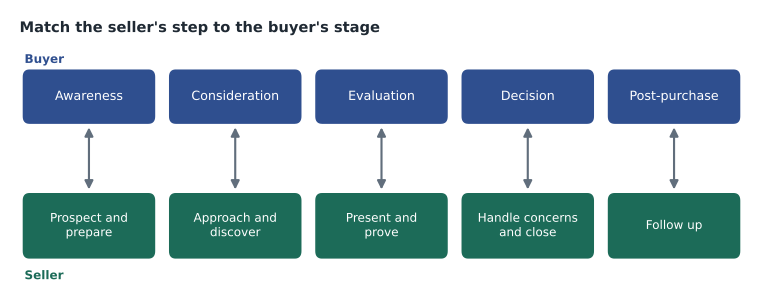
The sales process
The sales process is the set of steps a seller follows to help a customer through the journey. A classic version, taught in sales courses for decades, has seven steps. Modern teams rename and merge some of them, but the logic is the same.
| Step | What the seller does | Lesson in this course |
|---|---|---|
| 1. Prospecting | Finds people or organizations who might need the product | Lesson 2 (roles); covered in depth on the B2B track |
| 2. Preparation | Researches the customer and plans the contact | Lesson 6 |
| 3. Approach | Opens the conversation and builds rapport | Lesson 7 |
| 4. Discovery | Asks questions to understand needs, situation and decision process | Lessons 4 and 7 |
| 5. Presentation | Shows how the offer meets the needs uncovered | Lesson 4 |
| 6. Handling objections and closing | Answers concerns and asks for a commitment | Lessons 8 and 9 |
| 7. Follow-up | Delivers on promises, checks satisfaction and builds the relationship | Lesson 10 |
The steps are a guide, not a script. In a short retail conversation, Aiden may move from approach to discovery to presentation in two minutes, then loop back to discovery when a customer says "actually, it's for our cottage, not our house." In a long B2B sale, Maya will repeat discovery several times as she meets new people at the customer. The point of the process is to make sure nothing important is skipped, above all discovery, which inexperienced sellers rush.
Matching the seller to the buyer
The most common mistake in selling is acting at the wrong stage. A seller who presents a detailed proposal to a buyer who is still deciding whether the problem matters will be ignored; the buyer is not ready to compare options. A seller who keeps asking discovery questions to a buyer who has already decided and just wants a price will lose the sale to someone faster. Darnell calls this "selling to the calendar instead of the customer."
Each stage of the journey suggests what the seller should offer.
- Awareness: questions and insight that help the buyer see and size the problem, with no pressure to buy.
- Consideration: education about the kinds of solution and what each is good for, including options the seller does not sell.
- Evaluation: a clear, specific recommendation, evidence such as references or trials, and honest comparison with alternatives.
- Decision: a straightforward price, terms, delivery plan and help removing the last risks.
- Post-purchase: on-time delivery, help getting value from the product, and a quick response to problems.
Signals tell the seller where the buyer is. A buyer in awareness talks about symptoms ("the printers are always down"). In consideration, they ask about approaches ("is it better to lease or buy?"). In evaluation they ask about specifics ("what does your service contract cover?") and mention competitors. In decision they ask about price, contract terms and timing. Listening for those signals is more reliable than guessing.
B2B journeys involve many people
In B2B sales, several people take part in the decision, and each may be at a different stage. At Northfield Family Clinic, Janet, the office manager, felt the printer problem every day. The clinic's managing physician, Dr. Ravi Anand, had to approve any spending over 5,000 dollars and had not thought about printers at all. The bookkeeper cared about whether a lease would fit the monthly budget. Maya would need to help each of them move along the journey, and would only win the sale when the person who signed was ready.
This group is often called the buying centre. Course SLS-110 studies it in detail. For now, the key point is that the sales process must be run with each important person, not just the first contact.
Buyers who do their own research
Today many buyers complete much of the journey before they ever speak to a salesperson. A couple shopping for a sofa may have browsed Juniper & Pine's website, read reviews, compared prices at two other stores and watched a video about fabric types before walking in. A school business officer may have read three suppliers' websites, asked colleagues in other divisions and downloaded a buyer's guide before answering Owen's call. By the time they meet a seller, they may already be in evaluation or even decision.
This changes the seller's job in two ways. First, the seller must find out quickly what the buyer already knows, rather than starting from the beginning. A question such as "What have you looked at so far?" or "How did you come across us?" saves time and avoids repeating what the buyer has read. Second, the seller must add something the buyer could not get from research: judgment about their particular situation, a warning about a common mistake, a practical detail such as whether the sectional will fit through a narrow stairwell, or an introduction to a reference customer. A seller who only repeats the website has no reason to exist.
Self-directed research also means buyers may arrive with misconceptions. Online reviews skew toward very happy and very unhappy customers; comparison sites may leave out delivery and installation costs; a competitor's brochure may describe its own product generously and others unfairly. Good sellers correct misunderstandings gently, with evidence, and without disparaging competitors.
Using the journey to plan contact
Mapping where a customer is helps plan the next contact as well as the current one. Maya keeps a stage for every opportunity in Ridgeline's CRM, and each stage has a typical next action: an awareness-stage prospect gets a short, useful insight and a question; a consideration-stage prospect gets a guide comparing leasing and buying; an evaluation-stage prospect gets a reference call and a site visit. In the store, Aiden uses the same idea in a single conversation. A customer who has just started looking gets ideas and options; one who has narrowed down to two models gets a careful comparison; one who asks about delivery gets a clear offer.
The same habit protects against a quiet danger: losing customers after the sale. Ridgeline adds a post-purchase stage to every won deal in the CRM, with planned check-ins at two weeks, three months and before renewal. Juniper & Pine's system sends the associate a reminder to call each customer after delivery. The journey does not end when the money changes hands, and the process should not either.
Journeys that stall or loop back
Buyers do not always move forward. A school division in evaluation may return to consideration when a new superintendent asks whether the whole furniture plan should be rethought. A family about to buy a fridge may pause for months after an unexpected car repair. When an opportunity stalls, the useful question is not how to push it forward but why it stopped: has the problem become less urgent, has a new person joined the decision, or has something else taken the budget? A short, honest check-in, such as "Last time we spoke the printers were the priority; is that still true?", usually reveals the answer and tells the seller whether to wait, re-engage or let the opportunity go.
Worked problem
Estimating where the time goes in a sale
Darnell asks Maya to estimate the hours she will spend on the Northfield opportunity. She expects two discovery meetings of 1.5 hours each, a 2-hour site visit, 4 hours preparing a proposal, a 1-hour presentation, 1.5 hours of negotiation and contract work, and 3 hours of travel. If the deal is worth 18,000 dollars in first-year revenue, how much revenue does each hour of her time represent, and what share of her hours is spent face to face with the customer?
Show solution
- Add up all the hours.
- \[2(1.5) + 2 + 4 + 1 + 1.5 + 3 = 14.5 \text{ hours}\]
- Revenue per hour is the deal value divided by the hours.
- \[18{,}000 \div 14.5 \approx 1{,}241 \text{ dollars per hour}\]
- Face-to-face time is the meetings, site visit, presentation and negotiation.
- \[3 + 2 + 1 + 1.5 = 7.5 \text{ hours}\]
- \[7.5 \div 14.5 \approx 0.52\]
- So about 52 per cent of her time on the deal is spent with the customer.
Answer: The opportunity will take about 14.5 hours, about 1,241 dollars of first-year revenue per hour, with roughly half of the time spent with the customer. If Maya wins only one deal in three like it, the revenue per hour across all three attempts falls to about 414 dollars, which is why qualifying early, before investing hours, matters so much.
Back at Northfield, Maya changed her plan. Instead of a quote, she asked Janet for twenty minutes to understand how the clinic used its printers and rooms, and whether the managing physician might join for the last five. Janet agreed, a little surprised. "The last company just sent me a price list," she said.
Common mistakes
MistakeSending a quote to a buyer who has not yet decided the problem is worth solving.
InsteadFind out where the buyer is in the journey first, and offer what fits that stage.
MistakeFollowing the sales process as a fixed script.
InsteadUse the steps as a checklist and loop back, especially to discovery, whenever new information appears.
MistakeWorking only with the first contact in a B2B sale.
InsteadSeveral people take part in a business decision; each may be at a different stage and needs attention.
MistakeForgetting the post-purchase stage.
InsteadThe buyer's journey continues after the sale; follow-up builds referrals, renewals and repeat business.
Summary and key terms
- The buyer's journey describes how customers move through awareness, consideration, evaluation, decision and post-purchase.
- The sales process describes the seller's steps: prospecting, preparation, approach, discovery, presentation, handling objections and closing, and follow-up.
- Selling works best when the seller's step matches the buyer's stage, and the buyer's words signal which stage they are in.
- The steps are a checklist rather than a script, and sellers often loop back to discovery.
- In B2B sales several people take part in the decision, each possibly at a different stage, so the process must be run with each important person.
- Buyer's journey
- The stages a customer passes through from noticing a problem to judging a purchase.
- Sales process
- The steps a seller follows to help a customer through the journey.
- Awareness
- The stage in which a buyer notices a problem or opportunity.
- Evaluation
- The stage in which a buyer compares specific products and suppliers.
- Discovery
- Asking questions to understand a customer's needs, situation and decision process.
- Buying centre
- The group of people who take part in an organization's purchase decision.
Practice problems
Work each problem on paper first, then reveal the answer to check.
A customer says, "We're comparing your printers with two other suppliers' and want to see service terms." Which stage is this?
Show answer
Evaluation: the buyer is comparing specific suppliers and asking about specifics.
Why is sending a quote at the awareness stage usually a mistake?
Show answer
The buyer has not yet decided the problem is worth solving or which kind of solution fits, so a price answers a question they are not asking.
A deal takes 20 hours and is worth 10,000 dollars. If Maya wins one in four such deals, what is her revenue per hour across all four attempts?
Show answer
Four attempts take 80 hours for 10,000 dollars of revenue: 10,000 ÷ 80 = 125 dollars per hour.
Lesson quiz · 5 questions
Score 60% or more to complete this lesson.
Create a free account to save your progress, take quizzes and earn a certificate.