
SLS-110 · Lesson 10 of 12 · 20 min
Procurement, RFPs and purchasing rules
▶ Video coming soon A video version of this lesson is on the way.
On September 14, 2026, Prairie Valley School Division published a request for proposals for managed print services. Maya read all forty-one pages twice. The document described the division's schools and print volumes, listed mandatory requirements that every proposal had to meet, explained how proposals would be scored, set a deadline for questions, and gave a closing date and time after which no proposal would be accepted. One sentence on page six stopped her: from the date of publication until the contract was awarded, suppliers were not to contact any division employee about the competition except the named purchasing officer, in writing. The business manager she had met six times was now, for the purposes of this sale, out of bounds.
Procurement is the function an organization uses to buy goods and services: finding suppliers, running competitions, negotiating terms, managing contracts and making sure purchases follow policy and law. For salespeople, procurement can feel like an obstacle between them and the buyer. It is better understood as part of how organizations protect themselves from waste, favouritism and fraud. A seller who understands procurement rules, and works within them, wins more public and corporate contracts than one who tries to work around them.
Why procurement rules exist
Organizations create purchasing rules for several reasons. Rules help them get good value by making suppliers compete. They reduce the risk of fraud and conflicts of interest by separating the people who need a product from the people who sign contracts. They create a record that auditors can check. In the public sector, rules also give every qualified supplier a fair chance to win public money, and trade agreements require governments to open larger contracts to suppliers from other jurisdictions.
The purchasing officer at Prairie Valley explained this to Maya before the competition began. 'Every dollar we spend comes from taxpayers,' she said, 'and every contract can be questioned by an auditor, a board member or a supplier who lost. My job is to make sure we can show that the process was fair. If you help me do that, you'll find me very easy to work with.'
Common purchasing methods
Most organizations use different methods depending on the value and nature of the purchase. Small purchases may need only a purchase order or a credit card. Mid-sized purchases often require written quotes from several suppliers. Large or complex purchases go through a formal competition. The thresholds are set in each organization's purchasing policy and, for public bodies, by law and trade agreements.
| Method | Used when | What the seller submits |
|---|---|---|
| Purchase order or card | Small, routine purchases | An invoice against the order |
| Request for quotation (RFQ) | The requirement is clear and price is the main factor | A price for a defined product or service |
| Invitation to tender or bid | Specifications are fixed and the lowest compliant bid usually wins | A sealed bid meeting every specification |
| Request for proposals (RFP) | The buyer wants suppliers to propose solutions and will judge on several criteria | A full proposal scored against published criteria |
| Request for information (RFI) | The buyer is still learning what is available | Information only; no contract results directly |
| Sole source | Only one supplier can meet the need, with documented justification | A negotiated proposal |
| Standing offer or cooperative contract | Suppliers have been pre-approved through an earlier competition | Orders under the existing agreement |
Public procurement in Saskatchewan
Public bodies in Saskatchewan, including school divisions, municipalities and health organizations, follow their own purchasing policies and the trade agreements Saskatchewan has signed. The New West Partnership Trade Agreement among British Columbia, Alberta, Saskatchewan and Manitoba requires these organizations, often called the MASH sector, to compete openly for purchases above set thresholds: 75,000 dollars for goods and for services, and 200,000 dollars for construction. The Canadian Free Trade Agreement sets national rules, and public opportunities in Saskatchewan are posted on SaskTenders. Many school divisions also buy through group contracts arranged by the Saskatchewan School Boards Association.
Thresholds and rules change, and each organization's policy may be stricter than the law. A seller working with public bodies should read the organization's purchasing policy, which is usually published online, and ask the purchasing officer which rules apply to the opportunity. The answer determines whether the seller can win the business through a quote, must wait for a formal competition, or can sell through a cooperative contract the seller's company already holds.
Anatomy of a request for proposals
Requests for proposals follow a common structure, although details vary. An introduction describes the organization and why it is buying. A scope of work describes what is needed, sometimes as specifications and sometimes as outcomes. Mandatory requirements list conditions every proposal must meet, such as insurance, a security standard or a minimum response time; a proposal that fails any mandatory requirement is usually disqualified without being scored. Rated requirements are scored, often with points for each criterion. The document also sets out the evaluation method, the timeline, the rules of the competition and the contract terms the winner will sign.
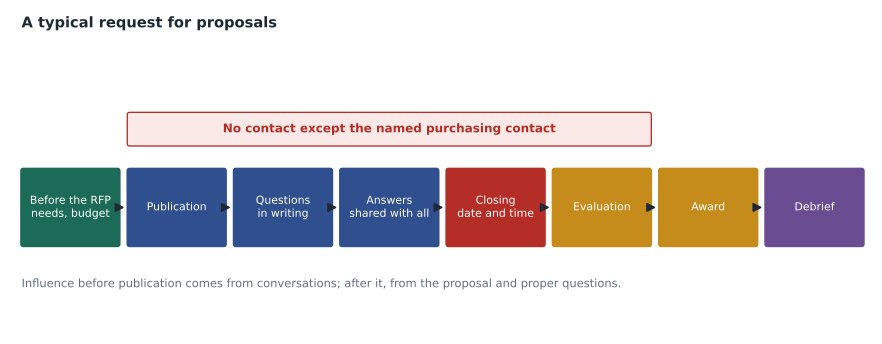
The rules of the competition
Three rules in most requests for proposals surprise new salespeople. The first is the communication restriction Maya found on page six. During the competition, suppliers may contact only the named person, usually in writing, so that no supplier gains an advantage from private conversations. Breaking the rule can disqualify the proposal. The second is that questions and answers are shared: if Maya asks a question, the answer will be published to every supplier, usually without saying who asked. The third is that the closing time is absolute. Public bodies routinely reject proposals that arrive one minute late, and courts have generally supported them.
These rules change where a seller's influence comes from. Once the request is published, the time for building relationships and shaping requirements has passed. The most useful work happens before publication, when the organization is identifying its needs and may welcome information from suppliers, for example through a request for information, a supplier day or ordinary sales conversations. After publication, the seller's influence comes from the quality of the proposal and from asking good questions through the proper channel.
Helping shape requirements, fairly
Because requirements decide who can win, suppliers are often tempted to help buyers write them in ways that favour their own products, for example by suggesting a specification only their model meets. Procurement professionals call this a wired or locked specification, and they watch for it. Public bodies may require specifications to describe performance rather than brands, may allow only a brand name followed by the words or equivalent, and may bar a supplier who helped draft a request from bidding on it. A seller who is caught steering a specification unfairly can lose the opportunity and the organization's trust.
There is an honest way to influence requirements. Before a competition, a seller can help the buyer understand the problem and the range of solutions, share evidence about what matters, such as response times or total cost of ownership, and suggest outcome-based requirements that any capable supplier could meet. Maya's earlier conversations had helped Prairie Valley see that service response time mattered more than print speed. When the request came out, it gave service the heaviest weight and required a four-hour on-site response, a standard that Ridgeline and at least two competitors could meet. Ridgeline still had to win on the quality of its proposal, but the competition now measured what the division actually needed.
How proposals are evaluated
Most requests for proposals use weighted scoring. Each rated criterion has a maximum number of points, and evaluators score each proposal against each criterion. Price is often scored by formula, so that the lowest price receives full points and other prices receive points in proportion. A common formula gives each proposal the lowest price divided by its own price, multiplied by the points available for price. Some competitions use a two-envelope method, in which technical proposals are scored before prices are opened, so that evaluators are not influenced by price when judging quality.
Worked problem
Scoring proposals the way the evaluators will
Prairie Valley's request gives 40 points for service and support, 25 for technical solution, 10 for experience and references and 25 for price. Price points are calculated as the lowest price divided by the supplier's price, times 25. Three suppliers pass the mandatory requirements. Ridgeline scores 34 for service, 20 for technical solution and 9 for experience, with a five-year price of 312,000 dollars. Supplier B scores 26, 22 and 8, with a price of 276,000 dollars. Supplier C scores 22, 18 and 7, with a price of 260,000 dollars. Who wins?
Show solution
- The lowest price is Supplier C's 260,000 dollars, so C receives the full 25 price points.
- Ridgeline's price points: 260,000 ÷ 312,000 × 25 ≈ 20.8.
- Supplier B's price points: 260,000 ÷ 276,000 × 25 ≈ 23.6.
- Ridgeline total: 34 + 20 + 9 + 20.8 = 83.8.
- Supplier B total: 26 + 22 + 8 + 23.6 = 79.6.
- Supplier C total: 22 + 18 + 7 + 25 = 72.0.
Answer: Ridgeline wins with 83.8 points, despite having the highest price, because service carries the most weight and Ridgeline's local technicians scored well there. The example shows why sellers should read the evaluation method before writing a word: a proposal should put the most effort where the most points are.
Evaluators score only what is written in the proposal. A seller who knows from earlier conversations that the division cares about fast service must show it in the proposal, with evidence such as response-time records and references, because evaluators may not be allowed to consider what they heard elsewhere. Proposals that answer each requirement in the order and wording of the request make the evaluators' job easier, and evaluators who can find answers quickly tend to score them fairly.
Debriefs and challenges
After an award, many public bodies offer unsuccessful suppliers a debrief, a meeting or call that explains how their proposal was scored. Debriefs are one of the best learning opportunities in selling, and sellers should request them whether they win or lose. A supplier who believes a competition was run unfairly may also have the right to challenge it, through the organization's own process, the bid dispute mechanisms in trade agreements or the courts. Challenges are serious steps that can damage relationships and should be considered carefully with the seller's management and, where needed, legal advice.
Procurement in private companies
Private companies are not bound by public procurement law, but many large ones have procurement departments with similar practices. A supplier may need to be approved and set up as a vendor before any order, which can involve tax forms, banking details, proof of insurance, a security or privacy questionnaire and sometimes a review of the supplier's financial health or environmental and social practices. Some companies use reverse auctions, in which suppliers bid prices down in real time, for standardized items. Smaller companies like Keystone or Halverson Law usually have no procurement department at all; the owner or office manager compares quotes informally.
Whatever the setting, the same principle applies. Procurement professionals are judged on fair processes, good value and low risk. A seller who makes their job easier, by answering exactly what was asked, meeting deadlines, providing documents promptly and respecting the rules, becomes a supplier procurement is happy to work with. A seller who tries to go around them, by contacting other employees during a competition or pressuring them to bend the rules, becomes a supplier procurement remembers for the wrong reasons.
Common mistakes
MistakeOnce an RFP is published, keep talking with your best contacts.
InsteadMost RFPs restrict contact to the named purchasing officer; breaking the rule can disqualify you.
MistakeEvaluators will remember what you told them in earlier meetings.
InsteadEvaluators score only what is in the proposal, so include the evidence.
MistakeThe lowest price always wins an RFP.
InsteadIn weighted scoring, service, quality and experience can outweigh price.
MistakeA proposal that arrives a few minutes late will be accepted.
InsteadClosing times are usually absolute, and late proposals are rejected.
Summary and key terms
- Procurement protects organizations from waste, favouritism and fraud, and gives qualified suppliers a fair chance.
- Methods range from purchase orders and quotes to tenders, RFPs, sole source and cooperative contracts.
- Saskatchewan public bodies follow their policies and trade agreements such as the NWPTA, with posted thresholds.
- Influence before an RFP is published comes from conversations; after publication it comes from the proposal and proper questions.
- Weighted scoring, often with a price formula, decides most RFPs.
- Debriefs are valuable learning, and private procurement uses similar vendor checks and processes.
- Procurement
- The function that finds suppliers, runs competitions, sets terms and manages contracts.
- Request for proposals (RFP)
- A formal invitation for suppliers to propose solutions, scored against published criteria.
- Mandatory requirement
- A condition every proposal must meet to be scored.
- Communication restriction
- A rule limiting supplier contact during a competition to a named person.
- Cooperative contract
- An agreement competed by one public body that others may buy from.
- Debrief
- A meeting explaining how a supplier's proposal was scored.
Practice problems
Work each problem on paper first, then reveal the answer to check.
Why couldn't Maya call the business manager after September 14?
Show answer
The RFP restricted supplier contact to the named purchasing officer, in writing, until the award.
The lowest price is 90,000 dollars and a supplier's price is 120,000 dollars, with 30 price points available. How many price points does the supplier get?
Show answer
90,000 ÷ 120,000 × 30 = 22.5.
What is the difference between a mandatory and a rated requirement?
Show answer
A mandatory requirement is pass or fail and must be met to be scored; a rated requirement earns points.
What is a wired or locked specification, and why is it a problem?
Show answer
A requirement written so that only one supplier's product can meet it; it defeats fair competition and can cost the seller the opportunity and the buyer's trust.
When is a seller's influence on a public purchase greatest?
Show answer
Before the RFP is published, while the organization is defining its needs.
Lesson quiz · 5 questions
Score 60% or more to complete this lesson.
Create a free account to save your progress, take quizzes and earn a certificate.