
SLS-110 · Lesson 9 of 12 · 19 min
The buying centre and stakeholders
▶ Video coming soon A video version of this lesson is on the way.
By the time the request for proposals came out on September 14, 2026, Darnell and Maya had met five people about Prairie Valley School Division's print contract: the business manager, the purchasing officer, the IT manager, a principal who chaired a committee on school technology and an administrative assistant who managed the printing budget for one large high school. Each wanted something different. The business manager wanted predictable costs. The purchasing officer wanted a fair, documented process. The IT manager wanted printers that would not create security problems on the division's network. The principal wanted teachers to stop losing time. The assistant wanted someone to call when a machine jammed on report-card day. And Maya had not yet met the person who would recommend the contract to the board: the superintendent of business administration.
Lesson 8 explained that organizations buy through a formal process. This lesson looks at the people who carry it out. Together they form what researchers call the buying centre, a term from Frederick Webster and Yoram Wind's 1972 work. Today many sales teams call it the buying group or the buying committee. Understanding who is in it, what each person cares about and how they influence one another is one of the most valuable skills in business selling.
Roles in the buying centre
Webster and Wind described five roles, and later writers added a sixth. Users are the people who will use the product or service. Influencers shape the decision by setting requirements or giving advice, often because of technical knowledge. Buyers have formal authority to select suppliers and arrange the terms, often in a purchasing department. Deciders have the power to make the final choice. Gatekeepers control the flow of information and access to the others. Initiators first recognize the need. Some models add approvers, who authorize the decision formally, such as a board.
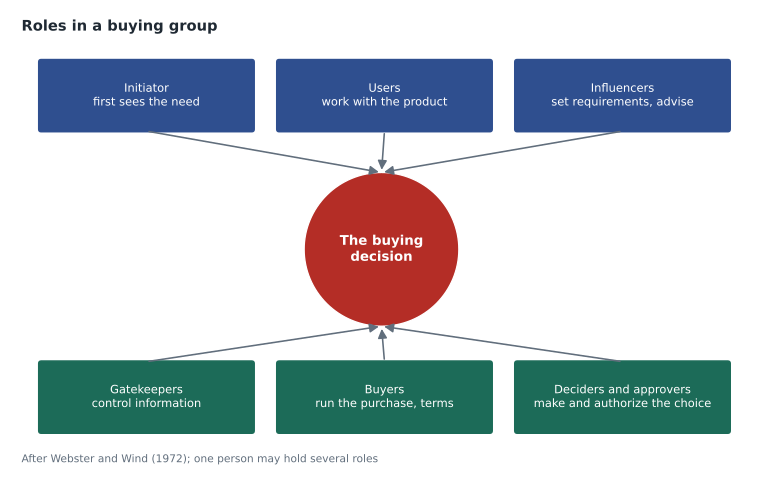
The roles describe functions, not job titles, and one person can play several. In a small clinic, the office manager may be initiator, buyer, gatekeeper and an important influencer, while the two owner physiotherapists are deciders. In a school division, the roles are spread across many people and departments, and the board approves the largest contracts. The roles also change from one purchase to another: the IT manager is a key influencer for printers on the network but may have no role in buying office chairs.
| Person | Role or roles | What they care about most |
|---|---|---|
| Business manager | Initiator, influencer | Predictable costs; fewer invoice disputes |
| Purchasing officer | Buyer, gatekeeper | A fair, documented process that follows policy |
| IT manager | Influencer | Network security and minimal support work |
| Principal on the technology committee | Influencer, voice of users | Teaching time lost to broken printers |
| School administrative assistant | User | Fast help when a machine fails |
| Superintendent of business administration | Decider | Not yet known: Maya has not met this person |
| Board of education | Approver | Value for public money and fairness |
How big are buying groups?
Research suggests that buying groups have grown. A study by CEB, now part of Gartner, reported in 2015 that the average number of people formally involved in a business purchase was 5.4, and later Gartner research has described typical groups of six to ten decision makers for complex purchases. Each brings information gathered separately and has to be brought to agreement. The same research found that the more people involved, the harder it is to reach any decision at all, which is one reason so many deals end in no decision.
For a salesperson, the size of the group means that a strong relationship with one person is rarely enough. A seller who works only through the first contact, however friendly, is at the mercy of conversations they never hear. Ridgeline's rule of thumb is that an account executive should have spoken directly with at least three members of the buying group, including the decider, before submitting a proposal for any contract over 25,000 dollars.
Economic, technical and user buyers
Robert Miller and Stephen Heiman, in their 1985 book Strategic Selling, offered a widely used sales version of buying-centre roles. They described the economic buyer, who gives final approval and controls the money; user buyers, who judge how the product will affect their work; technical buyers, who screen suppliers against specifications and can say no but usually cannot say yes; and the coach, someone who wants the seller to succeed and provides guidance about the organization. The framework is simpler than Webster and Wind's and focused on what each person can do to the sale.
The technical buyer deserves special attention because it is easy to mistake them for a decider. At Prairie Valley, the IT manager could disqualify any printer that failed the division's security requirements, but he could not choose between suppliers that passed. Treating him as the decider would have been a mistake; ignoring him would have been fatal. Maya scheduled a separate technical meeting with him and brought Ridgeline's network specialist, so his questions were answered in depth before the main proposal.
Champions, coaches and blockers
Inside most successful deals there is someone who actively wants the purchase to happen and works to make it happen. Sales teams call this person a champion. A champion is different from a friendly contact. A friendly contact is pleasant and shares information; a champion has influence, a personal stake in the outcome and the willingness to spend political capital to move the decision forward. The principal on the technology committee became Prairie Valley's champion, because broken printers had been the top complaint at every staff meeting she chaired.
The CEB researchers Brent Adamson, Matthew Dixon and colleagues, in their 2015 book The Challenger Customer, divided stakeholders into talkers, who share information freely but do not move decisions, mobilizers, who push the organization to act, and blockers, who resist change. They argued that sellers often spend too much time with friendly talkers and too little with mobilizers, especially skeptical ones who ask hard questions. The labels are a simplification, but the warning is useful: the person most eager to meet you is not necessarily the person who can make the purchase happen.
Blockers deserve respect rather than avoidance. A stakeholder who resists a purchase usually has a reason: a concern about cost, a worry about extra work, loyalty to the current supplier or a different priority for the budget. The purchasing officer at Prairie Valley initially seemed obstructive because she insisted on a formal request for proposals. Her concern was legitimate: the division's purchasing policy and the New West Partnership Trade Agreement required an open competition for a contract of that value. Once Maya understood that, she stopped trying to avoid the process and focused on helping the division write clear requirements, which lesson 10 covers.
Mapping stakeholders
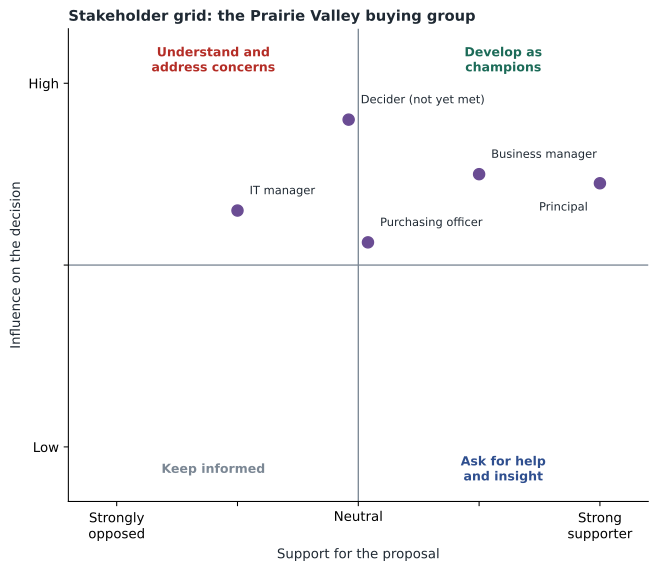
A stakeholder map is a simple tool for keeping track of the buying group. One common version places each person on a grid by two judgments: how much influence they have over the decision and how strongly they support the seller's proposal. People with high influence and low support need the most attention, because their concerns can stop the deal. People with high influence and high support are potential champions. People with low influence still matter, because they often affect the views of those with more.
Worked problem
Scoring the buying group's support
Maya rates each Prairie Valley stakeholder's influence from 1 (low) to 5 (high) and their current support for Ridgeline from −2 (strongly opposed) to +2 (strong supporter). Business manager: influence 4, support +1. Purchasing officer: influence 3, support 0. IT manager: influence 3, support −1. Principal: influence 3, support +2. Decider: influence 5, support unknown, which she scores 0. Multiply influence by support for each person and add the results. What does the total show, and where should she focus?
Show solution
- Business manager: 4 × (+1) = +4.
- Purchasing officer: 3 × 0 = 0.
- IT manager: 3 × (−1) = −3.
- Principal: 3 × (+2) = +6.
- Decider: 5 × 0 = 0.
- Total: 4 + 0 − 3 + 6 + 0 = +7.
Answer: The total of +7 is positive but fragile: it depends heavily on the principal, the largest single source of support comes from someone who cannot decide, and the person with the most influence is an unknown. Maya should focus on meeting the decider and on resolving the IT manager's concerns. The score is only a rough guide built from her own judgments, so its real value is in making her think about each person, not in the number itself.
Reaching the decider respectfully
Sellers often struggle to reach senior deciders, who are busy and protected by gatekeepers. Going around a contact to reach their boss can damage the relationship and is rarely necessary. A better approach is to ask the contact for help: 'Who else will be involved in recommending this to the board, and how can I make sure they have what they need?' Often the contact will invite the seller to a meeting or offer to present the material themselves. If the contact presents, the seller's job is to equip them well, with a short summary and answers to the questions the decider is likely to ask.
Maya used this approach with the Prairie Valley business manager. He arranged a twenty-minute meeting with the superintendent of business administration in the first week of September 2026. The decider's main concern turned out to be one nobody had mentioned: the division had signed a five-year contract with another supplier years earlier and had been unable to get out of it when service declined. She wanted a contract with clear service levels and the right to end it if they were missed. Maya would never have learned this from the other five stakeholders.
Keeping the map current and helping the group agree
Buying groups change during a sale. People leave or change jobs, new managers arrive with different priorities, and a reorganization can move a decision to a different department. A stakeholder map is useful only if it is kept up to date. Maya records each conversation in Ridgeline's CRM, with the person's role, main concerns and any change in their support, and she reviews the map with Darnell every two weeks for each large opportunity. When the Prairie Valley IT manager mentioned that he was retiring in the spring, she added his likely successor to the map and asked to include her in the technical meeting.
Because large groups struggle to agree, sellers can help by giving the whole group a shared picture of the decision. One common tool is a mutual action plan, a short document agreed with the buyer that lists the steps to a decision, who is responsible for each and the target dates. It turns the seller's private plan into a joint plan the buying group can see and correct. For Prairie Valley, the plan listed the technical review, the request for proposals, the evaluation and the board meeting, so every stakeholder knew where the decision stood and what was needed from them.
Ethics in the buying centre
Working with many stakeholders brings ethical obligations. Sellers must tell each person the same facts, even when different people care about different things; a cost figure given to the business manager must match the one given to the board. Sellers must not ask a champion to share confidential information, such as competitors' prices or internal deliberations, that the champion has no right to share. And in public bodies, gifts or hospitality offered to members of the buying group may break procurement rules or conflict-of-interest laws, as SLS-150 explains. A seller who wins by working honestly with every stakeholder keeps the trust of all of them, including those who preferred a competitor.
Common mistakes
MistakeBuild a strong relationship with one contact and let them handle the rest.
InsteadBuying groups often include six or more people; speak with several, including the decider.
MistakeThe technical expert decides.
InsteadTechnical buyers can usually say no but not yes; satisfy them without mistaking them for the decider.
MistakeThe friendliest contact is the champion.
InsteadA champion has influence, a personal stake and the willingness to push the decision forward.
MistakeBlockers should be avoided.
InsteadBlockers usually have legitimate concerns; understand and address them.
Summary and key terms
- The buying centre includes initiators, users, influencers, buyers, deciders, gatekeepers and sometimes approvers.
- Roles are functions, not titles; one person may hold several, and roles vary by purchase.
- Buying groups for complex purchases often include six to ten people, which makes agreement harder.
- Economic, technical and user buyers each affect the sale differently, and coaches and champions help it move.
- A stakeholder map by influence and support shows where attention is needed most.
- Every stakeholder must hear the same facts, and procurement and conflict-of-interest rules limit gifts and information sharing.
- Buying centre
- All the people who take part in an organization's purchase decision.
- Gatekeeper
- A person who controls the flow of information and access to others in the buying group.
- Economic buyer
- The person who gives final approval and controls the money.
- Technical buyer
- A person who screens suppliers against specifications and can reject them.
- Champion
- A stakeholder with influence who actively works for the purchase to happen.
- Stakeholder map
- A record of each buying-group member's role, influence, support and concerns.
Practice problems
Work each problem on paper first, then reveal the answer to check.
In a small clinic, which roles might the office manager hold?
Show answer
Initiator, buyer, gatekeeper and influencer, with the two owner physiotherapists as deciders.
What is the difference between a friendly contact and a champion?
Show answer
A champion has influence, a personal stake and is willing to push the decision forward; a friendly contact may only share information.
A stakeholder has influence 4 and support −2. What is their weighted score?
Show answer
4 × (−2) = −8.
What concern did the Prairie Valley decider have that no one else mentioned?
Show answer
Being locked into a long contract with poor service; she wanted clear service levels and the right to end the contract.
Lesson quiz · 5 questions
Score 60% or more to complete this lesson.
Create a free account to save your progress, take quizzes and earn a certificate.