
SLS-212 · Lesson 1 of 12 · 21 min
From discovery to presentation
▶ Video coming soon A video version of this lesson is on the way.
On the third Friday of September 2026, Farida Haddad booked Ridgeline's largest meeting room for the first session of what the sales team soon called the Friday presentation lab. Farida was Ridgeline's senior account manager and, by common agreement, the best presenter in the building. Darnell Brooks had asked her to run a lunchtime session every Friday until mid-November for the newer account executives, and Maya Chen was in the front row. Maya had been at Ridgeline for less than three weeks. She had already sat in on two discovery calls and had one of her own coming up with Keystone Grain Equipment. What she did not yet know was what to do with everything she was learning in those calls.
Farida began by putting a single slide on the screen. It showed two columns. On the left were notes from a real discovery call: the customer's words, the problems they described, the numbers they mentioned and the people they named. On the right was the opening slide of the presentation the seller had later given. The right-hand slide said "Ridgeline: Your Workplace Partner Since 2004" and showed a photograph of the warehouse. "Nothing on the left made it to the right," Farida said. "That is the most common presentation mistake in our business. We do the work of discovery, and then we present as if we had never met the customer."
This course is about the stage of the sales process that comes after discovery: showing the customer how you would solve the problem you have found together. It covers presentations to individuals and committees, product demonstrations in person and online, written proposals, formal responses to requests for proposals (RFPs), business cases and the moment when price is put on the table. It follows Maya through the fall of 2026 as Ridgeline competes for the Prairie Valley School Division managed print contract, demonstrates meeting-room technology to Keystone Grain Equipment, runs an online demonstration for the law firm Westgate & Rowe and writes a proposal for Eastgate Physiotherapy.
Where presentations fit in the sales process
SLS-101 introduced the sales process as a series of stages, and SLS-211 covers the discovery stage in depth. This course picks up where discovery ends. In most business-to-business sales the order is roughly: prospect, qualify, discover, present a solution, handle objections and negotiate, close, and then deliver and grow the account. Real sales are messier than that list, and stages overlap, but the order matters for one reason: a presentation is only as good as the discovery behind it.
A sales presentation, in the sense used in this course, is any planned communication in which a seller shows a customer how a specific solution meets that customer's needs. It may be a formal slide presentation to a committee, a fifteen-minute conversation across a desk with a printed one-page summary, a live demonstration of software, or a written proposal that the customer reads alone. What makes it a presentation, rather than a conversation, is that the seller has prepared it in advance, with a purpose and a structure.
A presentation is not the same as a pitch. A pitch is a generic description of a product or company, delivered in much the same form to everyone. Pitches have their place, at trade shows and in first conversations, but they belong before discovery, not after it. Once you know a customer's situation, a generic pitch wastes the most valuable thing you have learned.
| Generic pitch | Tailored presentation | |
|---|---|---|
| When it is used | Before discovery, to create interest | After discovery, to show a specific solution |
| Starting point | The seller's company and products | The customer's situation and goals |
| Content | Features and general benefits | The customer's problems, a proposed solution, evidence and next steps |
| Numbers | Industry averages or none | The customer's own numbers from discovery |
| Length | Fixed | Fitted to the audience and the decision |
| Ends with | A general call to action | A specific, agreed next step |
What discovery should give you
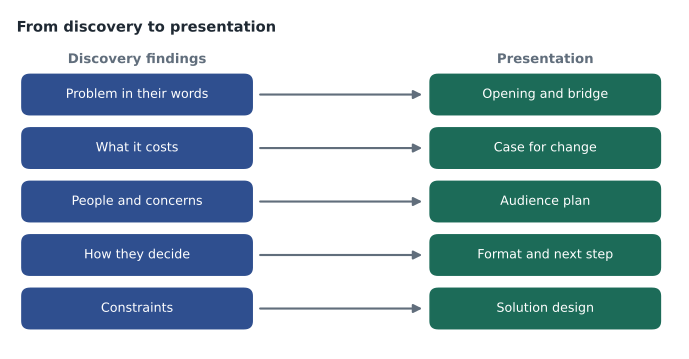
Farida's second slide was a checklist. Before she would build any presentation, she wanted answers to a set of questions from discovery. If she could not answer most of them, she told the group, the right move was usually another discovery conversation, not a presentation.
| Question | Why it matters for the presentation |
|---|---|
| What problem is the customer trying to solve, in their own words? | The presentation should open with that problem, stated the way they stated it. |
| What does the problem cost them, in money, time or risk? | This becomes the case for change and, later, the business case. |
| What would success look like to them? | This shapes the solution and the measures you propose. |
| Who is involved in the decision, and what does each person care about? | This decides who should attend and what each part of the presentation must cover. |
| How will they decide, and by when? | This tells you what format the decision needs: a meeting, a proposal, a formal RFP response. |
| What alternatives are they considering, including doing nothing? | This tells you what you must compare yourself against. |
| What constraints apply: budget, timing, policy, technology? | A solution that ignores a constraint will be rejected however good it looks. |
For Keystone Grain Equipment, Maya's discovery notes were good. Dale Petrie, Keystone's operations director, had told her that the company's two meeting rooms were regularly double-booked during dealer visits, because bookings were kept on a whiteboard outside the boardroom and in three different people's calendars. Twice in the previous year, a visiting dealer group had arrived to find another meeting already in the room. Dale called it "embarrassing in front of the people who sell our equipment". Linda Sorensen, the human resources manager, cared about something else: the training room was booked for safety courses months in advance, and those bookings kept being overwritten. Dale had a capital approval limit, and anything above it went to the owners' board.
With those notes, Maya could see the outline of a presentation before she opened any software. The opening would be the double-booking problem in Dale's words. The solution would be RoomFlow, Ridgeline's room-booking software, with a booking panel outside each room and calendar integration. The evidence would be a short demonstration of a booking conflict being prevented, and a reference from another customer. The two audiences, Dale and Linda, needed different parts of the story: Dale wanted the dealer-visit problem fixed and the cost kept within his limit, and Linda wanted the training schedule protected.
The bridge: confirming what you heard
The most reliable way to start a presentation after discovery is to confirm what you heard. Farida called this "building the bridge". Before showing any solution, the seller briefly summarizes the customer's situation, problems and goals, and asks whether the summary is right and complete. It takes two or three minutes, and it does three things.
First, it shows the customer that you listened, which is the single strongest way to earn attention for what follows. Second, it catches mistakes and changes: a priority may have shifted since discovery, a new stakeholder may have joined, or the budget may have moved. Third, it gives every person in the room a shared starting point, which matters most when some of them were not in the discovery conversations at all.
Worked problem
Writing a bridge statement
Maya is preparing her Keystone presentation. Write a bridge statement of no more than four sentences that confirms the situation, the problem, its effect and the goal, and ends with a check.
Show solution
- Situation: "Keystone has two meeting rooms and a training room, and bookings are kept on a whiteboard and in several calendars."
- Problem and effect: "That has led to double bookings, including twice in the last year when visiting dealers arrived to find their room taken, and training sessions being overwritten."
- Goal: "You want one reliable booking system that protects dealer visits and training, without adding work for your staff, and within your approval limit."
- Check: "Is that a fair summary, and has anything changed since we spoke?"
Answer: A good bridge statement is short, uses the customer's own words where possible, covers the effect of the problem and not just the problem, and ends by inviting correction.
If the customer corrects the summary, that is good news, not bad. It is far better to learn in minute two that the training room has been converted to office space than to discover it in minute twenty, halfway through a demonstration of training-room bookings. Experienced presenters prepare a few alternative paths through their material for exactly this reason.
Deciding whether you are ready to present
Not every sales conversation should lead to a presentation. Some customers ask for a presentation early, often because they want to compare suppliers quickly, and agreeing too soon puts the seller in the position of presenting a generic solution. Others never ask, and the seller has to propose one. A useful test is whether the seller can say, in one sentence, what problem the presentation will solve for whom, and what decision it is meant to help the customer make.
| Signal | Ready to present? | What to do |
|---|---|---|
| You can state the customer's problem and its cost in their words | Yes | Plan the presentation around that problem |
| You know who decides and they will attend or receive the material | Yes | Build the audience plan |
| The customer asks for "your standard presentation" before any discovery | Not yet | Offer a short conversation first, or a brief overview with discovery questions built in |
| You have spoken to only one person in a decision that involves several | Not yet | Ask to meet, or at least hear from, the others |
| The customer has a formal procurement process | Depends | Follow the process; see lesson 8 on RFPs |
| The customer has no problem you can solve | No | Say so, and stay in touch |
When a customer asks for a presentation too early, the seller can often turn the request into a better meeting. Maya used this approach with Westgate & Rowe, a law firm whose office lease ended on March 31, 2027. The firm's office manager, Priya Nandakumar, had asked for "your standard presentation on furniture and room booking" in her first email. Maya replied that she would be glad to show RoomFlow, and asked for twenty minutes first to understand the firm's move, so that the demonstration could use their own rooms and schedule. Priya agreed, and the later demonstration, described in lesson 5, was built on what Maya learned.
Choosing the right format
The format of a presentation should match the decision it supports, not the seller's habits. Ridgeline's sellers use five formats most often, and the same deal often uses more than one.
| Format | Best for | Example at Ridgeline |
|---|---|---|
| Conversation with a one-page summary | Small decisions made by one or two people | A replacement printer for a two-person office |
| Formal presentation to a group | Decisions involving several stakeholders | Prairie Valley's evaluation committee in October |
| Product demonstration | Solutions whose value is easiest to see in use | RoomFlow for Keystone's meeting rooms |
| Written proposal | Decisions that will be reviewed after the meeting, or by people not in the room | Eastgate Physiotherapy's owners, who decide at a monthly meeting |
| Formal RFP response | Public bodies and large organizations with procurement rules | Prairie Valley's managed print RFP |
A common pattern in mid-sized deals is a meeting that combines a short presentation and a demonstration, followed by a written proposal that the customer can circulate. The meeting persuades the people in the room; the proposal persuades the people who were not there and gives everyone a record of what was offered.
Planning the presentation in one page
Farida asked every account executive to complete a one-page plan before building any slides. She argued that slides were the last thing to make, not the first, because once slides exist people become attached to them. The plan forced the seller to decide the purpose, audience, message and next step first.
| Plan item | Maya's Keystone plan |
|---|---|
| Purpose: what decision should this help them make? | Agree to a two-room RoomFlow pilot and a quote for full installation |
| Audience and what each cares about | Dale Petrie: dealer visits, cost within his approval limit. Linda Sorensen: training schedule, staff effort |
| Key message in one sentence | RoomFlow ends double bookings by making one live schedule visible at every door and in every calendar |
| Evidence | Live demo of a conflict being blocked; reference from a manufacturer customer; setup timeline |
| Likely questions and concerns | Calendar compatibility, staff training, cost, what happens if the network is down |
| Desired next step | Pilot start date agreed and quote approved for review |
| Time available | Forty-five minutes, on site, Thursday October 8 |
Writing the key message as a single sentence is harder than it looks, and it is the part Farida checked most carefully. A good key message is specific to the customer, names the outcome rather than the product, and is something the customer could repeat to a colleague. "RoomFlow is a powerful, flexible booking platform" fails all three tests. "RoomFlow ends double bookings by making one live schedule visible at every door and in every calendar" passes them.
Ethics and accuracy from the start
A presentation is a promise. Everything a seller shows or says about what a product will do, how quickly it will be installed and what results it will produce is part of what the customer relies on when deciding. Claims about performance and results must be true and supportable, and examples must not create a false impression. Misleading representations in sales presentations can breach the Competition Act, and promises made in a presentation can become part of the contract or support a claim if they turn out to be false. SLS-150 covers those rules; this course returns to them in lessons 6, 9 and 10, where the temptation to exaggerate is strongest.
Farida put it more simply: "Never show a number you can't explain, and never promise a date that operations hasn't agreed to." She added one more rule from experience. If you do not know the answer to a question in a presentation, say so and promise to find out. Lesson 11 returns to that rule.
Common mistakes
MistakeOpening a presentation with your company's history and products.
InsteadOpen with the customer's situation and problem, in their words, and confirm it.
MistakeBuilding slides before deciding the purpose, audience and next step.
InsteadWrite a one-page plan first; make slides last.
MistakePresenting before discovery is complete because the customer asked.
InsteadOffer a short conversation first, or build discovery questions into the meeting.
MistakeUsing the same presentation for every customer.
InsteadTailor content, examples and numbers to what you learned in discovery.
MistakeEnding without a specific next step.
InsteadDecide the next step you want before the meeting and ask for it clearly.
Summary and key terms
- A sales presentation is any planned communication that shows a specific customer how a solution meets their needs; it is different from a generic pitch.
- A presentation is only as good as the discovery behind it: before presenting, the seller should know the problem, its cost, the people involved, the decision process, the alternatives and the constraints.
- A bridge statement confirms what you heard before you present anything.
- If you cannot state the problem and the decision in one sentence, you are probably not ready to present.
- Choose the format to fit the decision: a conversation, a group presentation, a demonstration, a written proposal or a formal RFP response.
- Write a one-page plan with purpose, audience, key message, evidence, likely questions and next step before making slides.
- Every claim in a presentation must be true and supportable.
- Sales presentation
- A planned communication showing a specific customer how a solution meets their needs.
- Pitch
- A generic description of a product or company delivered in much the same form to everyone.
- Bridge statement
- A short summary of the customer's situation, problem and goals, ending with a check, given before presenting a solution.
- Key message
- The one sentence the customer should remember and be able to repeat after the presentation.
- Presentation plan
- A one-page plan covering purpose, audience, key message, evidence, likely questions, next step and time.
- Next step
- A specific, agreed action that moves the sale forward, such as a pilot start date or a proposal review meeting.
Practice problems
Work each problem on paper first, then reveal the answer to check.
Rewrite this key message to be customer-specific: "Our managed print service is reliable and cost-effective."
Show answer
For example: "Managed print will cut your printer types from 61 to 44 and put every school on one toner order, so staff stop chasing supplies." It names the customer's outcome and could be repeated by them.
A prospect asks for your standard presentation before any discovery. What do you suggest?
Show answer
Offer a short conversation first so the presentation can use their situation, or a brief overview with discovery questions built into the meeting.
Why does a bridge statement end with a question?
Show answer
To invite correction, so that changed priorities, new stakeholders or mistakes surface before the solution is presented.
Lesson quiz · 5 questions
Score 60% or more to complete this lesson.
Create a free account to save your progress, take quizzes and earn a certificate.