
SLS-212 · Lesson 11 of 12 · 19 min
Handling questions during a presentation
▶ Video coming soon A video version of this lesson is on the way.
Prairie Valley's invitation to the shortlisted suppliers was precise: forty minutes to present, then twenty minutes for questions from the evaluation committee, on Tuesday, October 27, 2026, in the division office boardroom. Farida Haddad told the Ridgeline team that the twenty minutes mattered more than the forty. "Everyone prepares the presentation," she said at the Friday lab on October 23. "Hardly anyone prepares the questions. But the committee already has our written response. They've scored most of it. The questions are where they decide whether to believe it."
Questions are one of the best things that can happen in a presentation. A question means someone is listening, thinking about how the solution would work for them, and telling the seller what matters. Handled well, questions build trust faster than any slide. Handled badly, a single question can undo an hour of good work. This lesson covers how to prepare for questions, a method for answering them, difficult kinds of question and what to do when you do not know the answer.
Why questions matter
Questions reveal what the audience is really thinking. A question about rural service means rural service has been a problem. A question about price escalation means the business manager has been burned by increases before. A question about data on stored print jobs means someone is worried about privacy. Each question is a piece of discovery offered freely, and the seller who treats it that way learns more in twenty minutes than in many earlier conversations.
Questions are also where evaluators test credibility. Anyone can deliver a rehearsed presentation. Answering an unexpected question clearly, honestly and briefly shows that the seller understands the solution and the customer, and that the claims in the written response are backed by real knowledge.
Preparing for questions
The best way to handle questions is to anticipate them. Farida's team built a question bank: a list of every question the committee might ask, grouped by who was likely to ask it, with a short planned answer and the name of the team member who would answer.
| Likely asker | Question | Planned answer (short) | Answers |
|---|---|---|---|
| IT manager | How do the printers connect to our network, and who manages security updates? | Each device sits on your network segment for printers; we apply firmware updates monthly and report them to you | Installation lead |
| Business manager | Can the price go up during the contract? | Prices are fixed for the first two years; after that, increases are capped as set out in Form C | Maya |
| Principal | What happens if a printer breaks on a Monday morning in a rural school? | One call to our service desk; a technician within four business hours; a loaner if the fix takes longer than a day | Farida |
| Administrative assistant | Will we still have to order toner? | No; the printers report their levels and toner arrives before it runs out | Maya |
| Purchasing officer | How will you handle the change from the current supplier? | Over winter break, school by school, with a named coordinator | Farida |
| Superintendent | Why should we pay more than the lowest bidder? | Lower total cost of ownership, fewer models and four-hour rural service; see the comparison | Farida |
Building the bank had two benefits beyond the answers themselves. It showed gaps in the team's knowledge; nobody could say exactly how long firmware updates took, so the installation lead found out. And it decided who would answer what, which avoids a common problem in team presentations: two people starting to answer the same question, or nobody answering at all while everyone looks at each other.
A method for answering
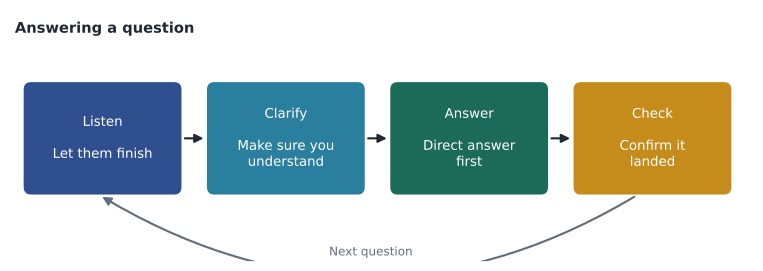
Most sales training teaches some version of the same method for answering questions and objections. SLS-213 lesson 3 uses a six-step method for objections. For questions in a presentation, Farida taught a shorter version she called listen, clarify, answer, check.
| Step | What it means | Example |
|---|---|---|
| Listen | Let the person finish; do not interrupt or start answering in your head | Wait through the whole question, even if you think you know where it is going |
| Clarify | Make sure you understand the real question, especially if it is broad or ambiguous | "When you say service in rural schools, do you mean response time, or who does the work?" |
| Answer | Give a direct answer first, then the reason or evidence, briefly | "A technician will be on site within four business hours. We have a technician based in the division's area three days a week." |
| Check | Confirm that the answer addressed the question | "Does that cover what you were asking?" |
Two parts of this method are often skipped. Clarifying feels like a delay, but answering the wrong question wastes far more time, and asking a clarifying question shows respect. Checking feels unnecessary, but it is the only way to know whether the answer landed, and it often brings a useful follow-up.
Answers in a presentation should be short. A useful rule is to give the direct answer in the first sentence and to finish within about a minute unless the asker wants more. Long answers lose the rest of the room, and they suggest the seller is uncertain. If a question needs a long technical answer, it is often better to give the short version and offer a separate conversation.
Worked problem
Timing the question period
The committee has 20 minutes for questions. Farida expects about 8 questions. If each answer, including clarifying and checking, takes about 90 seconds, how much time is left for the committee to ask the questions and for follow-ups?
Show solution
- Time for answers: 8 × 90 = 720 seconds = 12 minutes.
- Time left: 20 − 12 = 8 minutes, or an average of 8 × 60 ÷ 8 = 60 seconds per question for asking and following up.
- If answers run to 3 minutes each, the answers alone would take 8 × 3 = 24 minutes, more than the time available.
Answer: Answers of about 90 seconds use 12 of the 20 minutes and leave about a minute per question for asking and follow-ups. Answers twice as long would mean some questions were never asked.
Difficult questions
Some questions are harder than others, and each kind needs a slightly different approach.
| Kind of question | What is happening | Good approach |
|---|---|---|
| The comparison: "Your competitor offers next-day service for less." | The asker is testing you against an alternative | Do not criticize the competitor; explain your offer's value and the difference plainly |
| The hostile question | The asker is frustrated, sceptical or testing | Stay calm, acknowledge the concern, answer the substance |
| The off-topic question | Interesting but not relevant now | Answer briefly or offer to follow up afterward |
| The multi-part question | Several questions at once | Repeat the parts and answer each in turn |
| The question you cannot answer | You do not know, or are not allowed to say | Say so, and promise a specific follow-up |
| The question about the future | The asker wants a promise you cannot make | Say what is known and confirmed; do not speculate |
The comparison question came, as the team expected, from the business manager. The incumbent supplier had bid a lower price and offered next-day service. Farida's answer did not mention the competitor by name or criticize it. She said that Ridgeline's response time was four business hours, which in practice meant a broken printer in a morning would usually be fixed or replaced the same day, and that Ridgeline had a technician based in the division's area three days a week. Then she referred the committee to the cost comparison in the written response, which showed the effect of fewer device models on total cost. "We aren't the lowest price," she said. "We think we're the lowest cost over five years, and the comparison on page 22 shows how we got there."
Criticizing competitors is risky for several reasons. It sounds defensive, it invites the customer to defend the competitor, and statements about a competitor that turn out to be false can raise legal problems as well as ethical ones. Comparing offers accurately and fairly is fine; disparaging competitors is not.
Hostile and emotional questions
Sometimes a question carries frustration or anger, often about something that happened before the seller arrived. The principal on Prairie Valley's committee asked, with some heat, whether Ridgeline would "actually show up, unlike the last company". The question was really about his experience with the current supplier, not about Ridgeline.
Farida's approach followed the de-escalation principles in SLS-120 and SLS-130: stay calm, do not take the tone personally, acknowledge the frustration, and answer the substance. She said that it sounded as though slow service had caused real problems in the schools, asked which kind of fault had been worst, and then explained the four-hour response and the loaner promise. She added that the service level was in the contract, with credits if Ridgeline missed it, so the division would not have to rely on Ridgeline's word.
Acknowledging a concern is not the same as agreeing with it. "I can see why that's frustrating" does not admit fault; it shows the seller heard. Arguing with a hostile question, or answering it defensively, nearly always makes things worse.
When you do not know
Every presenter eventually faces a question they cannot answer. The temptation is to guess, especially in front of an evaluation committee. Guessing is a mistake. A wrong answer, discovered later, damages credibility on every other answer, and in a public procurement it can create a commitment the seller cannot keep.
The better approach is to say plainly that you do not know, say when you will find out, and then do it. The IT manager on Prairie Valley's committee asked whether the new devices could hold stored print jobs for a maximum of 24 hours before deleting them automatically, to meet a division privacy rule. Nobody on the Ridgeline team was certain. Maya said, "I don't want to guess on a privacy setting. I'll confirm with the manufacturer and send the answer to Ms. Sawatzky by Thursday." Because the competition had a single point of contact, the answer had to go through Colleen Sawatzky, the procurement officer, who would share it with the committee. Maya sent it on Wednesday: the devices could delete stored jobs after any period from one hour to 72 hours, set centrally.
Following up on time matters as much as the honest answer. A promised answer that never arrives is worse than a guess.
Questions in procurement settings
Questions in a formal procurement have extra rules. Evaluators may only score what is in the written proposal and in any formal clarification, so a seller cannot use the question period to change the price or add new commitments that other suppliers did not have the chance to offer. If the committee asks whether a supplier can do something not in the proposal, the safe answer is usually to describe what the proposal includes and, if the buyer wants more, to say the supplier would be glad to respond to a formal clarification request. Leah Marchand briefed the team on this before October 27: no new prices, no new promises, and anything the committee asked for in writing would be answered in writing through Ms. Sawatzky.
Clarification meetings are also recorded, formally or in notes, and the answers can become part of the contract. Prairie Valley's purchasing officer took minutes of every answer. That is one more reason to answer precisely and to avoid casual promises.
Managing the question period
In a group presentation, the presenter also manages the flow of questions. Useful habits include repeating or paraphrasing each question so everyone hears it, which is especially important in large rooms and hybrid meetings; inviting questions from people who have not spoken; watching the time and saying when only a few minutes remain; and keeping a visible list of follow-ups so the audience knows nothing has been forgotten.
At the end, a short summary of the follow-ups and the next step closes the session cleanly. Farida ended Prairie Valley's question period by listing the one open item (the stored-jobs question, to be answered by Thursday through Ms. Sawatzky), thanking the committee by role and confirming that Ridgeline would submit any best and final offer by the deadline in the procurement schedule.
Common mistakes
MistakePreparing the presentation but not the questions.
InsteadBuild a question bank with short answers and a named person for each.
MistakeAnswering before understanding the question.
InsteadListen to the end and clarify broad or ambiguous questions first.
MistakeGiving long answers.
InsteadGive the direct answer first and finish in about a minute unless asked for more.
MistakeCriticizing a competitor in response to a comparison.
InsteadExplain your offer's value and the differences plainly and fairly.
MistakeGuessing when you do not know.
InsteadSay you do not know, promise a specific follow-up and deliver it on time.
Summary and key terms
- Questions show what the audience is thinking and are where evaluators test credibility.
- Prepare a question bank with likely askers, short answers and a named team member for each.
- Use listen, clarify, answer, check: let the person finish, make sure you understand, give the direct answer first and confirm it landed.
- Keep answers to about a minute.
- Handle comparisons without criticizing competitors, hostile questions with calm acknowledgement and an answer to the substance, multi-part questions one part at a time, and questions about the future with only confirmed facts.
- When you do not know, say so, promise a specific follow-up and deliver it.
- In formal procurement, do not add new prices or commitments in the question period, and send written answers through the official contact.
- Repeat questions, include quiet participants, watch the time and summarize follow-ups at the end.
- Question bank
- A prepared list of likely questions with short planned answers and the team member who will answer each.
- Listen, clarify, answer, check
- Farida's four-step method for answering questions in a presentation.
- Clarifying question
- A question asked to make sure the seller understands what the asker really wants to know.
- Comparison question
- A question that tests the seller's offer against a competitor's or an alternative.
- Formal clarification
- A written question and answer exchanged through the official procurement contact.
- Follow-up list
- A visible record of questions to be answered after the presentation.
Practice problems
Work each problem on paper first, then reveal the answer to check.
A 15-minute question period is expected to bring 6 questions. If each answer takes 2 minutes, how much time is left for asking and follow-ups?
Show answer
6 × 2 = 12 minutes, leaving 3 minutes, or 30 seconds a question.
A buyer says, "Your competitor is cheaper." What do you avoid, and what do you do instead?
Show answer
Avoid criticizing the competitor; explain your offer's value and how total cost compares, fairly and specifically.
During an RFP clarification meeting, the committee asks if you could lower your price. What should you say?
Show answer
That the price is as submitted, and that you would respond to any formal request, such as a best and final offer, through the official process.
Lesson quiz · 5 questions
Score 60% or more to complete this lesson.
Create a free account to save your progress, take quizzes and earn a certificate.