
VIS-110 · Lesson 1 of 12 · 24 min
What light is
Photographers and cinematographers work with light the way painters work with paint. Every image begins as light leaving a source, bouncing off or passing through the world, entering a lens and landing on a sensor or film. Understanding what light physically is, how it is produced and how it is described makes it far easier to predict how a scene will look, to choose and modify light sources, to diagnose colour and exposure problems, and to talk precisely with crew members, clients and technicians. This course covers the physics of light, how light behaves when it meets objects, how it is measured, its quality, direction and contrast, natural light, colour temperature and white balance, how human vision works, how colour is described and reproduced, colour harmony, exposure tools, and how it all comes together in practice. This first lesson introduces light as electromagnetic radiation, the visible spectrum, how light sources produce light, and the basic quantities and vocabulary used throughout the course.
Light as electromagnetic radiation
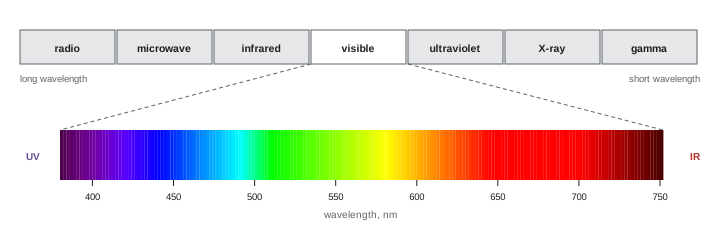
Light is a form of electromagnetic radiation: energy travelling as oscillating electric and magnetic fields. In a vacuum it travels at about 300,000 km per second, fast enough to circle the Earth more than seven times in a second, and it takes about eight minutes and twenty seconds to travel from the Sun to the Earth. Electromagnetic radiation spans an enormous range of wavelengths, from radio waves metres or kilometres long, through microwaves and infrared, to visible light, ultraviolet, X-rays and gamma rays far shorter than an atom.
The visible spectrum, the narrow band our eyes respond to, runs from about 380 nanometres (violet) to about 750 nanometres (deep red). A nanometre is one billionth of a metre. Within that band, wavelength corresponds roughly to the colours of the rainbow: violet and blue at short wavelengths, then cyan, green, yellow, orange and red at long wavelengths. Just beyond the visible range lie ultraviolet (shorter than violet) and infrared (longer than red). Camera sensors are naturally sensitive to some near infrared, which is why they include infrared-blocking filters; converted "infrared cameras" remove that filter for creative and scientific work.
Waves and photons
Light behaves both as a wave and as a stream of particles called photons. The wave description explains interference, diffraction and polarization (Lesson 2) and the relationship between wavelength λ, frequency f and speed c:
The particle description explains how light is emitted and absorbed in discrete packets of energy. A photon's energy is proportional to its frequency (E = hf, where h is Planck's constant), so blue photons carry more energy than red ones and ultraviolet photons more still, which is why ultraviolet light can damage skin, fade dyes and degrade materials while red light cannot. In a digital camera, each photon striking a photosite can free an electron; the sensor counts these electrons to measure how much light arrived. The random arrival of photons produces photon (shot) noise, which is why images captured with very little light look grainy no matter how good the camera is.
Worked problem
Frequency of green light
Green light has a wavelength of about 530 nm. What is its frequency?
Show solution
- Convert the wavelength: 530 nm = 530 × 10⁻⁹ m = 5.3 × 10⁻⁷ m.
- Use f = c ÷ λ = (3.0 × 10⁸ m/s) ÷ (5.3 × 10⁻⁷ m).
- f ≈ 5.7 × 10¹⁴ Hz, about 570 trillion oscillations per second.
Answer: About 5.7 × 10¹⁴ Hz. Visible light frequencies are in the hundreds of terahertz, far beyond anything electronics can follow directly, which is why sensors detect light by counting photons rather than measuring its waves.
How light is produced
Light sources produce light in a few fundamentally different ways, and the mechanism determines the colour and quality of the light:
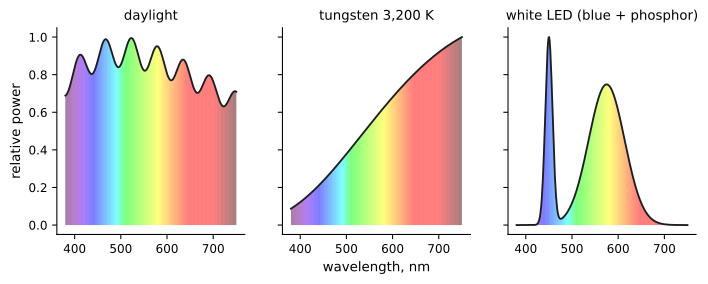
- Incandescence (thermal radiation): any hot object glows. The Sun, candles, fire, and tungsten and halogen lamps produce light because they are hot, emitting a continuous spectrum whose colour depends on temperature: a candle flame around 1,900 K glows orange, a tungsten lamp around 3,200 K is warm yellow-white, and the Sun's surface around 5,800 K appears white. This idea underlies colour temperature (Lesson 7).
- Gas discharge: an electric current through a gas excites atoms, which emit light at specific wavelengths (a line spectrum). Sodium street lamps emit nearly pure orange-yellow light; mercury, metal halide and HMI lamps add other materials to produce a broader, whiter mix; fluorescent tubes use mercury discharge to produce ultraviolet, which a phosphor coating converts to visible light.
- Electroluminescence: light-emitting diodes (LEDs) produce light when electrons cross a semiconductor junction, emitting a narrow band of wavelengths set by the material. White LEDs usually combine a blue LED with a yellow phosphor, or mix several colours (red, green, blue, and often amber, lime or white) to produce adjustable white and coloured light. LEDs now dominate lighting for film, photography and everyday use.
- Lasers produce intense, nearly single-wavelength, highly directional light, used in projectors, measurement and effects.
The spectrum of a source, the amount of energy it emits at each wavelength, determines how accurately it renders colours (Lesson 7). Two sources can look the same white to the eye yet render coloured objects quite differently because their spectra differ.
Intensity and brightness
How much light there is can be described in several ways (Lesson 3 covers measurement in detail):
- The power or flux of a source: how much light it emits in total, measured photometrically in lumens.
- Illuminance: how much light falls on a surface, measured in lux (lumens per square metre) or foot-candles.
- Luminance: how bright a surface appears, the light leaving it toward the viewer, measured in candelas per square metre (nits). Screens are rated in nits.
Brightness as we perceive it is not proportional to the physical amount of light. The eye and brain respond roughly logarithmically: doubling the light looks like a modest step, not twice as bright. This is why photographers measure light in stops, where each stop is a doubling or halving (Lesson 3), and why a scene can range from deep shadow to bright sky over a ratio of a million to one or more while still looking natural to us.
Light in everyday image making
Several practical consequences follow from the physics:
- Because light travels in straight lines (in a uniform medium), shadows form and the size and position of a source determine their shape (Lesson 4).
- Because light spreads out from a source, its intensity falls with distance (the inverse square law, Lesson 3).
- Because surfaces absorb and reflect wavelengths selectively, objects have colours (Lesson 2).
- Because sources differ in spectrum, the same object looks different under different lights, and cameras must be told how to interpret the light (white balance, Lesson 7).
- Because our perception adapts, we often do not notice what the camera records faithfully, such as a green cast from fluorescent lights or a blue cast in shade.
Light and safety
Working with light has hazards worth knowing from the start. Ultraviolet from the sun, HMI lamps without proper lenses, and some effects lights can burn skin and eyes. Looking at the sun, through a camera viewfinder or not, can cause permanent eye damage in seconds; never point an optical viewfinder at the sun, and use proper solar filters for solar photography. Powerful lights, especially lasers and some LEDs, can damage eyes at close range. Tungsten and HMI fixtures become extremely hot and can cause burns and fires. Electrical safety with lighting equipment is covered in Lesson 12.
Light sources image makers use
In practice, image makers work with a handful of source families, each with characteristic spectra and behaviour. Daylight, the combination of direct sun and skylight, changes constantly but is the reference against which other sources are judged. Tungsten and halogen lamps give smooth, continuous, warm spectra with excellent colour rendering, but are inefficient and hot. HMI (hydrargyrum medium-arc iodide) lamps produce powerful daylight-balanced light from a metal halide discharge and remain important for large film sets. Fluorescent fixtures designed for film use special phosphors for good colour, while ordinary office fluorescents often have green casts. LEDs, now the most common source on sets and in studios, range from excellent full-spectrum fixtures to cheap units with poor colour, and many offer tunable colour temperature, saturated colours and effects. Electronic flash produces a very short, intense burst of daylight-balanced light, ideal for freezing motion in still photography.
Knowing which family a source belongs to helps predict how it will look on camera: its colour, whether it flickers, how it renders skin, and how much heat it produces. When arriving at a location, a quick survey of the existing sources, sun through windows, overhead fluorescents, warm table lamps, screens, saves time and avoids surprises later.
Thinking like light
A helpful habit is to imagine following light from its source to the camera: where it starts, what it hits, how it bounces, what it passes through, and which part of it finally reaches the lens. This mental tracing explains why a white floor brightens a face from below, why a red wall tints nearby skin, why a window seems to glow when the room is dark, and why moving a light a small distance can transform an image. Every lesson that follows builds on this simple picture of light travelling, interacting and arriving.
The same picture applies whether the light comes from the sun or a small LED, and whether the image is made with a smartphone or a cinema camera. Equipment changes quickly; the behaviour of light does not, which is why this foundation remains useful throughout a career in image making.
A final point about vocabulary: in everyday speech, brightness, intensity, power and light level are used loosely and interchangeably. In this course and in professional work, it pays to be precise. When a gaffer asks for more light on a face, she usually means more illuminance on the subject; when a colourist talks about a bright sky, he means high luminance in the image; when a manufacturer advertises a powerful fixture, it may mean electrical watts, lumens or lux at a distance. Asking which quantity is meant avoids misunderstandings and wasted time on set.
Throughout the course, try each idea with your own camera or phone. Reading about light is useful, but seeing how your equipment responds, where it clips highlights, how it renders warm and cool sources, how much noise appears in dim scenes, turns knowledge into skill.
With these foundations in place, the next lesson follows light as it meets the world: bouncing, bending, scattering and being absorbed.
Common mistakes
MistakeAssuming all white light is the same.
InsteadRemember sources differ in spectrum and colour rendering.
MistakeExpecting brightness to double visually when light doubles.
InsteadThink in stops; perception is roughly logarithmic.
MistakePointing an optical viewfinder at the sun.
InsteadNever do this; use certified solar filters for sun work.
MistakeIgnoring infrared and ultraviolet effects.
InsteadKnow that sensors and materials respond beyond visible light.
MistakeBlaming the camera for noise in very dim scenes.
InsteadUnderstand that photon noise is physical; add light where possible.
Summary and key terms
- Light is electromagnetic radiation; the visible band runs from about 380 to 750 nm.
- Wavelength, frequency and speed are related by c = λf; photons carry energy E = hf.
- Sensors count photons; random photon arrival causes noise in dim scenes.
- Light is produced by incandescence, gas discharge, electroluminescence and lasers.
- A source's spectrum determines its colour and colour rendering.
- Flux (lumens), illuminance (lux) and luminance (nits) describe amounts of light.
- Perception is roughly logarithmic, so photographers work in stops.
- Electromagnetic radiation
- Energy travelling as electric and magnetic fields.
- Wavelength
- The distance between successive wave peaks.
- Visible spectrum
- Wavelengths the human eye can see, about 380 to 750 nm.
- Photon
- A particle or packet of light energy.
- Photon noise
- Random variation from the arrival of individual photons.
- Incandescence
- Light emitted by hot objects.
- Spectral power distribution
- The power a source emits at each wavelength.
- Lumen
- The unit of luminous flux.
- Lux
- The unit of illuminance, one lumen per square metre.
- Nit
- One candela per square metre, a unit of luminance.
Practice problems
Work each problem on paper first, then reveal the answer to check.
What range of wavelengths is visible?
Show answer
About 380 to 750 nm.
How long does sunlight take to reach Earth?
Show answer
About 8 minutes 20 seconds.
Which carries more energy, a blue or a red photon?
Show answer
A blue photon.
What is the frequency of 600 nm light?
Show answer
About 5 × 10¹⁴ Hz.
Why do cameras have infrared-blocking filters?
Show answer
Sensors are sensitive to near infrared.
Name four ways light is produced.
Show answer
Incandescence, gas discharge, electroluminescence, lasers.
How do most white LEDs make white light?
Show answer
A blue LED with a yellow phosphor, or mixed coloured LEDs.
What does luminance measure?
Show answer
How bright a surface appears, in cd/m² or nits.
Why do photographers use stops?
Show answer
Perception is roughly logarithmic.
Name two light-related hazards.
Show answer
UV burns, eye damage from the sun or lasers, hot fixtures.
Lesson quiz · 5 questions
Score 60% or more to complete this lesson.
Create a free account to save your progress, take quizzes and earn a certificate.