
VIS-210 · Lesson 10 of 12 · 27 min
Theory II: postmodernism, conceptual photography and the gaze
From the 1960s onward, photography moved to the centre of contemporary art, and critics began to question the modernist ideas that had dominated the previous half-century: the original creative genius, the unique masterpiece, the purity of the medium and the photograph as a transparent window on the world. Conceptual artists used photographs as plain documents of ideas; postmodern artists rephotographed, staged and appropriated images to expose how media shape identity; and feminist, Black and postcolonial critics asked who looks, who is looked at and who controls representation. This lesson introduces these movements and ideas, together with the legal debates about appropriation that followed them.
Conceptual art and the photograph as document
In the 1960s, conceptual artists treated the idea as the essence of an artwork and used photography as a deliberately unglamorous way to record actions, systems and lists. The American artist Ed Ruscha's book Twentysix Gasoline Stations (1963) presented flat, frontal photographs of service stations along a highway, a deadpan inventory that rejected the expressive fine print. Other conceptual artists photographed performances, earthworks or ordinary actions, with the photograph serving as evidence that something happened rather than as an aesthetic object.
In Germany, Bernd and Hilla Becher photographed water towers, blast furnaces, gas tanks and other industrial structures from a level viewpoint, under overcast skies, and displayed them in grids of similar forms called typologies. Their method echoed August Sander's portraits and New Objectivity, and as teachers at the Kunstakademie Düsseldorf they influenced a generation of photographers, including Andreas Gursky, Thomas Struth, Thomas Ruff and Candida Höfer, known as the Düsseldorf School, whose large colour prints became prominent in museums from the 1990s.
Worked problem
Designing a typology grid
A student plans a Becher-style typology of local mailboxes, displayed as a grid. The wall space is 2.4 m wide and 1.8 m tall. Each print will be 40 cm wide by 50 cm tall with a 10 cm gap between prints and at least 10 cm margin at every edge. How many prints fit, and how many photographs must the student make?
Show solution
- Horizontal: each print plus gap uses 50 cm, and the usable width is \( 240 - 2 \times 10 = 220 \) cm plus one extra gap to account for no gap after the last print, giving \( (220 + 10) / 50 = 4.6 \), so 4 columns.
- Vertical: each print plus gap uses 60 cm; usable height \( 180 - 20 = 160 \) cm, so \( (160 + 10) / 60 \approx 2.8 \), or 2 rows.
- Grid: \( 4 \times 2 = 8 \) prints.
Answer: Eight prints fit; the student should photograph many more, perhaps 25 to 30 mailboxes, under consistent conditions so the final eight can be chosen to show meaningful variation.
The Pictures Generation and appropriation
In 1977 the critic Douglas Crimp organized an exhibition called Pictures at Artists Space in New York, presenting young artists who worked with images borrowed from mass media. Their work and that of related artists became known as the Pictures Generation. These artists argued that we experience the world mainly through images already made by advertising, cinema, television and magazines, and they made art that exposed how such images construct desire and identity.
Cindy Sherman's Untitled Film Stills (1977 to 1980) are black-and-white photographs in which Sherman poses as female characters reminiscent of 1950s and 1960s films, such as the young woman alone in the city, the housewife or the starlet. No actual film is referenced; the images are generic, which is the point. They show femininity as a set of roles constructed by media, not a natural identity. Richard Prince rephotographed advertisements, most famously the cowboys from cigarette advertising, cropping out the text and presenting them as his own work, which questioned authorship and the myths of masculinity in advertising. Sherrie Levine's After Walker Evans (1981) consisted of photographs of reproductions of Evans's 1936 photographs from a catalogue, directly challenging the modernist ideas of originality and the male artist-genius.
Critics such as Douglas Crimp, Rosalind Krauss, Craig Owens and Abigail Solomon-Godeau theorized postmodern photography as a critique of originality and of the institutions, such as museums and the art market, that valued it. Krauss's essay "The Originality of the Avant-Garde" (1981) argued that the idea of originality was itself a modernist myth, sustained by the multiplicity of copies that photography makes obvious.
| Strategy | Example | What it questions |
|---|---|---|
| Deadpan document | Ruscha's gasoline stations | the expressive fine print |
| Typology | the Bechers' industrial structures | individual genius, subjective vision |
| Staged role-play | Sherman's Untitled Film Stills | natural identity, especially femininity |
| Rephotography | Prince's cowboys, Levine's Evans | originality, authorship, ownership |
| Photo-text | Rosler, Barbara Kruger | the authority of image and caption |
| Staged tableau | Jeff Wall's lightboxes | the line between documentary and fiction |
The Vancouver School and the staged photograph
Vancouver became an internationally important centre for photo-based art from the late 1970s. Jeff Wall, Ian Wallace, Ken Lum, Rodney Graham and Roy Arden, later joined by Stan Douglas, made work that critics grouped as the Vancouver School, though the artists often resisted the label. Jeff Wall's large colour transparencies displayed in backlit lightboxes, the format of bus shelter advertisements, began with The Destroyed Room (1978), a staged scene of a ransacked bedroom that referred to a nineteenth-century painting by Delacroix. Wall later described much of his work as "near documentary": staged reconstructions of everyday scenes, sometimes assembled digitally from many exposures, that look like documentary photographs. Ian Wallace combined photographs with monochrome painting, and Stan Douglas has made photographs and installations that reconstruct historical moments in Vancouver and elsewhere. Vancouver's art schools, artist-run centres and critical writing made the city a centre of debate about photography, painting and modern life.
Staged photography challenges the documentary tradition's claim to capture real moments. It also returns, in new form, to the composite and allegorical photographs of the 1850s by Rejlander and Robinson, and to the long tradition of history painting that Wall explicitly engaged.
The gaze
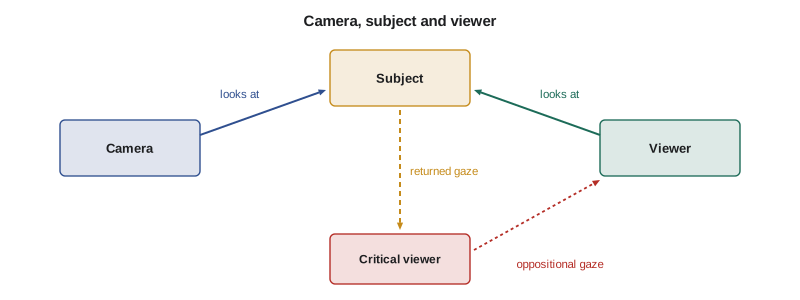
The concept of the gaze asks how looking involves power. The British art critic John Berger, in his television series and book Ways of Seeing (1972), wrote that in European art, men act and women appear: men look at women, and women watch themselves being looked at. He traced this pattern from oil painting to advertising photography, arguing that images position the ideal viewer as male and the subject as an object of possession.
The British film theorist Laura Mulvey, in her essay "Visual Pleasure and Narrative Cinema" (1975), developed the idea of the "male gaze". Drawing on psychoanalysis, she argued that classical Hollywood cinema structured looking so that the camera, the male protagonist and the spectator shared a position of looking at women, who were displayed as objects of desire. Her ideas spread quickly to photography criticism and practice.
The American writer bell hooks, in "The Oppositional Gaze" (1992), argued that Black women spectators had developed a critical, resistant way of looking at mainstream images that excluded or degraded them, and that looking could itself be an act of resistance. Her essay widened the concept of the gaze to include race and challenged feminist theories that had assumed a white spectator.
Representation, race and self-representation
Postcolonial theory, influenced by Edward Said's Orientalism (1978), examined how Western images constructed non-Western peoples as exotic, primitive or threatening others. Photographers and artists from communities that had been photographed by outsiders began to reclaim representation. The American artist Carrie Mae Weems's Kitchen Table Series (1990) staged scenes from a Black woman's life around a single kitchen table, presenting her own narratives of love, family and independence. Lorna Simpson combined photographs of Black women, often turned away from the camera, with fragments of text to question how images and language define identity.
In Canada, Indigenous photographers and artists have responded directly to the legacy of colonial photography. Jeff Thomas, an Onondaga photographer from Ontario, has made work that juxtaposes historical images of Indigenous people, including Curtis-style portraits, with his own photographs of contemporary urban Indigenous life, and has written about recovering the archive. Shelley Niro, a Mohawk artist from the Six Nations of the Grand River, made the hand-tinted series This Land Is Mime Land (1992), in which she and members of her family pose playfully in roles that subvert stereotypes. Such work turns the camera from an instrument of documentation by outsiders into a tool of self-representation and humour.
Appropriation and the law
Appropriation art raised legal questions about copyright. When does reusing a photograph create a new work, and when does it infringe the original photographer's rights?
In Canada, copyright law allows fair dealing for specific purposes: research, private study, education, parody, satire, criticism, review and news reporting, with criticism, review and news reporting requiring attribution. Parody, satire and education were added in 2012. The Supreme Court of Canada in CCH Canadian v. Law Society of Upper Canada (2004) described fair dealing as a user's right and set out factors for assessing fairness, including the purpose, character and amount of the dealing, alternatives available and the effect on the work. Appropriation art that copies a whole photograph for display or sale is not automatically covered, and artists and galleries often seek permission or legal advice.
Worked problem
Applying a structured fair-dealing or fair-use analysis
An artist downloads a professional photographer's portrait of a musician, adds coloured shapes and sells prints online as "art inspired by the photo," without permission. Analyze the case using the factors in your country's law.
Show solution
- Purpose: selling prints is not one of the listed fair dealing purposes unless the work is genuinely parody or satire, so the first step may fail.
- Amount: the whole photograph is used, which weighs against the artist.
- Market effect: the prints could substitute for licensed reproductions, harming the photographer's market.
- Practical lesson: ask permission, license the image, or make your own photograph.
Answer: The use is unlikely to be fair, and the safest course is to license the photograph or create original source material.
Practice: questioning the gaze
Choose three advertisements or magazine images that show people and analyze them using the concepts in this lesson. For each, ask who is looking, who is looked at, and where the image positions you as a viewer. Is the subject presented as an active person or as an object to be viewed? Does the subject return the gaze or look away? How do pose, framing, lighting and text work together?
Then make a small series of three self-portraits or portraits of willing collaborators that deliberately respond to one of the images: you might return the gaze, reverse the gender roles, replace stereotypes with self-chosen roles in the manner of Shelley Niro, or pair the image with text that disrupts its message in the manner of Barbara Kruger or Lorna Simpson. Write a short statement explaining which theory informed your response and what you discovered about how images construct identity and power.
Common mistakes
MistakeThinking conceptual photographs are poorly made by accident
InsteadTheir deadpan, unglamorous style is a deliberate rejection of the expressive fine print
MistakeAssuming Sherman's Film Stills copy real films
InsteadThey evoke generic roles; no specific film is reproduced
MistakeTreating appropriation as automatically legal because it is art
InsteadCopyright law applies, and the outcome depends on fair dealing or fair use factors
MistakeUsing the male gaze to describe any image of a woman
InsteadThe concept analyzes how images structure looking and power, not simply subject matter
MistakeIgnoring self-representation
InsteadIndigenous, Black and other artists have reclaimed the camera to represent themselves
Summary and key terms
- Conceptual artists used photography as a deadpan document of ideas and systems.
- The Bechers' typologies influenced the Düsseldorf School.
- The Pictures Generation, including Sherman, Prince and Levine, exposed how media images construct identity and questioned originality.
- The Vancouver School, especially Jeff Wall, developed staged near documentary photography.
- Berger, Mulvey and hooks theorized the gaze, gender, race and resistance.
- Indigenous and Black artists in Canada and the US have reclaimed photographic self-representation.
- Appropriation is limited by copyright, assessed through fair dealing in Canada and fair use in the US.
- Conceptual art
- Art in which the idea is primary and the object may be a simple document
- Typology
- A grid of similar subjects photographed consistently for comparison
- Pictures Generation
- Artists of the late 1970s and 1980s who worked with images from mass media
- Appropriation
- Reusing existing images to create new meanings
- Rephotography
- Photographing an existing photograph or reproduction
- Near documentary
- Jeff Wall's term for staged photographs that resemble documentary images
- Male gaze
- Mulvey's concept of looking structured around a male viewer and female object
- Oppositional gaze
- hooks's concept of resistant, critical looking by Black women spectators
- Fair dealing
- The Canadian user's right to use works for specified purposes if the dealing is fair
- Fair use
- The US doctrine allowing some uses of copyrighted works based on four factors
Practice problems
Work each problem on paper first, then reveal the answer to check.
What was the style of Ruscha's Twentysix Gasoline Stations?
Show answer
Flat, frontal, deadpan photographs presented as an inventory.
Name three photographers associated with the Düsseldorf School.
Show answer
Andreas Gursky, Thomas Struth and Thomas Ruff, or Candida Höfer.
Using the lesson's numbers, how many prints fit in the typology grid?
Show answer
Eight prints in four columns and two rows.
What did Sherman's Untitled Film Stills explore?
Show answer
Femininity as a set of roles constructed by media.
What did Levine's After Walker Evans challenge?
Show answer
Modernist ideas of originality and the artist-genius.
What format did Jeff Wall borrow for his lightboxes?
Show answer
Backlit advertising displays such as bus shelter signs.
Summarize Mulvey's male gaze.
Show answer
Cinema structured looking so camera, hero and spectator looked at women as objects of desire.
What did hooks add to theories of the gaze?
Show answer
Race, and the idea of a resistant oppositional gaze by Black women spectators.
Name an Indigenous Canadian photographer who responds to colonial images.
Show answer
Jeff Thomas or Shelley Niro.
What did the Supreme Court decide in Warhol v. Goldsmith?
Show answer
Licensing the Warhol image for a magazine cover was not fair use under the first factor.
Lesson quiz · 5 questions
Score 60% or more to complete this lesson.
Create a free account to save your progress, take quizzes and earn a certificate.