
VIS-210 · Lesson 7 of 12 · 27 min
Documentary and social reform
In the late nineteenth and early twentieth centuries, photographers began to use the camera deliberately to expose social problems and persuade the public to demand change. Tenement housing, child labour, rural poverty and the treatment of immigrants and minorities became subjects for photographs designed to move viewers to action. In the 1930s the word "documentary" was adopted to describe this kind of work, and government agencies in the United States and Canada sponsored large documentary programs. This lesson follows social documentary photography from Jacob Riis to the Farm Security Administration and the National Film Board of Canada, and examines both its achievements and the ethical questions it raises. PHOT-320 covers photojournalism ethics in contemporary practice; here the focus is on history and interpretation.
Jacob Riis and the tenements
Jacob Riis, a Danish immigrant who worked as a police reporter in New York, set out in the late 1880s to show middle-class readers how the poor lived in the city's overcrowded tenements. Magnesium flash powder, introduced in Germany in 1887, made it possible to photograph in dark rooms and alleys. Riis and his collaborators burst into cramped apartments and lodging houses at night, igniting flash powder that startled the occupants and, at least once, set a fire.
His book How the Other Half Lives (1890) combined text with illustrations based on his photographs; only a few were reproduced directly as halftones because the technology was still new. Riis's lectures with lantern slides drew large audiences and contributed to housing reforms in New York. Historians also note that his text relied on ethnic stereotypes, that he often treated his subjects as specimens rather than individuals, and that his flash photography violated their privacy. His legacy shows both the power and the problems of reform photography.
Worked problem
Why flash powder changed what could be photographed
A tenement interior lit by a single small window might require an exposure of about 2 minutes on a dry plate of the late 1880s. Magnesium flash produced a burst of light lasting roughly 1/30 second that was bright enough to expose the same plate. How many times shorter is the flash exposure, and what kinds of subjects did this make possible?
Show solution
- Convert 2 minutes to seconds: 120 s.
- Ratio: \( 120 \div (1/30) = 3{,}600 \).
- In stops: \( \log_2 3{,}600 \approx 11.8 \).
Answer: About 3,600 times shorter, nearly 12 stops, which made it possible to photograph people in dark interiors and at night, though the sudden explosion of light was intrusive and dangerous.
Lewis Hine and child labour
Lewis Hine, a sociologist and teacher, used photography more deliberately and respectfully. He began by photographing immigrants arriving at Ellis Island in 1904, aiming to show them as dignified individuals. From 1908 to 1924 he worked for the National Child Labor Committee, travelling across the United States to photograph children working in textile mills, coal mines, canneries, glass factories and fields. He often used ruses to get into workplaces, posing as a fire inspector, insurance agent or machinery photographer, and he recorded children's names, ages and heights by measuring them against his coat buttons.
Hine's photographs were published in pamphlets, posters and the NCLC's journal, often with captions and layouts he designed himself to make the case for reform. He called his approach "photo-interpretation" and insisted that photographs must be accompanied by accurate facts. His work contributed to state and federal child labour laws. Hine also wrote, in a phrase often quoted, that he wanted to show things that had to be corrected and things that had to be appreciated. Late in life he photographed construction workers on the Empire State Building in 1930 and 1931, celebrating labour.
The idea of documentary
The term "documentary" became common in the 1920s and 1930s. The Scottish filmmaker John Grierson, who later founded the National Film Board of Canada, used the word in 1926 to describe films that dramatized real life, and defined documentary as the "creative treatment of actuality". The phrase captures the tension at the heart of documentary photography: it claims to record reality, yet it is shaped by the photographer's creative choices and persuasive purposes.
The Farm Security Administration
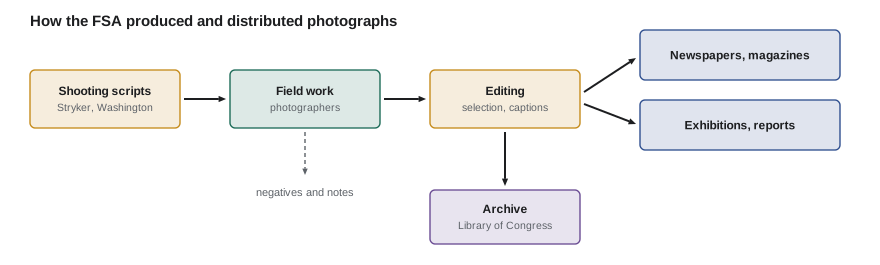
During the Great Depression of the 1930s, the United States government created programs to help farmers and rural workers. In 1935 the Resettlement Administration, which became the Farm Security Administration in 1937, set up a Historical Section headed by the economist Roy Stryker. Stryker hired photographers including Walker Evans, Dorothea Lange, Arthur Rothstein, Ben Shahn, Russell Lee, Marion Post Wolcott, John Vachon and Jack Delano, and later Gordon Parks. Their task was to document rural poverty and the government's relief programs and to supply photographs to newspapers and magazines to build public support.
Between 1935 and 1944, when the project had moved to the Office of War Information, the photographers produced about 175,000 film negatives as well as many prints and transparencies. Stryker sent them detailed "shooting scripts" listing subjects to cover, and he edited the results, sometimes punching holes in negatives he rejected. The collection, held by the Library of Congress and in the public domain, is one of the most important visual records of American life in the period.
| Photographer | Known for | Approach |
|---|---|---|
| Dorothea Lange | migrant workers in California and the Dust Bowl | empathetic portraits with detailed field notes |
| Walker Evans | Southern architecture, signs and tenant families | frontal, detached, precise large-format views |
| Arthur Rothstein | Dust Bowl landscapes | dramatic compositions, some staged details |
| Marion Post Wolcott | rural life and racial segregation in the South | wide-ranging, observant coverage |
| Russell Lee | everyday life in small towns | detailed series on communities |
| Gordon Parks | Washington, D.C., and racial injustice | portraits confronting segregation |
Iconic images and their afterlives
Dorothea Lange's photograph of a migrant mother with her children in a pea pickers' camp in Nipomo, California, in 1936 became one of the most reproduced photographs in history. Lange made a short series of exposures, moving closer each time, and the final close portrait was published widely. Decades later, the woman, Florence Owens Thompson, said she had never received anything from the photograph and felt her image had been used without her benefit; she had been told the pictures would help the camp, and some food relief did reach the workers. Her case is now a standard example in discussions of consent and the rights of documentary subjects.
In 1936 Arthur Rothstein photographed a bleached steer skull on cracked earth in South Dakota. Critics discovered that he had moved the skull to make a better composition, and opponents of the government used the case to accuse the FSA of faking evidence about the drought. The controversy raised a question still debated: does arranging a detail falsify a documentary photograph if the situation it represents is real?
Walker Evans and the writer James Agee spent the summer of 1936 with three white tenant farming families in Alabama for a magazine assignment. The magazine rejected the work, and it became the book Let Us Now Praise Famous Men (1941), in which Agee's anguished text questions the ethics of the project itself. Gordon Parks, the first Black photographer hired by the FSA, made a 1942 portrait of Ella Watson, a government cleaner, standing with a mop and broom before an American flag, which he called American Gothic, a direct and bitter commentary on racism in the nation's capital.
Worked problem
Analyzing a series to understand a single image
A documentary photographer makes six exposures of the same family: the first from about 5 m showing the tent and surroundings, then gradually closer, ending with a tight portrait at about 1.5 m. Only the last frame is published. What does looking at the whole series reveal that the single image hides?
Show solution
- The wider frames show context: the camp, the tent, other children and perhaps signs of the photographer's arrival.
- The progression shows the photographer actively shaping the image, moving closer and adjusting the pose and framing.
- Comparing frames reveals what was excluded from the published image and why it reads as universal rather than specific.
Answer: The series shows that the famous image was constructed through choices of distance, framing and selection, and it restores context the single frame removes.
Documentary in Canada and the NFB
In Canada, the National Film Board, founded in 1939 under John Grierson, became a major producer of still photographs as well as films. During the Second World War, the NFB's photographers documented the war effort, from factory workers and women in industry to soldiers in training. After the war, its Still Photography Division, formally organized in the early 1940s, continued to photograph Canadian life, industry, Indigenous communities and the North for government publications, exhibitions and press distribution. Photographers such as Chris Lund, Gar Lunney and Ronny Jaques produced thousands of images. Under the direction of Lorraine Monk from 1960, the division also produced celebrated photographic books, such as Canada: A Year of the Land (1967) for the centennial. In 1985 the division's collection became the basis of the Canadian Museum of Contemporary Photography, whose collection moved to the National Gallery of Canada in 2009. Critics have noted that NFB photography often presented an optimistic, unified image of the nation that could overlook inequality, and that some images of Indigenous and northern communities reflected government assimilation policies.
Ethics and critique
Documentary photography has always faced ethical questions. Did subjects consent, and did they understand how their images would be used? Did they benefit? Were they named or reduced to types? Did the photographer stage or arrange details? Who controlled the captions and the final publication?
In the 1970s and 1980s critics such as Martha Rosler and Allan Sekula questioned documentary more fundamentally. In her 1981 essay "In, around, and afterthoughts (on documentary photography)", Rosler argued that traditional documentary often aestheticized poverty for middle-class viewers, offering them pity rather than political understanding, and turned victims into objects of a sympathetic gaze while leaving the causes of injustice untouched. Her photo-text work The Bowery in two inadequate descriptive systems (1974–75) paired photographs of empty storefronts with lists of slang words for drunkenness, refusing to show the people themselves. Lesson 10 returns to these critiques.
Contemporary documentary photographers respond with collaborative and participatory methods: working with communities over long periods, sharing editorial control, giving cameras to participants, paying or otherwise benefiting subjects, and publishing names and voices alongside images.
Practice: a collaborative documentary exercise
Choose a small community you have access to, such as a club, a workplace, a neighbourhood market or a family group, and plan a short documentary project of eight to twelve images. Before photographing, explain your project, ask for consent and agree on how the photographs will be used. Invite participants to suggest what should be photographed and to choose one or two images themselves. Record their names, their words and their preferences about how they are described.
After editing, show the selection to the participants before sharing it more widely and ask whether the images and captions represent them fairly. Write a reflection comparing your process with the methods of Riis, Hine and the FSA. Many students find that collaboration changes not only the ethics of the project but also its look: participants often choose different moments, settings and expressions than an outside photographer would, and their captions add information that no photograph could show on its own.
Common mistakes
MistakeAssuming reform photographs were neutral records
InsteadThey were made to persuade, with captions and layouts designed for impact
MistakeIgnoring how Riis treated his subjects
InsteadHis flash raids invaded privacy, and his text used ethnic stereotypes
MistakeTreating an iconic image as the whole story
InsteadLook at the full series, the field notes and the subject's own account
MistakeThinking FSA photographers worked independently
InsteadStryker's scripts, editing and distribution shaped the collection
MistakeEquating sympathy with justice
InsteadCritics such as Rosler argued that pity can replace political understanding
Summary and key terms
- Riis used flash photography in the 1880s and 1890s to expose tenement conditions, with ethical problems.
- Hine photographed child labour for the NCLC from 1908 to 1924 with careful facts and captions.
- Grierson defined documentary as the creative treatment of actuality.
- The FSA, led by Roy Stryker, produced about 175,000 negatives documenting the Depression.
- Iconic images such as Lange's migrant mother raise questions of consent and benefit.
- The NFB's Still Photography Division documented Canada and became the basis of a national museum collection.
- Rosler and Sekula criticized documentary for aestheticizing poverty, prompting collaborative practices.
- Social documentary
- Photography made to expose social conditions and promote reform
- Flash powder
- Magnesium powder ignited to produce a brief, intense burst of light
- Photo-interpretation
- Hine's term for combining photographs with accurate facts and captions
- Shooting script
- A list of subjects that FSA photographers were asked to cover
- Farm Security Administration
- The US agency whose Historical Section documented rural America from 1935 to 1944
- Still Photography Division
- The NFB unit that produced Canadian documentary photographs from the 1940s to 1985
- Creative treatment of actuality
- Grierson's definition of documentary
- Iconic image
- A photograph so widely reproduced that it comes to symbolize an event or era
- Participatory photography
- Methods that share cameras, editing and authorship with the people photographed
- Aestheticization
- Making a subject beautiful in a way that may obscure its social or political meaning
Practice problems
Work each problem on paper first, then reveal the answer to check.
What technology allowed Riis to photograph dark tenement interiors?
Show answer
Magnesium flash powder, introduced in 1887.
In the lesson's example, how many stops shorter was a flash exposure than a 2-minute ambient exposure?
Show answer
Nearly 12 stops.
For which organization did Hine photograph child labour?
Show answer
The National Child Labor Committee.
How did Grierson define documentary?
Show answer
The creative treatment of actuality.
Who directed the FSA Historical Section?
Show answer
Roy Stryker.
About how many negatives did the FSA-OWI photographers produce?
Show answer
About 175,000.
What ethical issue does Florence Owens Thompson's story raise?
Show answer
Consent and benefit for documentary subjects.
Why was Rothstein's skull photograph controversial?
Show answer
He moved the skull, and critics accused the FSA of faking drought evidence.
What happened to the NFB Still Photography Division collection in 1985?
Show answer
It became the basis of the Canadian Museum of Contemporary Photography.
What was Rosler's main criticism of traditional documentary?
Show answer
It aestheticized poverty and offered pity instead of political understanding.
Lesson quiz · 5 questions
Score 60% or more to complete this lesson.
Create a free account to save your progress, take quizzes and earn a certificate.