
VIS-210 · Lesson 12 of 12 · 28 min
Capstone: a theorized photo essay
The capstone brings together the history and theory of this course with your own practice. You will produce either a theorized photo essay, a sequence of your own photographs accompanied by a critical text that situates the work historically and theoretically, or a critical research essay about a photographer, movement or archive. Both options ask you to make an argument, support it with evidence and show that you understand how photographs make meaning. This lesson explains the options, guides you through research, image-making, writing and presentation, and models the process with a worked example.
The two options
- Option A, the theorized photo essay: 10 to 15 original photographs, carefully sequenced, with a critical text of about 2,000 to 2,500 words that explains your aims, places the work in relation to at least two historical precedents and engages at least two theoretical ideas from the course.
- Option B, the critical research essay: an essay of about 3,000 words analyzing a photographer, body of work, movement, publication or archive, using primary sources where possible and at least two theoretical frameworks, illustrated by descriptions or properly licensed reproductions.
Both options require a clear thesis, accurate citation and attention to ethics, including consent, representation and copyright. Choose the option that best suits your goals; photographers building a portfolio often choose A, while those interested in curating, writing or graduate study may choose B.
Step 1: choosing a question
Strong capstones start with a question rather than a topic. "Street photography" is a topic; "Can street photography be ethical without consent in an age of facial recognition?" is a question. "My grandmother's photo album" is a topic; "How do family albums construct memory, and what do they leave out?" is a question. Good questions connect your interests to the course's threads: technology, purpose, circulation, power and meaning.
| Topic | Better question | Course links |
|---|---|---|
| Street photography | Can street photography be ethical without consent today? | Sontag, the gaze, privacy law |
| Family albums | How do albums construct memory and exclude difficult histories? | vernacular photography, Barthes, archives |
| Local landscape | How does my region's landscape photography reflect settlement and land use? | survey photography, New Topographics, colonialism |
| Phone photography | Is a computational phone image still an index? | Peirce, Bazin, computational photography |
| A historical archive | Whose voices are missing from this collection, and how can they be recovered? | Sekula, Tagg, recaptioning |
Step 2: research
Research combines primary and secondary sources. Primary sources might include photographs in archives, original magazines, exhibition catalogues, interviews, the photographer's own writings or your own family albums. Secondary sources include books and articles by historians and critics. Keep a research log recording each source, what it says and how it relates to your question.
Canadian researchers can use Library and Archives Canada's online collection search, the National Gallery of Canada's collection database, the McCord Stewart Museum's Notman archive, provincial archives and university special collections, and the Canadiana database for historical periodicals such as the Canadian Illustrated News. Many institutions offer research appointments to view original prints. Indigenous research should follow community protocols and, where relevant, frameworks such as the First Nations principles of OCAP (ownership, control, access and possession).
Step 3: making the work (Option A)
If you choose the photo essay, plan your shoot in relation to your question and precedents. Decide on format, camera, colour or monochrome, and approach: documentary, staged, typological, diaristic or archival. Make many more photographs than you need, perhaps five to ten times the final number, so that editing becomes a real act of selection. Keep notes on consent, locations and dates.
Worked problem
Planning a shooting ratio and schedule
You need 12 final photographs and want a selection ratio of 8 to 1. You expect to make about 40 usable frames per two-hour session. How many frames and how many sessions do you need, and how many hours should you plan?
Show solution
- Frames needed: \( 12 \times 8 = 96 \) usable frames.
- Sessions: \( 96 \div 40 = 2.4 \), so plan 3 sessions.
- Hours: \( 3 \times 2 = 6 \) hours of shooting, plus time for consent conversations, travel and reshoots.
Answer: About 96 usable frames over 3 sessions, roughly 6 hours of shooting, before allowing for reshoots and editing.
Step 4: editing and sequencing
Editing is where meaning is made. Lay out work prints or thumbnails and look for strong individual images, then for relationships between them. Consider the opening image, which sets the tone, and the closing image, which leaves a final impression. Pair images to create echoes and contrasts. Vary scale and rhythm. Think about Barthes's punctum: leave room for unexpected details to speak. Think about anchorage: decide whether titles and captions will fix meanings or leave them open.
Step 5: writing the critical text
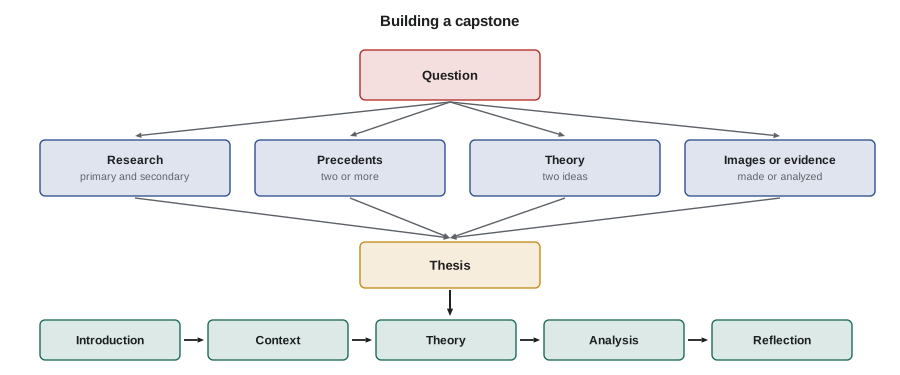
A critical text is not an artist's diary. It makes an argument about your work or your subject, supported by evidence. A reliable structure has five parts:
- Introduction: state your question, introduce the work or subject and give your thesis in one or two sentences.
- Context: place the work historically, discussing at least two precedents, photographers, movements or archives, and what you learned from them.
- Theory: explain at least two theoretical ideas and how they illuminate your images or subject, using short quotations with citations and paraphrase.
- Analysis: discuss specific images in detail using the four-step method, connecting formal choices to meaning.
- Reflection and conclusion: assess what the work achieves and fails to achieve, address ethical questions and suggest what remains open.
Worked problem
Revising a weak thesis
A student's draft thesis reads: "My photographs are inspired by Walker Evans and are about small towns." Revise it into an arguable thesis using course concepts.
Show solution
- Identify the problem: the sentence names an influence and a topic but makes no claim.
- Ask a question: what does borrowing Evans's frontal, detached style do to images of a contemporary town?
- Connect to theory: Sontag's argument about photographic appropriation and Rosler's critique of documentary.
- Revised thesis: "By adopting Walker Evans's frontal, detached style to photograph shuttered businesses in my hometown, my sequence tests whether documentary distance can avoid what Martha Rosler called the aestheticization of decline, and argues that pairing images with residents' own words restores the voices that the style tends to exclude."
Answer: The revised thesis makes an arguable claim, names precedents and theory, and states how the work responds to a problem.
Citation and ethics
Cite all sources, including photographs you discuss, in a consistent style such as the Chicago Manual of Style, commonly used in art history. When describing photographs by others, give photographer, title, date and collection. When reproducing images, follow copyright law and institutional permissions; descriptions are often safer than reproductions.
If your photo essay includes people, obtain informed consent appropriate to the context, explain how images will be used and respect requests for anonymity. Be especially careful with minors, vulnerable people, sacred places and communities that have been harmed by photography in the past.
In Canada, photographing people in public is generally lawful, but Quebec's Civil Code protects a person's right to their image, and the Supreme Court's Aubry decision (1998) held that publishing a recognizable photograph without consent can violate that right unless the public interest outweighs it. Other provinces recognize privacy torts. For academic work, your institution's research ethics board may need to review projects involving people, following the Tri-Council Policy Statement on ethical research.
Assessment
Your capstone is assessed with a rubric that weights each element.
| Criterion | Weight | What strong work shows |
|---|---|---|
| Question and thesis | 15 % | a clear, arguable thesis that drives the work |
| Historical context | 20 % | accurate, relevant precedents explained in depth |
| Theoretical engagement | 20 % | correct, critical use of at least two theories |
| Image-making or analysis | 25 % | strong images and sequencing, or close analysis of evidence |
| Ethics and citation | 10 % | consent, representation and accurate citation |
| Writing and presentation | 10 % | clear structure, prose and presentation |
Worked problem
Calculating a weighted rubric score
A student scores 80 % on thesis, 70 % on historical context, 90 % on theory, 85 % on image-making, 100 % on ethics and citation, and 75 % on writing. What is the weighted total?
Show solution
- Thesis: \( 0.15 \times 80 = 12 \).
- Context: \( 0.20 \times 70 = 14 \).
- Theory: \( 0.20 \times 90 = 18 \).
- Image-making: \( 0.25 \times 85 = 21.25 \).
- Ethics: \( 0.10 \times 100 = 10 \); writing: \( 0.10 \times 75 = 7.5 \).
- Total: \( 12 + 14 + 18 + 21.25 + 10 + 7.5 = 82.75 \).
Answer: About 83 %, with historical context the clearest area to strengthen.
Presenting the work
Present your capstone as you would to a gallery, editor or seminar. For a photo essay, consider print size, paper, sequence on the wall or in a book or zine, and how text appears. For a research essay, prepare a short presentation with images described or properly licensed. Practise explaining your thesis in two minutes; curators and editors often decide quickly whether a project is clear. Invite critique and record what you would change.
The capstone is a beginning. Many photographers return to their capstone questions for years, and the habits you build here, asking questions, researching precedents, thinking theoretically and acting ethically, will shape a lifetime of looking and making.
A sample capstone timeline
Most capstones fail not from lack of ideas but from lack of time. A simple plan over ten weeks helps. In weeks one and two, choose your question, discuss it with your instructor and begin your research log. In weeks three and four, complete most of your reading and archive visits, and make test photographs or gather primary sources. In weeks five to seven, carry out your main shooting sessions or detailed analysis, keeping notes on consent and decisions. In week eight, edit and sequence, or outline your essay's argument. In week nine, write and revise the critical text, ideally sharing a draft with a peer for feedback. In week ten, finalize prints or illustrations, check citations and permissions, and rehearse your presentation.
Build in at least one week of buffer, because weather, access, equipment and life will interfere. Keep backup copies of your files and notes in at least two places. A capstone finished calmly with time for revision is almost always stronger than one completed in a rush the night before it is due.
Finally, keep a short process journal throughout. Note what surprised you, which precedents changed your thinking, which images failed and why, and how your question evolved. The journal is not graded directly, but it makes the reflection section of your critical text far easier to write, and it gives you a record of how your thinking developed that you can return to when the next project begins.
Common mistakes
MistakeStarting with a topic instead of a question
InsteadTurn the topic into an arguable question linked to course concepts
MistakeWriting an artist's diary instead of an argument
InsteadMake a claim, support it with history, theory and close analysis
MistakeName-dropping theorists without explanation
InsteadExplain each idea accurately and show how it illuminates specific images
MistakeMaking only the final number of images
InsteadShoot many more than needed so editing is genuine selection
MistakeIgnoring consent and copyright
InsteadObtain informed consent, follow your institution's ethics process and license reproductions
Summary and key terms
- The capstone is either a theorized photo essay or a critical research essay.
- Strong capstones start with an arguable question linked to course threads.
- Research combines primary and secondary sources recorded in a log.
- Editing and sequencing are where a photo essay's meaning is made.
- A critical text has an introduction, context, theory, analysis and reflection.
- Ethics, consent and accurate citation are part of the assessment.
- A weighted rubric shows which areas of the work to strengthen.
- Thesis
- A clear, arguable claim that organizes a piece of writing or a project
- Photo essay
- A sequence of photographs with text that develops an idea or story
- Sequencing
- Arranging images in an order that creates relationships and meaning
- Selection ratio
- The number of frames made for each image used
- Research log
- A record of sources consulted and notes on each
- Informed consent
- Agreement to be photographed given with understanding of how images will be used
- Research ethics board
- A committee that reviews research involving people, called an IRB in the US
- Chicago style
- A citation style widely used in art history
- Rubric
- A scoring guide listing criteria and weights
- OCAP
- First Nations principles of ownership, control, access and possession of data and information
Practice problems
Work each problem on paper first, then reveal the answer to check.
What are the two capstone options?
Show answer
A theorized photo essay or a critical research essay.
Turn "family albums" into a research question.
Show answer
For example: how do family albums construct memory and what do they leave out?
What is the difference between primary and secondary sources?
Show answer
Primary sources come from the period studied; secondary sources are later analyses.
Using the lesson's numbers, how many usable frames are needed for 12 images at 8 to 1?
Show answer
96 frames.
What does the opening image of a sequence do?
Show answer
It sets the tone and introduces the essay's concerns.
List the five parts of the critical text.
Show answer
Introduction, context, theory, analysis, reflection and conclusion.
Why is a thesis such as "my photos are inspired by Evans" weak?
Show answer
It names an influence and topic but makes no arguable claim.
What did the Aubry decision establish?
Show answer
Publishing a recognizable photograph without consent can violate the right to one's image in Quebec.
Compute the weighted score in the lesson's example.
Show answer
About 82.75 %.
Which rubric criterion has the highest weight?
Show answer
Image-making or analysis, at 25 %.
Lesson quiz · 5 questions
Score 60% or more to complete this lesson.
Create a free account to save your progress, take quizzes and earn a certificate.