
VIS-210 · Lesson 11 of 12 · 29 min
Colour, digital and the networked image
For most of its first century, serious photography was black and white. Colour existed in commercial and amateur work but was widely dismissed by art photographers as vulgar or unreliable. Its acceptance as an artistic medium in the 1970s was one of the major shifts in photographic history. Soon after came another: the transition from film to digital capture, and then the networked, computational and AI-assisted images of the smartphone era. This lesson follows these changes and asks how they have affected the theories of the previous lessons, especially the belief in the photograph as an index of reality.
Early colour processes
Photographers wanted colour from the beginning. Some daguerreotypes and cartes de visite were hand-coloured with pigments. In 1861 the physicist James Clerk Maxwell demonstrated additive colour by photographing a tartan ribbon three times through red, green and blue filters and projecting the results together. The first commercially successful colour process was the Autochrome, introduced by the Lumière brothers in France in 1907. Autochrome plates used microscopic grains of potato starch dyed red-orange, green and violet as tiny filters over a black-and-white emulsion. The result was a unique colour transparency with a soft, pointillist quality, beautiful but slow and expensive.
Multi-layer colour films transformed colour photography. Kodachrome, introduced by Kodak in 1935 and developed by the musicians and amateur scientists Leopold Godowsky Jr. and Leopold Mannes, used three emulsion layers sensitive to different colours, with dyes added during complex processing. Agfacolor followed in Germany in 1936. Colour negative films for prints, such as Kodacolor in 1942, made colour snapshots common by the 1960s. Kodachrome's distinctive saturated look, especially in slides, shaped how mid-century travel, family and magazine photographs looked; Kodak ended its production in 2009.
| Year | Process or event | Significance |
|---|---|---|
| 1861 | Maxwell's three-colour projection | demonstrated additive colour |
| 1907 | Lumière Autochrome | first commercial colour process |
| 1935 | Kodachrome | multi-layer colour slide film |
| 1942 | Kodacolor negative film | colour prints for amateurs |
| 1976 | Eggleston at MoMA | colour accepted as fine art in a major museum |
| 2009 | Kodachrome discontinued | end of a defining colour film |
Colour becomes art
In the 1950s and 1960s, critics and curators associated colour with advertising, magazines and amateur snapshots. Walker Evans called colour photography vulgar in a well-known 1969 remark, though he later used Polaroid colour himself. A few photographers, such as Saul Leiter in New York, made painterly colour street photographs that were widely recognized only much later.
The turning point is usually dated to 1976, when John Szarkowski, director of photography at MoMA, exhibited William Eggleston's dye-transfer colour photographs of everyday scenes in Memphis and the American South. Critics were divided; some found the subjects banal, ceiling light bulbs, tricycles, parked cars, while others saw a new way of seeing ordinary America. Szarkowski's catalogue, William Eggleston's Guide, argued that colour was integral to the images, not decoration. In the following years, photographers such as Stephen Shore, whose Uncommon Places (1982) recorded American towns and roads with a large-format camera, Joel Meyerowitz and Joel Sternfeld established colour as a serious artistic medium. Since the 1980s, colour has been the norm in contemporary art photography.
In Vancouver, Fred Herzog, a German-born photographer who worked as a medical photographer, made thousands of Kodachrome slides of the city's streets, shop windows, neon signs and working-class neighbourhoods from the 1950s onward. Because colour was not taken seriously as art and slides were hard to print well, his work was little known until digital printing allowed large exhibition prints; a 2007 exhibition at the Vancouver Art Gallery brought him international recognition. Herzog is now considered a pioneer of colour street photography, and his work is a record of a Vancouver that has largely disappeared.
Film speed: ASA, DIN and ISO
Different countries once used different systems to rate film sensitivity. The American ASA system was arithmetic: doubling the number meant doubling the sensitivity. The German DIN system was logarithmic: an increase of 3 degrees meant doubling. The International Organization for Standardization combined them, so a film might be labelled ISO 100/21°. Digital cameras adopted the arithmetic ISO number.
Worked problem
Converting between ASA and DIN
The relation between arithmetic speed S and DIN degrees D is approximately \( D = 10 \log_{10} S + 1 \). What DIN value corresponds to ISO 100 and ISO 400, and how many stops apart are they?
Show solution
- For ISO 100: \( D = 10 \log_{10} 100 + 1 = 10 \times 2 + 1 = 21^\circ \).
- For ISO 400: \( D = 10 \log_{10} 400 + 1 \approx 10 \times 2.602 + 1 \approx 27^\circ \).
- The difference is 6 degrees; since 3 degrees equals one stop, that is 2 stops, matching \( 400 / 100 = 4 = 2^2 \).
Answer: ISO 100 is 21° and ISO 400 is 27°, two stops apart.
The digital transition
The first digital camera was built in 1975 by Steven Sasson, an engineer at Eastman Kodak. It weighed about 3.6 kg, recorded black-and-white images of 100 by 100 pixels, 0.01 megapixels, onto a cassette tape and took about 23 seconds to record each image. Kodak, whose business depended on film, did not commercialize it. Through the 1980s and 1990s, electronic still cameras, digital backs for professional cameras and the first consumer digital cameras appeared. Adobe Photoshop, released in 1990, made digital editing widely available. By the mid-2000s digital cameras outsold film cameras, and Kodak filed for bankruptcy protection in 2012.
Camera phones appeared around 2000, and the iPhone in 2007 and Instagram in 2010 accelerated a world in which billions of people carry a camera and share images instantly. Estimates of the number of photographs taken each year vary widely by source and method, but many recent estimates exceed a trillion, the overwhelming majority with phones.
Worked problem
Megapixels and film: an equivalence debate
A 35 mm film frame measures 36 by 24 mm. If a fine-grained film can resolve about 50 line pairs per millimetre in practice, roughly how many pixels would be needed to capture that detail, assuming two pixels per line pair?
Show solution
- Horizontal: \( 36 \times 50 \times 2 = 3{,}600 \) pixels.
- Vertical: \( 24 \times 50 \times 2 = 2{,}400 \) pixels.
- Total: \( 3{,}600 \times 2{,}400 = 8{,}640{,}000 \), about 8.6 megapixels.
- With very fine film and lenses at about 80 line pairs per mm, the estimate rises to about 22 megapixels.
Answer: Roughly 9 to 22 megapixels depending on film, lens and technique, which is why estimates of film's digital equivalent vary so widely and why simple comparisons are misleading.

Computational photography and the index
A modern smartphone does not simply record a single exposure. It may capture a burst of frames before and after you press the shutter, align and merge them to reduce noise and extend dynamic range, estimate depth to simulate background blur, apply scene recognition and selective adjustments to skies, faces and food, and sharpen details using machine learning. The resulting image is a computed estimate of what the scene looked like, informed by statistics from millions of other images.
This raises a theoretical question. If the index, the physical trace of light, grounds photography's authority, what happens when software reconstructs parts of the image? Some theorists argue that digital photographs remain indexical as long as they are derived from light recorded by a sensor; others argue that the boundary between capture and synthesis has blurred so far that every image must be treated with suspicion. Disputes over enhanced images of the moon on some phones in 2023 showed how controversial computational "improvement" can be.
Generative AI and authenticity
Generative AI systems can now produce photorealistic images from text prompts without any camera or scene. In 2023 the German artist Boris Eldagsen revealed that a winning entry in the Sony World Photography Awards was AI-generated and declined the prize, to provoke debate about whether such images belong in photography competitions. News organizations, platforms and competitions have since adopted rules about labelling AI-generated and AI-edited images.
Technical responses include content provenance standards. The Coalition for Content Provenance and Authenticity (C2PA), founded in 2021 by technology and media companies, publishes a standard for attaching signed "content credentials" to images that record their origin and edits. Some cameras, editing programs and platforms now support it. PHOT-320 discusses how news organizations use provenance; CRE-410 discusses AI tools for creators.
In Canada, the legal status of AI-generated images is unsettled. The Canadian Intellectual Property Office registered a work listing an AI system as co-author, and a public-interest legal clinic, CIPPIC, has challenged that registration in the Federal Court. The federal government has consulted on copyright and generative AI, but as of this writing the Copyright Act had not been amended to address it. Canadian law requires human skill and judgment for originality under the CCH decision, which many lawyers believe excludes purely machine-generated works.
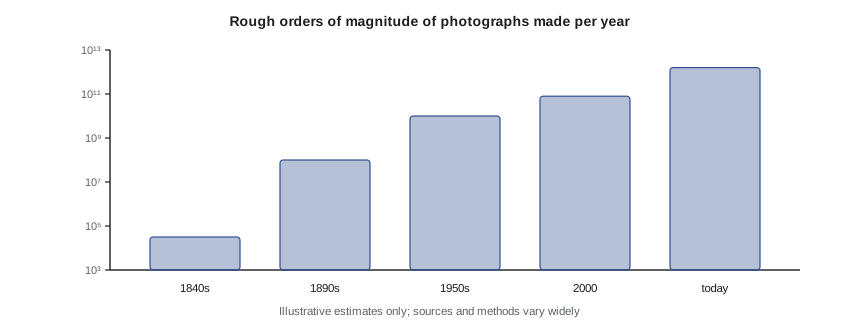
The networked image
Theorists of the networked image argue that photographs today are less objects than data in circulation. An image is captured, processed, uploaded, compressed, recommended by algorithms, shared, remixed, screenshotted and stored on servers. Its meaning depends on platform, caption, comments and the speed of scrolling. The artist and writer Hito Steyerl's essay "In Defense of the Poor Image" (2009) described low-resolution copies that circulate widely as having their own value, reversing the traditional preference for the pristine original. The photographer Joan Fontcuberta has used the term "post-photography" for images whose value lies in sharing and connection rather than recording.
These ideas return us to Benjamin's aura, Barthes's anchorage and Sontag's critique. Reproduction has become infinite and instant; captions and algorithms anchor meanings at scale; and the question of what photographs do to our experience of the world is more urgent than ever.
Worked problem
Storage arithmetic for a networked archive
A photographer shoots 40,000 raw files a year at about 50 MB each and keeps two backups in addition to the original files, following a 3-2-1 approach. How much storage is needed per year?
Show solution
- Original files: \( 40{,}000 \times 50 = 2{,}000{,}000 \) MB, about 2 TB.
- Total copies: three, the original and two backups.
- Total: \( 2 \times 3 = 6 \) TB per year, with at least one copy off site.
Answer: About 6 TB per year, a reminder that digital abundance creates real preservation costs that archives and individuals must plan for.
Practice: testing your own camera's processing
Photograph the same scene, such as a backlit window or a night street, with your phone's default camera and with a manual or raw mode that bypasses most processing. Compare the two files at full size. Look for differences in noise, sharpening, colour, shadow detail, sky treatment and skin tones. If your phone records editing history or content credentials, inspect what it records.
Write a short reflection on whether the processed image is still a trace of the scene, using Peirce and Bazin. Most students find that the processed image is more pleasing but less faithful in specific ways, such as smoothed textures or brightened shadows, while the raw file is closer to the sensor data but needs interpretation to look natural. Both involve choices, made either by you or by engineers who designed the camera's software, which is exactly the point Vilém Flusser made about the camera's program.
Common mistakes
MistakeAssuming colour photography began in the 1970s
InsteadColour processes date to the Autochrome of 1907 and Kodachrome of 1935; the 1970s marked art-world acceptance
MistakeThinking ASA and DIN scales work the same way
InsteadASA is arithmetic; DIN is logarithmic, with 3 degrees per stop
MistakeBelieving a phone photo is a single exposure
InsteadModern phones merge multiple frames and apply computational processing
MistakeTreating megapixel equivalents of film as fixed facts
InsteadEstimates vary with film, lens and technique
MistakeAssuming AI-generated images are automatically protected by copyright
InsteadBoth Canadian and US law emphasize human authorship, and the law is still developing
Summary and key terms
- Colour processes date from the Autochrome (1907) and Kodachrome (1935).
- Colour was accepted as art after Eggleston's 1976 MoMA exhibition; Canada's Fred Herzog was recognized later.
- ASA is arithmetic and DIN logarithmic; ISO combines them.
- The first digital camera (1975) recorded 0.01 megapixels; digital overtook film by the mid-2000s.
- Computational photography reconstructs images from multiple frames and learned statistics.
- Generative AI and content credentials have reopened questions about authenticity and authorship.
- Networked images circulate as data whose meaning depends on platforms and algorithms.
- Autochrome
- The Lumière brothers' 1907 colour process using dyed starch grains
- Kodachrome
- A multi-layer colour slide film introduced in 1935
- Dye transfer
- A colour printing process prized for rich, controllable colour
- New Colour photography
- The movement of the 1970s that established colour as an artistic medium
- DIN
- A logarithmic film speed scale in which 3 degrees equals one stop
- Demosaicing
- Reconstructing full-colour pixels from a sensor's colour filter array
- Computational photography
- Using software to combine and process captures into a final image
- Content credentials
- Signed provenance information attached to an image under the C2PA standard
- Generative AI
- Systems that create new images, text or other media from learned patterns
- Networked image
- An image understood as data circulating through platforms and algorithms
Practice problems
Work each problem on paper first, then reveal the answer to check.
Who introduced the Autochrome, and when?
Show answer
The Lumière brothers in 1907.
What made Kodachrome different from the Autochrome?
Show answer
It was a multi-layer film with three emulsion layers rather than a starch-grain screen.
Which 1976 exhibition marked colour's acceptance in a major museum?
Show answer
William Eggleston's photographs at MoMA, curated by John Szarkowski.
Why was Fred Herzog recognized late?
Show answer
Colour was not taken seriously as art, and slides were hard to print well until digital printing.
Convert ISO 100 to DIN.
Show answer
21°.
How many pixels did Sasson's 1975 digital camera record?
Show answer
100 by 100, or 0.01 megapixels.
Using 50 line pairs per mm, about how many megapixels does a 35 mm frame hold?
Show answer
About 8.6 megapixels.
What does a modern phone do when you press the shutter?
Show answer
It may merge several frames, estimate depth and apply computational adjustments.
What is the purpose of content credentials?
Show answer
To record an image's origin and edits in signed provenance data.
How much storage per year does the lesson's photographer need with three copies?
Show answer
About 6 TB.
Lesson quiz · 5 questions
Score 60% or more to complete this lesson.
Create a free account to save your progress, take quizzes and earn a certificate.