
BAR-121 · Lesson 1 of 12 · 25 min
What the MPT tests
▶ Video coming soon A video version of this lesson is on the way.
On Friday evening, September 18, 2026, Hollis Marchetti opens one more video call. By now the study group knows her calendar by heart: Tuesdays for the whole group, Saturday mornings and Monday evenings for multiple-choice drills, Wednesdays for essays and, from October, Thursdays for ethics. 'Fridays,' she says, 'are for the part of the exam people practice least and lose the most points on without noticing. The performance test.'
Two members will sit the Multistate Performance Test (MPT) in February 2027. Dana Whitfield takes it as part of the Texas exam and Ngozi Adeyemi as part of the New York exam; both jurisdictions still give the legacy Uniform Bar Examination (UBE). Sofia Reyes joins because California writes its own performance test, graded much the same way, and her July 2026 score report called her performance test 'middling'. Marcus Bell, who passed Missouri's first NextGen exam in July, comes to compare notes: the NextGen exam replaced the MPT with its own performance tasks, and he has just taken three of them. Eddie Boudreaux and Camila Ortiz Rivera sit in when they can. Neither Louisiana nor Puerto Rico gives the MPT, but both exams reward the same habit of working carefully from supplied materials.
This course follows the Friday sessions. It explains what the MPT is and how it is graded, then walks through the method one task at a time: reading the assignment, mining the library for rules, mining the file for facts, and writing the kinds of documents the test asks for under a 90-minute clock. Every performance test in this course, including its file, library and model answer, is original and written for the course. The jurisdictions, statutes, cases and people in them are fictional. None is taken from the performance tests that the National Conference of Bar Examiners (NCBE) releases.
What the MPT is
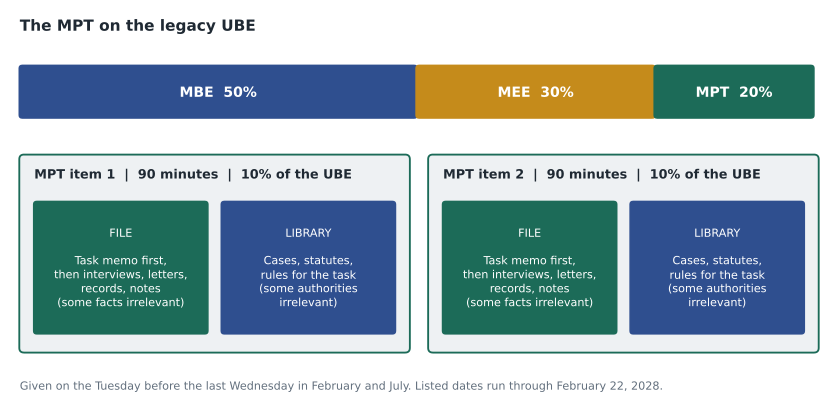
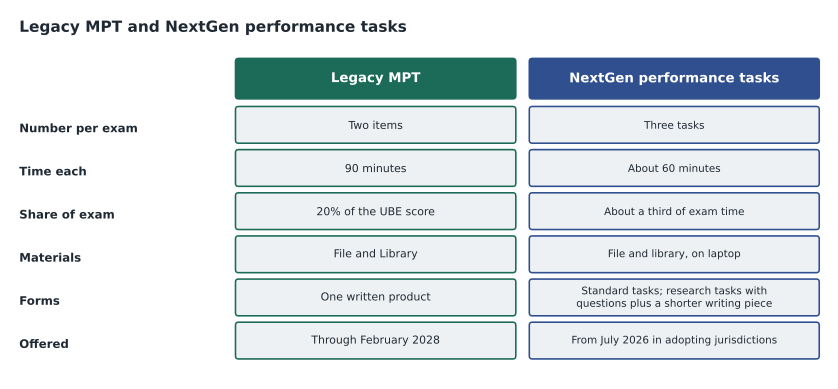
The MPT is one of the three components NCBE has prepared for the legacy bar exam, alongside the Multistate Bar Examination (MBE) and the Multistate Essay Examination (MEE). Each MPT item is a 90-minute task. NCBE describes it as a test of your ability to use fundamental lawyering skills in a realistic situation: you are a new lawyer, a supervising attorney gives you an assignment, and you must complete it using only the materials provided.
Every item has two parts. The File contains the facts: the first document is always a memorandum from the supervising attorney describing your task, and the rest are source documents such as interview transcripts, letters, pleadings, contracts, police reports, medical records or the lawyer's own notes. NCBE's instructions warn that some of the facts are irrelevant. The Library contains the law: cases, statutes, regulations or rules you need for the task, plus some that are not relevant. You do not need to know the substantive law in advance. NCBE's instructions tell you that your general knowledge of law is background only; the problem is meant to be solved from the File and the Library.
That design is why the MPT is often called a closed-universe test. It does not ask what the law of evidence or contracts is in the real world. It asks whether you can read unfamiliar authority, extract the governing rules, sort useful facts from noise, and produce a document that a supervising lawyer could use. Those are the things a new lawyer does every week.
How the UBE uses the MPT
Jurisdictions may select one or both MPT items. Jurisdictions that give the UBE use both, in a three-hour session, and on the UBE the MPT is weighted at 20 percent of the total score, with the MEE at 30 percent and the MBE at 50 percent. Put the two written components together and the written half of the exam is exactly that: half. The MPT alone is worth two fifths of it.
Do the arithmetic Marchetti likes to do on the first night. Each MPT item is worth 10 percent of the UBE score. Each MEE question is worth 5 percent. One performance test is therefore worth as much as two essays. 'People spend weeks memorizing future interests for the MBE,' she says, 'and then walk into a task worth twice as much as an essay having practiced it twice.'
NCBE gives the MPT on the Tuesday before the last Wednesday in February and July, the same day as the MEE in most jurisdictions. Its MPT page lists administrations on February 23, 2027, July 27, 2027 and February 22, 2028, the last date shown. That matches the end of the legacy UBE: between July 2026 and July 2028 most jurisdictions move to the NextGen bar exam, and the legacy exam is available through February 2028.
Not every jurisdiction uses the MPT. NCBE's list of user jurisdictions shows several states that do not administer it. Some, such as California, Florida, Louisiana, Nevada and Virginia, write or structure their own exams. Others, such as Connecticut, Idaho, Maryland, Missouri, Oregon and Washington, gave the first NextGen exam in July 2026 and no longer give the legacy components. California gives its own 90-minute performance test, drafted by the State Bar, alongside the MBE and its own essays. If your jurisdiction is not a UBE jurisdiction, its bar admission website is the authority on whether it uses the MPT, one item or two, and what weight it carries.
| Who | Exam in early 2027 | Performance test |
|---|---|---|
| Dana Whitfield | Texas, legacy UBE plus Texas Law Component | Two MPT items, 20 percent of the UBE |
| Ngozi Adeyemi | New York, legacy UBE | Two MPT items, 20 percent of the UBE |
| Sofia Reyes | California, February 2027 retake | One California performance test, drafted by the State Bar |
| Marcus Bell | Passed Missouri NextGen, July 2026 | Took three NextGen performance tasks |
| Eddie Boudreaux | Louisiana | No MPT; Louisiana writes its own tests |
| Camila Ortiz Rivera | Puerto Rico | No MPT; Puerto Rico writes its own exam |
The fictional world of the MPT
NCBE's instructions set every performance test in a fictional jurisdiction. The client lives in the fictional State of Franklin, in a fictional federal circuit, and Franklin has a trial court, an intermediate court of appeal and a supreme court. Other fictional states in the same circuit sometimes appear. The cases in the Library may be real, modified or written for the exam, and NCBE tells examinees to read each one as if it were new, even if it looks familiar, and to assume it was decided in the jurisdiction and on the date shown.
That instruction matters more than it seems. Some examinees recognize a famous case in the Library and rely on what they remember. But the version in the Library may have been edited: a fact changed, a holding narrowed, a dissent removed. The Library version governs. The same is true of statutes. A provision that resembles a uniform act may differ in a word that decides the problem.
This course uses its own fictional jurisdiction, the State of Marlow, with a Marlow Court of Appeals and a Marlow Supreme Court. Every Marlow statute and case you will read here was written for this course. None is real law, and none should be cited anywhere else.
What the MPT measures
NCBE has long described the MPT as testing six groups of fundamental lawyering skills drawn from the profession's own studies of what new lawyers need: problem solving, legal analysis and reasoning, factual analysis, communication, organization and management of a legal task, and recognizing and resolving ethical dilemmas. In practice, each task stresses some of these more than others. A brief stresses persuasive communication; a client letter stresses communicating with a non-lawyer; a task with a messy file stresses factual analysis.
The instructions name the grading criteria more simply. Graders look first at how well your answer responds to the instructions in the task memorandum, and then at the content, thoroughness and organization of your response. Responsiveness comes first for a reason. An elegant objective memo is a poor answer to an assignment that asked for a persuasive brief. A complete analysis of three issues is a poor answer to an assignment that said the partner has already handled one of them and wants only the other two.
Marchetti has graded performance tests as well as essays. 'The first thing I checked was whether the examinee did the job they were given,' she says. 'Right document, right audience, right issues, right format. You would be amazed how many people lost half the points before they wrote a word of analysis.'
How performance tests are graded
Like the MEE, the MPT is graded by each jurisdiction, not by NCBE. NCBE prepares grading materials, often called point sheets, that describe the issues the task raises and what a good answer contains, and it trains graders. Jurisdictions then grade their own examinees' answers, most commonly on a relative scale such as 1 to 6, ranking the answers to the same item against one another. On the UBE, the MPT and MEE raw grades are combined using the 20 and 30 percent weights, and the combined written score is scaled to the jurisdiction's MBE scores.
Two consequences follow. First, as with essays, you do not need a perfect answer, only one stronger than most. The examinees around you are under the same clock and most do not finish polishing. Second, organization is unusually visible on a performance test. A grader working from a point sheet is looking for specific issues, rules and facts. Headings that mirror the issues the task memo identifies make each point easy to find and credit.
NCBE publishes older performance tests with their point sheets as free study materials, and it posts summaries of recent items. Those summaries show the range of the test. In 2026 alone, items asked for objective memoranda on family law and on a lawyer's ethical duties and evidentiary privilege, a memorandum on a city's obligations under flag statutes and the First Amendment, and an analysis of how assets should be distributed after a simultaneous death. Practicing with released items is valuable; this course gives you its own original tasks so that you can learn the method first and save the released items for timed practice later.
Subjects that moved to the MPT in July 2026
Starting with the July 2026 exam, NCBE removed four subjects from the MEE: conflict of laws, family law, trusts and estates, and secured transactions. NCBE's preparation materials say that family law and trusts and estates may still appear on the MPT through February 2028, with the law supplied in the Library, as it always is. The summaries bear that out: a February 2026 item was a family law memorandum and a July 2026 item turned on a simultaneous death statute.
For a performance test, that changes less than it seems. You never need to know the law in advance. But familiarity helps you read faster. If you have seen the basic shape of intestate succession, will execution or marital property classification before, a Library on those subjects will feel like a refresher rather than a foreign language. The capstone in Lesson 12 includes one trusts and estates task and one family law task for that reason.
The NextGen performance tasks
Marcus describes the July 2026 NextGen exam for the group. It is given entirely on laptops over a day and a half, and it includes performance tasks that NCBE says take about a third of the exam time. Each administration has three of them, at roughly 60 minutes each. Like the MPT, each is a closed-universe problem about a single client matter, opening with a memo that introduces the client and lists the documents in the file and the resources in the library.
There are two kinds. A standard performance task asks for one extended piece of writing, such as part of a memo or a brief. A legal research performance task asks a series of multiple-choice and short-answer questions about the research materials, followed by a shorter written assignment. 'The research one felt like a law library scavenger hunt,' Marcus says. 'Which of these sources controls? Which case is binding? What would you search next? Then a short writing piece at the end.'
If you are taking the NextGen exam, everything in this course about reading the assignment, synthesizing authority, using facts and writing to the right audience applies directly. The differences are the shorter time per task and the research questions, which reward the same habits of reading authority carefully. BAR-130 covers the NextGen exam in detail.
Logistics
Most jurisdictions give the MPT on laptops with secure exam software, and some allow handwriting. The test materials themselves are usually a printed booklet you can mark up; NCBE's instructions say you may write notes anywhere in the booklet but should not tear out pages. Your jurisdiction's instructions control what you may bring, how the software handles the two items, and whether the two 90-minute items are given as a single three-hour block. If they are, you can, in principle, divide the time unevenly, but almost every coach advises against it: the two items are graded separately and equally, so each deserves its full 90 minutes.
NCBE's instructions also ask you not to put your real name in your work product. If the task is a letter, you sign it with the name the task memo gives you or a placeholder, not your own.
Worked problem
What one weak performance test costs
Dana asks how much difference one performance test can make. Suppose two examinees write identical MEE answers, each averaging 4. The first writes two MPT answers that each receive a 4. The second runs out of time on the second item and receives a 2 on it.
Show solution
- On the UBE, each MPT item carries 10 percent of the total score and each MEE question carries 5 percent.
- Losing two raw points on one MPT item is equivalent, in weight, to losing four raw points across the MEE.
- That is roughly the gap between an average essay set and a weak one.
- Because written scores are scaled to the MBE, the loss shows up as a lower written score relative to everyone else in the jurisdiction.
Answer: One unfinished performance test can cost as much as two badly missed essays. Timing practice pays.
Marchetti ends the first session with homework: find one released MPT online, read only the task memorandum and the list of documents, and write down in one sentence what the assignment is. 'Do not read the File yet,' she says. 'Next week we start with the memo, because that is where everyone goes wrong first.'
Practice problems
Work each problem on paper first, then reveal the answer to check.
How long is each MPT item, and how many does a UBE jurisdiction give?
Show answer
Ninety minutes each; UBE jurisdictions give two items, usually in one three-hour session.
What weight does the MPT carry on the legacy UBE?
Show answer
20 percent in total, so each item carries 10 percent, twice the weight of one MEE question.
What are the two parts of every MPT item?
Show answer
A File, which begins with the task memorandum and contains the facts, and a Library, which contains the legal authorities.
What do NCBE's instructions say about cases in the Library that look familiar?
Show answer
They may be real, modified or written for the exam; read them as given and treat the Library version as governing.
Which subjects may appear on the MPT after leaving the MEE in July 2026?
Show answer
Family law and trusts and estates, with the law supplied, through February 2028.
How do NextGen performance tasks differ in length and number?
Show answer
There are three per administration, at about 60 minutes each, including legal research tasks with questions and a shorter writing piece.
Common mistakes
MistakeThe MPT tests whether I know the law of a particular subject.
InsteadIt tests whether you can find and apply the law supplied in the Library to the facts in the File.
MistakeA famous case in the Library means I can rely on what I remember about it.
InsteadThe Library version may be modified; read it as if it were new.
MistakeI can borrow time from one MPT item to finish the other.
InsteadThe items are graded separately and equally; give each its full 90 minutes.
MistakeResponsiveness is a minor part of the grade.
InsteadIt is the first criterion in NCBE's instructions; the wrong document or the wrong issues cost heavily.
Summary and key terms
- Each MPT item is a 90-minute closed-universe task with a File of facts and a Library of law.
- UBE jurisdictions give two items worth 20 percent of the total score; each item outweighs two MEE questions.
- Graders look first at responsiveness to the task memo, then at content, thoroughness and organization.
- Since July 2026, family law and trusts and estates may appear on the MPT with the law supplied, through February 2028.
- NextGen replaces the MPT with three performance tasks of about 60 minutes each, including legal research tasks.
- Multistate Performance Test (MPT)
- NCBE's 90-minute lawyering-skills task, worth 20 percent of the legacy UBE across two items.
- File
- The part of an MPT item containing the task memorandum and the factual source documents.
- Library
- The part of an MPT item containing the cases, statutes and rules needed for the task, plus some that are not.
- Closed universe
- A test design in which all the facts and law needed are supplied in the materials.
- Point sheet
- NCBE's grading guide for an MPT item, describing the issues and what a good answer contains.
- Performance task
- The NextGen exam's replacement for the MPT, about 60 minutes long, in standard and legal research forms.
Lesson quiz · 5 questions
Score 60% or more to complete this lesson.
Create a free account to save your progress, take quizzes and earn a certificate.