
BAR-121 · Lesson 4 of 12 · 22 min
Working the file
▶ Video coming soon A video version of this lesson is on the way.
On Friday, October 9, 2026, Marchetti starts the call by asking each person for the single most important fact in the Ruiz File. Dana says the license capacity of eight. Ngozi says the drop-off ordinance was adopted only in June 2026. Sofia says the sign. Marcus waits, then says: 'The sign-in sheet. Tuesdays and Thursdays.' The others scroll back. Marchetti nods. 'That's the fact that could sink the whole first question, and Ms. Ruiz never mentions it in her interview. The File is where the answer hides.'
This lesson is about reading the File. You have the rules from the Library; now you need the facts that satisfy or defeat each element, the facts that hurt, and the facts that are there only to waste your time.
What a File contains
After the task memo, an MPT File holds source documents: interview or deposition transcripts, pleadings, letters and emails, contracts or leases, medical or police reports, business records, photographs described in words, and notes by the supervising attorney. NCBE's instructions say some facts are irrelevant. They also say, by implication, that the facts you need are in the File and nowhere else. You may not invent facts. If a fact you need is missing, the right response is to say so, explain why it matters, and, where the task allows, recommend how to find it.
Files are designed like real client files. The client's interview tells the story from the client's point of view, with the gaps and spin real clients bring. The documents tell a more complete, sometimes inconsistent, story. A good examinee reads both and notices where they diverge.
Read the File with the skeleton beside you
Because you read the task memo and the Library first, you arrive at the File with a skeleton of headings and a rule for each. Read each document asking one question: which heading does this fact belong to? Write the fact, in a few words with its source, under the heading on your scratch paper. Facts that fit no heading are probably irrelevant; note them briefly in case a later document makes them matter.
Here are the Ruiz File's source documents, condensed. As before, all of it is fictional.
Transcript of client interview, Lena Ruiz and Priya Nandakumar (excerpt). Ms. Ruiz has run Little Sprouts from her home for four years. She is licensed by the Marlow Department of Children's Services for up to eight children. 'I never go over eight. I'm careful about that.' She cares for seven enrolled children, ages one to five, from 7:00 a.m. to 6:00 p.m. on weekdays; nobody stays overnight. Her daughter Maya, age six, is at school until 3:30 and then home with the group until 6:00. Her son Diego, age eleven, also comes home after school. Her husband Tomás helps in the afternoons. Carla Diaz, who lives across town, works as her assistant from 8:00 to 2:00. The children use the living room, a playroom and the kitchen; the house is about 1,800 square feet. Parents drop off between 7:00 and 8:30 and pick up between 4:30 and 6:00. 'They pull into the driveway one at a time, or park on the street. Once in a while somebody pulls onto the grass when the driveway's full.' The yard sign was made by her brother. 'Everyone has a sign for something.'
City of Brookfield Code Enforcement: notice of violation. Cites four violations: operating a home occupation without a permit (section 17.40.050); exceeding six client visits per day for a home occupation (section 17.40.050(3)); displaying an exterior sign advertising a home occupation (section 17.40.050(4)); and failing to provide an off-street drop-off area for two vehicles (section 10.12.020). Orders the operation to cease within 30 days or face fines of 100 dollars per day.
Family child care license. Issued by the Marlow Department of Children's Services to Lena Ruiz, 418 Larch Street. Type: family child care home. Capacity: eight children. Valid through March 31, 2027.
Daily sign-in sheets, week of September 14. Seven enrolled children signed in each weekday. On Tuesday and Thursday, an additional line reads 'Leo (nephew), 3:30 to 5:45', initialed by Ms. Ruiz's sister.
Photograph of yard sign (described). A painted wooden sign reading 'Little Sprouts Family Child Care, Licensed' with a phone number, about three feet wide by two feet tall, on stakes about eight feet back from the sidewalk.
Letter from neighbors Arthur and June Pell. Complains about children's noise in the backyard in the late morning and threatens a nuisance lawsuit unless the noise stops.
Email from Sam Okoye to Priya Nandakumar. 'I've got the Pell letter. I'll respond to them directly. Leo is Lena's sister's kid, eight years old; Lena watches him a couple of afternoons a week while her sister works. No charge.'
Facts that decide the first question
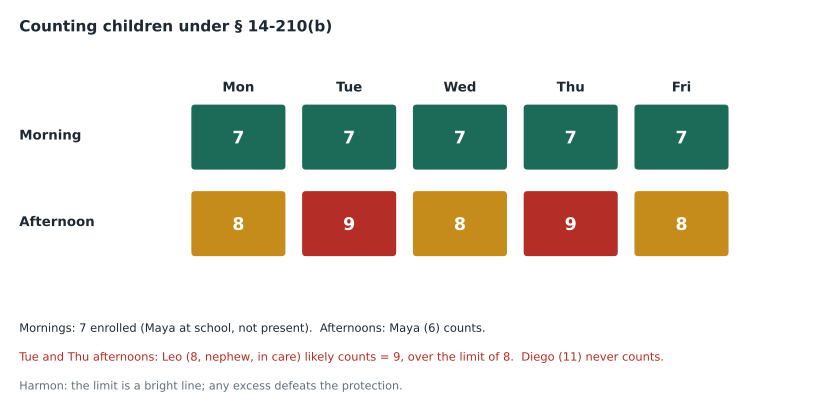
Under section 14-210(b) and Harmon, the count includes every child in care, plus the licensee's own children under ten who are present. Work it through by time of day. In the morning, seven enrolled children are present; Maya is at school, so she is not present and does not count. Seven. In the afternoon on Mondays, Wednesdays and Fridays, Maya comes home: she is the licensee's own child, under ten and present, so she counts. Eight. Diego is eleven, so under the statute and Harmon he does not count. Eight is within the limit.
Tuesdays and Thursdays are different. Leo, Ms. Ruiz's eight-year-old nephew, is present from 3:30 to 5:45 while she watches him for her sister. Leo is not her own child, so the 'own children under ten' rule does not apply to him. The question is whether he is a child to whom she 'provides care'. Harmon said a child who is not in care, such as a visiting relative who is not being cared for, does not count. Leo is a visiting relative, but Sam's email says Ms. Ruiz watches him while his mother works, and the sign-in sheet records him like the enrolled children. That looks like care. If he counts, the afternoon count on Tuesdays and Thursdays is nine.
Nine is over the limit, and Harmon says the limit is a bright line: a home over it loses the protection of section 14-210 entirely, however slight or temporary the excess. That is the weakness the task memo warned about. Ms. Ruiz says she never goes over eight, and she probably believes it, because she does not think of her nephew as one of the children she cares for. The documents tell a different story. A candid memo must say so.
Are there arguments the other way? Some. The care is unpaid and occasional; Leo is family; the statute's purpose, as Delaney described it, is to keep home-based child care in neighborhoods, and an aunt watching her nephew is not what the legislature feared. But Harmon rejected a 'small and temporary' excess argument, and the payment point does not appear in the statute or the cases. A careful memo presents these arguments honestly, rates them as weak, and recommends the practical fix: stop caring for Leo at the home during care hours, or arrange the schedule so the count never exceeds eight, before responding to the City.
Facts that decide the individual charges
If the home qualifies, the four charges sort neatly:
- Permit. Section 14-210(c) bars requiring a home occupation permit, and (a) makes the home a residential use for all zoning. The home occupation permit charge fails.
- Visits. The visit limit is part of the home occupation code, which does not apply to a residential use. Fourteen drop-off and pick-up trips a day (seven families, twice each) would exceed six, but the rule does not reach a qualifying home.
- Sign. The City cited the home occupation sign ban, which does not apply. But section 15.08.030 limits every residential lot to one sign of four square feet. Ms. Ruiz's sign is about six square feet. Under section 14-210(d), a sign rule that applies the same way to all residences is preserved. The City cited the wrong section, but it could cite the right one. Candor requires saying so and recommending a smaller sign.
- Drop-off. Section 10.12.020 applies only to child care centers and family child care homes, so under Delaney it is not a rule that applies in the same way to all residences. The charge fails. But Delaney also said the city may enforce its general lawn parking rule; parents occasionally pulling onto the grass could draw that kind of citation.
Facts for the alternative question
If the home does not qualify, section 17.40.050 governs, and the File shows she fails most of its conditions. She has no permit. Carla is one nonresident employee, which is allowed, and Tomás is a resident. The children use the living room, playroom and kitchen of an 1,800-square-foot house, which almost certainly exceeds 25 percent of the floor area; the File does not give room sizes, which is a gap worth noting. Fourteen visits a day exceed six. The sign advertises the occupation. Ms. Ruiz would need a permit and substantial changes, and some conditions, like the visit limit, are hard to meet for any child care operation. That conclusion explains why the first question matters so much and why fixing the Leo problem is urgent.
Gaps, inconsistencies and credibility
Performance test Files are deliberately incomplete and sometimes inconsistent. Three habits help.
First, note gaps. The Ruiz File does not give room measurements, so the 25 percent question cannot be answered precisely. It does not say whether Brookfield has a general noise or parking ordinance beyond the lawn rule Delaney mentions. A memo should identify gaps that matter and say what to find out, without inventing answers.
Second, note inconsistencies. Ms. Ruiz says 'I never go over eight'; the sign-in sheets show nine on two afternoons. When a client's account and the documents conflict, the documents usually deserve more weight, but the right move in an objective memo is to report both and explain the consequence.
Third, read dates. The drop-off ordinance was adopted in June 2026, after Ms. Ruiz had operated for years. That timing does not change the Delaney analysis, but it supports the purpose argument: a new rule aimed only at child care homes is what the statute was written to prevent. Dates can also decide whether a statute applies, whether a deadline has run or which version of a rule governs.
Irrelevant facts
The Pell letter is about noise and a threatened nuisance suit. The task memo assigned nuisance to Sam. The noise facts are irrelevant to the City's notice, which did not cite noise. Brother-made signs, the house's age and how long Ms. Ruiz has operated are color. The four years of operation might matter to an argument about fairness, but nothing in the Library makes length of operation legally relevant, so it deserves at most a sentence.
Distinguishing relevant from irrelevant facts is itself graded. NCBE's description of factual analysis includes recognizing which facts matter. A memo stuffed with every fact in the File signals that the writer could not tell the difference.
Worked problem
Turning a fact into analysis
Dana drafts a sentence about the sign: "Ms. Ruiz has a sign in her yard that is three feet by two feet." Marchetti asks what the sentence does.
Show solution
- A fact alone does no work; it must be tied to an element of a rule.
- State the rule: section 15.08.030 allows one sign of no more than four square feet per residential lot.
- Apply the fact: three feet by two feet is six square feet, which exceeds four.
- Explain the consequence: because section 15.08.030 applies the same way to all residences, section 14-210(d) preserves it, so the City could enforce it even though it cited the wrong section.
- Recommend: replace the sign with one of four square feet or less.
Answer: Revised: "Although the City cited the home occupation sign ban, which does not apply, Ms. Ruiz's sign, at about six square feet, exceeds the four-square-foot limit that section 15.08.030 places on every residential lot. Because that limit applies to all residences, section 14-210(d) preserves it, and the City could enforce it. We should advise her to replace the sign."
Marchetti's homework: write the Ruiz memo, timed, using only the outline you built from the memo, Library and File. 'Ninety minutes total, but you already did the reading, so give yourself 50 minutes to write. Next week we compare.'
Practice problems
Work each problem on paper first, then reveal the answer to check.
What may you not do with facts on a performance test?
Show answer
Invent them; use only facts in the File, and identify missing facts as gaps.
Why do the Tuesday and Thursday sign-in sheets matter?
Show answer
They show Leo in care, which may bring the afternoon count to nine and defeat the statute's protection under Harmon.
Does Diego count toward the limit?
Show answer
No. He is the licensee's own child but is eleven, and only own children under ten count.
Why might the City still win on the sign?
Show answer
Because section 15.08.030 limits every residential sign to four square feet, and section 14-210(d) preserves sign rules that apply to all residences.
Why does the drop-off charge fail if the home qualifies?
Show answer
Because section 10.12.020 applies only to child care operations, not to all residences, so Delaney says subsection (d) does not preserve it.
What should a memo do when the client's account conflicts with documents?
Show answer
Report both, explain the consequence of each, and generally give the documents significant weight.
Common mistakes
MistakeThe client's interview is the most reliable account of the facts.
InsteadCompare it with the documents; clients have gaps and spin.
MistakeIf a fact I need is missing, I can assume the likely answer.
InsteadIdentify the gap, explain why it matters and recommend how to fill it.
MistakeIncluding every fact shows thoroughness.
InsteadRelevance is graded; irrelevant facts dilute the analysis.
MistakeA fact that helps the City has no place in our memo.
InsteadAn objective memo reports bad facts candidly and analyzes them.
Summary and key terms
- Read the File with your heading skeleton and sort each fact under a heading as you go.
- Count, measure and compute from the documents; the decisive fact may not appear in the client interview.
- Report bad facts candidly, evaluate counterarguments and recommend practical fixes.
- Note gaps and inconsistencies instead of inventing facts; read dates.
- Recognize and skip irrelevant material, especially matters the task memo assigned elsewhere.
- Source document
- A document in the File, other than the task memo, from which the facts come.
- Factual analysis
- Identifying, evaluating and using the facts that matter to each element of a rule.
- Gap
- A fact needed for the analysis that the File does not supply.
- Inconsistency
- A conflict between two accounts or documents in the File.
- Bad fact
- A fact that weakens the client's position and must be addressed candidly.
Lesson quiz · 5 questions
Score 60% or more to complete this lesson.
Create a free account to save your progress, take quizzes and earn a certificate.