
BAR-121 · Lesson 6 of 12 · 23 min
Persuasive briefs
▶ Video coming soon A video version of this lesson is on the way.
On Friday, November 6, 2026, Marchetti changes the Ruiz facts. 'Two months have passed,' she tells the group. 'Ms. Ruiz took our advice. Since October 15 she has stopped watching Leo during care hours, and she replaced the sign with a two-by-two one. The City sued anyway and moved for a preliminary injunction to shut her down. Now we write the brief.' She sends a new task memo and a new case. 'Same law, new job. Watch how everything changes except the rules.'
Persuasive briefs are the second most common MPT task. They may be trial briefs supporting or opposing a motion, appellate briefs, or a single argument section for a partner who will write the rest. This lesson covers what a brief must do, how persuasive point headings work, how to handle authority that hurts you, and a model argument section for the Ruiz injunction.
The new task memo
**Ostrander and Vail LLP. MEMORANDUM. To: Applicant. From: Priya Nandakumar. Re: City of Brookfield v. Ruiz, Alder County District Court; opposition to motion for preliminary injunction.**
The City has moved for a preliminary injunction ordering Ms. Ruiz to stop operating Little Sprouts until trial. Its motion argues that her home is not protected by section 14-210 because the count exceeded eight children in September, that she is therefore an unpermitted home occupation, and that she also violates the drop-off ordinance. I will write the introduction, the statement of facts and the arguments on irreparable harm, the balance of hardships and the public interest. Please draft only the argument that the City is not likely to succeed on the merits. Follow the attached office guidelines on persuasive briefs. Ms. Ruiz has not cared for Leo during care hours since October 15, and her new sign is two feet by two feet; you may rely on her declaration saying so.
Office guidelines for persuasive briefs (excerpt). Write the argument under point headings that state the conclusion you want the court to reach and the main reason, as complete sentences. Subheadings follow the same rule. Do not write abstract statements of law as headings. Address adverse authority directly rather than ignoring it; courts notice. Do not restate the facts at length in the argument; weave in the facts that matter to each point.
What changed, and what did not
The rules are the same: section 14-210, Harmon, Delaney and the city code. The task is different in four ways. The document is a brief, so the stance is advocacy. The audience is a judge, not the partner. The scope is narrower: only likelihood of success on the merits, not the other injunction factors. And the facts have changed: the count is now eight at all times, and the sign complies with the general residential limit.
The Library adds one case. Whitcomb v. Marlow Board of Education (Marlow Supreme Court, 2017) (fictional): a party seeking a preliminary injunction must show a likelihood of success on the merits, irreparable harm without the injunction, that the balance of hardships favors it, and that the injunction serves the public interest. The court called a preliminary injunction 'an extraordinary remedy' and stressed that it is 'forward-looking: it restrains future conduct, and a party's past violations justify it only insofar as they show a threat of continuing violations'.
That sentence changes the Leo analysis. In the memo, Leo was a risk to be disclosed. In the brief, the question is whether the City is likely to obtain an order restraining future operation, and the future operation is within the limit. Harmon still says the line is bright, but it decides whether a home qualifies at a given time. It does not say that a home that once exceeded the limit is barred forever.
Point headings
Point headings are the outline of your argument and the first thing a judge, and a grader, reads. Persuasive headings state the conclusion you want and the reason, in a complete sentence. Compare:
- Weak: 'Section 14-210.'
- Weak: 'The definition of a family child care home.'
- Better: 'Ms. Ruiz's home is a family child care home.'
- Best: 'The City is unlikely to succeed because Ms. Ruiz's home cares for no more than eight children and is therefore a residential use protected by section 14-210.'
The best heading tells the judge what to decide and why, so that a reader who reads only the headings understands the argument. Office guidelines like the Ruiz excerpt often ask for exactly this, and following them earns points. Subheadings work the same way, one level down.
Persuasive techniques that work on a performance test
Persuasion on a performance test is mostly about structure and emphasis, not rhetoric. Lead with your strongest argument. Frame the rule in the terms most favorable to the client, using the authority's own language: Delaney's statement that the legislature wanted to stop cities from 'regulating family child care homes out of residential neighborhoods' is a gift. Apply the rule with specific facts. Then address the other side's best argument and explain why it fails.
Persuasion does not mean overstatement. Graders, like judges, discount advocacy that misstates the record or the law. 'Ms. Ruiz has always complied with the eight-child limit' would be false, and the City has the sign-in sheets. The persuasive version is accurate: she now complies, has complied since October 15, and an injunction restrains only future conduct.
Handling adverse authority and bad facts
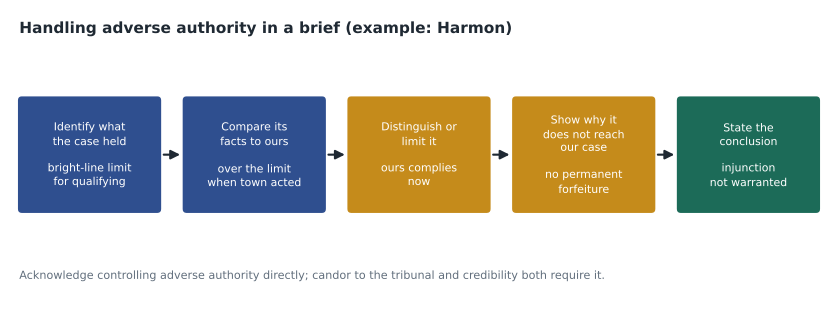
Harmon is adverse in part: it makes the limit a bright line and the City will rely on it. The office guidelines say to address adverse authority directly, and professional rules require candor to the tribunal about controlling authority that is directly adverse. The persuasive move is to acknowledge Harmon, state what it actually decided, and show why it does not help the City here. Harmon involved a home that exceeded the limit when the town acted; it decided whether that home qualified. It did not address a home that came into compliance before the court acted, and Whitcomb says an injunction looks forward.
The bad fact, the September excess, is handled the same way: acknowledge it briefly and accurately, then explain why it does not justify the relief sought. Hiding it is not an option. The City cited it in its motion, and a brief that ignores the other side's main point loses credibility with the court and with the grader.
A model argument section
Here is a model argument for the Ruiz opposition. It covers only likelihood of success, as the task memo asked, and follows the office guidelines.
**I. The City is unlikely to succeed on the merits because Ms. Ruiz's home is a family child care home that section 14-210 protects from the home occupation code and the drop-off ordinance.**
A preliminary injunction is an extraordinary remedy, available only if the City shows, among other things, a likelihood of success on the merits. Whitcomb. It cannot.
A. Ms. Ruiz's licensed home cares for no more than eight children and is therefore a residential use for all local zoning.
Section 14-210 makes a licensed family child care home 'a residential use of property for purposes of all local zoning and land use regulation'. § 14-210(a). A family child care home is one in which the licensee provides less-than-24-hour care to no more than eight children, counting her own children under ten who are present. § 14-210(b); Harmon. Ms. Ruiz is licensed for eight children through March 2027 and provides care only between 7:00 a.m. and 6:00 p.m. She cares for seven enrolled children. Her daughter, who is six, counts when home from school, for a total of eight. Her eleven-year-old son does not count. Harmon. Since October 15, no other child has been in her care during care hours. Ruiz Decl. Her home meets every element of the statute.
The City relies on two September afternoons when Ms. Ruiz watched her eight-year-old nephew, bringing the count to nine. That excess has ended, and it cannot support the relief the City seeks. A preliminary injunction is 'forward-looking: it restrains future conduct, and a party's past violations justify it only insofar as they show a threat of continuing violations'. Whitcomb. There is no threat of continuing violation. Ms. Ruiz stopped the practice as soon as she learned it mattered and has complied for weeks.
Harmon does not hold otherwise. There, the licensee was caring for ten children when the town acted and argued that a small excess should be ignored. The Supreme Court held that the limit is a bright line and that a home over it is not protected. Harmon decided whether a home exceeding the limit qualified at the time of enforcement; it did not hold that a home that once exceeded the limit loses the statute's protection permanently. Nothing in section 14-210's text supports such a forfeiture. The statute defines a family child care home by present conditions, 'a home in which the licensee provides care', in the present tense. Today, Ms. Ruiz's home is exactly that.
B. Because the home is a residential use, the City cannot require a home occupation permit or enforce the home occupation code's visit and sign limits.
The legislature expressly prohibited cities from requiring 'a home occupation permit' as a condition of operating a family child care home. § 14-210(c). And because the home is a residential use for all zoning, § 14-210(a), the home occupation code, which governs only home occupations, does not apply to it at all, including its six-visit limit and its sign ban. § 17.40.050(3)-(4). Applying those provisions to Ms. Ruiz would do exactly what the legislature forbade: treat a family child care home as a business rather than a home. Delaney.
C. The drop-off ordinance is not a regulation that applies in the same way to all residences, so section 14-210 bars its enforcement.
Section 14-210(d) preserves local parking regulations only if they apply 'in the same way to all residences in the zone'. The drop-off ordinance applies only to child care centers and family child care homes. § 10.12.020. The Court of Appeals has already held that a parking requirement imposed only on child care homes is not preserved, because it treats them as something other than residences, which subsection (a) forbids. Delaney. The City adopted the drop-off ordinance in June 2026, years after Ms. Ruiz began operating, and aimed it only at child care homes. It is precisely the kind of rule the legislature enacted section 14-210 to prevent: one that regulates family child care homes 'out of residential neighborhoods'. Id.
D. The City's sign theory fails, and in any event Ms. Ruiz's current sign complies with every rule that applies to residences.
The City seeks to enforce the home occupation sign ban, § 17.40.050(4), which does not apply to a residential use. The only sign regulation the statute preserves is one that applies to all residences, § 14-210(d), and Brookfield's residential sign rule allows one sign of up to four square feet per lot. § 15.08.030. Ms. Ruiz's current sign is two feet by two feet, or four square feet. Ruiz Decl. There is nothing to enjoin.
Because Ms. Ruiz's home is protected by section 14-210, and none of the City's theories survives that protection, the City has not shown a likelihood of success on the merits.
What makes the model work
The headings state conclusions and reasons, as the guidelines require. The strongest point, qualification, comes first, because every other argument depends on it. The bad fact is acknowledged in a sentence and then neutralized with Whitcomb. Harmon is confronted and distinguished on its own terms rather than ignored. The facts appear inside the arguments, not in a separate recitation. And the brief stays in its lane: no irreparable harm, no balance of hardships, no statement of facts.
Compare the memo. The memo flagged the old sign as a risk under section 15.08.030; the brief can say the new sign complies. The memo rated Leo as a serious risk; the brief shows why, on the current facts, it does not justify an injunction. 'That's the craft,' Marchetti says. 'Same truth, different job.'
Worked problem
Rewriting a weak heading
Sofia's first draft heading for part C reads: "Section 14-210(d) and the Delaney case." Marchetti asks her to apply the office guidelines.
Show solution
- Identify the conclusion the court should reach: the drop-off ordinance cannot be enforced against Ms. Ruiz.
- Identify the main reason: it does not apply the same way to all residences, so subsection (d) does not preserve it.
- Combine them into one complete sentence that a judge could adopt as a holding.
- Check against the guideline: no abstract statements of law; conclusion plus reason.
Answer: "The drop-off ordinance is not a regulation that applies in the same way to all residences, so section 14-210 bars its enforcement."
Common brief mistakes
The most common mistakes are writing objectively in a brief, as if the judge were the partner; using topic headings instead of argumentative ones; ignoring the other side's main argument; misstating the facts or overstating authority; including sections the task memo assigned to someone else; and failing to follow the office guidelines. Each costs points that have nothing to do with knowing the law.
Ngozi, whose first memo had been too much like a brief, finds the reverse problem in her brief: she wrote 'A court would likely find' four times. 'In a brief, you tell the court what to find,' Marchetti says. 'Respectfully, but you tell it.'
Practice problems
Work each problem on paper first, then reveal the answer to check.
What should a persuasive point heading contain?
Show answer
The conclusion you want the court to reach and the main reason, as a complete sentence.
How should a brief deal with adverse controlling authority?
Show answer
Acknowledge it, state accurately what it held, and distinguish or limit it.
Why does the Leo excess matter less in the brief than in the memo?
Show answer
The facts changed and an injunction is forward-looking under Whitcomb, so a cured past excess does not show a threat of continuing violation.
Which injunction factor did the task memo assign?
Show answer
Only likelihood of success on the merits.
Why is overstatement dangerous in a brief?
Show answer
Graders and judges discount advocacy that misstates the record or law, and the other side may have contrary documents.
Where should facts appear in the argument?
Show answer
Woven into each point where they support the rule, not in a separate recitation.
Common mistakes
MistakeTopic headings are clearer than sentence headings.
InsteadPersuasive headings state a conclusion and a reason; office guidelines often require them.
MistakeIgnoring a bad case keeps it out of the judge's mind.
InsteadThe other side will cite it; address it directly and distinguish it.
MistakePersuasive writing means strong adjectives.
InsteadPersuasion comes from structure, emphasis and accurate use of law and facts.
MistakeCovering every injunction factor shows thoroughness.
InsteadWrite only the parts assigned; extra sections waste time and ignore instructions.
Summary and key terms
- A brief argues for the client to a court; stance, audience and scope come from the task memo.
- Write point headings that state a conclusion and a reason; follow any office guidelines exactly.
- Lead with the strongest argument and frame rules in the authority's most favorable language.
- Acknowledge bad facts and adverse authority accurately, then distinguish or neutralize them.
- Stay within the assigned scope; weave facts into the arguments.
- Persuasive brief
- A document arguing a client's position to a court.
- Point heading
- A heading in a brief stating the conclusion the court should reach and the main reason.
- Preliminary injunction
- A court order restraining conduct before trial, granted only on a strong showing.
- Adverse authority
- Law that cuts against the client's position and must be addressed candidly.
- Candor to the tribunal
- A lawyer's professional duty not to mislead the court on law or facts, including disclosure of directly adverse controlling authority.
Lesson quiz · 5 questions
Score 60% or more to complete this lesson.
Create a free account to save your progress, take quizzes and earn a certificate.