
BAR-121 · Lesson 2 of 12 · 23 min
Reading the task memo
▶ Video coming soon A video version of this lesson is on the way.
On Friday, September 25, 2026, everyone reports back on the homework. Dana read a released MPT memo and wrote 'Write a memo about the lease.' Ngozi wrote 'Analyze whether the client can terminate the lease.' Sofia wrote 'Persuasive brief, argument section only, two issues, no statement of facts, opposing the landlord's motion, cite the cases.' Hollis Marchetti reads all three aloud and asks which one would earn the most points. Nobody hesitates. 'Sofia's,' Dana says. 'Because she wrote down what kind of document, which parts, which issues and for whom.'
'Exactly,' Marchetti says. 'The task memo is the only document in the File that tells you what the grader wants. Everything else is raw material. If you misread the memo, every minute after that is spent building the wrong thing.' This lesson is about reading the task memo the way a careful associate reads an assignment from a partner: slowly, twice, and with a pen.
Why the memo comes first
NCBE's instructions say that the first document in the File is a memorandum containing the instructions for the task. The instructions also say graders will consider how well your answer responds to those instructions before anything else. That makes the memo both the job description and the grading rubric in miniature. Most task memos are short, often less than a page, and most examinees read them in under two minutes. That is too fast. The memo deserves five minutes of your 90: one careful read, one slow reread with marks, and a short written restatement of the assignment at the top of your scratch paper.
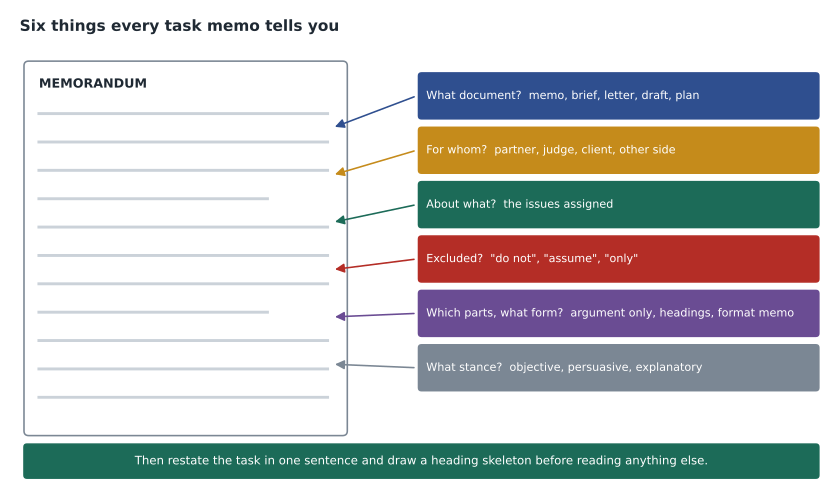
The memo answers six questions, and you should be able to answer each one before you open the rest of the File:
- What document? An objective memorandum, a persuasive brief or part of one, a letter, a will clause, a contract provision, a discovery plan, a closing argument, a set of jury instructions or something else.
- For whom? The supervising attorney, a judge, the client, opposing counsel, a mediator or a non-lawyer such as a city council.
- About what? Which issues, claims or questions, and which ones are excluded.
- Which parts? The whole document, or only the argument section, or only the discussion, or only certain provisions.
- In what form? Headings, a particular structure, a format attached as a model, a word or page guideline, citations or not.
- With what stance? Neutral and predictive, or persuasive for the client, or explanatory for a lay reader.
The running problem: the Ruiz file
Lessons 2 through 7 use one original performance test, the Ruiz matter, set in the fictional State of Marlow. You will see the task memo in this lesson, the Library in Lesson 3 and the rest of the File in Lesson 4, and you will write the memo in Lesson 5. Every name, statute and case in it is invented for this course. Here is the task memo, exactly as an examinee would see it.
Ostrander and Vail LLP, Brookfield, Marlow. MEMORANDUM. To: Applicant. From: Priya Nandakumar, Partner. Re: Lena Ruiz, Little Sprouts Family Child Care.
Our client, Lena Ruiz, runs a licensed family child care home from the house she owns at 418 Larch Street in Brookfield. Last week the City of Brookfield served her with a notice of violation. The notice says she is operating a home occupation without a permit, that she exceeds the limit on client visits for home occupations, that her yard sign violates the home occupation rules, and that she has not provided the off-street drop-off area the City now requires of child care homes. The notice orders her to stop operating within 30 days or face daily fines.
Ms. Ruiz believes state law protects her. I need to know whether she is right before we respond to the City. Please write an objective memorandum to me analyzing two questions. First, does Ms. Ruiz's home qualify for the protection of section 14-210 of the Marlow Family Child Care Act, and if so, which parts of the notice of violation can the City enforce against her and which can it not? Second, if her home does not qualify, does her operation meet the requirements for a permitted home occupation under Brookfield City Code section 17.40.050?
Do not address the neighbors' private nuisance threat; Sam Okoye is handling that. Do not write a statement of facts; I will prepare one for the file. Organize your discussion under headings for each question and, within each question, for each part of the notice you analyze. Be candid about weaknesses. I would rather know them now than learn them from the City Attorney.
Dissecting the Ruiz memo
Marchetti shares her screen and marks up the memo with the group. Here is what they find.
| Question | Answer from the Ruiz memo |
|---|---|
| What document? | An objective memorandum |
| For whom? | The supervising partner, Priya Nandakumar |
| About what? | Two questions: protection under section 14-210, and, in the alternative, compliance with section 17.40.050 |
| Excluded? | The neighbors' nuisance claim; a statement of facts |
| Which parts? | The discussion only, with no statement of facts |
| In what form? | Headings for each question and, within the first, for each part of the notice of violation |
| With what stance? | Neutral and candid, including weaknesses |
Look closely at the conditional structure of the assignment. The first question has two layers: whether the home qualifies for protection at all, and, if it does, which of the four charges in the notice survive. The second question is expressly in the alternative: 'if her home does not qualify.' An objective memo still answers the alternative question even if you conclude the home qualifies, because the partner needs a fallback if a court disagrees with you on the first question. Examinees who conclude 'the statute protects her, so the second question is moot' and stop have answered half the assignment.
The memo also tells you something about structure. 'Within each question, for each part of the notice you analyze' tells you the grader's point sheet almost certainly lists the four charges separately: the permit, the visit limit, the sign and the drop-off area. Your headings should name them. A grader scanning for 'sign' should find it in a heading.
Finally, notice the words 'be candid about weaknesses'. That is a signal that the File contains at least one bad fact, and that credit is available for spotting it. A memo that reads like a brief for the client will lose those points.
Reading for verbs
Task memos are short, so each verb carries weight. 'Analyze' and 'evaluate' call for objective work. 'Argue', 'persuade' and 'make the strongest case' call for advocacy. 'Explain' to a client calls for plain language and a recommendation. 'Draft' calls for a usable document, such as contract language or a will provision, often with a short explanation of choices. 'Identify' may call for a list, but usually a list with reasons. 'Recommend' calls for a conclusion you commit to.
Read for limiting words too: 'only', 'do not', 'assume', 'for purposes of this memo', 'the court has already ruled', 'the client has decided'. These close doors. If the memo says 'assume the contract is valid', any time you spend on formation is wasted and may make the grader wonder whether you read the assignment. If it says 'the client has decided not to pursue the fraud claim', do not recommend one.
Attached formats and models
Many performance tests include a second instruction document, such as an office memorandum on the firm's format for persuasive briefs or a sample client letter. Treat it as part of the task memo. If the firm's brief format says to write point headings as complete sentences that state the conclusion and the reason, do that. If it says not to include a statement of the case, leave it out. NCBE's point sheets regularly give credit for following format instructions, and graders notice when examinees ignore them.
A format memo may also tell you what not to do. A common example is an instruction that the argument should not merely list facts but tie each fact to the governing rule, or that headings should not be abstract statements of law. Those instructions describe exactly what a weak answer looks like. They are a free description of the grading standard.
Worked problem
Restating a task in one sentence
Ngozi practices on the Ruiz memo. Her first restatement is: "Write a memo about whether Ms. Ruiz can keep running her daycare." Marchetti asks her to try again with all six elements.
Show solution
- Document and audience: an objective memo to the supervising partner.
- Issues: section 14-210 protection and, in the alternative, home occupation compliance under section 17.40.050.
- Parts and exclusions: discussion only; no facts section; no nuisance claim.
- Form: headings by question and, under the first, by each of the four charges.
- Stance: neutral and candid about weaknesses.
Answer: Revised restatement: "Objective memo to Nandakumar, discussion only, analyzing (1) whether 14-210 protects Ruiz and which of the four charges (permit, visits, sign, drop-off) the City can still enforce, and (2) in the alternative, whether she meets 17.40.050; no facts, no nuisance; headings; flag weaknesses."
Reading the memo twice
Marchetti recommends a fixed routine for the memo. On the first read, read straight through without marking, just to understand the situation. On the second read, mark each of the six elements in the margin, circle every limiting word, and number the issues. Then write the one-sentence restatement and a skeleton of headings on your scratch paper before opening anything else. The skeleton for Ruiz looks like this:
- I. Section 14-210 of the Family Child Care Act
- A. Whether the home is a family child care home under the Act
- B. The home occupation permit requirement
- C. The client visit limit
- D. The yard sign
- E. The off-street drop-off requirement
- II. In the alternative: the home occupation requirements of section 17.40.050
That skeleton will change as you read the Library and File. You may discover that the visit limit and permit requirement rise or fall together, or that the sign raises a second rule you did not expect. But starting with a skeleton drawn from the memo keeps you anchored to the assignment while you read.
Common ways examinees misread memos
Over six years of grading, Marchetti kept a list of the misreadings she saw most often. The first is writing the wrong kind of document: a persuasive brief when asked for an objective memo, or a lawyer-to-lawyer memo when asked for a client letter. The second is answering a broader question than asked, such as analyzing every possible claim when the memo asked about one. The third is ignoring an exclusion, such as writing a statement of facts after being told not to. The fourth is missing an alternative question, as in the Ruiz memo. The fifth is ignoring a format memo. The sixth is answering the question in the abstract without making a recommendation the memo asked for.
'None of those are law mistakes,' she says. 'They are reading mistakes. And they are the cheapest points on the exam to protect.'
Sofia admits that her July performance test was the third kind. California's task asked for a letter to opposing counsel proposing settlement terms, and she wrote a two-page summary of the facts first because she was nervous. 'I lost probably ten minutes and the grader would have skipped it anyway,' she says.
How much time to spend
Five minutes on the memo may feel like a luxury in a 90-minute task. It is not. Marchetti's rule of thumb, which Lesson 9 develops, is roughly 45 minutes reading, analyzing and outlining and 45 minutes writing, which matches NCBE's own suggestion that about half your time should go to reading and organizing before you write. The memo is the first five of those 45 minutes, and it shapes all the rest. When you read the Library next, you will be reading it with your issues already numbered, looking for the rule each issue needs. When you read the File, you will be sorting facts into those numbered issues instead of reading them as a story.
Marcus confirms that the NextGen performance tasks reward the same discipline. 'Each one opens with a memo that tells you who the client is and what's in the file and library,' he says. 'With only an hour, I had to know exactly what I was producing before I read anything else.'
Marchetti's homework for next week: read the Ruiz Library, which she will send that night, with the skeleton in hand, and for each heading write the rule that answers it.
Practice problems
Work each problem on paper first, then reveal the answer to check.
What six things should you identify in every task memo?
Show answer
The document, the audience, the issues, the exclusions and parts required, the format, and the stance.
Why should an objective memo still answer an alternative question if you resolve the first question for the client?
Show answer
Because the supervising attorney needs a fallback if a court disagrees with your answer on the first question.
What does an instruction like "be candid about weaknesses" signal?
Show answer
That the File contains bad facts and that credit is available for identifying them honestly.
How should you treat a separate format memo in the File?
Show answer
As part of the task instructions; follow it, because graders give credit for doing so.
What should you write on your scratch paper before opening the rest of the File?
Show answer
A one-sentence restatement of the assignment and a skeleton of headings drawn from the memo.
In the Ruiz memo, which four charges should become headings?
Show answer
The home occupation permit, the client visit limit, the yard sign and the off-street drop-off requirement.
Common mistakes
MistakeThe task memo is a quick intro; the real work is in the Library.
InsteadThe memo defines the job and the grading; spend five minutes on it.
MistakeIf I resolve the first question, I can skip the alternative.
InsteadAnswer every question the memo asks, including conditional or alternative ones.
MistakeWriting a statement of facts is always safe.
InsteadIf the memo says not to, it wastes time and signals you did not read carefully.
MistakeA format memo is optional guidance.
InsteadIt is part of the assignment and often describes the grading standard.
Summary and key terms
- The task memo is both the job description and a miniature of the grading standard.
- Identify the document, audience, issues, exclusions, parts, format and stance before reading anything else.
- Answer alternative questions; follow format memos; watch for limiting words.
- Write a one-sentence restatement and a heading skeleton on your scratch paper.
- Spend about five minutes on the memo; most misreadings are reading mistakes, not law mistakes.
- Task memorandum
- The first document in an MPT File, in which a supervising attorney assigns the task.
- Format memo
- A document in the File setting out the firm's required format for a type of document.
- Alternative question
- A question the task memo asks to be answered on the assumption that an earlier question comes out the other way.
- Objective memorandum
- A neutral, predictive analysis written for a supervising lawyer, including weaknesses.
- Heading skeleton
- An outline of headings drawn from the task memo before reading the Library and File.
Lesson quiz · 5 questions
Score 60% or more to complete this lesson.
Create a free account to save your progress, take quizzes and earn a certificate.