
BAR-121 · Lesson 11 of 12 · 22 min
Grading and self-review
▶ Video coming soon A video version of this lesson is on the way.
On Friday evening, November 20, 2026, Marchetti tries something she says she has wanted to do since her grading days. She sends everyone a plausible point sheet for the Ruiz memo, then sends each person someone else's memo with the name removed, and asks them to grade it on a 1-to-6 scale before the call. When they meet, the grades are close: three of the five memos receive the same score from their peer grader as from Marchetti, and the other two are within a point. 'Now you know the secret,' she says. 'Grading a performance test is not mysterious. If you can grade one, you can write one that grades well.'
Self-review is how practice turns into improvement. Writing a timed performance test and never checking it teaches timing and little else. Checking it carefully against a point sheet teaches you which issues you miss, which rules you state badly and which facts you leave unused, and those patterns are the fastest path to a higher score. This lesson covers how graders actually work, how to grade your own answers, how to build an error log and how to use released materials efficiently.
How graders use point sheets
NCBE writes grading materials for each MPT item and trains graders from the jurisdictions that use it. The point sheet describes the issues the task raises, the authorities that resolve them, the key facts and the conclusions a good answer reaches, often with notes on how much weight each issue carries and what alternative conclusions are acceptable. Jurisdictions then grade their own examinees, usually by ranking answers to the same item against one another on a scale such as 1 to 6 after calibrating on sample answers.
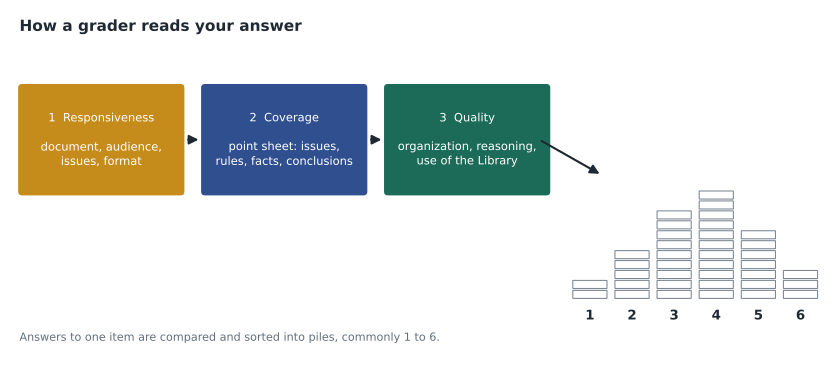
From the grader's side, the process is quick. Read the answer once, checking responsiveness: right document, right audience, right issues, right format. Then check coverage against the point sheet: which issues are addressed, with which rules and facts. Then judge quality: organization, reasoning, use of the Library. Answers are sorted into piles, compared and adjusted. A grader may read a hundred answers to the same item in a day.
Two lessons follow. First, coverage and responsiveness dominate. An answer that misses an issue on the point sheet cannot earn that issue's credit no matter how good the rest is. Second, organization affects how much credit the grader can find. A point buried in the wrong section may be missed by a tired reader.
A self-grading rubric
Jurisdictions describe their scores in general terms. Marchetti uses this rubric, adapted from published descriptions, for self-grading.
| Score | Typical answer |
|---|---|
| 6 | Fully responsive; covers all major and most minor issues; precise rules with Library citations; detailed use of facts; candid treatment of weaknesses; well organized |
| 5 | Responsive; covers all major issues; minor gaps in rules or facts; good organization |
| 4 | Responsive; covers most major issues; some conclusory application or imprecise rules; adequate organization |
| 3 | Partly responsive; misses a major issue or analyzes it thinly; facts used sparingly; organization uneven |
| 2 | Significant responsiveness problems, such as wrong document type; several issues missed; little factual analysis |
| 1 | Largely unresponsive, unfinished or incoherent |
Remember that real grading is relative. A self-grade of 4 means 'an answer that would probably land in the middle of the pile', not 'four out of six points earned'. The rubric is a way to compare your answer with what graders typically reward, not a prediction of your scaled score.
Grading your own answer, step by step
Self-grading works best with a delay. Write the test timed, put it away for at least a few hours, then grade it with fresh eyes against the point sheet. Marchetti's method has five steps.
- Responsiveness. Reread the task memo. Did you write the right document for the right reader, cover exactly the issues assigned, follow every format instruction, and exclude what you were told to exclude? Note each miss.
- Coverage. Go through the point sheet line by line. For each issue, mark whether you addressed it, whether you stated the rule correctly with its source, whether you used the key facts and whether your conclusion was reasonable. Count the issues you missed entirely.
- Quality. Look for conclusory application, missing counterarguments, misattributed authority, irrelevant material and disorganization.
- Score. Assign a rubric score, honestly. Then ask what single change would have raised it by a point.
- Log. Record the errors in your error log, by type.
The fourth step is the most valuable. 'Ask what one change would have earned another point,' Marchetti says. 'Usually it is not knowing more law. It is covering the issue you missed, or using the three facts you wrote in your outline and never put in the answer.'
The error log
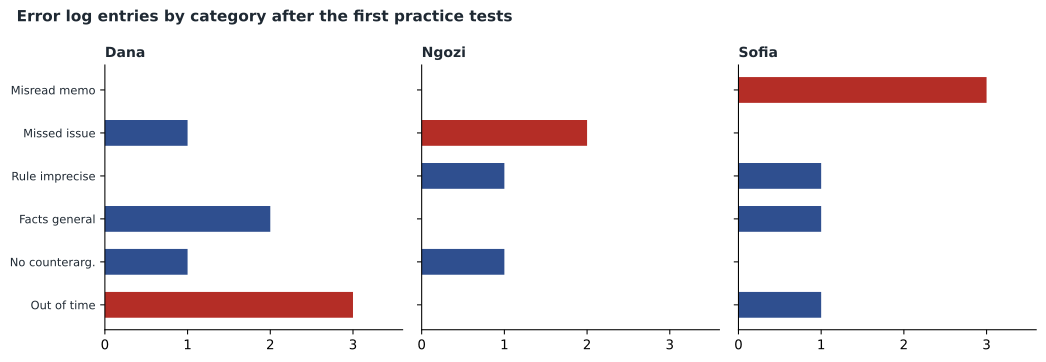
An error log is a running list of every mistake you find in practice, sorted into categories. After six or eight practice tests, patterns appear, and patterns can be fixed. Marchetti suggests these categories: misread the task memo; missed an issue; rule imprecise or misattributed; facts not used or used generally; no counterargument; disorganized or wrong headings; ran out of time; included irrelevant material. Each entry notes the test, what went wrong and the fix.
The group compares their logs after the peer grading. Dana's shows three 'ran out of time' entries and two 'facts not used' entries, all from the Library-heavy tests where she reads slowly. Ngozi's shows 'missed an issue' twice, both from second rules buried in the Library, like the Ruiz sign rule. Sofia's shows 'misread the task memo' three times. 'Three people, three different problems,' Marchetti says. 'That's why generic advice only gets you so far. Your log tells you what to practice.'
Peer review
Grading someone else's answer is surprisingly useful, for the reason Marchetti demonstrated: it shows you what graders see. You notice immediately when a rule is missing, when a heading hides an issue or when an answer spends a page on facts before saying anything. Seeing those problems in someone else's work makes them easier to spot in your own. If you study with others, trade anonymized answers to the same practice item and grade them against the point sheet before comparing notes.
Peer review also calibrates your self-grades. Most people grade themselves either too harshly or too generously. The peer grades in the Ruiz exercise showed that Sofia grades herself a full point below what others give her, and Dana half a point above. Knowing your bias helps you read your own scores realistically.
Using released materials
NCBE offers older MPT items with their point sheets as free downloads, plus paid study aids, and it posts summaries of recent items that describe each task. Released items are the closest thing to the real exam, and their point sheets are the closest thing to real grading guidance. Use them carefully: they are a finite resource.
Marchetti's plan for February examinees uses this course's original tasks for learning the method, then released items for timed practice from December onward, two a week, graded against the point sheets the next day. In the final weeks, she adds two-item, three-hour blocks to build stamina. She warns against reading point sheets before attempting the items: 'Once you have read a point sheet, that item is gone as a practice test. Do it cold, then grade.'
The recent summaries are also useful for a different reason: they show the range of subjects and tasks. Since July 2026, NCBE has said family law and trusts and estates may appear on the MPT with the law supplied. Seeing how a family law or estates item is structured, even without doing it, makes such an item less surprising on exam day.
Worked problem
Self-grading Dana's Ruiz memo
Dana grades her own Ruiz memo against the point sheet from Lesson 5, a day after writing it.
Show solution
- Responsiveness: objective memo, correct audience, no facts section, both questions addressed. One miss: she put the Leo conclusion only at the end, not in the short answers.
- Coverage: counting rule from Harmon, Maya and Diego, Leo likely counts, permit, visits, sign, drop-off and alternative analysis all present. Missed: the lawn parking caveat from Delaney and the floor-area gap.
- Quality: the sign section is conclusory ("the sign is too big") without the six-square-feet arithmetic; no counterargument on Leo.
- Score: a 4. The single change worth a point: analyze the Leo counterarguments and put the risk in the short answers.
- Log: "facts used generally" (sign), "no counterargument" (Leo), "missed minor issue" (lawn parking).
Answer: Dana's honest self-grade matches Marchetti's 4 and points to two specific fixes.
Reviewing under time pressure
Self-review also has an in-exam form: the last five minutes of each item. You cannot grade against a point sheet you do not have, but you can check responsiveness against the task memo, scan your headings for missing issues from your outline, and add a missed fact or a sentence of counterargument where it fits. Lesson 10's checklist is designed for exactly this.
Marchetti closes the session by announcing the capstone. 'Sunday afternoon, two complete performance tests, back to back, three hours, like the real session,' she says. 'Then grade yourselves first, before you see my grades.'
Practice problems
Work each problem on paper first, then reveal the answer to check.
What does an MPT point sheet describe?
Show answer
The issues, the authorities that resolve them, the key facts and acceptable conclusions, often with weights.
Why do coverage and responsiveness dominate scores?
Show answer
Because an answer cannot earn credit for issues it does not address or for a task it did not perform.
What are the five steps of Marchetti's self-grading method?
Show answer
Responsiveness, coverage, quality, score with one change worth a point, and logging errors.
What is an error log for?
Show answer
To record mistakes by category across practice tests so that patterns become visible and can be targeted.
Why should you not read a point sheet before attempting the item?
Show answer
Because the item can no longer serve as a cold practice test.
How does peer review help self-grading?
Show answer
It shows what graders see and calibrates whether you grade yourself too harshly or too generously.
Common mistakes
MistakeA self-grade of 4 means I earned four of six points.
InsteadScores are relative; a 4 means an answer likely in the middle of the pile.
MistakeMore practice tests are always better, even without grading them.
InsteadUngraded practice teaches timing but not which issues and rules you miss.
MistakeReading point sheets first helps me learn faster.
InsteadIt uses up the item as a practice test; attempt cold, then grade.
MistakeEveryone needs the same fixes.
InsteadError logs show individual patterns; practice should target yours.
Building your own point sheet
When you practice with this course's original tasks or with a released item whose point sheet you have not seen, you can build a provisional point sheet yourself before grading. Reread the task memo and list each issue it assigns. For each issue, list the rule from the Library, the case or statute that supplies it, the three or four facts that decide it and the conclusion a reasonable answer would reach. Add the counterarguments a careful lawyer would expect. Then grade your answer against that list.
Building the list does two things. It gives you a standard to grade against, and it trains the exact skill the exam rewards: seeing a task the way the examiners who wrote it see it. After a few rounds, Marchetti says, you start drafting your outline in the shape of a point sheet during the exam itself, which is the surest way to cover what the grader is looking for.
When self-grading disagrees with a released point sheet
Sometimes your answer reaches a conclusion the point sheet does not, or analyzes an issue in a way the point sheet does not mention. Do not assume you were wrong. Point sheets often note that reasonable answers may differ on close questions and that graders should credit well-reasoned alternatives. Ask instead whether your answer stated the right rule, used the right facts and explained its reasoning. If it did, you probably earned most of the credit even with a different conclusion. If your answer missed an issue entirely, that is the error to log.
Making review a habit
The group agrees on a routine for the winter. Each practice test is written on a weekday evening under a timer, graded the next evening against the point sheet using the five steps, and logged the same night. Once a week, on the Friday call, each person shares their latest error log totals and one change they are trying. Sofia volunteers to keep a shared spreadsheet of everyone's scores, so the group can see whether the changes are working. 'That spreadsheet is the most useful thing you will make all winter,' Marchetti says. 'Improvement you can see is improvement you will keep doing.'
A note on honesty with yourself
Self-grading only works if it is honest, and honesty is harder than it sounds at eleven at night after a long practice test. The usual temptation is to give yourself credit for an issue you 'basically' covered, or for a rule you meant to state. Marchetti's test is strict: would a grader who had never met you, reading quickly, find the point on the page? If not, it does not count. A harsh self-grade in December costs nothing. A generous one hides the problem until February, when it is too late to fix.
Marcus offers to grade one practice test a week for anyone who wants a second reader. Having taken the NextGen performance tasks, he notices that his own instincts now come from the same habits: read the memo twice, map the authorities, sort the facts, write for the reader. 'It's the same skill,' he says. 'The format changed. The grading didn't.'
Summary and key terms
- Graders check responsiveness, then coverage against the point sheet, then quality, and score relatively.
- Self-grade after a delay: responsiveness, coverage, quality, score and the one change worth a point.
- Keep an error log by category; patterns show what to practice.
- Peer review reveals what graders see and calibrates your self-grades.
- Use released items cold for timed practice and grade them against their point sheets.
- Self-grading
- Scoring your own practice answer against a point sheet and rubric.
- Error log
- A categorized record of mistakes across practice tests.
- Calibration
- Aligning graders, or your own self-grades, on what each score looks like.
- Coverage
- The extent to which an answer addresses each issue on the point sheet.
- Released item
- A past MPT published by NCBE for practice, often with its point sheet.
Lesson quiz · 5 questions
Score 60% or more to complete this lesson.
Create a free account to save your progress, take quizzes and earn a certificate.