
BAR-203 · Lesson 11 of 12 · 15 min
Score transfer, admission on motion, new pathways and practice after admission
▶ Video coming soon A video version of this lesson is on the way.
Rafael's office has hired three lawyers in the last two years: one transferred a UBE score from Colorado, one came on motion from New Mexico after a decade of practice, and one was licensed under a program for examinees who scored just below Arizona's passing score. A fourth staff member, a paralegal, recently became a licensed legal paraprofessional. 'Arizona has more ways in than any state I know,' Marchetti says. 'You need to understand all of them, because you will work beside people who used each one.' This lesson covers score transfer, admission on motion, the Arizona Lawyer Apprentice Program, the Government Law Admission Program, legal paraprofessionals, and what new lawyers must do after admission.
Admission by score transfer
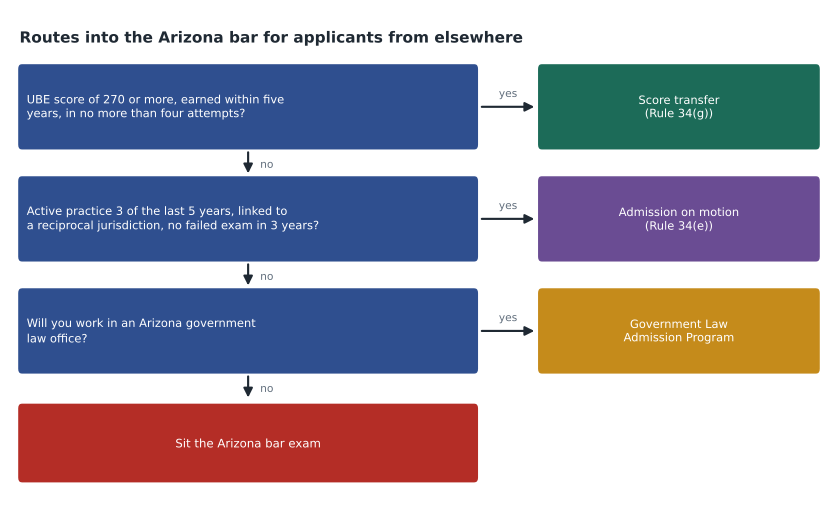
Under Rule 34(g), an applicant may be admitted by transferring a bar exam score earned in another jurisdiction that meets or exceeds the minimum the court sets. For the legacy UBE, the minimum is 270. Arizona began accepting transferred NextGen scores in July 2026, subject to the minimum the court sets for them. The score must have been earned within five years before the applicant takes the oath and is admitted in Arizona; the score counts as earned on the date of the exam that produced it. An applicant who did not reach the minimum score within four attempts, in any jurisdiction, is ineligible to transfer. Arizona does not accept transferred MBE scores standing alone.
Transfer applicants must meet the same core requirements as everyone else: an ABA-approved JD, a passing MPRE score earned within eight years of the application or within the oath period, good standing wherever admitted, no current or pending discipline, character and fitness clearance, and completion of the course on Arizona law. They file an application with character information and pay the transfer fee. Because character review takes time and the five-year clock keeps running, transfer applicants should file well before the score's expiry.
Admission on motion
Rule 34(e) allows experienced lawyers to be admitted without examination. The applicant must have been primarily engaged in the active practice of law for three of the five years immediately before filing, and the rule ties eligibility to reciprocity. The applicant must have been admitted by examination in a jurisdiction that allows Arizona lawyers admission on a basis equivalent to Arizona's rule, and either have practiced there for the required period, or, if admitted by exam in a non-reciprocal jurisdiction, have practiced the required period in a reciprocal one. The court designates reciprocal jurisdictions, and the admissions office publishes the list.
Qualifying practice includes representing clients, serving as a lawyer for a government or the military, teaching full time at an ABA-approved law school, serving as a judge or judicial clerk, and serving as corporate counsel. Unauthorized practice does not count, and the applicant's license must have been active throughout. An applicant who failed the Arizona exam, or failed another jurisdiction's exam to reach the Arizona minimum, within three years before filing is ineligible. The applicant must also hold an ABA-approved JD, have a passing MPRE score, be in good standing with no current or pending discipline, satisfy character and fitness, and complete the course on Arizona law. Applicants may ask for a pre-review of whether their practice qualifies, with a partial refund of the fee if it does not.
The Arizona Lawyer Apprentice Program
Arizona's passing score of 270 is at the top of the UBE range, and many examinees who score between 260 and 269 would have passed in other jurisdictions. In 2024, by Administrative Order 2024-148, the court created the Arizona Lawyer Apprentice Program to put some of those examinees to work where the need for lawyers is greatest. An examinee who scores 260 to 269 on the UBE and meets the other admission requirements, including character and fitness approval, may be licensed to practice under supervision if he or she secures qualifying employment: at least 30 paid hours a week for a public law employer, which by a later order includes legal services organizations, or for a private employer in a rural area, defined as a county with fewer than 600,000 residents in the most recent census.
The apprenticeship lasts two years. Supervision runs in phases, from close review of the apprentice's work in the first four months to monthly check-ins and then periodic mentoring. The supervisor must be an Arizona lawyer in good standing with at least five years of practice, a requirement that can be waived, and cannot be a relative or someone who lives with the apprentice. To convert to full admission at the end, the apprentice must comply with the program's requirements, the supervisor must attest that the apprentice can practice without supervision, and a judge or a lawyer outside the employer who knows the apprentice's work must recommend admission. An apprentice who later scores 270 or more on a UBE can convert without completing the two years. If an apprentice leaves qualifying employment, he or she has 60 days to find new qualifying work.
The program matters to Rafael's office directly: a legal aid office is a public law employer. If Rafael scores between 260 and 269 in February, he could keep working at his office under supervision rather than face an immediate retake on a new exam. Marchetti is careful to frame it correctly. 'It is a real option, and a good one for someone who wants to do exactly the work you already do. It is not a reason to aim for 265.'
The Government Law Admission Program
In 2025, by Administrative Order 2025-25, the court created the Government Law Admission Program, and on March 18, 2026, by Administrative Order 2026-32, it expanded it. The program allows lawyers admitted by examination in another US jurisdiction who do not meet the active practice requirement for admission on motion, including those whose experience was in nonlawyer roles, to be licensed to practice in Arizona government law offices. They must otherwise meet the core requirements, including an ABA-approved JD, the MPRE, good standing, character and fitness, and the course on Arizona law. After at least five years of practice in a government law office without discipline, a program licensee is deemed fully admitted under Rule 34(e).
Legal paraprofessionals
Arizona created a new licensed legal profession in 2021: the legal paraprofessional, or LP. LPs are licensed by the court under section 7-210 of the Arizona Code of Judicial Administration to provide limited legal services, including giving advice, drafting documents and appearing in court in some matters, within defined practice areas, without being lawyers. To be licensed, an applicant must meet education and experience requirements and pass a core exam on professional responsibility and a subject-matter exam for each practice area. The practice areas are family law, limited jurisdiction civil, limited jurisdiction criminal, administrative law and juvenile dependency, and in 2025 the court added probate as a sixth area, with its exam first available in January 2026.
The program has grown steadily. According to the court's 2025 annual report on the program, 111 LP licenses had been issued by December 31, 2025, with 121 practice-area endorsements, most of them in family law. LPs are bound by their own code of conduct, carry malpractice responsibility and are disciplined through the State Bar's process. Lawyers who work with LPs, as Rafael's office does, should know exactly what an LP may and may not do in each practice area, because an LP who goes beyond the authorized scope engages in unauthorized practice.
| Program | Who it serves | Key condition |
|---|---|---|
| Arizona Lawyer Apprentice Program | Examinees scoring 260 to 269 on the UBE | Two years of supervised practice in public law or a rural area |
| Government Law Admission Program | Lawyers admitted elsewhere who lack qualifying practice for motion | Practice in a government law office; full admission after five years |
| Legal paraprofessional license | Non-lawyers with qualifying education and experience | Pass core and practice-area exams; limited scope |
| Alternative business structure | Firms with nonlawyer owners or managers | License under Rule 31.1 and a compliance lawyer |
After admission
Admission is not the end of the requirements. New lawyers take the oath, enroll with the State Bar of Arizona and pay dues; the State Bar is a mandatory bar. Arizona lawyers must complete continuing legal education each year, with a portion devoted to professional responsibility, under the State Bar's rules and Rule 45 of the Supreme Court rules; check the State Bar's current requirements for the number of hours and special categories. Newly admitted lawyers must also complete the State Bar's course on professionalism within the time the rules require after admission. These are State Bar requirements, separate from the course on Arizona law that is a condition of admission.
New lawyers must also set up trust accounting correctly if they will hold client funds, register for the courts' electronic filing systems, and, if they will practice in federal court, apply separately for admission to the United States District Court for the District of Arizona.
Worked problem
Which route for Priya?
Priya passed the UBE in Colorado in July 2023 with a score of 272 and has worked for four years as an assistant city attorney in Denver. She has accepted a job with the Maricopa County Attorney's Office starting in June 2027. Which Arizona route fits best?
Show solution
- Her score of 272 meets Arizona's 270 minimum.
- A July 2023 score must be used for admission by July 2028, five years after the exam; a June 2027 start leaves time.
- She might also qualify on motion if Colorado is on Arizona's reciprocal list and her government practice counts as active practice for three of the last five years.
- Either route requires the MPRE at 85, character and fitness and the course on Arizona law.
Answer: Score transfer is the simplest route, filed promptly so character review finishes before June 2027. Admission on motion is a backup if the score were to expire, provided Colorado is a reciprocal jurisdiction.
Common mistakes
MistakeAny passing UBE score transfers to Arizona.
InsteadArizona requires 270, earned within five years and in no more than four attempts.
MistakeAdmission on motion is open to lawyers from any state.
InsteadIt requires a link to a reciprocal jurisdiction and three of the last five years of active practice.
MistakeThe apprentice program is a retake of the exam.
InsteadIt is supervised practice for two years in public law or rural areas for those scoring 260 to 269.
MistakeLegal paraprofessionals may do anything a lawyer does.
InsteadLPs are limited to their licensed practice areas and scope.
Choosing between routes
For lawyers who qualify by more than one route, the choice often turns on timing and cost. Score transfer is usually the fastest for recent examinees with qualifying scores, because it does not require proof of practice. Admission on motion suits experienced lawyers whose scores have aged out or who never took the UBE, provided their admitting jurisdiction is reciprocal. Lawyers who qualify for neither, but will work in public law, should look at the Government Law Admission Program. And examinees who sat in Arizona and fell just short should weigh the apprentice program against a retake.
A common mistake is to assume that a route open in one state is open in Arizona. Some states admit on motion without reciprocity, or with fewer years of practice, or accept lower UBE scores. Arizona's rules are stricter on score and reciprocity and more generous in its supervised-practice programs. Always check Arizona's current rules and reciprocal list before relying on a route.
Rafael's own fallback plan
Marchetti asks Rafael to write down, before the exam, what he would do with each possible result, so that he is not deciding under stress. Score 270 or more: complete the course on Arizona law and character review, and be sworn in. Score 260 to 269: talk to his director about the apprentice program, since a legal aid office is a qualifying public law employer, and decide within a few weeks whether to apply or to prepare for July NextGen. Score below 260: register for July 2027 NextGen promptly and switch to NextGen materials. 'Writing it down does not make failure more likely,' she says. 'It makes the week after results shorter.'
What changes for NextGen examinees
The routes described in this lesson were designed around the legacy UBE, and some will change as Arizona moves to NextGen. The apprentice program is tied to a UBE score range of 260 to 269; whether and how it will apply to NextGen scores depends on future court orders. Score transfer will continue for NextGen scores at the minimum the court sets, and admission on motion is unaffected because it does not depend on an exam score. Candidates sitting NextGen in July 2027 should check the current orders before assuming that any supervised-practice program applies to their score.
Rafael's office, like others, is watching. If the court extends the apprentice program to NextGen, legal aid offices and rural employers will again have a path to hire promising candidates who fall just short; if it does not, the program will gradually end as the last legacy scores age out.
Whatever happens to these programs, the core routes remain: pass the exam, transfer a qualifying score, or come on motion with qualifying practice from a reciprocal jurisdiction.
Summary and key terms
- Score transfer requires 270 (or the NextGen minimum), earned within five years and in no more than four attempts.
- Admission on motion requires three of the last five years of active practice and a link to a reciprocal jurisdiction.
- The Arizona Lawyer Apprentice Program licenses 260 to 269 scorers for two years of supervised public or rural practice.
- The Government Law Admission Program and legal paraprofessional licenses add further routes into practice.
- After admission, lawyers join the State Bar, complete CLE and a professionalism course, and set up trust accounts.
- Score transfer
- Admission based on a qualifying score earned in another jurisdiction.
- Admission on motion
- Admission without examination for experienced lawyers from reciprocal jurisdictions.
- Arizona Lawyer Apprentice Program
- Supervised licensure for examinees scoring 260 to 269.
- Government Law Admission Program
- Licensure for lawyers from elsewhere working in Arizona government law offices.
- Legal paraprofessional
- A court-licensed non-lawyer who may provide limited legal services in defined areas.
Lesson quiz · 5 questions
Score 60% or more to complete this lesson.
Create a free account to save your progress, take quizzes and earn a certificate.