
BAR-203 · Lesson 7 of 12 · 15 min
Arizona courts, civil procedure and the Arizona Constitution
▶ Video coming soon A video version of this lesson is on the way.
Rafael's legal aid office files most of its cases in justice courts and the superior court in Pima County, and he has drafted complaints and disclosure statements under the Arizona Rules of Civil Procedure for a year. Marchetti asks him to explain the system to the rest of the group as if they were new to it. 'Half of them will never practice in Arizona,' she says, 'but all of them should understand how a state's procedure can differ from the federal rules they studied for the MBE.' This lesson covers Arizona's court structure, how judges are chosen, the features of Arizona civil procedure that most surprise lawyers trained on the federal rules, and the parts of the Arizona Constitution that shape private litigation.
The courts
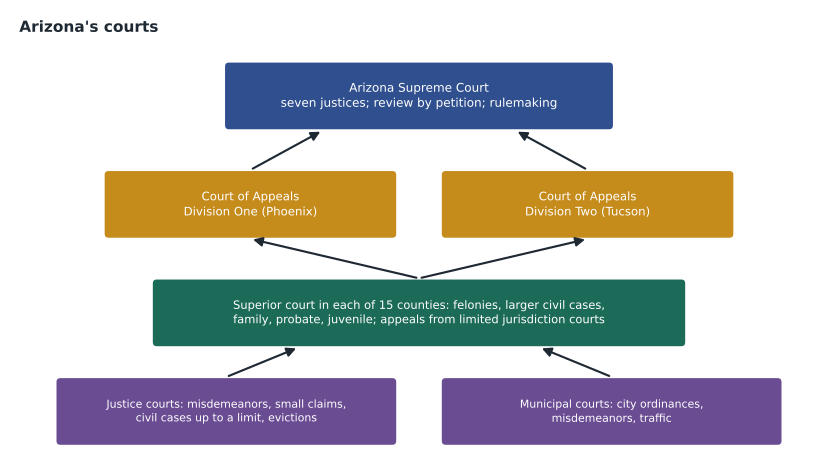
Arizona has an integrated judicial system administered by the Arizona Supreme Court. At the top is the Supreme Court itself, with seven justices since the legislature enlarged it from five in 2016. It hears cases mainly by discretionary review of Court of Appeals decisions, has original jurisdiction over certain matters, and hears death penalty appeals directly. It also has broad administrative and rulemaking authority over all Arizona courts and the practice of law, which is the source of the admission rules discussed in this course.
The Court of Appeals is divided into two divisions: Division One, based in Phoenix, and Division Two, based in Tucson. Each hears appeals from the superior courts in its assigned counties. Division One also hears certain statewide matters, such as appeals from the Industrial Commission and unemployment decisions.
The superior court is the general jurisdiction trial court, with a court in each of Arizona's fifteen counties. It hears felony cases, civil cases above the limit of the justice courts, family law, probate, juvenile and mental health matters, and appeals from limited jurisdiction courts. Below it are the limited jurisdiction courts: justice courts, organized by precinct within each county, which hear misdemeanors, small claims, civil cases up to a statutory limit, and residential eviction cases; and municipal courts, which hear city ordinance violations, misdemeanors and traffic matters within city limits. Rafael's eviction defense work is almost entirely in justice courts.
How judges are chosen
Arizona was one of the first states to adopt merit selection. Since a 1974 constitutional amendment, justices of the Supreme Court, judges of the Court of Appeals, and superior court judges in the most populous counties are appointed by the governor from lists of nominees submitted by commissions on appellate and trial court appointments, and then stand for retention elections. Voters decide whether to keep each judge, rather than choosing between candidates. In the less populous counties, superior court judges are elected in nonpartisan elections. Justices of the peace are elected, and municipal judges are usually appointed by city councils.
For a new lawyer, the practical consequences are modest but real. Judicial performance reviews, published before retention elections by a commission on judicial performance review, are a public source of information about trial judges, and lawyers who appear before judges are among those surveyed for them.
Civil procedure: where Arizona differs from the federal rules
The Arizona Rules of Civil Procedure are modeled on the federal rules, and many provisions are numbered and worded alike. The Arizona Supreme Court restyled the rules effective January 1, 2017, partly to align their organization with the federal rules. But several features differ in ways that matter on the first day of practice.
The first is disclosure. Rule 26.1 imposes an initial disclosure obligation broader than the federal Rule 26(a)(1). Each party must disclose, without a discovery request, the factual basis of its claims or defenses, the legal theories on which they rest, the names of witnesses and the subject of their expected testimony, persons with relevant knowledge, documents and electronically stored information that may be relevant, damages computations and insurance agreements, among other things. Arizona courts have long described the rule's purpose as preventing trial by ambush, and they can exclude evidence or witnesses that were not timely disclosed. The duty is continuing: parties must supplement disclosures promptly as new information comes to light.
The second is case tiers. Under Rule 26.2, civil cases are assigned to one of three tiers based on the amount claimed and the complexity of the case. Each tier comes with presumptive limits on discovery, such as the number of interrogatories, requests for production and the hours of fact-witness depositions, and on the time allowed to complete discovery. Lower tiers get tighter limits. Parties may seek more discovery by agreement or court order, but the default is proportional to the stakes.
The third is compulsory arbitration. Arizona statutes and Rule 72 require that civil cases seeking only money below a limit set by each superior court go first to court-annexed arbitration before a lawyer serving as arbitrator, with the right to appeal for a trial de novo. Lawyers practicing in superior court must learn their county's limit and procedures, and new lawyers are often appointed to serve as arbitrators.
The fourth is attorney fees. Arizona follows the American rule that each side pays its own lawyer, but A.R.S. section 12-341.01 allows the court to award reasonable fees to the successful party in any contested action arising out of a contract. The provision applies to a wide range of claims connected to contracts, and it changes the economics of commercial and consumer litigation: the prospect of paying the other side's fees affects whether to sue, settle or defend.
| Topic | Federal Rules of Civil Procedure | Arizona Rules of Civil Procedure |
|---|---|---|
| Initial disclosure | Rule 26(a)(1): witnesses, documents, damages, insurance that the party may use | Rule 26.1: broader, including factual bases and legal theories; continuing duty; exclusion for nondisclosure |
| Discovery limits | Proportionality under Rule 26(b)(1); numeric limits on interrogatories and depositions | Three tiers under Rule 26.2 with presumptive limits tied to amount and complexity |
| Small money cases | No compulsory arbitration under the federal rules | Compulsory arbitration under Rule 72 below a limit set by each superior court |
| Fees in contract cases | American rule unless a statute or contract provides otherwise | A.R.S. 12-341.01 permits fee awards to the successful party in contested actions arising out of contract |
Suing public entities
Claims against Arizona public entities and public employees are governed by special statutes that catch many new lawyers. Under A.R.S. section 12-821.01, a person with a claim against a public entity or public employee must file a notice of claim with the person authorized to accept service within 180 days after the cause of action accrues. The notice must contain facts sufficient to understand the basis of liability and a specific amount for which the claim can be settled, with facts supporting that amount. A claim that is not properly noticed is barred. Under A.R.S. section 12-821, the action itself must then be brought within one year after the cause of action accrues. These periods are far shorter than the general two-year limitation period for personal injury claims under A.R.S. section 12-542.
The Arizona Constitution and private litigation
Arizona's 1912 constitution, written in the Progressive Era, contains several provisions that limit the legislature's power to restrict injured people's claims. Article 18, section 6 provides that the right of action to recover damages for injuries shall never be abrogated. Article 2, section 31 provides that no law shall be enacted limiting the amount of damages to be recovered for causing the death or injury of any person. And Article 18, section 5 provides that the defenses of contributory negligence and assumption of risk shall in all cases be questions of fact left to the jury. Together these provisions explain why Arizona has no statutory cap on damages in personal injury cases and why courts have struck down some legislative attempts to limit claims. Lesson 8 shows how they interact with Arizona's comparative fault statute.
The Arizona Constitution also has its own declaration of rights. Article 2, section 8 provides that no person shall be disturbed in private affairs, or the home invaded, without authority of law, and the Arizona Supreme Court has sometimes read it more protectively than the Fourth Amendment, particularly for the home. Article 2, section 2.1, the Victims' Bill of Rights adopted by voters in 1990, gives crime victims rights to be informed, present and heard in criminal proceedings. Lesson 9 returns to both.
Worked problem
Ana and the missing notice of claim
On March 1, 2026, a city bus clips Ana's car in Tucson, injuring her. Her lawyer files suit against the city on February 20, 2027 without having served a notice of claim. What problem does the city raise?
Show solution
- A claim against a public entity requires a notice of claim within 180 days after accrual under A.R.S. 12-821.01, including a specific settlement amount and supporting facts.
- The 180-day period ran in late August 2026, and no notice was served.
- The action must also be filed within one year under A.R.S. 12-821; suit on February 20, 2027 is within one year, but the missing notice is a separate bar.
Answer: The city will move to dismiss because no timely notice of claim was filed. The two-year general limitation period does not help Ana, because the public entity statutes control.
Common mistakes
MistakeArizona disclosure works like federal Rule 26(a)(1).
InsteadArizona Rule 26.1 is broader and requires disclosure of factual bases and legal theories, with exclusion as a sanction.
MistakeA suit against a city has two years like other injury claims.
InsteadA notice of claim is due within 180 days, and suit within one year.
MistakeArizona caps damages in personal injury cases.
InsteadThe Arizona Constitution forbids laws limiting damages for death or injury.
MistakeEvery Arizona judge is elected in a contested race.
InsteadAppellate judges and superior court judges in the most populous counties are appointed under merit selection and face retention elections.
A day in justice court
Rafael describes a typical morning in a Pima County justice court eviction calendar to the group. Residential eviction actions in Arizona move quickly under the Arizona Rules of Procedure for Eviction Actions, a separate set of rules adopted by the Supreme Court. The landlord files a complaint, the tenant is summoned to appear within days, and the initial appearance is often the trial. Tenants may raise defenses such as improper notice, the landlord's failure to maintain the premises as required by the Arizona Residential Landlord and Tenant Act, or retaliation, but must be ready to present them at once. Judgments can be entered the same day, and a writ of restitution can issue within days after that. 'The speed is the hardest thing to explain to clients,' Rafael says. 'By the time many tenants find us, the trial is tomorrow morning.'
That speed is why procedural details matter. A notice that does not meet the statutory requirements, a complaint that misstates the amount owed, or a failure to follow the eviction rules on service can lead to dismissal, which gives the tenant time to cure, move or negotiate. New lawyers who practice in limited jurisdiction courts need to learn the specialized rules that apply there, which often differ from the Arizona Rules of Civil Procedure used in superior court.
Appeals in brief
Appeals from superior court judgments in civil cases go to the Court of Appeals by notice of appeal, which must generally be filed within 30 days after entry of the judgment under the Arizona Rules of Civil Appellate Procedure. Appeals from justice and municipal courts go first to the superior court, sitting as an appellate court, and further review is limited. Review in the Arizona Supreme Court is by petition for review, which the court grants in a minority of cases, usually those raising important questions of statewide significance or conflicts among Court of Appeals decisions. Special actions, Arizona's procedure for seeking extraordinary relief similar to writs of mandamus or prohibition, allow review of some interlocutory rulings; the Supreme Court adopted new Rules of Procedure for Special Actions effective in 2025, and lawyers should consult the current rules before filing.
Why procedure belongs in this course
None of this appears on the UBE or NextGen exam, which test federal procedure. But procedural mistakes cause more harm to clients than almost anything else a new lawyer can do: a missed notice of claim, an unmet disclosure deadline, an appeal filed a day late. Marchetti asks every candidate in her group, whatever their jurisdiction, to make one page listing the procedural deadlines that could end a client's case in their state. For Arizona, Rafael's list starts with the 180-day notice of claim, the one-year limit against public entities, the two-year personal injury limit, the 30-day notice of appeal, and the disclosure deadlines under Rule 26.1.
Marchetti adds one more item to Rafael's list: the limits on time to respond to a complaint, to disclose, and to object, because missing any of them can cost a client the case before it is heard on the merits.
Marchetti's broader point is that every state's procedure has traps like these, and that a new lawyer's first job in any new court is to find them before they find the client.
Summary and key terms
- Arizona's courts are the Supreme Court (seven justices), a two-division Court of Appeals, a superior court in each county, and justice and municipal courts.
- Merit selection with retention elections applies to appellate judges and superior court judges in the most populous counties.
- Arizona civil procedure differs from the federal rules in broad Rule 26.1 disclosure, Rule 26.2 tiers, compulsory arbitration and fee awards in contract actions.
- Claims against public entities require a notice of claim within 180 days and suit within one year.
- The Arizona Constitution forbids abrogating injury claims and capping damages, and leaves contributory negligence to the jury.
- Rule 26.1 disclosure
- Arizona's broad, continuing duty to disclose claims, defenses, witnesses and documents without a request.
- Case tiers
- Rule 26.2's categories that set presumptive discovery limits.
- Compulsory arbitration
- Court-annexed arbitration required for smaller money claims before trial.
- Claim notice (public entities)
- The statutory notice required before suing an Arizona public entity or employee.
- Merit selection
- Appointment of judges from commission lists, followed by retention elections.
Lesson quiz · 5 questions
Score 60% or more to complete this lesson.
Create a free account to save your progress, take quizzes and earn a certificate.