
BAR-203 · Lesson 8 of 12 · 16 min
Arizona torts: comparative fault, several liability and damages
▶ Video coming soon A video version of this lesson is on the way.
Rafael's office does not handle personal injury cases, but its clients are often on the receiving end of them: tenants hurt by unsafe conditions, workers injured on the job, pedestrians struck by cars. 'Every week someone asks me whether they have a case,' he says. 'I know the MBE answer. I need the Arizona answer.' This lesson covers the features of Arizona tort law that most often change outcomes: pure comparative fault, the near abolition of joint and several liability, the role of nonparties at fault, the constitutional protections for injured people, and a few statutes that shape common claims.
Pure comparative fault
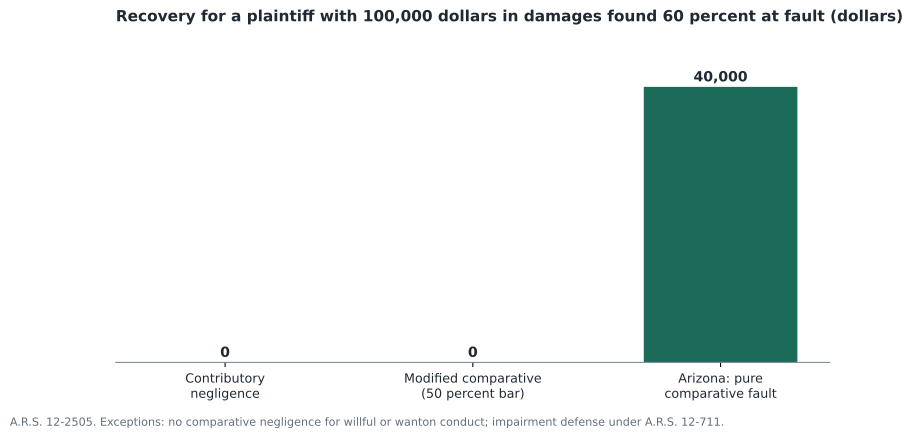
Arizona adopted comparative negligence by statute in 1984, and A.R.S. section 12-2505 sets the rule. The claimant's own fault does not bar recovery; it reduces the damages in proportion to the claimant's share of fault. Arizona uses pure comparative fault: a claimant found 80 percent at fault can still recover 20 percent of his or her damages from a defendant found 20 percent at fault. There is no threshold, such as the 50 or 51 percent bar used in modified comparative fault states.
The statute has an important exception. Section 12-2505 provides that there is no right to comparative negligence in favor of a claimant who intentionally, willfully or wantonly caused or contributed to the injury or death. A separate statute, A.R.S. section 12-711, gives defendants a complete defense where the claimant was under the influence of alcohol or drugs and, as a result, was at least 50 percent responsible for the accident. Lawyers advising clients with impairment facts should read both statutes closely, because they change a pure comparative fault case into one where recovery can be barred.
Because of Article 18, section 5 of the Arizona Constitution, the defenses of contributory negligence and assumption of risk are always questions of fact for the jury. Arizona courts have held that this provision gives the jury discretion to decide whether and how to apply a plaintiff's fault, and trial courts give a jury instruction reflecting that discretion. The result is that a defendant cannot obtain a judgment as a matter of law simply because the plaintiff was negligent; the jury decides.
On the bar exam, the MBE's default rule is also pure comparative negligence unless a question says otherwise, so this is one area where Arizona law and the UBE default agree. Candidates should still answer the question asked, applying whatever rule the question states.
Several liability and nonparties at fault
The bigger departure from the MBE default is joint and several liability. In 1987, the Arizona legislature largely abolished it. Under A.R.S. section 12-2506, each defendant's liability is several only, not joint: each defendant pays only the damages allocated to it in direct proportion to its percentage of fault, and a separate judgment is entered against each. If one defendant is insolvent, the plaintiff bears that loss rather than the solvent defendants.
The statute keeps joint and several liability in a few situations, which the statute lists. They include defendants who were acting in concert, defined narrowly as entering into a conscious agreement to pursue a common plan or design to commit an intentional tort and actively taking part in it; a party who is liable for the fault of another person because that person was its agent or servant; and certain claims under federal law and hazardous waste statutes. Outside those exceptions, liability is several.
Section 12-2506 also requires the trier of fact to consider the fault of all persons who contributed to the injury, whether or not they are parties to the case, and whether or not they could be sued. That includes nonparties who settled, nonparties who are immune, and nonparties who simply were not named. A defendant who wants the jury to allocate fault to a nonparty must give notice under the rules of civil procedure, identifying the nonparty and the basis of the claim that the nonparty was at fault, within the time the rules allow. Rule 26(b)(5) of the Arizona Rules of Civil Procedure governs the notice. Plaintiffs' lawyers learn early to identify every possible nonparty at fault and decide whether to sue them, because fault allocated to an unnamed nonparty reduces what the named defendants pay.
| Situation | MBE default | Arizona rule |
|---|---|---|
| Plaintiff partly at fault | Pure comparative negligence unless stated otherwise | Pure comparative fault under A.R.S. 12-2505; jury decides whether to apply plaintiff's fault |
| Two negligent defendants, one insolvent | Joint and several liability: plaintiff may collect all from the solvent one | Several liability under A.R.S. 12-2506: each pays only its share |
| Fault of someone not sued | Often not allocated | Allocated to nonparties at fault after proper notice |
| Acting in concert to commit an intentional tort | Joint liability | Joint and several liability preserved |
No caps on damages
Article 2, section 31 of the Arizona Constitution forbids any law limiting the amount of damages recoverable for causing the death or injury of any person. As a result, Arizona has no statutory cap on compensatory or punitive damages in personal injury and wrongful death cases, unlike many states that cap noneconomic damages in medical malpractice cases. The anti-abrogation clause of Article 18, section 6 adds a related protection: the legislature may regulate claims, but it may not abolish a right of action for injuries that existed at common law. Arizona courts have applied these clauses to strike down or narrow some statutes affecting injury claims, while upholding others as permissible regulation. A lawyer evaluating a statute that limits an injury claim should check how Arizona courts have treated it under these provisions.
Punitive damages are available in Arizona, but the standard is demanding. Under Arizona case law, a plaintiff must prove by clear and convincing evidence that the defendant acted with an evil mind, either intending to cause injury or consciously pursuing a course of conduct knowing that it created a substantial risk of significant harm to others. Ordinary negligence, even gross negligence in the everyday sense, is not enough.
Wrongful death
Arizona's wrongful death statutes, A.R.S. sections 12-611 to 12-613, allow an action when death is caused by a wrongful act that would have entitled the injured person to sue had he or she lived. The action is brought by the surviving spouse, child, parent or guardian, or personal representative, for the benefit of the statutory beneficiaries. Unlike some states, Arizona allows recovery of damages for the survivors' own losses, including loss of companionship and the grief and sorrow they suffer, as the jury finds fair and just. The general two-year limitation period for personal injury under A.R.S. section 12-542 also applies to wrongful death, running from the date of death.
Common Arizona statutes in injury practice
A few other statutes appear often. Arizona's dram shop statutes, A.R.S. sections 4-311 and 4-312, impose liability on licensed liquor sellers who sell to an obviously intoxicated person or to an underage person in some circumstances, while protecting social hosts and limiting other claims. Arizona's recreational use statute limits the liability of landowners who open land to the public for recreation without charge. Public entity claims require the notice of claim discussed in Lesson 7. And Arizona's anti-SLAPP statute, A.R.S. section 12-751, provides a procedure to dismiss claims that target the exercise of constitutional rights of petition and speech in certain settings.
Workers' compensation is the exclusive remedy for most workplace injuries against the employer, administered by the Industrial Commission of Arizona. Arizona's constitution gives workers a distinctive option: Article 18, section 8 allows an employee to reject the compensation system before injury and keep the right to sue the employer, though few employees do. Claims against third parties, such as manufacturers or other contractors, remain available alongside workers' compensation.
Worked problem
Allocating fault in Tucson
Mia, a pedestrian, is struck in a crosswalk by a delivery van whose driver was speeding. The van's brakes were poorly maintained by a repair shop Mia did not sue. Mia was looking at her phone. The jury finds her damages are 200,000 dollars and allocates fault: van driver 50 percent, repair shop (a properly noticed nonparty) 30 percent, Mia 20 percent. The driver was acting within the scope of employment for the delivery company, which Mia sued along with the driver. What can Mia recover, and from whom?
Show solution
- Pure comparative fault reduces Mia's recovery by her 20 percent share.
- Liability is several: each defendant pays only its share.
- The repair shop's 30 percent share is allocated to a nonparty and is not recoverable from the defendants.
- The delivery company is liable for the driver's fault because the driver was its servant acting within the scope of employment, an exception that makes them jointly responsible for the driver's 50 percent.
Answer: Mia recovers 100,000 dollars, the 50 percent allocated to the driver, for which the driver and the delivery company are jointly and severally liable. The 30 percent allocated to the unsued repair shop is lost unless she sues the shop within the limitation period.
Common mistakes
MistakeIn Arizona, a plaintiff more than 50 percent at fault recovers nothing.
InsteadArizona uses pure comparative fault under A.R.S. 12-2505.
MistakeArizona defendants are jointly and severally liable for the whole judgment.
InsteadA.R.S. 12-2506 makes liability several, with narrow exceptions.
MistakeFault can only be allocated to people in the lawsuit.
InsteadThe jury allocates fault to properly noticed nonparties too.
MistakeArizona caps noneconomic damages in malpractice cases.
InsteadThe Arizona Constitution forbids damages caps for death or injury.
Premises liability and landlord duties
Many of Rafael's clients are tenants, and their injuries often happen at home. Arizona follows the Restatement approach to landowner duties in many respects, with the duty owed depending in part on the entrant's status, but Arizona courts have emphasized that duty is a question of law based on the relationship between the parties and public policy, not on foreseeability alone. In Gipson v. Kasey, decided in 2007, the Arizona Supreme Court held that foreseeability is not a factor in deciding whether a duty exists, though it remains relevant to breach and causation. Duties may arise from special relationships, such as landlord and tenant, and from statutes, which can supply public policy supporting a duty.
For landlords, the Arizona Residential Landlord and Tenant Act, A.R.S. title 33, chapter 10, requires landlords to comply with building codes materially affecting health and safety, make repairs needed to keep the premises fit and habitable, and keep common areas clean and safe. Breach of those duties can support both statutory remedies, such as a tenant's notice to repair and termination rights, and a negligence claim when a tenant is injured.
Medical malpractice
Arizona does not cap damages in medical malpractice cases, because of Article 2, section 31. The legislature has instead regulated how claims proceed. A.R.S. section 12-2603 requires a plaintiff in a medical malpractice case to certify whether expert testimony is necessary and, if so, to serve a preliminary expert opinion affidavit. A.R.S. section 12-2604 sets qualifications for standard-of-care experts, generally requiring that the expert practice in the same specialty as the defendant. These statutes have survived challenges as permissible regulation rather than abrogation, and they make expert screening one of the first tasks in any malpractice case.
Why the UBE answer and the Arizona answer differ
Marchetti finishes the torts session with a warning she gives every candidate from a state whose law departs from the MBE defaults. On the February exam, when an MBE question involves two negligent defendants and is silent on the rule, assume joint and several liability, because that is what NCBE's outline tells examinees to do. In practice in Tucson the week after admission, the answer is several liability under A.R.S. 12-2506. The two answers are not in conflict; they answer different questions. 'One is what the test asks,' she says. 'The other is what your client needs. Keep them in separate drawers until after February 24.'
A checklist for injury intake
Rafael turns the lesson into an intake checklist for the clinic's volunteers. When a client describes an injury: note the date, because the two-year limit under A.R.S. 12-542 starts running; ask whether any government entity, employee or vehicle was involved, because the 180-day notice of claim deadline may apply; list everyone who might share fault, because unnamed parties can still be allocated fault; ask about alcohol or drugs on the client's part, because of the impairment defense; and ask whether the injury happened at work, because workers' compensation may be the exclusive remedy against the employer. The checklist does not decide whether the client has a case, but it makes sure no deadline or defense is missed before a lawyer looks at the file.
Rafael adds a final line to the checklist: if a client signed a release or settlement with anyone involved, get a copy at once, because releases of one party can affect how fault is allocated and what the client can still recover from others.
Marchetti points out that several of these steps, especially identifying nonparties at fault and government involvement, are worth doing even before deciding whether to take a case, because the deadlines start running at the moment of injury, not when a lawyer is hired.
Summary and key terms
- Arizona uses pure comparative fault; the jury decides whether and how to apply a plaintiff's fault.
- A.R.S. 12-2506 makes liability several only, except for acting in concert, vicarious liability and a few statutory claims.
- The jury allocates fault to all who contributed, including properly noticed nonparties.
- The Arizona Constitution forbids damages caps and protects common-law injury claims from abrogation.
- Punitive damages require clear and convincing evidence of an evil mind; wrongful death allows recovery for survivors' own losses.
- Pure comparative fault
- A system in which a plaintiff's fault reduces but never bars recovery.
- Several liability
- Each defendant pays only its own share of fault.
- Nonparty at fault
- A person not in the case to whom the jury may allocate fault after notice.
- Acting in concert
- A conscious agreement to commit an intentional tort, which preserves joint liability in Arizona.
- Anti-abrogation clause
- Article 18, section 6, which protects the right of action for injuries.
Lesson quiz · 5 questions
Score 60% or more to complete this lesson.
Create a free account to save your progress, take quizzes and earn a certificate.