
BAR-203 · Lesson 9 of 12 · 16 min
Arizona community property, family law and real estate
▶ Video coming soon A video version of this lesson is on the way.
The most common question at Rafael's legal aid office's family law clinic is some version of 'What is mine?' A client who bought a truck during a marriage, a client whose spouse ran up credit card debt, a client whose house is in her mother's name: each needs an answer under Arizona's community property statutes. Arizona is one of nine community property states, and its marital property law has roots in the Spanish civil law that governed the region before 1848. This lesson covers community property, divorce and its financial consequences, children's issues, covenant marriage, and the real estate rules that most often catch new lawyers: deeds of trust, trustee's sales and anti-deficiency protection.
What is community property
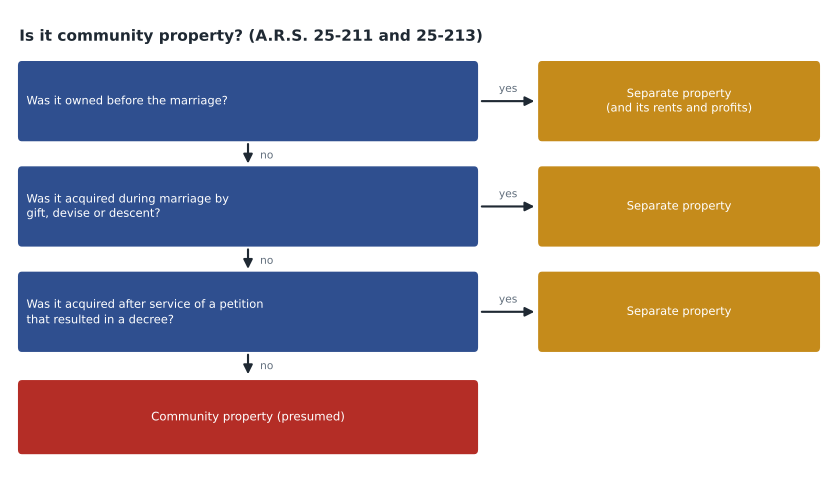
Under A.R.S. section 25-211, all property acquired by either spouse during the marriage is community property, with listed exceptions. The main exceptions are property acquired by gift, devise or descent, which remains the separate property of the spouse who received it, and property acquired after service of a petition for dissolution, legal separation or annulment, if the petition results in a decree. Section 25-213 defines separate property: property owned before marriage, property acquired during marriage by gift, devise or descent, and the increase, rents, issues and profits of separate property.
Arizona law presumes that property acquired during marriage is community property, and a spouse who claims that such property is separate must prove it, generally by clear and convincing evidence. Commingling can make that difficult: separate funds deposited into a joint account and mixed with community earnings may lose their separate character if they can no longer be traced. Separate property can also become partly community if community funds or effort are used to improve it or pay down its mortgage, which can give the community a lien or an interest measured by Arizona case law.
Managing community property and paying debts
Spouses have equal management, control and power to dispose of community property under A.R.S. section 25-214, with important exceptions. Both spouses must join in any transaction to acquire, dispose of or encumber an interest in real property, other than an unpatented mining claim or a lease of less than one year, and in any transaction of guaranty, indemnity or suretyship. A deed or mortgage signed by only one spouse affecting community real property can be challenged, which is why title companies insist on both signatures.
Debts follow a related structure under A.R.S. section 25-215. Debts incurred by a spouse during marriage for the benefit of the community are community obligations, which can be satisfied from community property and from the separate property of the spouse who incurred the debt. A spouse's separate debts, such as debts incurred before marriage, can be satisfied from that spouse's separate property and, to a limited extent, from community property equal to the value of that spouse's contribution to the community. Creditors in Arizona therefore commonly sue both spouses when pursuing a community debt.
Dissolution and division
Arizona is a no-fault divorce state. A court may enter a decree of dissolution if it finds the marriage irretrievably broken, which can be shown by one spouse's testimony; the other spouse's disagreement does not prevent the decree. In dividing property, A.R.S. section 25-318 directs the court to assign each spouse his or her separate property and to divide community, joint tenancy and other commonly held property equitably, though not necessarily in kind, without regard to marital misconduct. Arizona courts treat an equal division as the usual starting point for equity, departing only for sound reasons, such as one spouse's excessive or abnormal spending, destruction, concealment or fraudulent transfer of community property, which the statute specifically allows the court to consider. Property acquired outside Arizona is treated as community property for division purposes if it would have been community property had it been acquired in Arizona.
Spousal maintenance, Arizona's term for alimony, is governed by A.R.S. section 25-319. The court first decides whether a spouse is eligible under the statute's grounds, such as lacking sufficient property to provide for reasonable needs, or being unable to be self-sufficient through appropriate employment, and then sets the amount and duration considering the statutory factors. The Arizona Supreme Court has adopted Spousal Maintenance Guidelines that help courts set the amount and duration once eligibility is found. Marital misconduct is not a factor in eligibility, though excessive spending or concealment may be.
Children: legal decision-making and parenting time
Arizona replaced the terms custody and visitation in 2013. Courts now decide legal decision-making, meaning the authority to make major decisions for a child, and parenting time, under A.R.S. section 25-403 and related statutes, in accordance with the child's best interests. The statute lists factors, including the child's relationship with each parent, the child's adjustment, the mental and physical health of those involved, which parent is more likely to allow frequent and meaningful contact with the other, and any domestic violence or child abuse. Under A.R.S. section 25-403.03, joint legal decision-making may not be awarded if the court finds significant domestic violence, and the court must consider domestic violence in deciding parenting time. Child support is set under the Arizona Child Support Guidelines adopted by the Supreme Court and updated periodically.
Covenant marriage
Arizona is one of three states, with Louisiana and Arkansas, that offer covenant marriage. Under A.R.S. section 25-901 and following, a couple may choose at marriage, or convert an existing marriage, into a covenant marriage by declaring their intent and, in most cases, completing premarital counseling. A covenant marriage can be dissolved only on limited grounds listed in A.R.S. section 25-903, such as adultery, a felony conviction with imprisonment, abandonment for at least a year, physical or sexual abuse, living separate and apart for a statutory period, habitual drug or alcohol abuse, or both spouses agreeing to the dissolution. Few couples choose covenant marriage, but a family lawyer must ask, because the grounds for dissolution differ.
Real estate: deeds of trust and anti-deficiency protection
Most Arizona home loans are secured not by mortgages but by deeds of trust under Arizona's Deed of Trust Act, A.R.S. title 33, chapter 6.1. A deed of trust lets the trustee sell the property at a nonjudicial trustee's sale after default and notice, without going to court. A lender may still use judicial foreclosure, but the trustee's sale is faster and more common.
Arizona protects many homeowners from deficiency judgments. Under A.R.S. section 33-814(G), if trust property of two and one-half acres or less, limited to and used for a single one-family or single two-family dwelling, is sold at a trustee's sale, the lender cannot obtain a deficiency judgment for any balance remaining after the sale. A.R.S. section 33-729(A) provides similar protection for purchase-money mortgages on comparable residential property foreclosed judicially. Where a deficiency action is allowed, section 33-814 requires it to be brought within ninety days after the trustee's sale, and the deficiency is measured against the property's fair market value, not just the sale price. Arizona courts have applied these protections broadly, though questions arise about properties under construction, refinanced loans and homes that were never occupied by the borrower.
Arizona's recording statute, A.R.S. section 33-412, makes unrecorded conveyances void as to creditors and subsequent purchasers for value without notice. Arizona also allows spouses to hold title as community property with right of survivorship under A.R.S. section 33-431, which combines the tax treatment of community property with a survivorship feature so that the surviving spouse takes the whole without probate.
| Issue | MBE default | Arizona rule |
|---|---|---|
| Marital property | Common-law title system; equitable distribution at divorce | Community property under A.R.S. 25-211; equitable division, presumptively equal, under 25-318 |
| Foreclosure | Judicial foreclosure of a mortgage, with deficiency judgment | Nonjudicial trustee's sale under a deed of trust; anti-deficiency protection for qualifying homes |
| Recording | Race, notice or race-notice, as the question states | A.R.S. 33-412: unrecorded conveyances void against later purchasers for value without notice |
| Spousal survivorship | Tenancy by the entirety or joint tenancy | Community property with right of survivorship (A.R.S. 33-431) |
Worked problem
After the trustee's sale
Carlos and Elena bought a two-bedroom house on a quarter-acre lot in Mesa and lived in it. After Carlos lost his job, they defaulted, and the lender sold the house at a trustee's sale for less than the loan balance. The lender then sued both of them for the deficiency. What should their lawyer argue?
Show solution
- The property is two and one-half acres or less and was limited to and used as a single one-family dwelling.
- It was sold at a trustee's sale under a deed of trust.
- A.R.S. 33-814(G) therefore bars a deficiency judgment.
Answer: Their lawyer should move to dismiss under the anti-deficiency statute. Had the property been a vacant lot or a rental fourplex, the protection would not apply, and the lender would have ninety days after the sale to sue for a fair-market-value deficiency.
Common mistakes
MistakeAn inheritance received during marriage is community property.
InsteadProperty acquired by gift, devise or descent is separate under A.R.S. 25-211 and 25-213.
MistakeOne spouse can sell community real estate alone.
InsteadBoth spouses must join in transactions affecting community real property under A.R.S. 25-214.
MistakeAn Arizona court can award more property to the spouse who was faithful.
InsteadDivision is made without regard to marital misconduct, though wasteful spending may be considered.
MistakeA homeowner always owes the shortfall after a trustee's sale.
InsteadA.R.S. 33-814(G) bars deficiencies on qualifying homes of two and one-half acres or less.
Community property in practice: three questions clients ask
The first question is usually about debt. A client whose spouse ran up credit cards during the marriage asks whether she is responsible. Under A.R.S. 25-215, a debt incurred during marriage for the benefit of the community is a community obligation that can be collected from community property, including the client's share, and from the separate property of the spouse who incurred it. The client's own separate property is generally not reachable for the other spouse's community debt. At dissolution, the court allocates community debts along with community assets, and A.R.S. 25-318 allows the court to consider debts in dividing property. Creditors are not bound by the allocation, however, so a decree that assigns a debt to one spouse does not stop the creditor from pursuing the other if both are liable to the creditor.
The second question is about retirement accounts. Contributions to a pension or retirement account made during marriage are community property, even if the account is in one spouse's name. At dissolution, Arizona courts divide the community portion, often using a qualified domestic relations order to divide employer plans without tax penalties. Contributions made before marriage, and their growth, remain separate if traceable.
The third question is about a business. A business started during marriage is community property. A business owned before marriage remains separate, but if one spouse's work during the marriage increased its value, the community may be entitled to a share, measured under Arizona case law by methods that compare a fair return on the separate capital with the value attributable to community effort.
Prenuptial and postnuptial agreements
Spouses can change the default rules by agreement. Arizona has adopted the Uniform Premarital Agreement Act, A.R.S. sections 25-201 to 25-205, which allows a couple to agree before marriage on the ownership and management of property, disposition on separation or death, and other matters, but not to adversely affect a child's right to support. An agreement is unenforceable if a party did not sign it voluntarily, or if it was unconscionable when signed and the party did not receive, did not waive and could not reasonably have obtained fair disclosure of the other's property and obligations. Postnuptial agreements are also allowed, but courts scrutinize them for fairness because spouses owe each other fiduciary duties.
Leaving Arizona or arriving
Arizona's division statute reaches property acquired elsewhere: under A.R.S. 25-318, property acquired outside Arizona is treated as community property for division if it would have been community property had it been acquired in Arizona. A couple who moves to Arizona from a common-law state and divorces here will have their out-of-state acquisitions divided as if they were community property. The rule applies to division at dissolution; at death, separate statutes govern.
Rafael's clinic now gives every new family law client a one-page handout on these rules, written in plain English and Spanish, so that clients understand from the first meeting why the date of acquisition and the source of the money matter so much in Arizona.
A note on exam answers
As with torts, keep Arizona's property and family rules separate from exam answers. The MBE tests common-law marital property only incidentally and assumes judicial foreclosure with deficiency judgments unless told otherwise. On the February exam, answer the question asked under the rule the question states or NCBE's defaults. In practice in Arizona, use the statutes in this lesson.
Summary and key terms
- Property acquired during marriage is community property unless acquired by gift, devise or descent or after service of a petition resulting in a decree.
- Spouses manage community property equally, but both must join in real property transactions and guaranties.
- Arizona divorce is no-fault; community property is divided equitably, usually equally, without regard to misconduct.
- Courts decide legal decision-making and parenting time by the child's best interests; covenant marriage limits grounds for dissolution.
- Deeds of trust and trustee's sales dominate Arizona real estate, with anti-deficiency protection for qualifying homes.
- Community property
- Property acquired by either spouse during marriage, owned equally by both.
- Separate property
- Property owned before marriage or received by gift, devise or descent, and its profits.
- Legal decision-making
- Arizona's term for authority over major decisions about a child.
- Covenant marriage
- An optional form of marriage with limited grounds for dissolution.
- Anti-deficiency statute
- A law barring a lender from suing for the balance after foreclosure on qualifying property.
Lesson quiz · 5 questions
Score 60% or more to complete this lesson.
Create a free account to save your progress, take quizzes and earn a certificate.