
BAR-203 · Lesson 2 of 12 · 16 min
Eligibility, education, deadlines and fees
▶ Video coming soon A video version of this lesson is on the way.
Rafael's second session with Marchetti is about paperwork. 'The rules decide whether you may sit,' she says, 'and the calendar decides when. Most candidates who lose a sitting do not lose it on the exam. They lose it in the filing window.' This lesson covers who is eligible to sit the Arizona exam, how early a student can sit, the filing calendar, the fees, and the special rules for applicants who need testing accommodations.
Who may sit
Rule 34(b) sets out the general qualifications for admission, and they also govern who may apply to sit the exam. An applicant must be over 21 years of age. The applicant must be of good moral character and mentally, emotionally and physically able to engage in the active and continuous practice of law. An applicant already admitted elsewhere must be in good standing there, or must have resigned in good standing; the Committee may look past a deficiency that consists only of unpaid fees or incomplete continuing education that the applicant could not cure in the other jurisdiction.
The education requirement is a Juris Doctor from a law school that was provisionally or fully approved by the American Bar Association at the time the degree was conferred. There is one alternative: an applicant with a JD from a school that was not ABA-approved can qualify if he or she has been actively engaged in the practice of law in one or more states, territories or the District of Columbia for at least three of the five years before applying. Arizona does not accept an LLM in place of a JD, does not admit graduates of foreign law schools who lack a qualifying JD, and does not allow study in a law office in place of law school.
These rules matter for planning. A graduate of a California-accredited school that is not ABA-approved, for example, cannot sit in Arizona straight out of school, though he or she could become eligible after three years of active practice following admission in California. A lawyer trained abroad who wants to practice in Arizona typically has to earn a JD at an ABA-approved school first.
Sitting before graduation
Arizona allows some students to sit the exam before their JD is conferred. Under Rule 34(b)(2), a student may sit early if he or she is expected to graduate within 120 days of the first day of the exam, has no more than eight semester hours left to complete, and meets the other conditions in the rule, including certification from the law school. The rule protects the integrity of the result: if the JD is not conferred within the required period, the exam scores are void. Early sitting is aimed mainly at students who finish their degree in a winter term and want to sit the February exam rather than wait until July.
Rafael considered early sitting but did not qualify: he graduated in May 2026, too late for February and too early to need the rule for July. Early sitters for the February 2027 exam face the same NextGen consideration that Rafael does: a failure in February means a retake in July 2027 on the NextGen exam.
The filing calendar
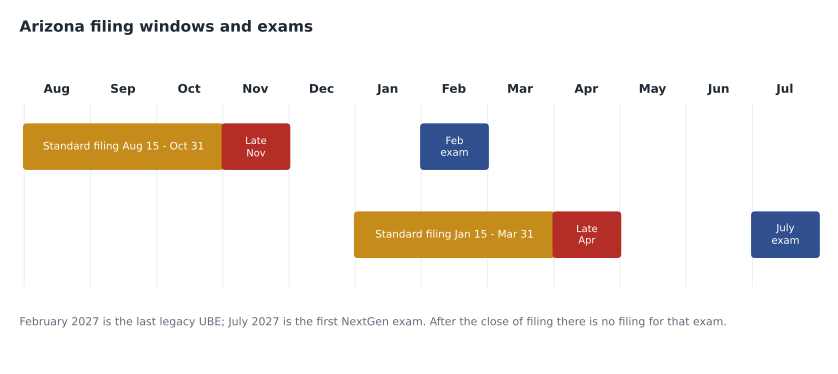
The Arizona exam is given twice a year, at the end of February and at the end of July. Applications are filed online through the court's bar admissions portal, and each exam has a standard filing period, a late filing period with an additional fee, and a hard close of filing. Based on the court's published schedule and NCBE's jurisdiction information, the windows run as follows.
| Exam | Standard filing period | Late filing period | Close of filing | Proof of graduation |
|---|---|---|---|---|
| February | August 15 to October 31 | November 1 to November 30 | November 30 | February 1, for those who finish the prior semester |
| July | January 15 to the end of March | April 1 to April 30 | April 30 | June 15, for those who finish the prior semester |
After the close of filing, there is no way to sit that exam. An applicant who misses the late deadline must wait for the next exam, which for anyone missing the February 2027 deadline means waiting until the first NextGen exam in July 2027.
Marchetti's rule for Rafael was to file in the first half of the standard period, not the last week. 'The fee is lower, you have time to fix anything the office flags, and your character investigation starts sooner. People who file on the last day are always the ones who discover their fingerprint card is the wrong kind.' Arizona requires fingerprints on the court's own fingerprint card, taken by local law enforcement, not the generic card a fingerprinting service may hand out.
Fees
Arizona's fees are set by the court and published by the admissions office. For the bar exam, the application fee in the standard filing period is 680 dollars, and filing in the late period adds a late fee. Exam applicants also pay a separate character report fee of 400 dollars, which covers the character investigation. After passing, an applicant pays an administrative fee for admission of 185 dollars, which includes access to the course on Arizona law. State Bar membership dues are billed separately by the State Bar once the applicant is admitted. Applicants who need to take the MPRE pay NCBE's fee directly to NCBE.
Score transfer and admission on motion applicants follow different fee schedules, published with those application forms; the character report and admission fees described above apply to exam applicants. Because fees change, confirm current amounts on the admissions website before filing. The application must be complete when filed, with the fee, the character report, the photograph, the fingerprint card and supporting documents. Incomplete applications delay the character investigation and can cause the applicant to miss the exam.
| Item | Amount (published 2026 schedule) | Who pays |
|---|---|---|
| Exam application, standard filing | 680 dollars | Exam applicants |
| Late filing | Higher fee during the late period | Exam applicants filing late |
| Character report | 400 dollars | Exam applicants |
| Administrative fee for admission (includes the course on Arizona law) | 185 dollars | Exam applicants, after passing |
| MPRE | NCBE's fee, paid to NCBE | All applicants |
What the application asks
The bar application is long. It asks for a full residential, employment and education history; every court proceeding in which the applicant has been a party; every arrest, citation and criminal charge, including those dismissed, sealed or expunged; academic discipline; financial delinquencies; professional licenses and any discipline; and other matters bearing on character. The court publishes sample application questions so applicants can see what is asked before they open the portal. Lesson 3 explains how to answer the character questions. For now, the practical point is to start gathering records early: old addresses, employer contact details, court records for traffic matters, and credit reports.
Accommodations
Applicants with disabilities may request testing accommodations, such as extra time, a separate room, breaks or assistive technology. The request is made with the application on the court's accommodation form, together with documentation from a qualified provider using the form that matches the basis of the request. The admissions office advises applying early, because incomplete requests may be denied and there may not be time to cure them before the exam. Applicants who received accommodations on the MPRE or in law school should not assume they carry over: Arizona decides accommodation requests for its own exam, though prior accommodations are relevant evidence.
Requests for accommodations unrelated to disability, such as nursing breaks or religious observance, are handled through the admissions office as well, and should be raised as early as possible.
Worked problem
Can Lena sit in February?
Lena expects to finish her JD at an ABA-approved school on December 18, 2026, with six semester hours left in her final term. The February 2027 exam begins on February 23. She files her application on November 15. May she sit, and what must she watch?
Show solution
- Early sitting under Rule 34(b)(2) requires expected graduation within 120 days of the first day of the exam and no more than eight semester hours remaining.
- December 18 is before the exam, so she will in fact have graduated; she must provide proof of graduation by the February 1 deadline for prior-semester graduates.
- November 15 falls in the late filing period, so she will pay the late fee; the close of filing is November 30.
- If she fails in February, her retake would be the July 2027 NextGen exam.
Answer: Lena may sit, paying the late fee, provided her degree is conferred and documented by February 1. Filing during the standard period would have saved the late fee and given her investigation a head start.
Common mistakes
MistakeA non-ABA JD is never good enough for Arizona.
InsteadA non-ABA JD qualifies after three of the last five years of active practice elsewhere.
MistakeI can file late in December if I pay extra.
InsteadThe close of filing for the February exam is November 30; after that there is no filing.
MistakeAny fingerprint card will do.
InsteadArizona requires its own fingerprint card, taken by law enforcement.
MistakeMy law school accommodations carry over automatically.
InsteadArizona decides accommodation requests for its own exam on its own forms.
Building a filing checklist
Marchetti gives every Arizona candidate the same checklist, and Rafael copies it into his calendar. Six weeks before the filing window opens: order official transcripts if the application requires them, download the sample application questions, and pull a credit report. Four weeks before: make an appointment with a law enforcement agency for fingerprints on the Arizona card, and gather court records for every traffic citation and any other proceeding. Two weeks before: draft the residence and employment history in a spreadsheet with exact dates, because the portal's forms are easier to complete from a finished list. In the first two weeks of the window: file, pay, upload the photograph and confirm that the office has received the fingerprint card. Then, every two weeks until the exam, check the portal for requests from the admissions office and answer each one within days, not weeks.
She also tells him what not to do. Do not guess at dates in the history; write 'approximately' and explain how you estimated them. Do not round a period of unemployment into a neighboring job. Do not leave a question blank because it seems irrelevant; answer 'none' or 'not applicable' so the reviewer knows you read it. And do not wait for the admissions office to ask for something you know is missing. A short letter explaining that a record has been requested and when it is expected keeps the file moving.
For the July exam the rhythm is the same, shifted to the spring: the window opens in mid-January, the standard period runs to the end of March, and the close of filing is April 30. Candidates who graduate in May should plan to file in January or February, while they still have a law school's registrar and career office at hand to help with documents.
Finally, Marchetti reminds Rafael that the application is a continuing obligation. Anything that changes after filing, such as a new address, a new job, a traffic citation or a court filing, must be reported to the admissions office until he is admitted. Lesson 3 explains why the Committee takes that duty seriously.
When the rules and the instructions disagree
Occasionally, a candidate finds that a date or a fee on a third-party website differs from the court's own materials, as the filing deadline for the July exam does between some published sources, which give March 30 or March 31. When that happens, follow the court's current instructions and, if in doubt, file earlier rather than later. Third-party summaries, including law school guides, bar review company pages and this course, are useful starting points but are not the rules. The court's admissions website and the rules themselves govern.
Rafael's own application illustrates the point. A friend told him that Arizona required official law school transcripts with the application. The court's checklist for his exam said otherwise for his situation; what it required was proof of graduation by the stated deadline. Checking the official checklist saved him a week of chasing documents he did not need, and it reminded him to confirm that his law school would send the certification on time.
Finally, keep copies of everything you submit and every confirmation you receive. If a document goes missing, a dated confirmation email or portal screenshot is often the fastest way to show that you filed on time.
A word on cost planning
Bar admission is expensive even before bar review. Rafael adds up his Arizona costs: the application fee, the character report fee, the administrative fee for admission, fingerprinting, travel to the test site in Phoenix and a hotel for two nights, plus State Bar dues after admission. His legal aid office reimburses part of the cost, as many public interest employers do, and his law school offers small bar-expense grants. Candidates should budget early and ask employers and schools what help is available, because financial stress in the last weeks before the exam is avoidable.
Summary and key terms
- Applicants must be over 21, of good character and fit, in good standing elsewhere, and hold an ABA-approved JD or a JD plus three of the last five years of practice.
- Students within 120 days of graduation with no more than eight semester hours left may sit early; scores are void if the JD is not conferred.
- Each exam has a standard period, a late period with an added fee and a hard close of filing: November 30 for February and April 30 for July.
- Exam applicants pay a 680 dollar application fee, a 400 dollar character report fee and, after passing, a 185 dollar admission fee that includes the course on Arizona law.
- Accommodation requests go in with the application, with full documentation.
- Early sitting
- Sitting the exam before the JD is conferred, under Rule 34(b)(2).
- Close of filing
- The last day to apply for a given exam.
- Character report
- The detailed background report every exam applicant files, with its own fee.
- Administrative fee for admission
- The fee paid after passing, which includes the course on Arizona law.
- Testing accommodation
- A change in testing conditions granted for a documented disability or other approved reason.
Lesson quiz · 5 questions
Score 60% or more to complete this lesson.
Create a free account to save your progress, take quizzes and earn a certificate.