
BAR-204 · Lesson 1 of 12 · 15 min
Becoming a lawyer in Arkansas
▶ Video coming soon A video version of this lesson is on the way.
Caleb Ostrander joins Hollis Marchetti's study group in the fall of 2026 with a plan that is simple to state and harder to carry out: pass the February 2027 bar exam in Arkansas and be sworn in before the summer. He finished law school in May 2026 at one of Arkansas's two law schools, grew up in Jonesboro, and now works as a law clerk at a small firm in Fayetteville whose clients are mostly farms, family businesses and landowners. He has heard three things about the Arkansas bar from classmates: that the passing score is high, that the exam is 'the national one', and that nobody knows what the exam will look like after 2028. Marchetti tells him that all three are true, and that the third is the most interesting.
'Every jurisdiction does three things,' she says at their first session. 'It decides who may apply, it tests what you know, and it decides whether you can be trusted with other people's money and secrets. Arkansas does all three. What makes Arkansas unusual right now is that its supreme court has not yet decided what test it will give once the current exam is retired. You are sitting the current exam, so that question will not change your February, but it will shape your advice to every law student who asks you about the bar in the next two years.'
This lesson maps the whole process: the authorities involved, the requirements you must meet, the order in which you usually meet them, and the places where candidates most often go wrong. Later lessons take each step in detail and then turn to the Arkansas law that sets the state apart in practice.
Who controls admission
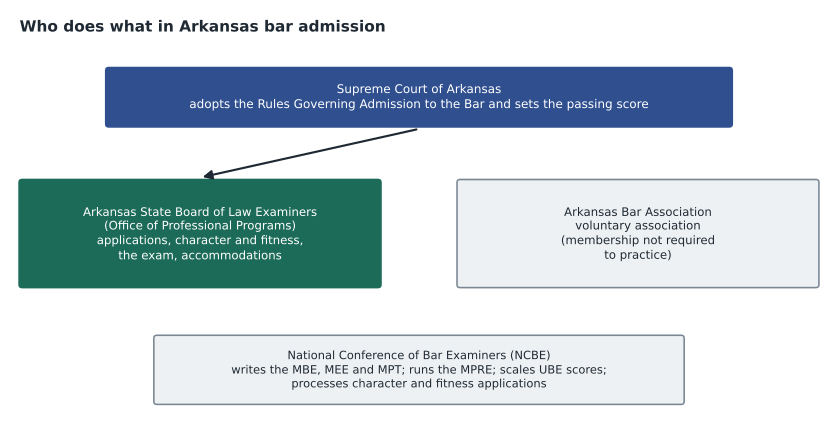
Admission to practice law in Arkansas is controlled by the Supreme Court of Arkansas. The court adopts the Rules Governing Admission to the Bar, sets the passing score, and changes the rules by per curiam order, an unsigned order of the whole court. When the rules change, the change comes from the court, not from the bar association or the law schools. Recent examples include the June 12, 2025 per curiam on the NextGen bar exam (2025 Ark. 119), which Lesson 5 covers, and a June 11, 2026 per curiam amending Rule VI to say who may administer the attorney's oath (2026 Ark. 114). Because the court changes its rules this way, this course keeps telling you to check the current rules on the Arkansas Judiciary website rather than rely on summaries, including this one.
The day-to-day work is done by the Arkansas State Board of Law Examiners, which works through the court's Office of Professional Programs in Little Rock. The board receives and reviews applications, runs the character and fitness investigation, gives the exam twice a year, and decides accommodation requests. Applicants reach it by email at BarExamApplicants@arcourts.gov. The board's pages on the Arkansas Judiciary website carry the current instructions and application for each exam, and those instructions are the documents you must follow line by line.
The National Conference of Bar Examiners (NCBE), a national nonprofit, plays a supporting role. NCBE writes the three tests that make up the Uniform Bar Examination (UBE), scales and equates the scores, runs the Multistate Professional Responsibility Examination (MPRE), and offers a character and fitness application service that Arkansas uses for standard applicants. NCBE does not admit anyone. 'NCBE builds the exam,' Marchetti says. 'Arkansas decides what to do with your score and whether you get in.'
Once admitted, a lawyer practices under other parts of the court's system as well. The Arkansas Bar Association is a voluntary association, not a mandatory one, so joining it is a choice. Licensing, the annual license fee, continuing legal education and lawyer discipline all run through the supreme court and its offices. Lesson 11 returns to life after admission.
The requirements in one list
For an applicant seeking admission by examination, the requirements published by the board come down to five. You must be eligible, which in Arkansas mainly means holding a J.D. or LL.B. from a law school approved by the American Bar Association (ABA) when the degree was conferred, and being a U.S. citizen, a lawful permanent resident or otherwise authorized to work or study in the United States. You must file a complete application by the deadline. You must pass the UBE with a total score of at least 270. You must earn a scaled score of at least 85 on the MPRE within the time the board allows. And you must satisfy the board that you have the good moral character and mental and emotional stability the rules require.
| Requirement | What Arkansas asks | Where this course covers it |
|---|---|---|
| Eligibility | J.D. or LL.B. from an ABA-approved school; lawful status; good standing if licensed elsewhere | Lesson 2 |
| Application | Received by November 15 for February or April 1 for July; 1,000 dollar fee | Lesson 2 |
| Character and fitness | Detailed questionnaire, references, fingerprints, NCBE application for standard applicants | Lesson 3 |
| MPRE | Scaled score of 85 or more, earned within three years before or one year after the passing exam | Lesson 3 |
| Bar exam | UBE total of 270 or more | Lesson 4 |
| Admission | Certification, petition and oath before an authorized officer | Lessons 2 and 11 |
Look at what is not on the list. Arkansas does not, as of November 2026, require a separate state-law test or a required online course on Arkansas law. NCBE's jurisdiction page lists no jurisdiction-specific component for Arkansas. That makes Arkansas different from neighbors such as Missouri, which adds the Missouri Educational Component Test, and from Texas, which adds its own law component. The absence of a state component is one of the open questions in the court's 2025 per curiam, which asked the board to consider whether to add an Arkansas-specific component in the future.
Two numbers to remember: 270 and 85
Arkansas asks more of candidates on both national scores than many jurisdictions do. Its UBE passing score of 270 sits at the top of the range among UBE jurisdictions, where passing scores run from 260 to 270. Its MPRE requirement of 85 is likewise at the high end of the range, which runs from 75 to 86. These numbers matter in two ways. First, they set the target for your preparation: a candidate who would pass comfortably in a 260 jurisdiction can fail in Arkansas with the same performance. Second, they shape score portability: a 270 earned in Arkansas meets the passing score of every UBE jurisdiction, while a score earned elsewhere must reach 270 to transfer into Arkansas.
The order of events
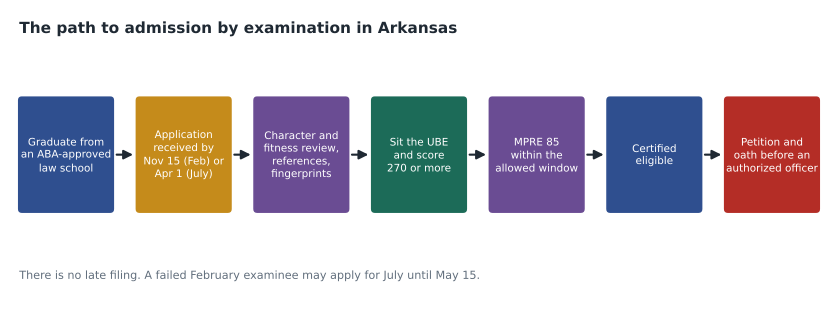
Most Arkansas applicants move through the process in a predictable order. During law school, they take the MPRE, often in the second or third year, keeping in mind that the score must fall within the window Lesson 3 explains. In the final year, they gather the documents the application asks for: past addresses, employment history, references who have known them at least four years, and records for anything that requires a 'yes' answer on the character questions. After graduation, they file the application by the deadline, pay the fee and complete the fingerprinting steps. They then sit the exam in Little Rock or Fayetteville on the last Tuesday and Wednesday of February or July. Results follow some weeks later. A successful candidate who has met every other requirement is certified as eligible, files a petition and takes the oath, and is enrolled as a licensed attorney.
Two features of the Arkansas calendar surprise people. The first is the early July deadline: applications for the July exam must be received by April 1, before most students graduate in May. A law student who plans to sit in July therefore files while still in school, and the law school later certifies the degree. The second is the retake deadline: an applicant who sits the February exam and fails may apply for the following July exam until May 15, after February results are released. Lesson 2 covers both.
Worked problem
Planning Caleb's calendar
Caleb graduated in May 2026, took the MPRE in March 2025 and scored 92, and wants to sit the February 2027 exam. When must his application arrive, and is his MPRE score usable?
Show solution
- The February 2027 application must be received by November 15, 2026, at 5 p.m. at the board's office; postmarks do not count.
- His MPRE score must be at least 85: 92 qualifies.
- It must have been earned within three years before the exam he passes, or within one year after it. March 2025 is within three years of February 2027.
- If he fails in February and retakes in July 2027, the score is still within three years of July 2027.
Answer: He must file by November 15, 2026; his MPRE score is usable for February 2027 and, if needed, July 2027.
Where candidates go wrong
The first common mistake is treating the 270 as a formality. Marchetti shows Caleb a simple fact about scaled scores: because UBE scores are equated across administrations, the same performance earns roughly the same score wherever it is earned. The difference between a 266 and a 270 can be a handful of MBE questions and part of one essay grade. Candidates who aim for a 'safe pass' in a lower-score state sometimes fall just short in Arkansas.
The second is missing a document. The Arkansas application is detailed. It wants an original signed application, not a copy or scan, a notarized authorization and release, a law school verification form unless the school certifies directly, a state police identity verification form or an out-of-state fingerprint card, references sent directly by the references, and supporting documents for every 'yes' answer. An application that arrives without these is incomplete, and incomplete applications create delays near exam day.
The third is assuming the deadline bends. The instructions for recent administrations say the application must be received by 5 p.m. on the deadline date at the board's office, and that postmarked applications do not qualify. The same instructions describe no late-filing period. If the deadline falls on a weekend or holiday, the board's page says it moves to the next business day, but otherwise there is no grace.
The fourth is forgetting that the application is a continuing duty. The board expects applicants to keep their applications current until the day they are admitted, including changes of address, employment, and anything new that would change an answer to a character question. A new citation, lawsuit or debt problem after filing must be reported.
Common mistakes
MistakeArkansas adds a state-law test to the UBE.
InsteadAs of November 2026, Arkansas gives the UBE with no state-law component and no required Arkansas law course.
MistakeNCBE decides who is admitted.
InsteadThe Supreme Court of Arkansas controls admission; the State Board of Law Examiners applies the rules; NCBE writes and scores the national tests.
MistakeA postmark by the deadline is enough.
InsteadThe application must be received at the board's office by 5 p.m. on the deadline; postmarks do not qualify.
MistakeArkansas has already adopted the NextGen exam.
InsteadThe court deferred its decision in 2025 Ark. 119; comments and the board's report are due by December 31, 2026.
How to use this course
Each lesson ends with a short quiz, and the course ends with a twenty-question exam. Lessons 1 through 6 and Lesson 11 cover the admission process: who may sit, what the exam is, how it is scored, what may change and what happens after. Lessons 7 through 10 turn to Arkansas law itself: its courts and procedure, its tort law, its property and family law, and its law of wills, probate and dower. Arkansas does not test that law on its bar exam today, so treat those lessons as preparation for practice, for the questions clients ask in the first year, and for whatever Arkansas component the court may add later. Lesson 12 pulls the substantive lessons together in original practice questions and an essay, and closes with an exam-week plan.
Facts about the admission process in this course come from the Arkansas Judiciary website, the Supreme Court of Arkansas's per curiam orders and rules, and NCBE's published jurisdiction information, as they stood in November 2026. Where a fact could not be confirmed from an official source, the course says so or describes it in general terms. Some official pages disagree with each other on small points, such as where to send an application or how to pay; when that happens, the course points it out and tells you to follow the current exam instructions.
Caleb leaves the first session with an assignment: find the Rules Governing Admission to the Bar on the Arkansas Judiciary website, read the rule on eligibility, download the instructions for the February 2027 exam, and read the 2025 NextGen per curiam. 'You do not need to memorize the rules,' Marchetti says. 'You need to know where they are, and you need to read them yourself before every deadline.'
Summary and key terms
- The Supreme Court of Arkansas controls admission; the Arkansas State Board of Law Examiners, through the Office of Professional Programs, runs the process; NCBE writes and scores the national tests.
- Exam applicants need a J.D. or LL.B. from an ABA-approved school, a timely and complete application, a UBE score of 270 or more, an MPRE score of 85 or more within the allowed window, and character and fitness approval.
- Arkansas has given the UBE since February 2020 and has no state-law component or required state law course.
- Applications must be received by November 15 for February and April 1 for July; failing February examinees may apply for July until May 15.
- The court has not decided what exam to give after the legacy UBE ends; comments and the board's report are due by December 31, 2026.
- Rules Governing Admission to the Bar
- The Supreme Court of Arkansas's rules on who may be admitted to practice law in Arkansas and how.
- Arkansas State Board of Law Examiners
- The board that reviews applications, investigates character and fitness, gives the bar exam and decides accommodations.
- Per curiam
- An unsigned opinion or order of the whole court; the Supreme Court of Arkansas changes its admission rules this way.
- Uniform Bar Examination (UBE)
- The NCBE exam made up of the MBE, MEE and MPT, given in Arkansas since February 2020.
- Passing score
- The minimum total UBE score Arkansas accepts; it is 270.
Lesson quiz · 5 questions
Score 60% or more to complete this lesson.
Create a free account to save your progress, take quizzes and earn a certificate.