
BAR-204 · Lesson 2 of 12 · 16 min
Eligibility, education, deadlines and fees
▶ Video coming soon A video version of this lesson is on the way.
Marchetti opens the second session by asking Caleb to read the eligibility list from the July 2026 Arkansas instructions aloud. It has five items, and she makes him explain each one in his own words. 'Eligibility is a gate,' she says. 'If you are not eligible, nothing else matters: not your MBE score, not your references, not how hard you studied. The good news is that the Arkansas gate is short and clear. The bad news is that it is strict.'
The five eligibility conditions
The board's instructions for recent exams list five conditions for sitting the Arkansas bar exam. First, the applicant must be a citizen of the United States, a lawful permanent resident, or otherwise authorized to work or study lawfully in the United States. Second, the applicant must hold a Juris Doctor degree from a law school that was approved by the American Bar Association when the degree was conferred; the board's general requirements page also accepts the older LL.B. degree on the same condition. Third, the applicant must be of good moral character and possess the mental and emotional stability to practice law. Fourth, an applicant already licensed elsewhere must be in good standing in every jurisdiction of admission. Fifth, such an applicant must not be currently subject to lawyer discipline or the subject of a pending disciplinary matter in any other jurisdiction.
| Condition | What it means in practice |
|---|---|
| Lawful status | Citizenship, permanent residence or other lawful authorization to work or study in the United States |
| ABA-approved degree | A J.D. (or LL.B.) from a school approved by the ABA at the time the degree was conferred |
| Character and fitness | Good moral character and the mental and emotional stability to practice law (Lesson 3) |
| Good standing | For lawyers already admitted elsewhere: good standing everywhere admitted |
| No pending discipline | For lawyers admitted elsewhere: no current discipline or pending disciplinary matter |
The ABA requirement, and why it matters
Arkansas ties eligibility to the ABA's approval of the law school. A graduate of a school that was not ABA-approved when the degree was conferred cannot sit the Arkansas exam on that degree, no matter how strong the school or the student. The rule looks at the moment of graduation: a school that gained provisional ABA approval before the student graduated counts, while a school that gained approval only afterward does not help that graduate.
Arkansas has two law schools, both ABA-approved: the University of Arkansas School of Law in Fayetteville and the University of Arkansas at Little Rock William H. Bowen School of Law. The board's instructions note a practical consequence of having in-state schools: graduates of those two schools do not submit the law school verification form themselves, because the schools certify their graduates directly to the board. Graduates of any other school must send the verification form.
The ABA requirement has become more visible nationally in the last two years. BAR-101, the first course in this program, describes how Texas ended its ABA-only requirement in January 2026 and how Florida opened its exam to graduates of schools approved by other accreditors from October 1, 2026. Arkansas has not made a similar change as of November 2026; its published instructions still require an ABA-approved degree. Candidates from non-ABA schools, and foreign-educated lawyers, should read the current rules and contact the board before assuming any route is open.
Foreign-trained lawyers face the same gate. Many jurisdictions, including New York and California, let some foreign-educated lawyers qualify through an LL.M. degree or through practice. The Arkansas instructions describe no such route for exam applicants: the degree must be a J.D. or LL.B. from an ABA-approved school. A lawyer educated abroad who wants to practice in Arkansas usually needs to earn an ABA-approved J.D., or first qualify in another state and later explore the routes in Lesson 11, all of which have their own education requirements.
Filing deadlines
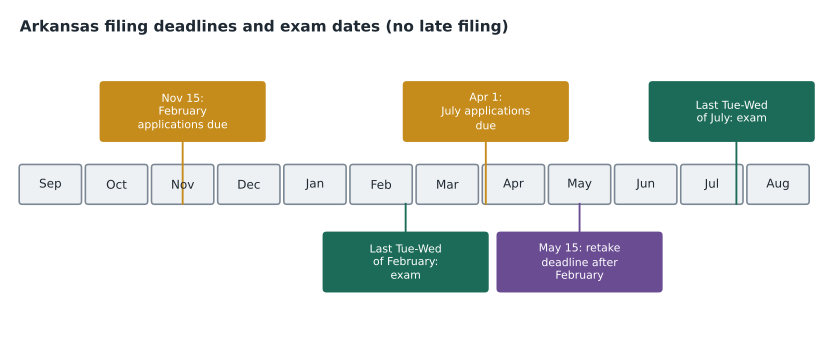
The Rules Governing Admission set the filing deadlines, and the board's page summarizes them. For the February exam, the application must be filed by November 15 of the preceding year. For the July exam, it must be filed by April 1 of the same year. An applicant who sat the February exam and failed may apply for the July exam until May 15. If a deadline falls on a weekend or legal holiday, it moves to the next business day.
The instructions for the July 2026 exam make the rule concrete: the application had to be received at the board's office by 5 p.m. on Wednesday, April 1, 2026. Applications that were merely postmarked by that date, or that were delivered somewhere other than the board's office, did not qualify. Requests for testing accommodations had to arrive by the same deadline. The instructions describe no late-filing period and no late fee, which means the deadline works as a wall rather than a price.
The exam dates
Arkansas gives the bar exam on the last Tuesday and Wednesday of February and July, the national UBE dates. In July 2026, for example, the MPT and MEE were given on Tuesday, July 28, and the MBE on Wednesday, July 29. The exam is given at the same time in two places, Little Rock and Fayetteville. Applicants state a preferred location, but the board does not guarantee it; each applicant is told the assigned location at least 45 days before the exam. Applicants approved for accommodations test in Little Rock at a separate site.
Fees and payment
The application fee for the Arkansas bar exam is 1,000 dollars, and it is not refundable. That fee applies to first-time takers, repeaters and lawyers admitted elsewhere who sit the exam. Applications for admission by transferred UBE score and admission on motion carry their own fee of 1,500 dollars, as Lesson 11 explains.
Here the official sources do not all say the same thing, and Marchetti uses the point to teach a habit. The instructions for the July 2026 exam required payment by cashier's check or money order payable to the Arkansas State Board of Law Examiners, and refused personal checks, business checks, cash and credit cards. The board's general requirements page now describes paying the fee online through the state's payment portal at the end of the exam application. Both describe the same amount. 'When two official pages disagree,' she says, 'you follow the instructions for the exam you are sitting, and you send the board a short email to confirm. Then you keep the answer.'
Three kinds of application
The board's page describes three ways to apply. A standard application is for first-time takers and for anyone whose earlier application is more than three years old. It includes the full Arkansas questionnaire and the NCBE character and fitness application. An abbreviated application is for repeat takers within three years of their first application; they send updates on character matters directly to the board instead of starting over. An applicant who keeps failing must file a new standard application, with a new NCBE application, every three years.
The third kind is a courtesy seat. Arkansas lets a person sit the UBE in Arkansas solely to earn a score to transfer to another UBE jurisdiction. Courtesy-seat applicants do not complete the NCBE character and fitness application, because Arkansas is not deciding whether to admit them; the jurisdiction that receives the score will do its own review. A courtesy seat is useful for someone who lives in Arkansas but wants to be admitted elsewhere, for example in Tennessee or Oklahoma.
| Application | Who uses it | Character and fitness |
|---|---|---|
| Standard | First-time takers; anyone whose last application is more than three years old | Full Arkansas questionnaire plus NCBE application |
| Abbreviated | Repeat takers within three years of the first application | Updates sent directly to the board |
| Courtesy seat | People sitting in Arkansas only to earn a transferable UBE score | No NCBE application; the receiving jurisdiction reviews |
What goes in the envelope
The July 2026 instructions list what a complete application contains. There is the completed original application with all supplemental sheets; the board does not accept copies or scans. There is a notarized authorization and release form, a law school verification form unless the applicant graduated from one of the two Arkansas schools, and either the Arkansas State Police identity verification form for in-state applicants or a fingerprint card for out-of-state applicants. There is a preferred exam location form, every supplemental character and fitness document, and the fee. Several items go directly to the board from someone else: the MPRE score from NCBE if it is not already on file, certificates of good standing and disciplinary history from any jurisdiction where the applicant is admitted, and reference forms, which each reference returns directly. Applicants must also include a copy of every application they have filed with other jurisdictions.
Fingerprinting rests on a statute. The instructions cite Arkansas Code section 12-12-211, under which the board obtains criminal background checks. In-state applicants complete a state police identity verification form and are later sent instructions for electronic fingerprinting; out-of-state applicants request a fingerprint card from the board, which is stamped to show the statute, and take it to a fingerprinting service.
Worked problem
Is the application complete?
Priya, a graduate of an out-of-state ABA-approved school, mails a scanned copy of her signed application, a notarized release, her school's verification form, a fingerprint card and a cashier's check, and asks her references to email letters to her so she can forward them. What is wrong?
Show solution
- The board requires the completed original application; a scan or copy is not accepted.
- References must send their forms directly to the board; letters routed through the applicant do not satisfy the instructions.
- She must also include copies of applications filed in other jurisdictions, if any, and the location form.
- The payment method should match the current instructions, which have changed between check and online payment; she should confirm with the board.
Answer: The original application and direct reference forms are missing; she should fix both well before the deadline.
Accommodations
Applicants with disabilities may request testing accommodations. Every applicant seeking accommodations files the board's request forms and supporting documentation by the filing deadline. The board decides the request, and the instructions put the burden of proof on the applicant. The board may have the documents reviewed by a medical specialist, psychologist or neuropsychologist at the board's expense, while the applicant pays the cost of establishing the disability in the first place. Repeat applicants whose needs have not changed may use a shorter form, but a new full request is needed if the original was made more than five years earlier. Approved applicants test in Little Rock at a separate location.
Laptops
Arkansas permits applicants to type the MEE and MPT on their own laptops using the exam software the board designates. Applicants register the software in advance and bring their own laptop and charger; external devices are not allowed. If the laptop fails during the exam, the applicant must finish by hand. The MBE is answered on paper. An applicant may withdraw the laptop election and handwrite instead, but must tell the board.
Common mistakes
MistakeAny accredited law degree qualifies.
InsteadArkansas requires a J.D. or LL.B. from a school approved by the ABA when the degree was conferred.
MistakeThere is a late-filing period with a higher fee.
InsteadThe instructions describe none; the application must be received by the deadline.
MistakeA failed February examinee must wait until next year.
InsteadA February examinee who fails may apply for July until May 15.
MistakeA courtesy seat leads to admission in Arkansas.
InsteadA courtesy seat only produces a UBE score to transfer elsewhere; it skips the NCBE character application because Arkansas is not admitting the applicant.
Caleb's assignment this week is practical. He makes a list of every address he has had in the past five years, every job in the past ten, and three people outside his family who have known him for at least four years and do not share a household or employer with one another. 'Start with the list,' Marchetti says. 'Lesson 3 is about what you do with it.'
Keeping your records organized
Marchetti recommends a simple system for the Arkansas application. Keep one folder, paper or digital, for each part of the application: residence history, education, employment, references, character documents and fees. Put a dated note in each folder every time you send or receive something, such as the day a reference says she mailed her form or the day the state police identity form went out. When the board writes to ask about a missing item, you can answer in a day instead of a week. Keep a copy of the complete application exactly as filed, because the board expects later updates to match it, and because other jurisdictions may ask for it if you later seek admission elsewhere.
The same habit helps with the questions on prior applications. The Arkansas application asks for copies of every bar application filed in another jurisdiction, and character answers should be consistent across them. An applicant who disclosed a matter to one state and omitted it from another invites questions about candor that are harder to answer than the matter itself.
Summary and key terms
- To sit the Arkansas exam, an applicant needs lawful status, a J.D. or LL.B. from a school ABA-approved when the degree was conferred, good character and fitness, and good standing with no pending discipline if licensed elsewhere.
- Applications must be received by November 15 for February and April 1 for July; February examinees who fail may apply for July until May 15; there is no late filing.
- The exam fee is 1,000 dollars and is not refundable; confirm the payment method in the current instructions.
- Standard, abbreviated and courtesy-seat applications serve different applicants; standard applicants also complete the NCBE character and fitness application.
- The exam is given in Little Rock and Fayetteville; accommodations requests are due with the application.
- ABA-approved law school
- A law school approved by the American Bar Association; Arkansas requires the approval to exist when the degree was conferred.
- Standard application
- The full Arkansas application with the NCBE character and fitness application, for first-time takers or after three years.
- Abbreviated application
- A shorter application for repeat takers within three years of their first application.
- Courtesy seat
- Sitting the UBE in Arkansas only to earn a score to transfer to another jurisdiction.
- Retake deadline
- May 15, the date by which a failed February examinee may apply for the July exam.
Lesson quiz · 5 questions
Score 60% or more to complete this lesson.
Create a free account to save your progress, take quizzes and earn a certificate.