
BAR-204 · Lesson 4 of 12 · 15 min
The Arkansas bar exam: format, scoring and passing score
▶ Video coming soon A video version of this lesson is on the way.
At the fourth session Marchetti draws two days on the screen. 'This is the Arkansas bar exam,' she says. 'It is also the exam in every other UBE jurisdiction, give or take a passing score. That is good news for you. Every study guide, every practice question and every course you can buy for the UBE fits Arkansas exactly.' Caleb asks the obvious question: if the exam is the same everywhere, what makes Arkansas different? 'Two things,' she says. 'The number you need, and what the court does with your score afterward.'
Arkansas and the UBE
Arkansas has given the Uniform Bar Examination since the February 2020 administration. Before that it gave its own exam, which combined the MBE with Arkansas essays. The switch made Arkansas scores portable: a score earned in Arkansas can be transferred to other UBE jurisdictions, and scores earned elsewhere can be transferred into Arkansas, subject to each jurisdiction's own rules. The board's instructions put it simply: Arkansas now follows NCBE standards, so the exam is the UBE.
The two days
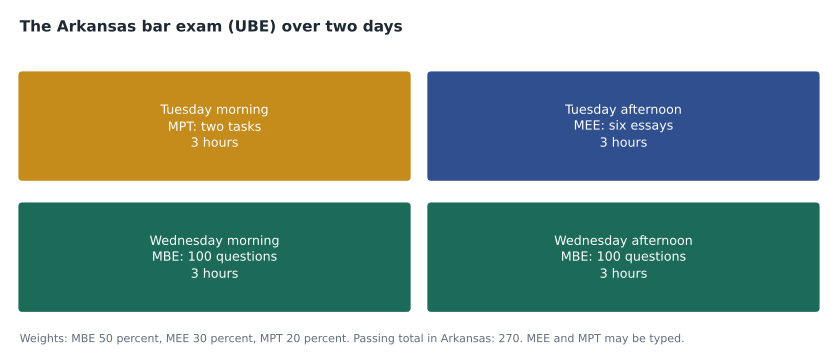
The exam runs over two days, the last Tuesday and Wednesday of February and July. On Tuesday morning, applicants work two Multistate Performance Test (MPT) tasks in a three-hour session. On Tuesday afternoon, they write six Multistate Essay Examination (MEE) essays in another three-hour session. On Wednesday, they answer the 200 multiple-choice questions of the Multistate Bar Examination (MBE), 100 in the morning and 100 in the afternoon, each session lasting three hours.
The three components
The MBE is the multiple-choice portion. Of its 200 questions, 175 are scored and 25 are unscored pretest questions mixed in so that NCBE can try them out. The scored questions cover seven subjects in equal measure: civil procedure, constitutional law, contracts, criminal law and procedure, evidence, real property and torts. BAR-110 and BAR-111 in this program review them in depth.
The MEE is the essay portion: six thirty-minute essays drawn from the MEE subject list. Since the July 2026 exam, NCBE has removed four subjects from the MEE (conflict of laws, family law, trusts and estates, and secured transactions), so the essays now draw on business associations and the MBE subjects. Family law and trusts and estates can still appear on the MPT with the law supplied, through February 2028. BAR-120 covers the essay exam and these changes.
The MPT is the performance test: two ninety-minute tasks in which applicants receive a file of facts and a library of law and must produce a lawyering document, such as a memo, brief or letter. The MPT tests skills rather than memory. BAR-121 covers it.
How the UBE is weighted and scored
On the UBE the MBE counts for 50 percent of the total score, the MEE for 30 percent and the MPT for 20 percent. The scaled MBE score is reported on a 200-point scale. The written portion, the six essays and two performance tests together, is graded by the jurisdiction's graders and then scaled to the MBE, so that a written score is comparable from one administration to the next. The two scaled halves are combined into a total on a 400-point scale.
The grading is relative. Graders in each jurisdiction rank answers against one another on each question, using NCBE's grading materials, rather than comparing them to a fixed answer. Scaling then converts the raw written grades to the MBE scale, which has been equated so that a given scaled score represents the same level of performance across administrations. The practical lesson for candidates is that every point counts and no single question decides the result: a weak essay can be made up elsewhere.
| Component | What it is | Weight |
|---|---|---|
| MBE | 200 multiple-choice questions (175 scored) in seven subjects | 50 percent |
| MEE | Six 30-minute essays | 30 percent |
| MPT | Two 90-minute performance tasks | 20 percent |
The passing score: 270
Arkansas requires a total UBE score of at least 270. Passing scores among UBE jurisdictions range from 260 to 270, and only a few jurisdictions sit at the top of that range. Arkansas set its score at 270 when it adopted the UBE, keeping the demanding standard of its old exam.
What does 270 mean in practice? Because the total is on a 400-point scale built from two 200-point halves, a 270 total is the equivalent of averaging 135 on each half. A candidate whose scaled MBE is 140 needs a scaled written score of 130 to reach 270; a candidate whose MBE is 130 needs a written score of 140. The two halves are added, so strength on one can carry weakness on the other.
Worked problem
Will this score pass in Arkansas?
Caleb takes a full practice exam and estimates a scaled MBE of 138 and a scaled written score of 129. Would that total pass in Arkansas? In a 260 jurisdiction?
Show solution
- Add the halves: 138 plus 129 is 267.
- Arkansas requires 270; 267 falls three points short.
- In a jurisdiction with a 260 passing score, 267 would pass.
- To reach 270, he could raise the MBE to 141 with the same written score, or the written score to 132 with the same MBE, or improve a little on both.
Answer: 267 fails in Arkansas but would pass in a 260 jurisdiction; he needs about three more scaled points.
Pass rates
Arkansas's demanding score shows in its results. Pass rates published by bar-prep companies, drawing on the board's results, show overall rates in the mid-sixties for recent years, with first-time takers passing at much higher rates than repeat takers, and February administrations, which have more repeat takers, well below July. Those figures come from secondary sources rather than from a page of the board this course could confirm, so treat them as a rough picture. The lesson for candidates is consistent with every jurisdiction: first-time takers who prepare fully pass at much higher rates than candidates who sit underprepared and retake.
Results and what comes next
The board releases results some weeks after each exam; check the board's pages for the expected date for your administration. A passing candidate is not yet admitted. The candidate must also have a qualifying MPRE score on file and be approved for character and fitness, and then becomes eligible for admission. Lesson 11 covers the petition and oath. A failing candidate may retake. For a February examinee who wants to sit again in July, the application is due May 15; a July examinee files by November 15 for the next February. Within three years of the first application, a repeat taker uses the abbreviated application.
The board offers applicants the option to sign a form allowing it to release their MPRE and UBE scores to their law school's academic success director. That consent helps schools support graduates who need to retake, and it is voluntary.
Score portability from Arkansas
A UBE score earned in Arkansas is portable. An Arkansas examinee can ask NCBE to transfer the score to other UBE jurisdictions, which will admit the applicant if the score meets their own passing score and age limit and the applicant meets their other requirements. Because Arkansas's passing score is 270, a passing Arkansas score meets the score requirement of every UBE jurisdiction. The courtesy seat Lesson 2 described exists for exactly this reason: a person can sit in Arkansas to earn a score for use elsewhere.
Portability will become more complicated after the legacy UBE ends. NCBE has announced that the current UBE will be given through February 2028, after which most jurisdictions will give the NextGen exam. A legacy UBE score earned in Arkansas will still be a legacy score, and each jurisdiction decides how long it will accept legacy scores and whether it will accept them at all after it switches. Lesson 5 explains why Arkansas's own future is undecided.
Exam-day rules worth knowing
The instructions for each exam list what applicants may and may not bring. A valid photo identification is required on both days. Doors close promptly at the assigned start time, and late arrivals are not admitted. Prohibited items include phones and other electronics, watches, paper, pens, food, drinks and bags. Applicants who type the written portion bring their own laptop and charger, with no external devices. If the laptop fails, the applicant finishes in handwriting. These rules can change from one administration to the next, so read the instructions for your exam the week before.
Common mistakes
MistakeArkansas still gives Arkansas essays.
InsteadArkansas has given the UBE, with no state essays, since February 2020.
MistakeThe MBE and written portions must each pass separately.
InsteadThe two scaled halves are added; the total must reach 270.
MistakeA score of 266 passes everywhere.
InsteadIt passes in many UBE jurisdictions but not in Arkansas, which requires 270.
MistakeThe MEE still tests family law and trusts and estates.
InsteadNCBE removed those subjects from the MEE starting July 2026; they can appear on the MPT with the law supplied.
Marchetti closes with a study note. 'Arkansas asks for 270, so plan for 275. Give yourself a margin for a bad essay or a tough MBE afternoon. Your preparation is exactly the preparation in BAR-110 through BAR-121, and nothing on exam day will be Arkansas-specific.'
Planning your study around the Arkansas score
Because Arkansas asks for 270, Marchetti builds Caleb's plan with a margin. She sets weekly targets for MBE practice in all seven subjects, timed essays twice a week and one full performance test each week, and she tracks his practice scores against a goal of 275. She explains the arithmetic of the margin. A candidate whose practice performance sits right at 270 has about an even chance on exam day, because performance varies from one sitting to the next. A candidate whose practice performance sits five points higher has a much better chance of clearing 270 on a bad day.
She also explains why the written portion deserves as much attention as the MBE. Because the written score is scaled to the MBE and counts for half the total, improving essay and performance test grades moves the total as much as improving MBE accuracy. Many candidates spend most of their time on multiple-choice questions because progress there is easy to measure, and then lose the points they needed on essays they never practiced under time pressure. A balanced plan practices all three parts under exam conditions.
How the essays and performance tests are graded
Arkansas's graders grade the MEE and MPT using NCBE's grading materials and a relative scale: answers are compared with one another and placed into grade bands, rather than measured against a fixed checklist. Graders reward answers that identify the issues the question raises, state the governing rules accurately, apply them to the facts with reasons, and reach a conclusion. Clear organization helps graders find those elements quickly. Headings that track the call of the question, short paragraphs and a conclusion for each issue are habits worth building during practice.
For the MPT, graders look for the skills the task requires: following the task memo's instructions, extracting the governing rules from the library, using the relevant facts from the file, and producing the kind of document asked for in the right tone. A performance test that ignores the format the supervising attorney requested, or that relies on outside law instead of the library, loses points even if its analysis is sound. BAR-121 practices these skills in detail.
Retaking the exam
Candidates who do not pass should know three Arkansas rules. First, the deadlines: a February examinee may apply for July until May 15, and a July examinee files by November 15 for February. Second, the application: within three years of the first application a repeat taker files the abbreviated application, and after three years must file a new standard application with a new NCBE character application. Third, the MPRE window, which runs from the exam the candidate eventually passes and can expire for a candidate who retakes several times. Candidates who retake should also study their score reports, which show the scaled MBE and written scores separately, and target the weaker half.
A sample week
A typical full-time study week for Caleb in January looks like this: MBE sets of thirty-three questions on four mornings, reviewed the same afternoon; two timed essays on Tuesday and Thursday, compared with model answers; a full MPT on Saturday morning; and one rest day. In the final two weeks he will take one full simulated exam on consecutive days at the same times as the real exam, to practice stamina as well as knowledge.
He will also practice handwriting at least one essay, in case his laptop fails on exam day. The instructions require examinees whose laptops fail to finish by hand, and a candidate who has never written an essay by hand under time pressure can lose time and points at the worst moment.
Summary and key terms
- Arkansas has given the UBE since February 2020: MPT and MEE on Tuesday, MBE on Wednesday.
- The MBE counts 50 percent, the MEE 30 percent and the MPT 20 percent; the written portion is scaled to the MBE.
- Arkansas requires a total of 270, the top of the UBE range; the two scaled halves are added together.
- Since July 2026 the MEE no longer tests conflict of laws, family law, trusts and estates or secured transactions.
- A passing Arkansas UBE score can be transferred to other UBE jurisdictions; the legacy UBE runs through February 2028.
- MBE
- The Multistate Bar Examination, 200 multiple-choice questions in seven subjects.
- MEE
- The Multistate Essay Examination, six 30-minute essays.
- MPT
- The Multistate Performance Test, two 90-minute lawyering tasks using a file and library.
- Scaling
- Converting raw written grades to the MBE scale so scores are comparable across administrations.
- Score portability
- The ability to transfer a UBE score to other UBE jurisdictions.
Lesson quiz · 5 questions
Score 60% or more to complete this lesson.
Create a free account to save your progress, take quizzes and earn a certificate.