
BAR-204 · Lesson 11 of 12 · 15 min
Score transfer, admission on motion and practice after admission
▶ Video coming soon A video version of this lesson is on the way.
At the eleventh session Marchetti invites Marcus Bell, the Missouri lawyer who passed the first NextGen exam in July 2026, to join the call. He has been offered a job at a firm in Bentonville that works on both sides of the Missouri line, and he wants to know how he could be admitted in Arkansas. Caleb, meanwhile, wants to know what happens after he passes: how he is sworn in, and what he must do each year to keep his license. 'Two roads into Arkansas without sitting its exam,' Marchetti says, 'and one long road after you are in.'
Admission by transferred UBE score
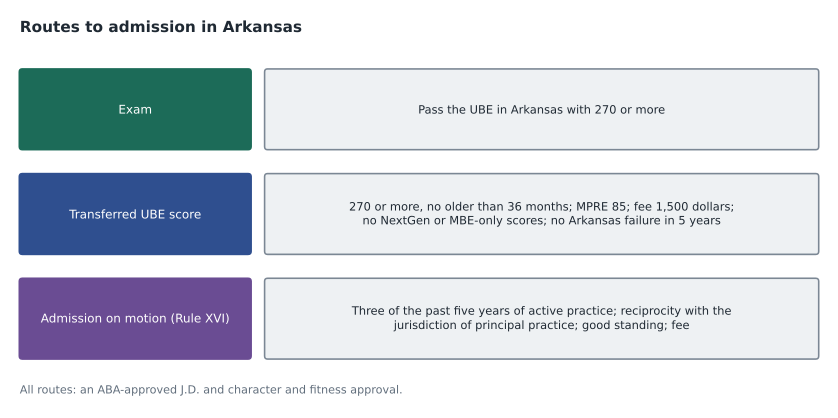
Arkansas admits lawyers and new graduates who earned a qualifying UBE score elsewhere. The board's score transfer instructions set the requirements. The applicant needs a UBE scaled score of 270 or better, from an exam taken within 36 months of when the board receives the application. The applicant needs an MPRE scaled score of at least 85. The applicant must hold a J.D. from a law school approved by the ABA when the degree was conferred, and must be a U.S. citizen, a lawful permanent resident or otherwise authorized to work or study in the United States. The applicant must not have failed the Arkansas bar exam within the five years before applying. And an applicant already admitted elsewhere must be in good standing everywhere and not subject to discipline or a pending disciplinary matter. The application fee is 1,500 dollars.
Two cautions apply. First, Arkansas accepts transferred UBE scores, not transferred MBE scores alone; a candidate who sat a non-UBE exam elsewhere cannot carry an MBE score into Arkansas. Second, as Lesson 5 explained, Arkansas does not accept transferred NextGen scores as of November 2026. The board's transfer instructions also contain a small inconsistency, describing the score window as 'thirty (36) months'; NCBE's Arkansas page lists the maximum score age as 36 months. Applicants close to the limit should confirm with the board.
Transfer applicants complete the same character and fitness steps as exam applicants: an original notarized application, certificates of good standing sent directly from each jurisdiction and dated within ninety days of the application, references returned directly to the board, a law school verification form, the authorization and release forms, and fingerprinting completed within ninety days of filing. They must keep the application current through admission, including any change of employment.
Worked problem
Can Marcus transfer his score?
Marcus passed the NextGen exam in Missouri in July 2026 with a score of 648. Can he transfer it into Arkansas? What if he had passed the legacy UBE in Missouri in July 2025 with a 272?
Show solution
- Arkansas does not accept transferred NextGen scores as of November 2026, so his 2026 score cannot be transferred.
- A legacy UBE score of 272 from July 2025 would meet Arkansas's 270 and fall within 36 months until about July 2028.
- He would also need an MPRE of 85, an ABA-approved J.D., good standing and character and fitness approval, and pay 1,500 dollars.
- He should watch the court's NextGen decision, which may change transfer rules.
Answer: His NextGen score does not transfer today; a 272 legacy UBE score would have qualified within 36 months.
Admission on motion
A lawyer with years of practice elsewhere may be admitted without an exam under Rule XVI of the Rules Governing Admission to the Bar. The applicant must have been admitted in another state, territory or the District of Columbia; hold a J.D. or LL.B. from a law school ABA-approved when the degree was conferred; and have been primarily engaged in the active practice of law for three of the five years immediately before applying. Qualifying practice includes representing clients, serving as a government lawyer or in the military, teaching at an ABA-approved law school, serving as a judge or judicial law clerk, and working as corporate counsel. Practice that was unauthorized where performed does not count.
Arkansas's admission on motion is reciprocal. The jurisdiction where the applicant had his or her principal place of practice for the two years before applying must allow Arkansas lawyers a similar accommodation. The board may excuse that two-year requirement for applicants on continuous active military duty. The applicant must be in good standing everywhere admitted, not subject to discipline or a pending disciplinary matter, and must satisfy the character and fitness standards. An applicant who failed the Arkansas bar exam within the previous five years is not eligible. The applicant designates the Clerk of the Supreme Court for service of process, files a petition and oath within one year after being certified eligible, and pays the fee, 1,500 dollars according to published fee schedules.
The rule has changed over time. In February 2020, the court amended Rule XVI to require five of the past seven years of practice; the amendment history of the current rule shows a later amendment effective December 3, 2020, and the current text and NCBE's Arkansas page both state three of the past five years. That kind of history is a reminder to read the rule in force on the day you apply.
Becoming a lawyer: the petition and the oath
Passing the exam and clearing character and fitness makes an applicant eligible for admission, but the applicant becomes a lawyer only by completing the final steps: filing the petition and taking the attorney's oath. Rule VI of the Rules Governing Admission governs the oath. In June 2026, the supreme court amended Rule VI (2026 Ark. 114) to make clear who may administer it. The oath must be taken before an officer authorized by the rule, and a notary public cannot administer it. The rule lists the authorized officers, including the Secretary of State or a designee, current and former state and federal judges and justices, county and circuit clerks, justices of the peace, certain city clerks and recorders, and the Clerk of the Supreme Court and deputies. New lawyers who plan a family swearing-in should make sure the person administering the oath is on that list.
Keeping the license: fees, CLE and conduct
Arkansas lawyers pay an annual license fee to the Clerk of the Supreme Court and must meet the state's continuing legal education requirement. Under the Arkansas Rules for Minimum Continuing Legal Education, each attorney must complete at least twelve hours of approved CLE in each reporting period ending June 30, including at least one hour of ethics. Ethics hours beyond the first count toward the general hours. A lawyer who earns more than the requirement may carry forward up to eleven general hours and one ethics hour into the next period. A newly admitted lawyer's first reporting period begins on the date of enrollment and ends on June 30 of the period after licensing, so new lawyers should check the CLE office's guidance for their first deadline.
The Arkansas Bar Association is voluntary. Many lawyers join it for its sections, publications and continuing education, but membership is not a condition of practice, unlike in states with a unified bar such as Alabama or Texas. Licensing, CLE and discipline run through the supreme court and its offices, including the Office of Professional Conduct, which investigates and prosecutes complaints of lawyer misconduct before the Supreme Court Committee on Professional Conduct.
| Obligation | Arkansas rule |
|---|---|
| Annual license | Annual license fee paid to the Clerk of the Supreme Court |
| CLE | 12 hours per period ending June 30, at least 1 hour of ethics |
| Carryover | Up to 11 general hours and 1 ethics hour |
| Bar association | Voluntary (Arkansas Bar Association) |
| Discipline | Office of Professional Conduct and the Committee on Professional Conduct |
The Arkansas Rules of Professional Conduct in practice
Arkansas lawyers are governed by the Arkansas Rules of Professional Conduct, adopted by the supreme court and based on the ABA Model Rules. New lawyers should pay early attention to the rules that most often lead to discipline: competence and diligence, communication with clients, fees, safekeeping client property in trust accounts, conflicts of interest and confidentiality. Arkansas, like other states, requires lawyers who hold client funds to keep them in trust accounts separate from their own money, and participates in an interest on lawyers' trust accounts program that funds legal aid. Before relying on Model Rule knowledge from the MPRE, a new lawyer should read the Arkansas version of the rule in question.
Lawyers also need to know when they may practice in Arkansas without being admitted, and when they may not. Lawyers admitted elsewhere may appear in a particular Arkansas case by permission of the court, often called pro hac vice admission, under the court's rules, usually with local counsel. Lawyers who move to Arkansas and practice before being admitted risk the unauthorized practice of law, which Arkansas, like every state, prohibits. Marcus, for example, should not begin advising Arkansas clients on Arkansas law until he is admitted there, even while working in a Bentonville office.
Common mistakes
MistakeAny UBE score of 266 transfers into Arkansas.
InsteadArkansas requires 270 or better, no older than 36 months.
MistakeA NextGen score can be transferred into Arkansas.
InsteadAs of November 2026, Arkansas does not accept transferred NextGen scores.
MistakeAny notary can swear in a new Arkansas lawyer.
InsteadRule VI, amended in 2026, says a notary public cannot administer the attorney's oath; only listed officers can.
MistakeArkansas lawyers must join the state bar association.
InsteadThe Arkansas Bar Association is voluntary; licensing and discipline run through the supreme court.
Marcus leaves the call with a plan: keep his Missouri license, watch for the court's NextGen decision, and if nothing changes, apply for admission on motion once he has three years of practice. Caleb leaves with a date in mind: if he passes in February, he will ask the judge he clerked for in law school to administer his oath.
The first year of practice
Marchetti closes the session with advice for Caleb's first year. Read the Arkansas Rules of Professional Conduct once from beginning to end, not just the rules the MPRE emphasized. Set up a calendar system before your first case and use it for every deadline. Learn your firm's trust account procedures before you handle client money, and never mix client funds with your own. Find a mentor outside your firm, such as through the bar association or a local legal aid program, to call when you have an ethics question at night. And keep track of your CLE hours from the start, so the June 30 deadline never arrives as a surprise.
She also suggests that he consider pro bono work early. Legal aid organizations in Arkansas serve clients across the state, especially in rural counties with few lawyers, and they train new lawyers in housing, family and consumer cases that build skills quickly. The Arkansas Rules of Professional Conduct, like the Model Rules, encourage lawyers to provide legal services to people who cannot afford them.
Practicing across state lines
Lawyers in northwest Arkansas, like Marcus, often work near the Missouri and Oklahoma lines, and lawyers in eastern Arkansas near Tennessee and Mississippi. Multi-state practice raises questions every lawyer should be ready to answer: Is the lawyer admitted where the client's matter will be heard? Does the matter require advice on another state's law? Would temporary practice be permitted under that state's version of the multijurisdictional practice rule? A lawyer who expects to practice regularly in two states should seek admission in both, using the routes in this lesson where available, rather than relying on temporary practice provisions that are meant for occasional matters.
When admission is delayed
Some applicants pass the exam but wait for admission because a character and fitness question remains open or an MPRE score is missing. During that time they may not practice law, though many work as law clerks under supervision, which is permitted because they are not holding themselves out as lawyers. An applicant in that position should keep the application current, respond quickly to the board's requests, and tell any employer the expected timing. The one-year limit for filing the petition and oath after certification, stated in the admission on motion rule and reflected in the board's practice, is a reminder not to let the final step slide once eligibility is certified.
Keeping your license active
Each year an Arkansas lawyer must pay the annual license fee and report CLE compliance. Failing to do either can lead to suspension of the license until the lawyer cures the deficiency and pays any penalty. Lawyers who leave practice temporarily, move away or retire can take inactive or other status under the court's rules, which changes their fee and CLE obligations. A lawyer should update contact information with the Clerk whenever it changes, because notices about licensing and discipline are sent to the address on file.
Summary and key terms
- Transferred UBE scores: 270 or better, within 36 months, MPRE 85, ABA-approved J.D., no Arkansas failure within five years, fee 1,500 dollars; no NextGen or MBE-only scores.
- Admission on motion under Rule XVI: three of the past five years of active practice, reciprocity with the jurisdiction of principal practice, good standing and character and fitness.
- The attorney's oath must be taken before an officer listed in Rule VI; since June 2026 the rule says a notary cannot administer it.
- Arkansas lawyers complete 12 CLE hours, including 1 ethics hour, each period ending June 30.
- The Arkansas Bar Association is voluntary; the supreme court handles licensing and discipline through its offices.
- Score transfer
- Admission based on a UBE score earned in another jurisdiction that meets Arkansas's requirements.
- Admission on motion
- Admission without exam for experienced lawyers from reciprocal jurisdictions under Rule XVI.
- Reciprocity
- The requirement that the applicant's jurisdiction of practice give Arkansas lawyers a similar accommodation.
- Attorney's oath
- The oath a new lawyer takes before an authorized officer to complete admission.
- Pro hac vice
- Permission for a lawyer admitted elsewhere to appear in a particular case.
Lesson quiz · 5 questions
Score 60% or more to complete this lesson.
Create a free account to save your progress, take quizzes and earn a certificate.