
BAR-204 · Lesson 6 of 12 · 15 min
What the exam tests and how Arkansas law appears
▶ Video coming soon A video version of this lesson is on the way.
Caleb comes to the sixth session with a confession. He has been reading Arkansas cases at night, worried that an essay will ask about an Arkansas rule. 'Stop,' Marchetti says, kindly. 'Not because Arkansas law is unimportant. It is the law you will practice. But it is not the law you will be graded on in February. Today is about drawing that line clearly, so you spend your study hours where they score, and your evenings later where they matter.'
No state component, no state law on the exam
As of November 2026, Arkansas has no jurisdiction-specific component. NCBE's Arkansas page lists the required exams as the MBE, MEE, MPT and MPRE, and marks the jurisdiction-specific requirement and any jurisdiction-drafted exam as not applicable. The board's instructions list no required course on Arkansas law. Unlike Missouri, Texas, Washington, Arizona or Alabama, Arkansas does not ask applicants to complete a test, quiz or course on its own law before admission.
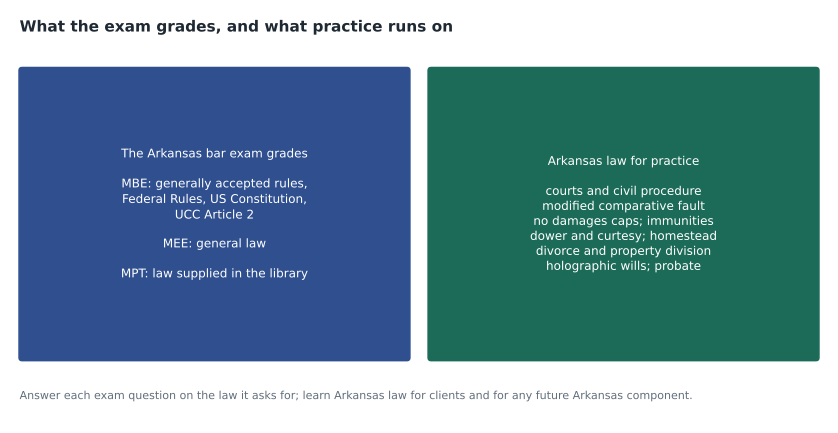
That means the Arkansas bar exam is graded under the law the UBE tests, not under Arkansas law. The MBE asks about generally accepted rules, the Federal Rules of Civil Procedure and the Federal Rules of Evidence, the United States Constitution, and Article 2 of the Uniform Commercial Code. Its torts questions assume pure comparative negligence and joint and several liability unless a question says otherwise, which is not Arkansas's approach, as Lesson 8 explains. The MEE and MPT likewise ask for general law or for the law supplied in the materials.
When Arkansas rules and exam rules differ
Some Arkansas rules differ sharply from the rules the UBE tests. Marchetti gives three examples, each covered later in the course. On negligence, the MBE assumes pure comparative fault unless told otherwise; Arkansas uses a modified comparative fault system in which a plaintiff whose fault equals or exceeds the defendants' recovers nothing. On marital property at death, the UBE does not test dower; Arkansas still gives a surviving spouse dower or curtesy rights in the deceased spouse's land. On wills, the MEE subjects no longer include trusts and estates, but Arkansas recognizes holographic wills proved by three witnesses to the handwriting, a rule a general-law answer would never mention.
The rule for the exam is to answer on the law the question asks for. If an MBE torts question is silent, answer on pure comparative fault and joint and several liability, as NCBE's outline directs, even though Arkansas would treat the case differently. If an MPT task supplies a statute, apply that statute. If an MEE question asks for generally accepted law, give it. Writing an Arkansas answer to a general-law question costs points.
Worked problem
An MBE question in an Arkansas study session
A practice MBE question: a plaintiff is 55 percent at fault for a collision and the defendant is 45 percent at fault; damages are 100,000 dollars. The question says nothing about the jurisdiction's rule. What does the plaintiff recover on the MBE, and what would happen under Arkansas law?
Show solution
- On the MBE, assume pure comparative negligence unless the question says otherwise.
- Under pure comparative negligence the plaintiff recovers damages reduced by her share of fault: 45,000 dollars.
- Under Arkansas's modified rule, a claimant whose fault equals or exceeds the defendant's recovers nothing.
- Answer the exam question on the MBE default: 45,000 dollars.
Answer: MBE answer: 45,000 dollars. Arkansas answer in practice: nothing, because 55 percent is not less than 45 percent.
Why Arkansas law still matters to you now
If Arkansas law is not on the exam, why study it at all? Marchetti gives four reasons. First, practice. On the day Caleb is sworn in, his firm's clients will ask Arkansas questions: whether a farmer who was partly at fault in a tractor collision can recover, whether a widow keeps the family homestead, whether a handwritten will found in a desk drawer is valid. A new lawyer who knows the basic Arkansas rules handles those conversations competently and knows what to research.
Second, the future exam. As Lesson 5 explained, the court has asked the board whether Arkansas should add a state-specific component when the legacy UBE ends. If it does, the topics most likely to appear are the Arkansas rules that matter most in practice and that NextGen omits. Lessons 7 through 10 are a head start.
Third, competence. The Arkansas Rules of Professional Conduct, which largely follow the ABA Model Rules, require competent representation: the legal knowledge, skill, thoroughness and preparation reasonably necessary for the representation. That duty starts on the first day of practice, not when a lawyer feels ready.
Fourth, the habit of distinguishing general law from local law. Every lawyer who practices in more than one jurisdiction, or who studies for the bar in one place and practices in another, must keep the two apart. Learning to ask which law applies is one of the most important skills the exam and practice share.
Where Arkansas law comes from
Arkansas law has the same sources as other states, arranged in a familiar hierarchy. At the top is the Arkansas Constitution of 1874, which has been amended many times. Some amendments matter constantly in practice. Amendment 80, adopted by voters in 2000, reorganized the courts, as Lesson 7 explains. Article 5, section 32 forbids laws that limit the amount of damages recoverable for injuries resulting in death or for injuries to persons or property, with an exception for workers' compensation, which is why Arkansas courts have struck down damages caps. Article 9 protects the homestead from most creditors.
Below the constitution are statutes, collected in the Arkansas Code of 1987 Annotated, cited as Ark. Code Ann. with a title, chapter and section number, such as Ark. Code Ann. section 16-64-122 on comparative fault. The General Assembly meets in regular session in odd-numbered years and in fiscal sessions in even-numbered years, so statutes change most often after the spring of odd years.
Court rules come next. The Supreme Court of Arkansas adopts the Arkansas Rules of Civil Procedure, the Rules of Appellate Procedure, the Rules of Evidence and the Rules of Professional Conduct, as well as the admission rules this course has been reading. Then there is case law. The Supreme Court of Arkansas and the Arkansas Court of Appeals publish opinions online, and since 2009 Arkansas has used public-domain citations such as 2011 Ark. 518 for the supreme court and 2015 Ark. App. 100 for the court of appeals. Federal law applies in Arkansas as everywhere, and federal courts in the Eastern and Western Districts of Arkansas hear federal cases there.
| Source | Example | Where to find it |
|---|---|---|
| Constitution | Article 5, section 32 (no damages caps); Amendment 80 (courts) | Arkansas Secretary of State and legislature sites |
| Statutes | Ark. Code Ann. section 16-64-122 (comparative fault) | Arkansas Code, through the legislature and commercial services |
| Court rules | Arkansas Rules of Civil Procedure | Arkansas Judiciary website |
| Cases | Bayer CropScience LP v. Schafer, 2011 Ark. 518 | Arkansas Judiciary opinions site |
Building a practice file while you study
Marchetti suggests a compromise between Caleb's night reading and his bar study. During the weeks before the exam, he should spend his study time on the UBE. But each time he reviews an MBE or MEE subject, he can write one line in a separate file noting where Arkansas differs, to be filled in after the exam. Torts: modified comparative fault, no damages caps under the constitution. Property: dower and curtesy, homestead. Wills: holographic wills with three witnesses to the handwriting. Procedure: Arkansas rules of civil procedure based on the federal rules, with differences. After the exam, while waiting for results, he can turn those lines into the notes he will use in practice.
A word on the Arkansas Rules of Professional Conduct
The MPRE, which Arkansas requires, tests the ABA Model Rules rather than the Arkansas rules. The Arkansas Rules of Professional Conduct follow the Model Rules closely, with some differences in wording and in a few substantive provisions, as most states' rules do. An Arkansas lawyer is bound by the Arkansas rules, not the Model Rules, so a new lawyer should read the Arkansas version of the rules on confidentiality, conflicts, trust accounts and advertising before relying on Model Rule knowledge in practice. Lesson 11 returns to professional obligations after admission.
Common mistakes
MistakeArkansas essays require Arkansas law.
InsteadThe Arkansas bar exam is the UBE, graded on general law or the law supplied; Arkansas has no state component.
MistakeArkansas law is irrelevant until after the exam.
InsteadIt is not graded on the exam, but it governs practice from the first day and may appear in a future Arkansas component.
MistakeAn MBE torts question should be answered under Arkansas's modified comparative fault.
InsteadUnless told otherwise, the MBE assumes pure comparative negligence.
MistakeThe MPRE tests the Arkansas Rules of Professional Conduct.
InsteadIt tests the ABA Model Rules; Arkansas's rules follow them closely but not perfectly.
Researching Arkansas law efficiently
New Arkansas lawyers research with the same tools as lawyers elsewhere, plus a few local resources. The Arkansas Judiciary website publishes the supreme court's and court of appeals' opinions, the court rules and the per curiam orders that amend them, all free. The Arkansas Code is available through the General Assembly's site and through commercial services, and annotated versions identify the cases that interpret each section. For a quick start on an unfamiliar area, practitioners use Arkansas practice treatises and continuing legal education materials, many published by the Arkansas Bar Association, and law review articles from the University of Arkansas and UALR Bowen.
Marchetti suggests that Caleb start every research question with three checks. First, is there an Arkansas statute? Many common questions, from comparative fault to dower to will formalities, are answered by statute. Second, has the statute been challenged? Arkansas's supreme court has struck down several statutes under article 5, section 32 or under its own rule-making power, so a statute in the code may not be enforceable. Third, is there a court rule? Questions about procedure and evidence are governed by rules the court adopts, which sometimes differ from both the federal rules and the statutes on the same subject.
Separation of powers and Arkansas rules
One theme appears in several later lessons and is worth naming here. Amendment 80 gives the Supreme Court of Arkansas the power to prescribe the rules of pleading, practice and procedure for all courts. The court has treated that power as exclusive and has struck down statutes that it viewed as procedural rules adopted by the legislature, including provisions of the 2003 Civil Justice Reform Act and of the Medical Malpractice Act. For a new lawyer, the lesson is that a statute that seems to govern procedure must be checked against the court's rules and its decisions on separation of powers before it is relied on.
The same skill on exam day
The habit of asking which law applies is also an exam skill. MPT tasks often place the examinee in a fictional jurisdiction with its own cases and statutes, and graders reward examinees who apply that law rather than their own memory. MEE questions sometimes specify a rule, and MBE questions sometimes state that a jurisdiction has a particular statute. Reading each question for the law it asks you to apply, and setting aside what you know from elsewhere, is exactly the discipline Caleb will need when he moves from the exam to Arkansas practice.
Comparing Arkansas with its neighbors
It helps to see Arkansas's choices beside its neighbors'. Missouri and Oklahoma give the UBE or NextGen with their own requirements; Missouri adds a state component test. Tennessee requires an online course on Tennessee law. Texas adds its own law component, and Louisiana and Mississippi write exams that test their own law. Arkansas, with no state component at all, is the outlier in the region, which is one reason the court asked the board whether an Arkansas component should come with the next exam.
For candidates, the comparison has a practical edge. A Tennessee or Missouri lawyer transferring a UBE score into Arkansas faces no Arkansas law requirement, while an Arkansas lawyer transferring a score into those states must complete their components. Reading each state's current requirements before applying avoids surprises.
Summary and key terms
- As of November 2026, Arkansas has no jurisdiction-specific component and no required course on Arkansas law.
- The exam is graded on general law, the federal rules and the materials supplied; answer each question on the law it asks for.
- Arkansas law differs from UBE defaults in key areas, including modified comparative fault, dower and curtesy, and holographic wills.
- Arkansas law matters for practice, for competence and for any future Arkansas component.
- Arkansas law comes from the 1874 Constitution and its amendments, the Arkansas Code, court rules and published opinions with public-domain citations.
- Jurisdiction-specific component
- A state-law test, quiz or course some jurisdictions add to the national exam; Arkansas has none.
- MBE default rules
- NCBE's instruction to assume, for example, pure comparative negligence unless a question says otherwise.
- Arkansas Code of 1987 Annotated
- The official compilation of Arkansas statutes, cited as Ark. Code Ann.
- Public-domain citation
- A citation such as 2011 Ark. 518 that identifies an opinion by year and number.
- Amendment 80
- The 2000 amendment to the Arkansas Constitution that reorganized the state courts.
Lesson quiz · 5 questions
Score 60% or more to complete this lesson.
Create a free account to save your progress, take quizzes and earn a certificate.