
BAR-208 · Lesson 10 of 12 · 18 min
Delaware trusts, wills and estates
▶ Video coming soon A video version of this lesson is on the way.
This is the lesson Tamsin has been waiting for, because it is the work she does every day. Her firm drafts wills, administers estates through the Register of Wills and, more and more, sets up Delaware trusts for clients who live in other states. 'Half our trust clients have never lived here,' she says. 'They come for the law.' Marchetti tells her that the Board knows that too, and that wills and trusts questions are a natural place to test Delaware's distinctive statutes.
Why Delaware trust law draws national business
Delaware has spent decades building trust law that attracts settlors from other states. Four features stand out on the essays and in practice.
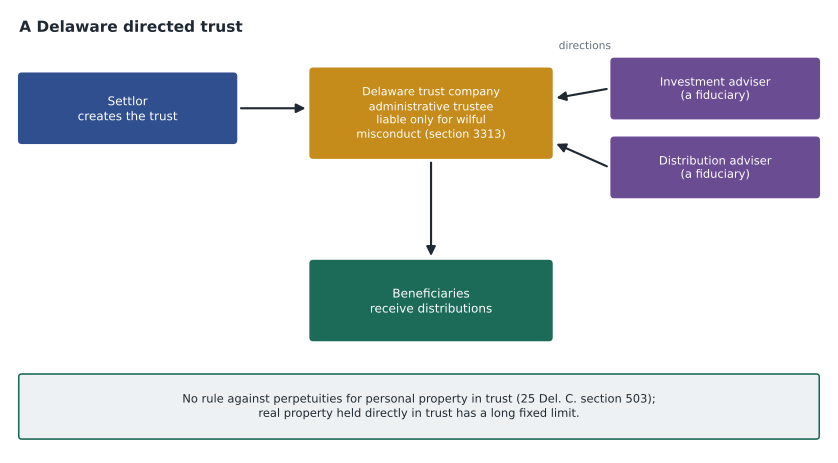
Duration. Delaware has effectively abolished the rule against perpetuities for personal property held in trust, under Title 25, section 503, so a trust holding stocks, bonds and similar assets can last indefinitely. Real property held directly in a trust is subject to a long fixed limit, generally 110 years. These are often called dynasty trusts.
Directed trusts. Delaware allows a trust instrument to divide trustee functions among a trustee and one or more advisers, such as an investment adviser or a distribution adviser. Under Title 12, section 3313, an adviser who holds the power to direct is treated as a fiduciary, and a trustee who follows an adviser's direction is generally liable only for its own wilful misconduct. Families use directed trusts to keep a long-time investment manager while using a Delaware trust company as trustee.
Flexibility over information and change. Delaware permits so-called quiet or silent trusts, in which the instrument may limit or delay the information given to beneficiaries for a period, within statutory limits. It also allows decanting: a trustee with discretion to distribute principal can, in many cases, pay it to a new trust with different administrative terms.
Asset protection. Delaware was one of the first states to allow a settlor to create a trust for his or her own benefit that is protected from many of the settlor's creditors, under the Qualified Dispositions in Trust Act.
The Qualified Dispositions in Trust Act
The Act, in Title 12, chapter 35, subchapter VI, creates what practitioners call a Delaware asset protection trust. The key definitions are in section 3570.
A qualified disposition is a transfer of property to a trust with at least one qualified trustee, made by a trust instrument. A qualified trustee must be either an individual Delaware resident other than the transferor, or a trust company or bank authorized to act as trustee in Delaware and supervised by a recognized regulator. The qualified trustee must have a real Delaware connection, such as keeping custody of some trust assets in Delaware, keeping records, preparing tax returns or materially participating in administration.
The trust instrument must name a qualified trustee, expressly make Delaware law govern its validity, construction and administration, be irrevocable, and include a spendthrift clause. The transferor may keep significant rights without making the trust revocable, including a veto over distributions, certain powers of appointment, the right to income, discretionary distributions of principal by the trustee, the power to remove and replace trustees and advisers, and the right to live in a residence held by the trust.
Creditor challenges. Section 3572 limits creditor attacks on a qualified disposition. A creditor must proceed under Delaware's fraudulent transfer statute, and the Court of Chancery has exclusive jurisdiction. A creditor whose claim arose after the transfer must sue within four years after the transfer and must show the transfer was made with actual intent to defraud that creditor. A creditor whose claim arose before the transfer must sue within the period allowed by the fraudulent transfer statute. In every case the creditor must prove its case by clear and convincing evidence.
Exceptions. Section 3573 lets two kinds of claims reach the trust despite those limits: claims for child support, alimony or a property division owed to a spouse, former spouse or child, to the extent of that debt; and claims by a person who suffered death, personal injury or property damage on or before the date of the transfer caused by the transferor. The family exception does not cover elective share or forced heirship claims, and a spouse who receives the required disclosures and signs a written consent before the transfer loses the benefit of the exception.
| Issue | Rule under the Act |
|---|---|
| Qualified trustee | Delaware resident individual (not the transferor) or a supervised Delaware-authorized trust company, with Delaware administration |
| Required terms | Irrevocable, Delaware governing law, spendthrift clause, at least one qualified trustee |
| Later creditors | Must sue within four years after the transfer and prove actual intent to defraud them |
| Burden of proof | Clear and convincing evidence |
| Court | Court of Chancery, exclusive jurisdiction |
| Exceptions | Support, alimony and property division claims; tort claims for harm on or before the transfer |
Wills in Delaware
Execution. Under Title 12, section 202, a will must be in writing, signed by the testator or by another person in the testator's presence and at the testator's express direction, and attested and subscribed in the testator's presence by two or more credible witnesses. Delaware does not recognize unwitnessed holographic wills: a handwritten will is valid only if it meets the same formalities. A will can be made self-proving with an affidavit of the testator and witnesses, which avoids the need to locate witnesses at probate.
Probate. Each of Delaware's three counties, New Castle, Kent and Sussex, has a Register of Wills, who admits wills to probate and grants letters testamentary or of administration. Disputes go to the Court of Chancery, which hears will contests, called caveats, and supervises estate and trust administration. Chancery's jurisdiction over trusts and estates is one reason Delaware's probate system works smoothly for out-of-state families with Delaware trusts.
The elective share. A surviving spouse who is unhappy with the will can elect a statutory share instead. Delaware's elective share is generally one-third of the decedent's elective estate, which includes certain non-probate transfers, reduced by amounts the spouse already receives. The election must be made within the time the statute allows.
Taxes. Delaware repealed its estate tax for deaths on or after January 1, 2018, and it has no inheritance tax, which simplifies planning for Delaware residents and adds to the state's appeal for trusts.
Worked problem
A Delaware wills and trusts essay
Hypothetical: Edwin, a Delaware resident, signed a typed will in his kitchen with only his neighbor as a witness. Two years earlier, after a car accident he caused that injured a cyclist, he had transferred his investment account to a Delaware trust with a Delaware trust company as trustee, naming himself as discretionary beneficiary. The cyclist obtained a judgment last year. Edwin has died. His wife wants to know whether the will is valid and whether the cyclist can reach the trust.
Show solution
- Will: section 202 requires two credible witnesses; one witness is not enough, so the will is invalid and Edwin's estate passes by intestacy unless an earlier valid will exists.
- Trust: a transfer to a Delaware trust company, if irrevocable, governed by Delaware law and containing a spendthrift clause, is a qualified disposition.
- Creditor limits: the cyclist's claim arose before the transfer, so she is a pre-existing creditor who must sue within the fraudulent transfer statute's period.
- Exception: more importantly, section 3573 exempts tort claims for injury occurring on or before the transfer date, so the cyclist can reach the trust to the extent of her judgment.
- Wife: if intestacy gives her less than she expects, she should consider the elective share, which reaches certain non-probate assets.
Answer: The answer turns on three statutes: section 202 for execution, the Act's definitions and section 3573 for the tort exception.
Common mistakes
MistakeSaying a Delaware trust must end within the common law perpetuities period.
InsteadDelaware has effectively abolished the rule for personal property in trust under 25 Del. C. section 503; real property has a long fixed limit.
MistakeTreating a holographic will as valid in Delaware without witnesses.
InsteadSection 202 requires two credible witnesses for every will.
MistakeThinking an asset protection trust defeats every creditor.
InsteadSection 3573 exempts support, alimony and property division claims and tort claims for harm on or before the transfer.
MistakeSending a will contest to the Superior Court.
InsteadCaveats and trust and estate disputes go to the Court of Chancery.
Advising an out-of-state client about a Delaware trust
Much of Tamsin's trust work involves clients from other states who want the benefits of Delaware law. Marchetti uses one of those conversations to pull the lesson together. A client in New Jersey asks whether she can move an existing family trust to Delaware. The answer depends on the trust instrument, which may allow a change of trustee or situs, and on Delaware's statutes allowing a trust to be administered in Delaware with Delaware law governing its administration. A Delaware trust company becomes trustee, the family's investment manager becomes an investment adviser under a directed trust arrangement, and the trust gains Delaware's flexibility on duration, information and modification.
Two cautions apply. First, moving a trust does not erase the law of the state where it was created for every purpose; questions about the validity of the original transfer or the rights of creditors may still involve that state's law. Second, Delaware's asset protection statute protects only transfers that meet its requirements, and courts in other states have sometimes refused to apply another state's asset protection law to their own residents' creditors. That is why section 3572 includes a provision requiring a trustee to step down if a court refuses to apply Delaware law, with a successor appointed under the trust instrument or by the Court of Chancery.
Trust administration disputes
The Court of Chancery hears disputes between trustees and beneficiaries, petitions for instructions, accountings and actions to remove trustees. Beneficiaries of directed trusts sometimes sue both the trustee and the advisers, and the directed trust statute will shape who bears responsibility for each decision. A beneficiary who complains about investments should look first at whether an investment adviser directed them; a beneficiary who complains about administration, such as late distributions or poor records, should look at the administrative trustee.
Estate administration basics
When a Delaware resident dies, the personal representative named in the will, or an administrator appointed under the intestacy statute, applies to the Register of Wills in the county of residence for letters. The personal representative collects assets, gives notice to creditors, pays valid claims and taxes, files inventories and accountings with the Register and distributes the estate. Small estates may qualify for simplified procedures. Assets held in trust, jointly owned assets with survivorship rights and accounts with named beneficiaries pass outside probate, which is one reason funded revocable trusts are common in estate plans.
On an essay, estate administration questions usually test basic sequencing: which court or official acts, what the personal representative must do first, and how non-probate assets affect the answer. A candidate who knows that the Register of Wills handles routine probate and that Chancery hears disputes will be on solid ground.
Will contests and capacity
A will can be challenged for lack of testamentary capacity, undue influence, fraud, improper execution or revocation. Testamentary capacity generally requires that the testator understood the nature of the act, the general extent of the property and the natural objects of the testator's bounty. Undue influence requires more than persuasion: it requires influence that overcame the testator's free will. Delaware courts consider factors such as the testator's susceptibility, the influencer's opportunity and disposition and whether the will reflects the influence, and they may shift the burden of proof where a confidential relationship exists and the beneficiary actively participated in preparing the will.
Intestacy in brief
When there is no valid will, Delaware's intestacy statute decides who takes. In general, a surviving spouse takes the whole estate if the decedent left no surviving descendants or parents, and shares the estate with descendants or parents in other cases, under rules that depend on whether the descendants are also the spouse's. Without a spouse, the estate passes to descendants, then to parents, then to siblings and their descendants and more remote relatives. On an essay where a will fails, state that intestacy applies, identify the surviving relatives and apply the general order of distribution rather than guessing precise fractions.
Summary and key terms
- Delaware trust law attracts national business: no rule against perpetuities for personal property in trust, directed trusts with advisers, quiet trusts and decanting.
- Under 12 Del. C. section 3313 a trustee following an adviser's direction is generally liable only for wilful misconduct.
- The Qualified Dispositions in Trust Act permits self-settled asset protection trusts with a Delaware qualified trustee, Delaware law, irrevocability and a spendthrift clause; later creditors have four years and must prove actual intent to defraud by clear and convincing evidence.
- Support, alimony and property division claims and pre-transfer tort claims are excepted under section 3573.
- Wills require a writing, the testator's signature and two credible witnesses; the Registers of Wills handle probate and Chancery hears contests; Delaware has no estate tax since 2018.
- Qualified disposition
- A transfer to a Delaware asset protection trust that meets the Act's requirements.
- Qualified trustee
- A Delaware resident individual or supervised Delaware trust company that administers a qualified disposition trust in Delaware.
- Directed trust
- A trust in which advisers direct the trustee on investments, distributions or other functions.
- Caveat
- A challenge to the validity of a will, heard in Delaware by the Court of Chancery.
- Elective share
- A surviving spouse's statutory share of the decedent's elective estate in place of the will's provisions.
Practice problems
Work each problem on paper first, then reveal the answer to check.
How many witnesses does a Delaware will need?
Show answer
Two or more credible witnesses who attest and subscribe in the testator's presence.
Which court has exclusive jurisdiction over creditor challenges to a qualified disposition?
Show answer
The Court of Chancery.
Name the two exceptions to the Act's creditor protection.
Show answer
Support, alimony and property division claims of a spouse, former spouse or child, and tort claims for death, injury or property damage on or before the transfer.
Lesson quiz · 5 questions
Score 60% or more to complete this lesson.
Create a free account to save your progress, take quizzes and earn a certificate.