
BAR-208 · Lesson 4 of 12 · 18 min
The Delaware bar exam: format, scoring and passing score
▶ Video coming soon A video version of this lesson is on the way.
By the fourth call Tamsin has filed her application, paid the final-deadline fee and asked her preceptor to confirm her summer weeks. Now she wants to know exactly what she will face on February 23 and 24, 2027. Marchetti shares her screen and draws two boxes, one for each day.
Two days, four parts
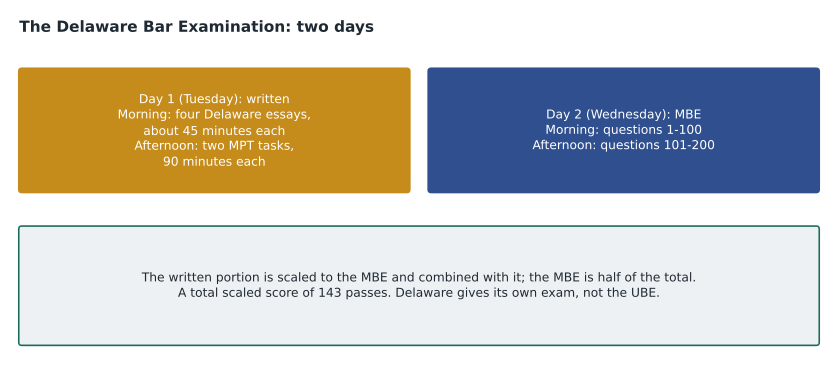
The Delaware Bar Examination runs on the last Tuesday and Wednesday of February and July. The Board's description is simple: two full days, with the written portion first.
Tuesday morning: four Delaware essay questions. The session is about three hours, which works out to roughly 45 minutes per essay. The questions are written by the Board and test Delaware law in the subjects listed in Board Rule 12.
Tuesday afternoon: two Multistate Performance Test (MPT) tasks, each designed to take 90 minutes. The MPT is written by NCBE. It gives the examinee a closed file of facts and a library of cases and statutes, usually from a fictional jurisdiction, and asks for a practical document such as a memo, brief or client letter.
Wednesday: the Multistate Bar Examination (MBE), 200 multiple-choice questions in two three-hour sessions, 100 in the morning and 100 in the afternoon. Of the 200 questions, 175 are scored and 25 are unscored pretest questions that look exactly like the others. The MBE covers civil procedure, constitutional law, contracts, criminal law and procedure, evidence, real property and torts.
The 2023 reforms cut the essays from eight to four and the essay subjects from 14 to 10, so the written day is now shorter than it was for earlier generations of Delaware lawyers. Some Board web pages still describe eight essays in their summaries, a leftover from the old format; the Board's FAQ and its 2023 announcement describe four.
How the score is built
Delaware scores the exam the way most jurisdictions that use the MBE do. NCBE scores the MBE and reports a scaled MBE score. The Board grades the essays and MPT answers, and then scales the written scores to the MBE, a statistical step that puts the written scores on the same scale as the MBE so that results are comparable from one exam to the next. The MBE counts for half of the combined score, and the written portion for the other half. Bar-prep summaries describe the written half as split evenly between the essays and the MPT.
The total is reported on a 200-point scale, and an applicant passes with a total of 143. Before July 2023 the passing score was 145. The Board lowered it after a two-year review that included psychometric advice, and the court described the change as part of a modernization rather than a lowering of standards.
| Component | Who writes it | Weight | Notes |
|---|---|---|---|
| Four Delaware essays | Board of Bar Examiners | Part of the written half | Delaware law; Board Rule 12 subjects |
| Two MPTs | NCBE | Part of the written half | Closed file and library; practical writing |
| MBE | NCBE | Half of the total | 175 scored and 25 pretest questions |
| Total | 200-point scale | 143 passes (145 before 2023) |
There is no compensation between parts beyond what the combined score allows. A strong MBE can carry a weaker written performance and the reverse, because only the total matters. Delaware does not require a minimum score on each part.
Worked problem
Reading a Delaware total
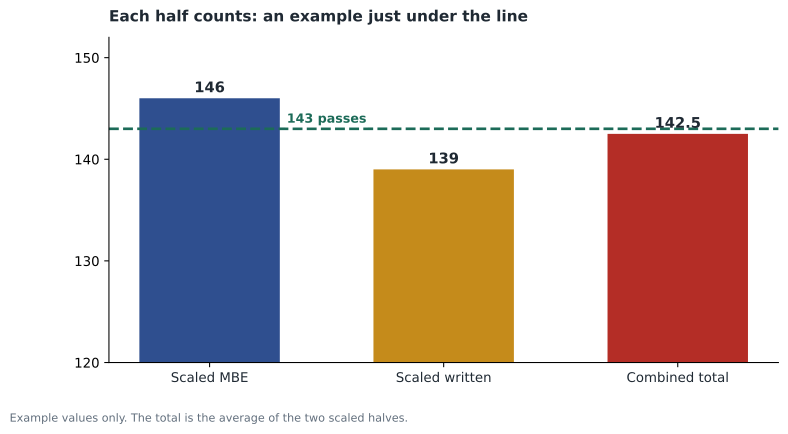
Tamsin wants to see how the pieces fit. In a hypothetical example, an applicant's scaled MBE score is 146 and the scaled written score is 139. What is the combined total, and does it pass?
Show solution
- Each half counts equally, so the total on the 200-point scale is the average of the two scaled scores.
- The average of 146 and 139 is 142.5.
- The passing score is 143, so this applicant falls just short.
- A modestly better written score, say 141, would give a total of 143.5 and pass.
Answer: The numbers are illustrations, but the arithmetic shows why written practice matters even for strong multiple-choice takers: each point on the written side moves the total by half a point.
What the essays reward
Delaware essay grading follows the same logic as essay grading elsewhere. Graders look for the issues the question raises, an accurate statement of the governing rule, careful application to the facts, and a sensible conclusion. Graders do not give credit for long recitations of law that the facts do not call for. Board publications describe the essays as testing the ability to identify legal issues, apply law to facts, separate relevant from irrelevant facts and write clearly.
Because each essay has about 45 minutes, organization is everything. Marchetti teaches Tamsin a four-part routine for each one: read the call of the question first; read the facts once quickly and once carefully, marking dates, parties and documents; outline in no more than eight minutes; and write in short, headed sections, one issue per section, finishing with a direct answer to the call.
Past questions. The Board posts prior exam questions on its website, going back many years, with recent February and July exams available. They are the best guide to the Board's style. Marchetti assigns Tamsin one recent essay a week, written under time limits, beginning with the questions from the 2024 through 2026 exams that reflect the four-essay format.
The MPT and the MBE
The MPT rewards a different skill: following instructions. The task memo tells the examinee what to write, for whom and in what format. The file contains facts, some irrelevant, and the library contains the only law the examinee may use. Points go to examinees who produce the document requested, organize it around the legal standards in the library and use the facts precisely. Marchetti points Tamsin to the performance test course in this program for method and practice.
The MBE is the same national test every MBE jurisdiction uses. It tests general principles of law, not Delaware law, so the core MBE review courses in this program apply directly. For Tamsin the MBE is the familiar part; for many Delaware candidates it is the part most worth drilling, because it is half the score.
Results, retakes and review
Results. NCBE's figures put average grading time at about nine weeks for a February exam and eleven weeks for a July exam. The Board posts results and notifies applicants. Passing applicants then move to the character investigation, the clerkship and checklist, and the pre-admission conference.
Retakes. Delaware does not limit the number of times an applicant may take the exam, and since February 2024 there are two chances a year instead of one. Before the 2023 reforms an unsuccessful candidate waited a full year to try again, a burden the court specifically cited when it added the February exam.
Review of grades. Rule 52 provides that decisions on specific grades are not reviewable by the court. An applicant can appeal Board decisions on qualifications, but not argue that an essay deserved more points. The practical lesson is to put the effort into preparation, not into planning a challenge afterward.
Laptops. Applicants who type the written portion pay a laptop fee and must follow the Board's software and registration instructions. Missing a software deadline can mean handwriting the essays, so put the laptop deadlines in the same calendar as the filing deadlines.
Common mistakes
MistakeExpecting eight essays because an older guide says so.
InsteadSince 2023 the Delaware exam has four essays; Board summaries that say eight are out of date.
MistakeThinking each part must be passed separately.
InsteadOnly the combined total matters; 143 passes.
MistakePlanning to appeal an essay grade.
InsteadRule 52 makes decisions on specific grades unreviewable.
MistakeSkipping the MPT because it is not Delaware law.
InsteadThe MPT is half of the written day and is graded with the essays; practice it.
A study plan built on the score
Because the score structure is simple, it supports a simple plan. Marchetti's rule of thumb for Delaware candidates is to divide study time roughly in proportion to the score, with an extra share for whatever is weakest. Half the score comes from the MBE, so roughly half the practice time goes to timed MBE sets and review. The other half goes to the written day: Delaware essays and MPTs, alternating so that neither is neglected.
For a candidate studying full time over ten weeks, that might mean 50 MBE questions a day with careful review of every miss, three Delaware essays and one MPT a week, and one full simulated written day and one full MBE day in the last three weeks. For a candidate like Tamsin, who works full time and studies evenings and weekends, the same ratio applies on a smaller scale: 25 MBE questions on weekday evenings, two essays and an MPT on weekends, and a simulated exam in early February.
Marchetti also asks candidates to grade their own essays against a checklist before reading a model answer. Did I answer every part of the call? Did I state the Delaware rule accurately, or a general rule? Did I use the facts, especially the specific numbers, dates and documents? Did I reach a conclusion on each issue? Self-grading trains the habits graders reward and reveals patterns, such as consistently running out of time on the fourth essay.
Handling the MPT under time
The MPT is where many strong students lose easy points. Marchetti teaches a fixed rhythm for each 90-minute task: read the task memo first and note exactly what document is required and for whom; read the library before the file, so the legal standards frame the facts; outline by issue, using the elements from the library as headings; and leave 40 to 45 minutes to write. Follow any format instructions in the memo precisely, such as whether to include a statement of facts. Never import outside law; the library is the only law that counts.
Because the MPT is graded with the Delaware essays as part of the written half, a candidate who performs consistently on the MPT can steady the written score even if one essay goes badly. That is a strong reason to practice it every week rather than treating it as an afterthought.
Test-day logistics
The Board sends instructions before each exam with the test site, check-in times, prohibited items and laptop rules. Read them twice. Common mistakes include bringing prohibited items such as watches or phones into the room, missing a laptop software deadline, and arriving with an admission document that does not match the identification the Board requires. Treat the instructions as part of the exam.
Plan meals, travel and parking for both days, and plan the evening between them. Marchetti tells every candidate the same thing: the night after the written day is not the time to relearn a subject. Eat, review a one-page list of MBE reminders and sleep. The MBE rewards a clear head more than one more hour of review.
Reading the score report
Delaware reports results through the Board, and a candidate who does not pass receives score information that shows how the written portion and the MBE contributed to the combined score. Marchetti tells Tamsin to read that information the same way she reads a practice score: which part fell short, and by how much. Because the written score is scaled to the MBE, a weak MBE performance drags down the scale applied to the essays, and a weak written performance cannot be rescued by a modest MBE gain. A candidate who misses 143 by a few points usually needs steady work on both, not a complete change of method.
Tamsin will not need this section, Marchetti says, but she wants her to know it before the exam, because knowing that the result is a combined score takes some pressure off any single session. One hard essay or one difficult MBE block does not decide the result. The task on each day is to collect points steadily, move on from any question that goes badly and keep the timing plan intact.
Building stamina
The Delaware exam is two full days, and the second day is six hours of multiple-choice questions after a day of writing. Tamsin's plan includes two full simulated days in January: four essays and two MPTs on a Saturday, followed by 200 MBE questions on Sunday, both under real timing with real breaks. The goal is not the score on those days but learning how her concentration holds in the last hour of each session, and what she needs to eat, drink and do at lunch to stay sharp.
Summary and key terms
- Tuesday has four Delaware essays (about three hours) and two 90-minute MPTs; Wednesday is the 200-question MBE.
- Written scores are scaled to the MBE; the MBE is half of the total on a 200-point scale, and 143 passes.
- The 2023 reforms cut the essays from eight to four, the subjects from 14 to 10 and the passing score from 145 to 143, and added a February exam.
- Results take about nine weeks for February and eleven for July; there is no limit on attempts.
- Specific grades are not reviewable by the Supreme Court.
- Scaling
- The statistical step that places written scores on the MBE scale so results are comparable across exams.
- MPT
- The Multistate Performance Test, a 90-minute practical writing task using a closed file and library.
- MBE
- The Multistate Bar Examination, 200 multiple-choice questions, 175 of them scored.
- Pretest questions
- Unscored MBE questions mixed in with the scored ones to test them for future use.
Practice problems
Work each problem on paper first, then reveal the answer to check.
How many Delaware essays are on the current exam?
Show answer
Four, in about three hours on Tuesday morning.
What fraction of the total does the MBE contribute?
Show answer
Half; the scaled written portion contributes the other half.
An applicant fails in July 2027. When is the next chance?
Show answer
February 2028, which will be Delaware's first NextGen exam.
Lesson quiz · 5 questions
Score 60% or more to complete this lesson.
Create a free account to save your progress, take quizzes and earn a certificate.