
BAR-208 · Lesson 6 of 12 · 18 min
The Delaware essays: subjects and how Delaware law appears
▶ Video coming soon A video version of this lesson is on the way.
Tamsin has now written two practice essays from the Board's posted questions, one on a limited liability company dispute and one on a will. She scored them herself against Marchetti's rubric and is frustrated. 'I knew the general law,' she says. 'But both answers wanted something specific to Delaware that I didn't know was coming.' That is exactly the point of this lesson: the essays are where Delaware tests Delaware.
What Board Rule 12 covers
Board Rule 12 lists the subjects on which the Delaware essays may be based. The 2023 reforms cut the list from 14 areas to 10. Bar-prep summaries of the current rule list the areas as:
Business entities, meaning Delaware corporations, limited liability companies and limited partnerships.
Civil procedure, including the rules of the Delaware courts and federal procedure, with Family Court practice mentioned in some summaries.
Constitutional law.
Contracts.
Criminal law and procedure, including the Delaware Criminal Code.
Equity, the law the Court of Chancery applies: fiduciary duties, equitable remedies and doctrines such as laches.
Evidence.
Property.
Torts.
Wills and trusts.
Summaries describe the list slightly differently, and the rule's own wording controls. Read the current Board Rule 12 on the Board's website before you build your outline, and note any phrases the Board has added or clarified.
A clarification on criminal law. When the Board amended Rule 12 in 2023 it added language saying that the essays will not ask the examinee to identify the degree of an offense or the quantity tiers for drug offenses. The Board later issued a public statement explaining that this applies only to drug offenses: degrees of other offenses may be tested. It also warned applicants not to read the statement as a hint about whether criminal law will appear on any particular exam.
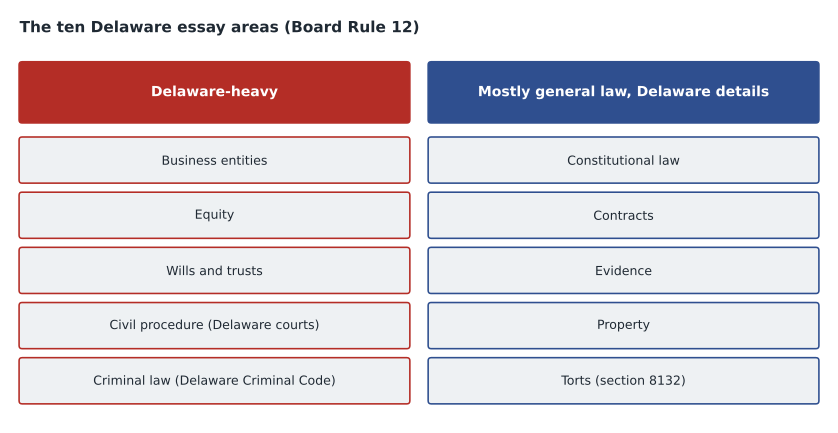
Where Delaware law matters most
Marchetti divides the ten areas into two groups for planning purposes.
Delaware-heavy subjects. Business entities and equity are the subjects most closely tied to Delaware's identity. A question on a corporation or an LLC will usually assume Delaware law, and the expected answer will apply the Delaware General Corporation Law (DGCL), the Delaware Limited Liability Company Act or the Delaware Revised Uniform Limited Partnership Act, along with Court of Chancery doctrine. Wills and trusts questions draw on Title 12 of the Delaware Code, where Delaware has some of the most distinctive trust law in the country. Civil procedure questions may involve the Superior Court Civil Rules, the Court of Chancery Rules or Family Court practice. Criminal questions draw on the Delaware Criminal Code in Title 11.
General law with Delaware details. Constitutional law, contracts, evidence, property and torts are largely the same general law tested on the MBE, but the Board can build in Delaware rules. The Delaware Uniform Rules of Evidence closely follow the Federal Rules of Evidence. Delaware tort law uses modified comparative negligence under 10 Del. C. section 8132: a plaintiff's negligence reduces recovery but bars it only if it is greater than the negligence of the defendants. Delaware's general limitations periods include two years for personal injury and three years for most contract claims. The Delaware Constitution of 1897 has its own features, including an amendment process that runs through two successive General Assemblies rather than a popular vote.
| Area | Typical Delaware twist | Where to look |
|---|---|---|
| Business entities | DGCL, LLC Act and LP Act; Chancery doctrine; 2025 SB 21 amendments | Title 8 and Title 6 of the Delaware Code; Lessons 8 and 9 |
| Equity | Fiduciary duties, laches, equitable remedies in Chancery | Court of Chancery cases; Lesson 9 |
| Wills and trusts | Will formalities, elective share, directed and asset protection trusts | Title 12; Lesson 10 |
| Civil procedure | Superior Court and Chancery rules, long-arm and director consent statutes | Court rules; Title 10; Lesson 7 |
| Criminal law and procedure | Delaware Criminal Code classes and offenses (no drug degree or tier identification) | Title 11; Board clarification |
| Torts | Modified comparative negligence (not greater than) | 10 Del. C. section 8132 |
| Evidence | Delaware Uniform Rules of Evidence follow the federal rules closely | D.R.E. |
| Constitutional law | US Constitution plus Delaware Constitution of 1897 | Del. Const. |
| Contracts and property | Mostly general law; watch statutes of limitation and Delaware statutes when raised | Title 6, Title 10, Title 25 |
Reading a Delaware essay question
Delaware essay questions follow a familiar pattern: a fact pattern of several paragraphs followed by one or more numbered questions. Marchetti teaches Tamsin to read the questions first. They tell her which subject is being tested, what role she is playing (often an associate advising a client or a law clerk advising a judge) and whether the Board expects Delaware law or general law. When the facts name a Delaware entity, a Delaware court or a Delaware county, assume Delaware law applies unless told otherwise.
The call often signals a court. A question that asks what relief the stockholders can obtain in the Court of Chancery is inviting an equity answer: fiduciary duties, standard of review and equitable remedies. A question that asks how a party should respond to a complaint in Superior Court is inviting a civil procedure answer under the Superior Court Civil Rules. A question about a will contest in the Register of Wills or Chancery is inviting Title 12.
Time discipline. With about 45 minutes per essay, there is no time to write everything you know. Spend the time on the issues the facts actually raise. A well-organized answer that identifies four issues and resolves each one beats a long answer that recites every rule in the subject.
Worked problem
Outlining a Delaware business entities essay
Hypothetical: Brandywine Kayak Co. is a Delaware corporation. Its board, three of whose five directors work for the company's 40 percent stockholder, approves a sale of a warehouse to that stockholder at a price an outside appraiser called low. A minority stockholder asks what claims she has and what the board should have done. Outline the answer.
Show solution
- Identify the issue: a transaction between the corporation and a stockholder who may be a controlling stockholder, approved by a board with conflicted directors.
- Controller status: after the 2025 amendments, a holder of at least one-third of the voting power with managerial authority over the business, or one who controls a majority of the board, is a controlling stockholder; 40 percent plus three of five directors points strongly that way.
- Standard of review: without cleansing, entire fairness, fair dealing and fair price, with the burden on the defendants.
- Cleansing: under amended section 144, a non-going-private controller transaction is protected if approved by a committee of at least two disinterested directors or by a majority of the votes cast by disinterested stockholders, with proper disclosure.
- Conclusion: as described, neither safe harbor was used, so the stockholder can press an entire fairness claim; the board should have used an independent committee or a disinterested stockholder vote.
Answer: Lessons 8 and 9 explain each step. The point here is the structure: issue, rule, application and a direct answer to each part of the call.
Building a Delaware outline
Marchetti recommends a single outline of no more than 40 pages, built around the ten areas but weighted toward the Delaware-heavy ones. For each area, Tamsin will list the rules most likely to be tested, the Delaware statute or doctrine that changes the general answer, and two or three short practice prompts. She will draft it from the lessons in this course, the Board's posted questions and the Delaware Code itself, not from a commercial outline of uncertain date. Delaware corporate law changed significantly in 2025, and an outline written before then can lead to wrong answers.
Past questions as a map. Reading a run of recent Board questions shows the Board's habits: which subjects appear most often, how it frames the call, and whether it asks for advice, analysis or a ruling. Marchetti asks Tamsin to keep a log of every posted question she reads since the four-essay format began in July 2023, with the subject, the issues and the Delaware rules each one required. After ten questions the log becomes the best study guide she has.
Common mistakes
MistakeAnswering a Delaware corporate question with the general MBE rule or another state's statute.
InsteadAssume Delaware law when the facts involve a Delaware entity, and use the DGCL and Chancery doctrine.
MistakeUsing a corporate outline written before 2025.
InsteadThe 2025 SB 21 amendments changed the controlling stockholder definition, section 144 safe harbors and books-and-records inspection.
MistakeIdentifying the degree of a drug offense in a criminal answer.
InsteadThe Board has said the essays will not require identifying drug offense degrees or quantity tiers; other offense degrees may be tested.
MistakeWriting long recitations of rules the facts do not raise.
InsteadWith about 45 minutes per essay, focus on the issues in the facts and answer the call directly.
Practice prompts by area
Marchetti gives Tamsin one short practice prompt for each Delaware-heavy area, to answer in outline form in about 15 minutes each.
Business entities: A Delaware LLC agreement says managers owe no fiduciary duties. A manager signs a supply contract with his own company on terms favorable to it. What claims, if any, do the other members have? (Think about section 18-1101(c), express terms and the implied covenant.)
Equity: A buyer of a Delaware farm sues the seller, who refuses to close, and asks for an order requiring the sale. Which court, what remedy, and what defenses might the seller raise? (Think about Chancery jurisdiction, specific performance for land and laches.)
Wills and trusts: A testator signs a will with one witness and later creates a revocable trust funded with her house. Is the will valid, and what happens to the house at death? (Think about section 202 and non-probate transfers.)
Civil procedure: A plaintiff files a breach of contract claim for damages in the Court of Chancery. The defendant moves to dismiss for lack of jurisdiction. What happens? (Think about adequate remedy at law and section 1902 transfer.)
Criminal law: A defendant is charged under the Delaware Criminal Code with a theft offense. What elements must the State prove, and how do degrees of theft work? (Remember that non-drug offense degrees may be tested.)
Each prompt tests the same habit: spot the Delaware rule that changes the general answer and apply it in a few precise sentences.
Common Delaware essay traps
Marchetti keeps a list of mistakes she sees repeatedly in Delaware practice essays. Candidates apply the Model Business Corporation Act instead of the DGCL. They forget that Chancery has no jury. They treat an LLC like a corporation, ignoring the agreement. They cite federal pleading standards. They recite the rule against perpetuities for a Delaware trust of securities. They forget that a will needs two witnesses. And under time pressure, they skip the conclusion. Reading this list before each practice essay is a cheap way to avoid expensive errors.
Using the posted questions well
The Board's posted questions are only useful if they are used under realistic conditions. Marchetti's method: set a 45-minute timer, write without notes, then compare the answer to the relevant lesson and the Delaware Code rather than to a commercial model answer of unknown quality. Note every rule you misstated and add it to the outline. After a few weeks, the outline will reflect exactly the gaps the questions revealed.
Writing the answer: a template
Marchetti gives Tamsin a template for every Delaware essay. Begin each numbered question with a one-sentence conclusion. Follow with the rule, naming the Delaware statute, rule or case where you can. Apply the rule to each important fact, quoting or paraphrasing the facts directly. End with a conclusion that matches the opening sentence. Use headings that track the call of the question so the grader can find each answer.
Two further habits help. When Delaware law differs from the general rule, say so in a sentence: for example, that Delaware state courts apply reasonable conceivability rather than federal plausibility, or that a Delaware LLC agreement may eliminate fiduciary duties. And when a fact cuts both ways, give both sides before reaching a conclusion. Graders reward the analysis more than the bottom line, and a well-reasoned answer that reaches a different conclusion from the model can still earn high marks.
Summary and key terms
- Board Rule 12 lists ten essay areas since 2023: business entities, civil procedure, constitutional law, contracts, criminal law and procedure, equity, evidence, property, torts, and wills and trusts.
- Business entities, equity, wills and trusts, Delaware civil procedure and the Delaware Criminal Code are the most Delaware-specific areas.
- Other areas are mostly general law with Delaware details, such as modified comparative negligence under section 8132 and the Delaware Rules of Evidence.
- The essays do not require identifying degrees or quantity tiers of drug offenses; other offense degrees may be tested.
- Read the call first, assume Delaware law for Delaware entities and courts, and answer each part directly within about 45 minutes.
- Board Rule 12
- The Board rule listing the subjects that may be tested on the Delaware essays.
- DGCL
- The Delaware General Corporation Law, Title 8, chapter 1 of the Delaware Code.
- Modified comparative negligence
- Delaware's rule that a plaintiff's negligence reduces damages but bars recovery only if greater than the defendants' combined negligence.
- Delaware Uniform Rules of Evidence
- Delaware's evidence rules, closely modeled on the Federal Rules of Evidence.
Practice problems
Work each problem on paper first, then reveal the answer to check.
How many essay subject areas does Board Rule 12 list since 2023?
Show answer
Ten, down from 14.
Under 10 Del. C. section 8132, when does a plaintiff's negligence bar recovery?
Show answer
Only when it is greater than the negligence of the defendants against whom recovery is sought.
A question asks what relief stockholders can obtain in the Court of Chancery. What kind of answer does it invite?
Show answer
An equity and business entities answer: fiduciary duties, the standard of review and equitable remedies.
Lesson quiz · 5 questions
Score 60% or more to complete this lesson.
Create a free account to save your progress, take quizzes and earn a certificate.