
BAR-208 · Lesson 9 of 12 · 18 min
Equity, fiduciary duties and the 2025 amendments
▶ Video coming soon A video version of this lesson is on the way.
Marchetti opens the call with a confession of her own. 'Half the corporate outlines my students used two years ago are wrong now,' she says. 'Not because anyone made a mistake, but because Delaware changed the rules in 2025 and the Supreme Court confirmed the change in 2026.' This lesson covers the equity side of the Delaware essays: what the Court of Chancery does, the fiduciary duties it enforces, the standards of review it applies, and the 2025 statutory changes that reshaped conflicted transactions.
Equity in the Court of Chancery
The Court of Chancery applies the principles of equity inherited from the English High Court of Chancery. On the essays, equity questions usually involve one of three things: an equitable remedy, an equitable defense or a fiduciary relationship.
Equitable remedies. Chancery can grant injunctions, specific performance, rescission, reformation, constructive trusts, accountings and other relief unavailable at law. A preliminary injunction generally requires a reasonable probability of success on the merits, a threat of irreparable harm if relief is denied and a balance of hardships favoring the plaintiff. Specific performance is typically available for contracts involving unique property, including land, where damages would not be adequate.
Laches. Because statutes of limitation apply by their terms to actions at law, Chancery uses the equitable defense of laches: unreasonable delay by the plaintiff that prejudices the defendant. In deciding whether delay is unreasonable, Chancery generally looks to the analogous statute of limitations, and a claim filed after that period is usually barred absent unusual circumstances, while a claim filed within it is rarely barred by laches.
Maxims. Equity's maxims still appear in decisions and on exams: he who seeks equity must do equity, equity aids the vigilant, equity will not suffer a wrong without a remedy, and equity regards as done that which ought to be done.
Fiduciary duties of directors and officers
Directors and officers of a Delaware corporation owe the corporation and its stockholders fiduciary duties of care and loyalty. Good faith is part of the duty of loyalty, as the Delaware Supreme Court held in Stone v. Ritter (2006).
The duty of care requires directors to act on an informed basis. Liability for care breaches requires gross negligence, and the leading case, Smith v. Van Gorkom (1985), found directors liable for approving a merger after a brief meeting without adequate information. Most charters now exculpate directors from money damages for care breaches under section 102(b)(7).
The duty of loyalty requires directors to act in the corporation's best interests, not their own. It covers self-dealing, usurping corporate opportunities and bad faith. Bad faith includes intentionally failing to act in the face of a known duty to act.
Oversight. Under In re Caremark International Inc. Derivative Litigation (Del. Ch. 1996) and Stone v. Ritter, directors can be liable for a sustained failure of oversight: either utterly failing to implement any reporting or information system, or consciously failing to monitor one and ignoring red flags. In Marchand v. Barnhill (2019), the Supreme Court allowed a Caremark claim to proceed against directors of an ice cream maker that had no board-level system for monitoring food safety, its most important compliance risk.
Standards of review
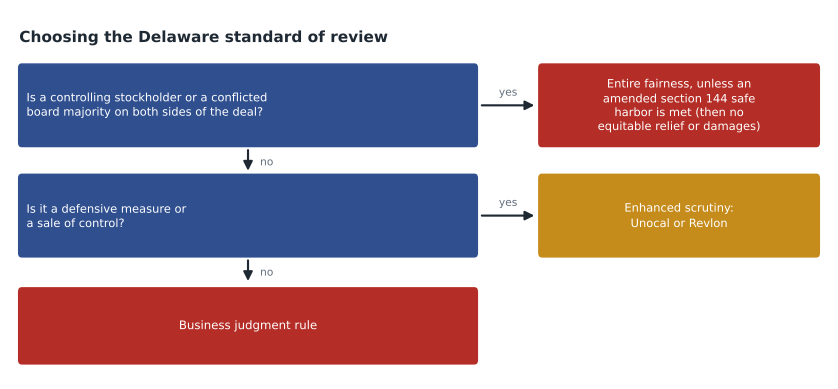
Delaware courts review board decisions under three main standards.
The business judgment rule. The default. The court presumes directors acted on an informed basis, in good faith and in the honest belief that the action was in the company's best interests. A plaintiff must rebut the presumption; otherwise the court will not second-guess the decision.
Enhanced scrutiny. In defensive and sale-of-control situations, the board must show its actions were reasonable. Unocal Corp. v. Mesa Petroleum (1985) governs defensive measures; Revlon v. MacAndrews and Forbes Holdings (1986) requires a board selling control to seek the best value reasonably available.
Entire fairness. When a majority of the board is conflicted or a controlling stockholder stands on both sides of a transaction, the defendants must prove fair dealing and fair price, as in Weinberger v. UOP (1983). It is Delaware's most demanding standard.
Cleansing. Delaware law lets parties move a transaction back to the business judgment rule. Under Corwin v. KKR Financial Holdings (2015), a fully informed, uncoerced vote of disinterested stockholders cleanses a transaction not involving a controller. For controller transactions, Kahn v. M and F Worldwide Corp. (2014), known as MFW, required both an independent special committee and a majority-of-the-minority vote, conditioned from the start. In In re Match Group Derivative Litigation (2024), the Supreme Court extended the MFW requirements to all controller transactions in which the controller receives a non-ratable benefit.
The 2025 amendments: SB 21
On March 25, 2025, Governor Matt Meyer signed Senate Substitute 1 for Senate Bill 21, amending the DGCL. It took effect on signing and, by its terms, applies to transactions before and after enactment, with an exception for cases already pending. It changed three things that matter on the essays.
Who is a controlling stockholder. New definitions in section 144 treat as a controlling stockholder a person who owns or controls a majority of the voting power in director elections; who has the right to elect a majority of the board; or who holds at least one-third of the voting power and exercises managerial authority over the business. A holder below one-third is not a controller under the statute.
Safe harbors for conflicted transactions. Amended section 144 provides that a transaction involving a controlling stockholder, other than a going-private transaction, cannot be the subject of equitable relief or damages if it is approved by a committee of at least two directors the board has determined to be disinterested, or approved or ratified by a majority of the votes cast by disinterested stockholders, in each case with material facts disclosed. A going-private transaction needs both approvals. Unlike MFW, the approvals need not be conditions from the outset. Transactions involving conflicted directors or officers get a similar safe harbor.
Disinterested directors. A director whom the board has determined to be independent under the listing standards of a national stock exchange is presumed disinterested, and a plaintiff can rebut that presumption only with substantial and particularized facts. Controllers are liable for damages only for breaches of the duty of loyalty or transactions from which they derived an improper personal benefit, not for care breaches in their capacity as controllers.
Books and records. Section 220 now limits inspection to an enumerated list of records, such as the charter and bylaws, board and committee minutes and materials, financial statements and director independence questionnaires. A stockholder must show good faith, a proper purpose and records specifically related to that purpose, described with reasonable particularity. Other records are available only on a showing of compelling need by clear and convincing evidence, and the corporation can impose reasonable confidentiality conditions.
| Issue | Before SB 21 | After SB 21 (March 25, 2025) |
|---|---|---|
| Controller definition | Case law: majority holder or actual control | Majority voting power, right to elect a majority, or one-third plus managerial authority |
| Controller transaction (not going private) | MFW: committee and minority vote, conditioned from the start (Match Group, 2024) | Committee of at least two disinterested directors OR disinterested stockholder vote |
| Going-private transaction | MFW | Both approvals, but not required from the outset |
| Independence | Fact-specific | Presumption for directors independent under exchange rules |
| Section 220 records | Broad, case-defined | Enumerated list; more only on compelling need |
The constitutional challenge. Stockholders argued that SB 21 unconstitutionally stripped the Court of Chancery of equitable jurisdiction and destroyed accrued claims. The Court of Chancery certified the questions, and on February 27, 2026, in Rutledge v. Clearway Energy Group LLC, the Supreme Court, sitting en banc, rejected both challenges. Chancery keeps jurisdiction to decide whether the safe harbor conditions are met, and retroactive application did not violate due process because a plaintiff's expectation of continued law is not a vested right.
The Tesla decision. On December 19, 2025, in the appeal of the Tesla compensation litigation, Tornetta v. Musk, the Supreme Court reversed the Court of Chancery's order rescinding Elon Musk's 2018 pay package. It held rescission an improper remedy because it could not restore the parties to their earlier positions, awarded the plaintiff nominal damages of one dollar because no other remedy had been sought, and reduced the attorney fee award. The case is a reminder that Chancery's remedies are equitable and must fit the circumstances.
Derivative suits and demand futility
A stockholder suing on the corporation's behalf must make a demand on the board or plead that demand would be futile, under Court of Chancery Rule 23.1. In United Food and Commercial Workers Union v. Zuckerberg (2021), the Supreme Court adopted a single three-part test applied director by director: whether the director received a material personal benefit from the misconduct; whether the director faces a substantial likelihood of liability on any of the claims; and whether the director lacks independence from someone who received a material benefit or faces such a likelihood. If at least half of the board fails the test, demand is excused.
Worked problem
Applying SB 21 to the Brandywine Kayak facts
Recall Lesson 6: Brandywine Kayak Co.'s 40 percent stockholder, who chairs the board and runs operations, buys a warehouse from the company. Three of five directors work for him. Suppose instead that the board formed a committee of the two remaining directors, both independent under exchange standards, which negotiated and approved the sale after full disclosure. A minority stockholder sues for damages. Analyze.
Show solution
- Controller: 40 percent plus managerial authority exceeds the one-third threshold, so he is a controlling stockholder under amended section 144.
- Transaction type: a sale of an asset to the controller, not a going-private transaction.
- Safe harbor: approval by a committee of at least two disinterested directors with material facts disclosed satisfies the statute for a non-going-private transaction; the directors are presumed disinterested because of their exchange independence.
- Result: no equitable relief or damages, unless the plaintiff pleads substantial and particularized facts rebutting disinterest or showing a disclosure failure.
- Constitutionality: Rutledge (2026) upheld the safe harbor, including its retroactive application.
Answer: Before SB 21, Match Group would have required both a committee and a minority vote conditioned from the outset. That change is why older outlines lead to wrong answers.
Common mistakes
MistakeApplying MFW's dual requirement to every controller transaction.
InsteadAfter SB 21, non-going-private controller transactions need only a disinterested committee or a disinterested stockholder vote; going-private deals need both.
MistakeTreating a 25 percent holder as a statutory controller.
InsteadThe statute requires at least one-third of the voting power plus managerial authority, or majority control.
MistakeSaying Tornetta upheld the rescission of Musk's pay package.
InsteadThe Supreme Court reversed rescission on December 19, 2025 and awarded nominal damages.
MistakeApplying statutes of limitation directly in Chancery.
InsteadChancery uses laches, guided by the analogous limitations period.
Writing an equity answer
Equity questions reward a predictable structure. Marchetti teaches Tamsin to answer in four moves. Identify the relationship: who owes duties to whom, and are the duties fiduciary or contractual? Identify the standard of review: business judgment, enhanced scrutiny or entire fairness, and whether a statutory safe harbor or cleansing vote changes it. Apply the standard to the facts, especially the process the board followed and any conflicts. Then address remedy: what relief Chancery can give and any defenses such as laches or exculpation. A candidate who works through those four moves will rarely miss a major issue.
Exculpation and the standard of review
Exculpation under section 102(b)(7) matters most at the pleading stage. When a charter exculpates directors for care breaches, a plaintiff seeking money damages from those directors must plead a non-exculpated claim, usually loyalty or bad faith, for each director. That interacts with the Zuckerberg test: a director who faces only an exculpated care claim does not face a substantial likelihood of liability for demand futility purposes. Candidates should connect these doctrines rather than discussing them in isolation.
Summary and key terms
- Chancery grants equitable remedies, applies laches guided by analogous limitations periods and enforces fiduciary duties.
- Directors owe care and loyalty, with good faith part of loyalty (Stone v. Ritter); Caremark and Marchand govern oversight claims.
- Standards of review: business judgment rule, enhanced scrutiny (Unocal, Revlon) and entire fairness (Weinberger); Corwin cleanses non-controller deals.
- SB 21 (March 25, 2025) defined controlling stockholders, created section 144 safe harbors (committee or stockholder vote; both for going-private deals) and narrowed section 220; Rutledge (Feb. 27, 2026) upheld it.
- Tornetta v. Musk (Dec. 19, 2025) reversed rescission; Zuckerberg (2021) sets the three-part demand futility test.
- Entire fairness
- Delaware's strictest standard of review, requiring fair dealing and fair price.
- Caremark claim
- A claim that directors breached the duty of loyalty by failing to oversee the company's compliance.
- Safe harbor (section 144)
- Statutory protection from equitable relief and damages for conflicted transactions approved by disinterested directors or stockholders.
- Laches
- The equitable defense of unreasonable delay that prejudices the defendant.
- Demand futility
- The showing that a pre-suit demand on the board would be pointless, under the Zuckerberg test.
Practice problems
Work each problem on paper first, then reveal the answer to check.
What two approvals does amended section 144 require for a going-private transaction?
Show answer
Approval by a committee of at least two disinterested directors and approval by a majority of votes cast by disinterested stockholders.
What did the Supreme Court hold in Rutledge v. Clearway Energy Group (2026)?
Show answer
SB 21's safe harbors do not unconstitutionally strip Chancery's equity jurisdiction, and their retroactive application does not violate due process.
State the Zuckerberg demand futility questions.
Show answer
For each director: a material personal benefit, a substantial likelihood of liability, or a lack of independence from someone who has either; demand is excused if at least half the board fails.
Lesson quiz · 5 questions
Score 60% or more to complete this lesson.
Create a free account to save your progress, take quizzes and earn a certificate.