
BAR-208 · Lesson 2 of 12 · 18 min
Eligibility, education, the preceptor and application deadlines
▶ Video coming soon A video version of this lesson is on the way.
On the second call Tamsin brings a printout of Supreme Court Rule 52 with half the page highlighted. 'I thought eligibility meant having a law degree,' she says. 'This reads like a checklist for a security clearance.' Marchetti laughs and suggests they take it one paragraph at a time, because each paragraph turns into a document the Board will want to see.
Age, pre-legal education and law school
Three of the Rule 52(a) requirements are about who may apply at all.
Age. An applicant must be at least 21. In practice almost every law graduate already is, but the rule is there.
Pre-legal education. The applicant must have completed the studies required for admission to law school. The rule does not strictly require a bachelor's degree. If a law school admitted the applicant without one, the school must give the Board a statement explaining why, and the Board decides how undergraduate work is assessed.
Law school. The applicant must have graduated with a JD, or an equivalent degree, from a law school on the ABA's approved list at the time the degree was awarded. That is the default rule, and most Delaware applicants meet it without thinking about it.
The waiver route. Rule 52 lets the Board, on petition, waive the law school requirements in two situations. The first is an applicant with a law degree from outside the United States plus an LLM that the Board finds substantially equivalent to a JD. The second is an applicant who is a member in good standing of the bar of another US state, the District of Columbia or Puerto Rico, if the Board finds the applicant qualified. That is why NCBE's summary of Delaware's rules lists an ABA-approved JD as not strictly required and foreign graduates as eligible: both depend on a successful petition, not on an automatic exception.
| Applicant | Law school requirement | Route |
|---|---|---|
| Graduate of an ABA-approved school | Met by the degree | Standard application |
| Lawyer admitted in another state with a non-ABA degree | May be waived on petition | Petition to the Board, then the full exam |
| Foreign law graduate with a qualifying LLM | May be waived on petition if the Board finds the LLM substantially equivalent to a JD | Petition to the Board, then the full exam |
| Foreign law graduate without an LLM | Not met | Generally ineligible unless another route applies |
Marchetti stresses the last column. Even a petitioner whose education requirement is waived still sits the same exam, completes the same clerkship and checklist, and goes through the same character investigation. Delaware waives requirements about where you studied, not requirements about what you must show once you apply.
The preceptor
Every applicant needs a preceptor. Under Rule 52 and the Board's preceptor rules, the preceptor must be a member of the Delaware Bar admitted for at least ten years. The preceptor vouches for the applicant's character and fitness, supervises or approves the clerkship, certifies the checklist and files certificates with the Board at set points in the process.
What a preceptor does. A good preceptor is part sponsor and part mentor. The preceptor meets the applicant, learns enough about the applicant's background to certify character honestly, helps arrange clerkship placements and checklist activities, and signs off when they are complete. Many preceptors also introduce applicants to the Delaware State Bar Association's events and to the judges and court staff the applicant will soon work with.
Finding one. Applicants who work at a Delaware firm, agency or court usually find a preceptor where they work. Applicants who do not know any Delaware lawyers can ask the Board to assign one through its preceptor bank, a list of volunteer lawyers willing to serve.
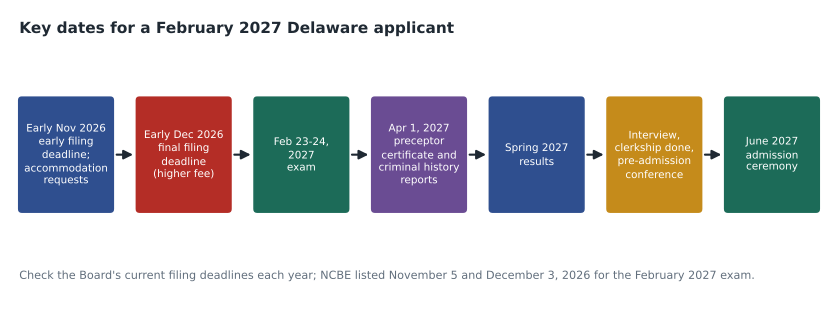
Timing. The Board's FAQ says applicants identify their preceptor and upload the Preceptor First Certificate by September 1 for the July exam and by April 1 for the February exam, the same dates on which criminal history reports are due. Those dates fall after the exam, while the Board is grading, because the full character investigation happens only for passing applicants. Some bar-prep summaries describe these dates differently, so check the current instructions for your exam rather than a summary.
Tamsin's preceptor will be Gregory Ashe, the senior partner at her firm, admitted in Delaware since the 1990s. Marchetti reminds her that 'senior partner at my firm' is not enough by itself; she should confirm his admission date in the Supreme Court's attorney records, because the ten-year rule is measured from Delaware admission, not from his first license anywhere.
Applying to sit the exam
Applicants file with the Board through its online application system and also complete the NCBE Character and Fitness Application, which NCBE uses to compile and verify the applicant's history for the Board. Since the 2023 reforms the Board has worked with NCBE on that application, so many of the questions will look familiar to anyone who has applied elsewhere.
What goes in. The Board's checklist of documents for a law graduate typically includes a recent photograph, an authorization and release, affidavits confirming that the application is complete, an NCBE acknowledgment and the NCBE character application itself. Law school certifications and transcripts follow, and fingerprint-based Delaware and FBI criminal history reports are required later in the process.
Deadlines. Delaware uses two filing deadlines for each exam. For a February exam the early deadline falls in early November and the final deadline in early December of the year before. For a July exam the early deadline falls in early April and the final deadline in early May. NCBE's November 2026 summary lists November 5 and December 3 for the February 2027 exam; Board pages have used the first Tuesday of the month as the rule of thumb. Because the two descriptions do not always line up, use the date on the Board's current instructions.
Fees. The filing fee depends on whether the applicant is a law graduate or a lawyer admitted elsewhere, and on which deadline the applicant meets. For recent exams the fees were 700 dollars for a law graduate filing by the early deadline and 900 dollars by the final deadline, and 800 and 1,000 dollars for lawyers admitted elsewhere. A laptop fee of 100 dollars applies to applicants who type the written portion. Before 2023 the late fees were much higher, 1,400 dollars for graduates and 1,600 for lawyers, and cutting them was one of the 2023 reforms.
Accommodations. Requests for testing accommodations, with supporting documentation, are due on or before the early filing deadline. An applicant who files late cannot expect the Board to process an accommodation request in time.
| Item | February exam | July exam |
|---|---|---|
| Early filing deadline | Early November | Early April |
| Final filing deadline | Early December | Early May |
| Fee, law graduate | 700 dollars early, 900 final (recent exams) | 700 dollars early, 900 final (recent exams) |
| Fee, lawyer admitted elsewhere | 800 dollars early, 1,000 final | 800 dollars early, 1,000 final |
| Accommodation requests | By the early deadline | By the early deadline |
| Preceptor first certificate and criminal history reports | April 1 after the exam | September 1 after the exam |
Limited practice before admission
Delaware has a narrow path for some law graduates to appear before admission. Under Supreme Court Rule 55, a graduate of an ABA-accredited law school who works for certain Delaware nonprofit or government agencies may, at the Board's discretion, be permitted to practice in Delaware courts and agencies on matters for that office or its clients. The graduate applies to the Board under its rules, applies for the bar exam and completes the character application. This is limited permission tied to the employer, not admission, and it ends if the graduate leaves the job or fails to complete the admission requirements.
The deadline that follows you
Rule 52 has a final deadline that surprises applicants: every requirement must be met, and admission completed, by December 31 of the year after the applicant passes the exam. An applicant who passes in February 2027 therefore has until December 31, 2028. Someone who misses it without an extension must retake the exam. The Board can extend the deadline on a petition under its rules, but an applicant should not plan on one.
Marchetti draws the lesson for Tamsin. 'Passing is not the finish line. Your clerkship, your checklist, your preceptor's certificates, your interview and the pre-admission conference all have to fit inside that window. Most people finish within months, but I've seen people lose their result because a job took them out of state and the clerkship never got finished.'
Worked problem
Checking eligibility for three applicants
Hollis gives Tamsin three short profiles. (1) Rhea graduated in 2026 from an ABA-approved school. (2) Omar is admitted in New Jersey and graduated from a law school that was not ABA-approved. (3) Lucía holds a law degree from Spain and an LLM from a US school. Who can apply, and how?
Show solution
- Rhea meets the law school requirement through her degree and files the standard application.
- Omar does not meet the default requirement, but as a member in good standing of another state's bar he may petition the Board to waive it.
- Lucía may petition for a waiver if the Board finds her foreign degree plus LLM substantially equivalent to a JD.
- All three, if eligible, need a preceptor, the MPRE, the exam, the clerkship and checklist, the character investigation and the pre-admission conference.
Answer: The waiver changes who may sit the exam, never what a successful applicant must then complete.
Common mistakes
MistakeAssuming any US law degree qualifies.
InsteadThe default rule requires a JD from an ABA-approved school; others need a Board waiver on petition.
MistakeChoosing a preceptor who has practiced 15 years but was admitted in Delaware only six years ago.
InsteadThe ten-year requirement is measured from admission to the Delaware Bar.
MistakeFiling an accommodation request with a late application.
InsteadAccommodation requests are due by the early filing deadline.
MistakeThinking passing the exam locks in admission forever.
InsteadAll requirements must be met by December 31 of the year after passing, or the applicant must retake the exam unless the Board extends the time.
Working with a preceptor
Marchetti has seen preceptor relationships go well and badly, and she gives Tamsin a short list of habits that make the relationship work. Meet early, before the application is filed, so the preceptor knows the applicant well enough to certify character honestly. Share the Board's preceptor instructions and deadlines in writing rather than assuming the preceptor remembers them; busy partners have many other deadlines. Keep a running log of clerkship hours and checklist items, with dates, the supervising lawyer and a one-line description, and send it to the preceptor every month. Ask the preceptor to introduce you to lawyers in other practice areas whose work can satisfy checklist items you cannot complete at your own office.
If the relationship breaks down, for example because the preceptor retires, leaves Delaware or changes firms, the applicant should tell the Board promptly and arrange a substitute, using the preceptor bank if necessary. A gap in the certifications can delay admission even after a passing result.
A note on documents
Delaware's process generates a stack of paper: the application, affidavits, the NCBE character application, law school certifications, the preceptor's certificates, criminal history reports, clerkship and checklist certifications and the pre-admission conference registration. Marchetti asks Tamsin to create one folder, physical or electronic, with a subfolder for each item and a cover sheet listing what was sent, how and when. 'Nobody fails the Delaware bar because of the paperwork,' she says. 'But people do get admitted months late because of it.'
Applicants who are lawyers admitted elsewhere should add certificates of good standing from every jurisdiction where they are admitted and, if they are petitioning for a waiver of the law school requirement, the petition and supporting materials. Foreign-educated applicants should allow extra time for degree evaluations and translations, because the Board must be able to compare the foreign degree and LLM with a JD before it can act on the petition.
Planning the year
For Tamsin, the year from now until admission divides into three stages. From November to February she studies and completes paperwork. From February to April she sits the exam and files the post-exam documents. From April to June she finishes the clerkship and checklist, goes through the character interview and attends the pre-admission conference. Seeing it as three stages, rather than as one exam, makes the process feel manageable.
Summary and key terms
- Applicants must be 21, have completed pre-legal study and hold a JD from an ABA-approved school, unless the Board waives the law school requirement on petition.
- Waivers are available for foreign graduates with an LLM the Board finds substantially equivalent to a JD and for lawyers in good standing elsewhere.
- Every applicant needs a preceptor admitted in Delaware for at least ten years; a preceptor bank helps those without one.
- There are early and final filing deadlines for each exam, with higher fees after the early deadline; accommodation requests are due by the early deadline.
- All requirements must be completed by December 31 of the year after passing.
- Preceptor bank
- The Board's list of volunteer Delaware lawyers who can be assigned as preceptors.
- Preceptor First Certificate
- The preceptor's initial certificate to the Board, due after the exam on a set date.
- Waiver petition
- A request asking the Board to waive the ABA law school requirement for a foreign-educated applicant or a lawyer admitted elsewhere.
- Rule 55 practice
- Limited permission for certain law graduates working for qualifying Delaware agencies to practice before admission.
Practice problems
Work each problem on paper first, then reveal the answer to check.
What two groups can ask the Board to waive the ABA law school requirement?
Show answer
Foreign law graduates with an LLM the Board finds substantially equivalent to a JD, and lawyers in good standing in another US jurisdiction.
When are accommodation requests due?
Show answer
On or before the early filing deadline for the exam.
An applicant passes in July 2027. What is the last day to complete admission without an extension?
Show answer
December 31, 2028.
Lesson quiz · 5 questions
Score 60% or more to complete this lesson.
Create a free account to save your progress, take quizzes and earn a certificate.