
BAR-212 · Lesson 2 of 12 · 16 min
Eligibility, education, deadlines and fees
▶ Video coming soon A video version of this lesson is on the way.
Two weeks into the study group, Kainoa brings a question from his firm. A senior associate, Teodora Valdez, was admitted in California eight years ago after graduating from a California law school that is accredited by the State Bar of California but not by the ABA. She moved to Honolulu with her family in 2025 and now works under the firm's supervision on research and drafting. 'She wants to know if she can sit the Hawaiʻi exam,' Kainoa says, 'or whether she has to go back to law school.' Marchetti smiles. 'Hawaiʻi has an answer for exactly her situation. It is one of the more generous eligibility rules in the country for experienced lawyers, even though it has no admission on motion. Let us start with the ordinary rule and work out to hers.'
This lesson covers who may sit for the Hawaiʻi examination, the filing deadlines, the documents applicants must submit, the fees and the practical steps that keep an application from being dismissed. The source for most of it is RSCH Rule 1.3, the Board of Examiners' Rules of Procedure and NCBE's jurisdiction information for Hawaiʻi. Fees and procedures change, so Marchetti's standing instruction applies: before you file, read the Board's current application instructions and confirm every amount.
The ordinary rule: an ABA-accredited J.D. or LL.B.
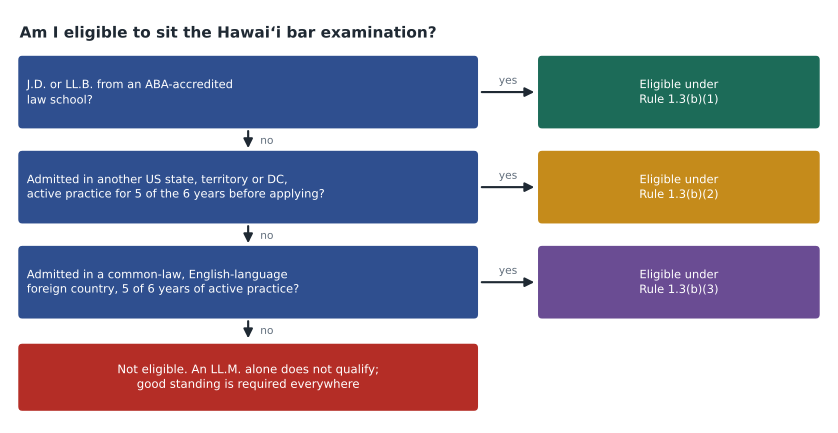
Under RSCH Rule 1.3(b)(1), an applicant qualifies by graduating with a J.D. or LL.B. from a law school accredited by the American Bar Association. The rule is specific about graduate degrees: an LL.M., M.C.L. or S.J.D. does not substitute for the first professional degree. That matters for two groups. Foreign-trained lawyers who earn an LL.M. at an ABA-accredited school cannot use that degree alone to qualify in Hawaiʻi, as they can in New York and several other jurisdictions. NCBE's information for Hawaiʻi confirms that an LL.M. from an ABA-approved school alone does not qualify a foreign graduate. And graduates of law schools that are not ABA-accredited cannot rely on their degrees alone, however good the school.
An applicant on this route proves eligibility by submitting a certified transcript or other official documentation showing graduation, as section 2.2 of the Board's Rules of Procedure requires. Most applicants sit for the examination after graduation; an applicant who will not have graduated by the examination date should read the current instructions carefully, because the transcript requirement is tied to graduation.
The experienced-lawyer route
Rule 1.3(b)(2) opens the examination to lawyers who did not graduate from an ABA-accredited school but who are admitted to practice by the highest court of another state, a territory or the District of Columbia. Such a lawyer may apply if he or she has actively practiced law for at least five of the six years immediately before applying. Rule 1.3(b)(3) extends the same idea to lawyers admitted in a foreign country whose legal system is based on the English common law and where English is the language of practice; they too need five of the six preceding years of active practice. Rule 1.3(b)(4) counts service as a judge of a court of record as active practice.
Two conditions apply to every applicant on these routes. First, the lawyer must be in good standing: under Rule 1.3(b)(5), an applicant may not sit or be admitted while suspended or disbarred elsewhere, or while permitted to practice elsewhere only under supervision. Second, the lawyer must prove the practice requirement with evidence, as section 2.2 of the Board's Rules of Procedure provides. That usually means letters from employers, court records, client records with identifying details removed, or similar documents showing the nature and duration of the practice. 'Active practice' is not the same as bar membership; a lawyer who held a license but did not practice for most of those years will not qualify.
Worked problem
Teodora's eligibility
Teodora graduated in 2017 from a California-accredited law school that is not ABA-accredited. She was admitted in California in 2018 and practiced full time at a Los Angeles firm until she moved to Hawaiʻi in mid-2025. Since then she has worked under supervision as a law clerk in Honolulu. She wants to file for the July 2027 examination by April 1, 2027. Is she eligible?
Show solution
- Her degree is not from an ABA-accredited school, so Rule 1.3(b)(1) does not apply.
- She is admitted by the highest court of another state, California, so Rule 1.3(b)(2) may apply.
- The six years before an April 2027 application run from about April 2021 to April 2027. She actively practiced in California from April 2021 to mid-2025, a little over four years.
- Her work in Honolulu since mid-2025 is supervised clerking in a jurisdiction where she is not licensed, which is unlikely to count as the active practice of law.
- She falls short of five of the six years for April 2027; she should confirm with the Board how it treats her California practice and her Hawaiʻi work before filing.
Answer: On these facts Teodora probably does not yet meet the five-of-six-years requirement for the July 2027 examination; the timing matters, and she should ask the Board before filing.
Marchetti draws a lesson from the example: 'The window moves with you. Every month you are not practicing slides the six-year window forward and drops a month of practice off the back. Lawyers who move to Hawaiʻi and plan to sit should do the math before they leave their old jobs, not after.'
Filing deadlines
Section 2.1(b) of the Board's Rules of Procedure sets two filing deadlines: on or before November 1 of the preceding year for the February examination, and on or before April 1 for the July examination. NCBE's information for Hawaiʻi lists those same dates for the July 2026 and February 2027 examinations and lists no late filing period. That is an important difference from many states, which accept late applications for an additional fee. In Hawaiʻi, an applicant who misses the deadline waits for the next examination.
The July deadline deserves special attention. April 1 falls during the spring semester, often before a third-year student has finished classes, let alone graduated. Students who plan to sit in July after graduation need to assemble their applications in the middle of the semester. Marchetti tells law students to put March 1 on their calendars as the day the application should be essentially done, leaving a month for missing records, notarization and payment.
| Examination | Filing deadline | Late filing | Examination dates |
|---|---|---|---|
| July 2026 | April 1, 2026 | None listed | Last Tuesday and Wednesday of July |
| February 2027 | November 1, 2026 | None listed | February 23 and 24, 2027 |
| July 2027 | April 1, 2027 | None listed | Last Tuesday and Wednesday of July |
What the application includes
The Hawaiʻi application is submitted with the filing fee and the character report fee. It asks for the applicant's personal history, including every residence and every job for a set period, education, bar admissions elsewhere, any disciplinary history, criminal and civil court matters, financial matters such as defaulted debts and bankruptcies, and other matters relevant to character and fitness. Supporting documents typically include the law school's certification or transcript, proof of identity, and records for anything that requires a yes answer. Applicants also pay NCBE's character report fee directly with the application. Section 2.6(a) of the Board's Rules of Procedure warns that a missing or incorrect NCBE payment leads to dismissal of the application without prejudice, and section 2.3 provides that an application filed without the Board's fee is rejected unless the supreme court waives it.
The duty to keep an application current continues after filing. Sections 2.7 and 2.8 require applicants to cooperate with the Board and to update their applications with any change in the information provided, until admission. A new traffic citation with a court date, a lawsuit, a change of job or a new address all count. Lesson 3 explains why candor and prompt updates matter so much in the character and fitness review.
Fees
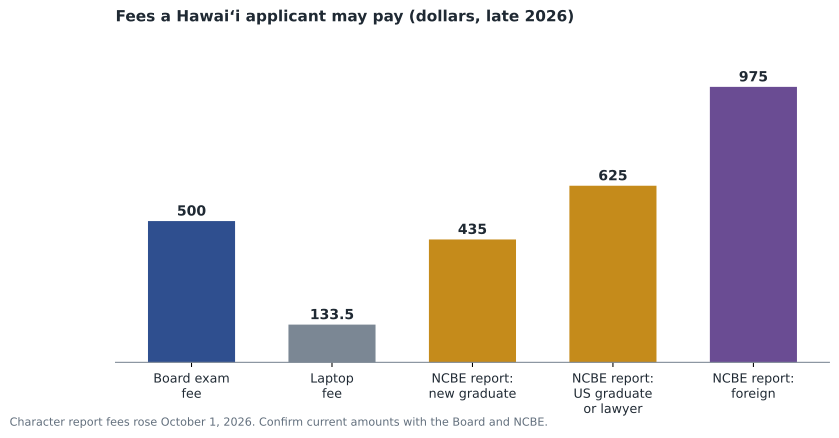
NCBE's information for Hawaiʻi lists the bar examination fee as 500 dollars, plus the character report fee, for first-time takers, attorneys and repeaters alike. Applicants who are permitted to type the written portions on their own laptops pay a laptop fee, listed at 133.50 dollars. The filing fee is nonrefundable and nontransferable under section 2.3 of the Board's Rules of Procedure; an applicant who withdraws before the examination must do so in writing under section 2.9 and does not get the fee back or carry it forward.
NCBE's character report fees rose on October 1, 2026. For a new application, the fee depends on the applicant's category: 435 dollars for an applicant whose first law degree is expected within a year or less and who is not authorized to practice anywhere; 625 dollars for an applicant whose United States law degree was awarded more than a year ago or who is authorized to practice only in the United States; and 975 dollars for an applicant whose law degree is from outside the United States or who is authorized to practice in a foreign country. Reduced fees apply when NCBE prepared a report for the applicant within the past four years: 275 dollars when the earlier report was for a different jurisdiction, 135 dollars when it was for Hawaiʻi, and 500 dollars for a foreign-category report prepared for any jurisdiction.
Practical steps
Most problems with Hawaiʻi applications are avoidable. Marchetti's checklist for her Hawaiʻi candidates starts with the calendar: identify the deadline for the examination you want and plan to file a month early. Next comes the MPRE: confirm that your score will fall within the two-year window for that examination, and arrange for NCBE to report it. Then the records: order transcripts, gather employment and residence histories with addresses and dates, and collect court and financial records for anything you must disclose. Finally the money: pay the Board's fee and NCBE's fee in the form and amount the instructions require, and keep receipts.
Applicants coming from the mainland face one more practical question: where they will stay for the examination. The examination is given only in Honolulu, and examination weeks often coincide with busy travel seasons. Kainoa, who lives on Oʻahu now, is lucky. A classmate from Kauaʻi booked her room and inter-island flight in November for the February examination, and a mainland candidate in the group booked hers before she even filed. Lesson 12 returns to examination-week logistics.
Common mistakes
MistakeAn LL.M. from an ABA-accredited school qualifies a foreign lawyer to sit in Hawaiʻi.
InsteadRule 1.3(b)(1) excludes graduate degrees; foreign lawyers qualify only through five of six years of active practice in a qualifying common-law country.
MistakeHawaiʻi accepts late applications for an extra fee.
InsteadNCBE lists no late filing period; the deadlines are November 1 and April 1.
MistakeBar membership elsewhere satisfies the practice requirement.
InsteadRule 1.3(b)(2) and (3) require active practice for five of the six years before applying, proven with evidence.
MistakeA withdrawn applicant can carry the fee forward to the next examination.
InsteadThe filing fee is nonrefundable and nontransferable.
Planning backward from the deadline
The safest way to meet a Hawaiʻi filing deadline is to plan backward from it. Marchetti asks every candidate to write the deadline at the top of a page and then list, working backward, each item the application needs and how long it will take to get. Some items depend only on the applicant, such as answering the questions and gathering addresses and employment dates. Others depend on other people: a law school that must certify a degree, a court in another state that must send a certified copy of a record, or a former employer who must confirm dates. Those outside items set the real schedule.
| Weeks before the deadline | Task |
|---|---|
| Eight | Read the Board's current instructions and the NCBE application questions in full |
| Seven | Request records from courts, schools and agencies that take time to respond |
| Five | Complete the residence, employment and education history, checking dates against documents |
| Three | Draft explanations for any disclosures and have a trusted reader review them |
| Two | Assemble the complete application and pay the fees |
| One | File, keep a full copy and confirm receipt |
Kainoa followed a version of this plan, but he started late and filed only a few days before the November 1 deadline. 'It worked,' Marchetti tells him, 'but you had no margin. If a court clerk on the mainland had been slow with a record, you would have been filing in a hurry or not at all.' Applicants for the July examination should note that the April deadline falls in the busiest weeks of the final law school semester, so the backward plan for July should begin in the winter.
A last point on fees: keep receipts for every payment, both to the Board and to NCBE, and confirm the current amounts on the official pages just before paying. Fees change, as NCBE's increase in its character report fee on October 1, 2026 showed, and an application filed with the wrong fee can be delayed while the difference is collected.
Summary and key terms
- An ABA-accredited J.D. or LL.B. qualifies an applicant; an LL.M. or other graduate degree does not substitute.
- Lawyers admitted in another US jurisdiction, or in a common-law English-language foreign country, may sit after five of the six preceding years of active practice.
- Applications are due November 1 for February and April 1 for July, with no late filing period listed.
- The examination fee is 500 dollars plus NCBE's character report fee, which rose on October 1, 2026.
- Applicants must keep their applications updated and cooperate with the Board until admission.
- ABA-accredited law school
- A law school accredited by the American Bar Association, whose J.D. qualifies an applicant under Rule 1.3(b)(1).
- Active practice
- Actual engagement in the practice of law, as distinct from holding a license; Hawaiʻi requires five of six years for experienced-lawyer applicants.
- Character report fee
- The fee paid to NCBE for its character and fitness investigation, set by applicant category.
- Dismissal without prejudice
- Ending an application without deciding its merits, so the applicant may file again for a later examination.
Lesson quiz · 5 questions
Score 60% or more to complete this lesson.
Create a free account to save your progress, take quizzes and earn a certificate.