
BAR-212 · Lesson 4 of 12 · 17 min
The Hawaiʻi bar exam: format, scoring and passing score
▶ Video coming soon A video version of this lesson is on the way.
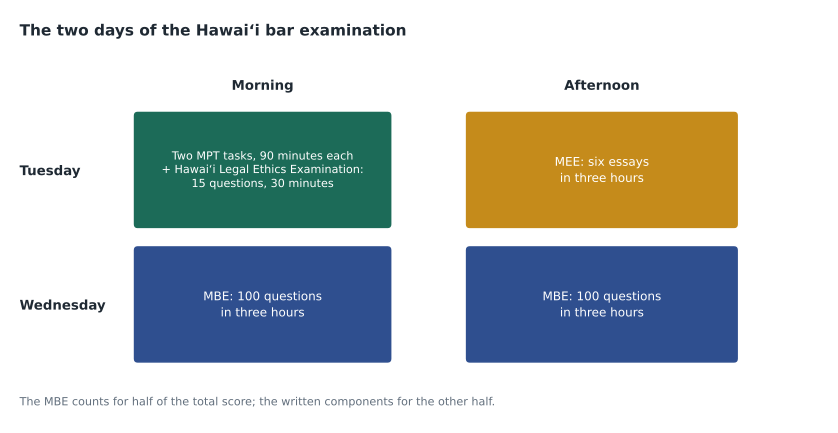
Marchetti opens the fourth session with a single sheet of paper divided into four boxes: Tuesday morning, Tuesday afternoon, Wednesday morning, Wednesday afternoon. 'Fill these in from memory,' she tells Kainoa. He writes 'MBE' in both Wednesday boxes and 'essays' in the Tuesday afternoon box, then stops. 'And Tuesday morning is the performance test,' he says, 'plus that short ethics thing.' 'Good,' Marchetti says. 'Now tell me how much each box counts and what score you need. That is what we will work out today, because how you divide your study time should follow how the points are divided.'
This lesson describes the two days of the Hawaiʻi bar examination, how each part is scored, how the parts are combined, the passing score and what happens after the examination. The sources are RSCH Rule 1.3, the Hawaiʻi Judiciary's description of the Hawaiʻi Legal Ethics Examination, NCBE's jurisdiction information for Hawaiʻi and NCBE's descriptions of its own tests. Where a detail comes from a bar-preparation provider rather than an official source, the lesson says so.
When and where
Under RSCH Rule 1.3(g), the Hawaiʻi bar examination is held in Honolulu twice a year, during the week of the last Wednesday of February and the last Wednesday of July. In practice, the examination falls on the last Tuesday and Wednesday of those months. The February 2027 examination is scheduled for Tuesday, February 23, and Wednesday, February 24, 2027. There is only one examination site, so applicants from the neighbor islands and the mainland travel to Oʻahu.
Tuesday morning: the MPT and the Hawaiʻi Legal Ethics Examination
The first morning combines two parts. The Multistate Performance Test (MPT) consists of two ninety-minute tasks written by NCBE. Each task gives the applicant a file of facts, such as interview notes, letters and documents, and a library of legal authorities, and asks the applicant to produce a lawyerly document: an objective memorandum, a persuasive brief, a client letter, a settlement proposal or something similar. The MPT does not test whether the applicant has memorized the law; the library supplies the law. It tests whether the applicant can sort relevant from irrelevant facts, read and apply authority and write clearly under time pressure. Since July 2026, NCBE has also used the MPT to test family law and trusts and estates, with the needed law supplied, after removing those subjects from the essay examination.
The Hawaiʻi Legal Ethics Examination is the only part of the current examination written by the Board itself. According to the Hawaiʻi Judiciary, it consists of fifteen multiple-choice questions on the Hawaiʻi Rules of Professional Conduct, answered in thirty minutes on Tuesday morning, and the Board numbers it as Question No. 8, following the six MEE questions and two MPT tasks in the overall question count. The Judiciary emphasizes that it is not the MPRE and not the Hawaiʻi Professionalism Course; it is a separate test of the Hawaiʻi rules. Lesson 10 covers the Hawaiʻi rules most likely to be tested.
Tuesday afternoon: the MEE
The Multistate Essay Examination (MEE) consists of six essay questions, each designed to take about thirty minutes, for three hours in all. NCBE writes the questions; graders in Hawaiʻi grade the answers using NCBE's analyses and grading workshops. Since the July 2026 administration, the MEE draws on business associations, civil procedure, constitutional law, contracts, criminal law and procedure, evidence, real property and torts. Conflict of laws, family law, trusts and estates and secured transactions were removed as essay subjects that month. An MEE question can mix subjects, and the answers are graded on issue identification, accurate statement of the rules, application to the facts and organization.
Wednesday: the MBE
The Multistate Bar Examination (MBE) fills all of Wednesday: 200 multiple-choice questions in two three-hour sessions of 100 questions each. Of the 200, 175 are scored and 25 are unscored pretest questions that NCBE is trying out for future use; applicants cannot tell which are which. The scored questions are divided evenly among seven subjects: civil procedure, constitutional law, contracts, criminal law and procedure, evidence, real property and torts. Each MBE question is a short fact pattern followed by four answer choices, and the pace works out to about 1.8 minutes per question.
How the parts are scored and combined
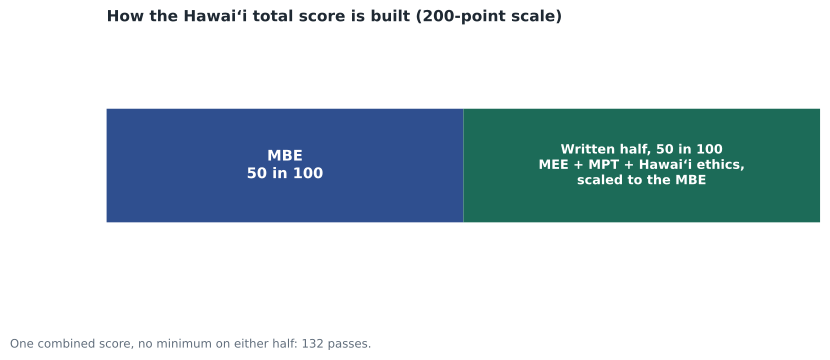
NCBE's information for Hawaiʻi states that the MBE counts for fifty percent of the combined score. The other half comes from the written components, the MEE, the MPT and the Hawaiʻi Legal Ethics Examination. Like UBE jurisdictions, Hawaiʻi scales its written scores to the MBE: the raw written scores are converted to the same scale as the scaled MBE scores before the two halves are combined. Scaling ties the written grades, which can vary in difficulty from one examination to the next, to the MBE, which NCBE equates so that a given scaled score represents the same level of performance on every administration. A strong performance on one half can make up for a weaker performance on the other.
Hawaiʻi reports the combined total on a 200-point scale. That is the main visible difference from the UBE, which reports totals on a 400-point scale. The exact weights within the written half, how much the MEE, the MPT and the ethics questions each contribute, are set out in the Board's own scoring materials, which NCBE references but does not reproduce. Bar-preparation providers commonly describe the written half as dominated by the MEE and MPT, with the ethics questions contributing a small share. Applicants who want precise weights should ask the Board.
The passing score
An applicant passes with a combined scaled score of at least 132. The supreme court announced the current figure on January 28, 2025, effective beginning with the February 2025 examination. For years before that, the passing score had been 133, and the court had announced several times, including for the February and July 2021 examinations, that it would remain 133. Some study guides still list 133. When you see a conflicting number, check the date: the court's 2025 announcement controls.
The passing score applies to the total, not to any single part. There is no separate minimum on the MBE or on the essays. An applicant who scores well below average on the MPT can still pass with a strong MBE and solid essays, and the reverse is also true. That is one reason Marchetti tells her Hawaiʻi candidates not to abandon any part of the examination in their preparation, even the fifteen ethics questions. 'Every point is the same point,' she says. 'A question you get right on the ethics test is worth exactly as much as one you get right anywhere else, and the Hawaiʻi rules are easier to learn than a new MBE subject.'
Worked problem
Reading a score report
Two friends sit the July examination. Leilani's scaled MBE score is high and her written score is modest; Makoa's written score is high and his MBE is modest. On the 200-point scale, each friend's combined score is 134. Has each passed?
Show solution
- Hawaiʻi uses a single combined score; the MBE is half and the scaled written components are the other half.
- There is no minimum score on either half.
- Each combined score, 134, is at least 132.
- Both pass, even though their strengths are opposite.
Answer: Both passed: Hawaiʻi applies the 132 passing score to the combined total, with no minimum on either half.
Results and review
NCBE lists the average grading period for Hawaiʻi as ten to twelve weeks. After grading, the Board files a notice with the supreme court listing the applicants who passed; the notice for the July 2026 examination, filed September 18, 2026, listed 116 names. Rule 1.3(g)(4) permits the clerk to send an unsuccessful applicant his or her scores on request within thirty days, but the rule is blunt about challenges: there is no right of appeal as to the examination or its results. An applicant who fails studies the score report, adjusts the plan and files for the next examination. NCBE lists no limit on the number of attempts in Hawaiʻi.
Pass rates vary from one administration to the next. A bar-preparation provider reports that about 71 in 100 applicants passed the July 2025 examination, about 77 in 100 of them first-time takers, and that about 59 in 100 passed the February 2026 examination, with first-time takers again doing far better than repeaters. February pass rates are generally lower than July rates in Hawaiʻi, as in most jurisdictions, because February has a larger share of repeat takers. The numbers are a reminder, Marchetti says, that most well-prepared first-time takers pass.
Common mistakes
MistakeHawaiʻi reports scores on the UBE's 400-point scale.
InsteadHawaiʻi reports its combined score on a 200-point scale; 132 passes.
MistakeThere is a minimum score on the MBE.
InsteadThe 132 passing score applies to the combined total only.
MistakeThe MEE still tests family law and trusts and estates.
InsteadSince July 2026 those subjects appear only on the MPT, with the law supplied.
MistakeAn applicant can appeal a failing grade.
InsteadRule 1.3(g)(4) gives no right of appeal as to the examination or its results.
Using the scoring to plan study
Because Hawaiʻi combines the MBE and the written components into a single total, with no minimum on either half, candidates can plan their study around their own strengths and weaknesses. The question is where an extra week of work will add the most points. A candidate with a weak MBE and strong writing gains more from timed MBE sets than from another round of essay practice. A candidate whose essays are thin gains more from writing timed MEE answers and studying model answers.
Marchetti asks every candidate to take a full diagnostic early, score each part and then compare the results with the passing score. 'You do not need to be excellent everywhere,' she says. 'You need a total of 132. Find the cheapest points first.' For most candidates, the cheapest points are on the MPT, which needs no memorization, and on the fifteen Hawaiʻi ethics questions, which test a short list of rules that can be learned in a few weeks.
| Diagnostic result | Likely best use of extra time |
|---|---|
| Weak MBE, strong written | Daily timed MBE sets in the weakest subjects, with careful review of every miss |
| Strong MBE, weak MEE | Timed essays two or three times a week, compared against model answers |
| Weak MPT | One full timed MPT a week, focusing on reading the library and organizing the answer |
| Unsure of Hawaiʻi ethics rules | A differences chart and timed sets of fifteen questions in thirty minutes |
A study calendar for February 2027
Kainoa has about thirteen weeks between the start of his study plan in late November 2026 and the examination on February 23 and 24, 2027. He is working at the firm through mid-December, then studying full time. Marchetti helps him divide the time into three phases. In the first phase, while he is still working, he reviews the MBE subjects in the evenings and on weekends and does twenty to thirty MBE questions a day. In the second phase, from late December, he studies full time, adds two timed essays and one MPT each week and builds his Hawaiʻi ethics differences chart. In the third phase, the last three weeks, he takes a full simulated examination over two days, reviews his weakest subjects and practices the ethics examination at full speed.
Worked problem
Choosing where to spend the last two weeks
Two weeks before the examination, Kainoa's practice scores suggest a total close to the passing score. His MBE practice scores are steady; his essays are inconsistent, strong in some subjects and weak in others; and he gets about ten of fifteen ethics questions right. Where should he focus?
Show solution
- The MBE is steady, so he should keep up daily practice to stay sharp but not make it the main focus.
- The essays are inconsistent, which usually means gaps in particular subjects; he should list the subjects where he was weak and write one timed essay in each.
- The ethics questions are a small, learnable set; reviewing the Hawaiʻi variations and doing two more timed sets could add points quickly.
- He should not start any new subject or outline in the last two weeks.
Answer: Focus on the weak essay subjects and the Hawaiʻi ethics rules, while keeping MBE practice steady.
Rest and recovery
Two days of examination are physically demanding. Candidates often study hard right up to the night before and then find that they are tired by the second afternoon. Marchetti builds rest into every plan: one full day off a week during the study period, at least seven hours of sleep a night in the last two weeks, and a quiet evening between the two examination days. 'The second afternoon of the MBE counts as much as the first morning,' she says. 'Arrive at it with something left.'
Summary and key terms
- The examination is held in Honolulu on the last Tuesday and Wednesday of February and July.
- Tuesday morning has two MPT tasks and the fifteen-question Hawaiʻi Legal Ethics Examination; Tuesday afternoon has six MEE essays; Wednesday is the 200-question MBE.
- The MBE is half the score; the written components, scaled to the MBE, are the other half.
- The passing score is 132 on a 200-point scale, effective since February 2025.
- Unsuccessful applicants may request their scores, but there is no appeal; Hawaiʻi sets no limit on attempts.
- MPT
- The Multistate Performance Test, in which applicants complete lawyering tasks using a supplied file and library.
- MEE
- The Multistate Essay Examination, six thirty-minute essay questions written by NCBE.
- MBE
- The Multistate Bar Examination, 200 multiple-choice questions, 175 of them scored, in seven subjects.
- Scaling
- Converting raw written scores to the MBE score scale so the two halves can be combined fairly.
- Hawaiʻi Legal Ethics Examination
- The Board's fifteen-question multiple-choice test on the Hawaiʻi Rules of Professional Conduct.
Lesson quiz · 5 questions
Score 60% or more to complete this lesson.
Create a free account to save your progress, take quizzes and earn a certificate.