
BAR-212 · Lesson 6 of 12 · 17 min
What the exam tests and where Hawaiʻi law appears
▶ Video coming soon A video version of this lesson is on the way.
Kainoa's firm keeps a shelf of Hawaiʻi Revised Statutes volumes in its conference room, and on his first week of bar study he took one home. 'Wrong book,' Marchetti tells him when he mentions it. 'Keep it for your job. For the exam, the law you need is mostly general law, the majority rules and the federal rules NCBE tests. The one place Hawaiʻi law shows up directly on the current exam is the ethics test. But you are going to practice here, so I want you to know exactly where the exam's law and Hawaiʻi's law part ways. That is how you avoid writing a Hawaiʻi rule on a national essay, or a national rule in a Hawaiʻi courtroom.'
This lesson explains what law the Hawaiʻi examination tests, how the one Hawaiʻi component fits in, how Hawaiʻi law is built and where to find it, and the most important points where Hawaiʻi law differs from the general rules tested on the MBE and MEE. Lessons 7 through 10 then go deeper into the Hawaiʻi law a new lawyer uses most.
The law on the national components
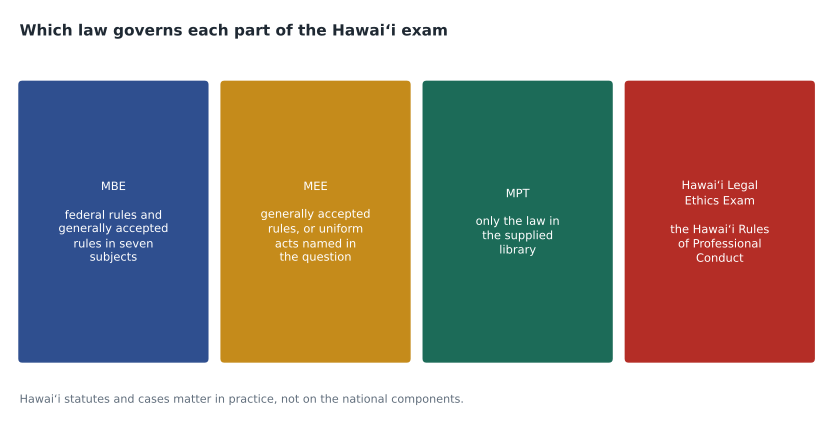
The MBE, MEE and MPT are written by NCBE for use in many jurisdictions, so they cannot test the law of any one state. NCBE's subject matter outlines tell applicants what law governs. On the MBE, civil procedure questions are answered under the Federal Rules of Civil Procedure and federal jurisdiction statutes, evidence questions under the Federal Rules of Evidence, constitutional law under the United States Constitution as interpreted by the Supreme Court, and contracts under the common law and Article 2 of the Uniform Commercial Code. Criminal law, real property and torts questions are answered under generally accepted rules, often the majority rule, unless the question says otherwise. MEE questions follow the same approach, and some tell the applicant to apply a particular uniform act or to assume a particular rule.
The MPT supplies its own law. Each task includes a library of statutes, regulations and cases from a fictional jurisdiction, and applicants are expected to work only from that library. A strong MPT answer that cites real Hawaiʻi law instead of the supplied authorities will lose points, however accurate the Hawaiʻi law is.
The Hawaiʻi component
The Hawaiʻi Legal Ethics Examination is different. Its fifteen multiple-choice questions test the Hawaiʻi Rules of Professional Conduct, which the supreme court adopted and has amended several times, most broadly in a set of amendments effective January 1, 2014. The Hawaiʻi rules follow the structure and numbering of the ABA Model Rules, and most rules are identical or nearly so. The differences are specific, and they are exactly what a Hawaiʻi-specific test is likely to probe: the mandatory disclosure duty in Rule 1.6(c), the writing requirements in Rules 1.5 and 1.8, the trust account rules in Rule 1.15 and the advertising rules in Rules 7.1 through 7.5. Lesson 10 covers them.
Marchetti's study plan for the ethics component is short and specific. Read the Hawaiʻi rules from start to finish once, side by side with the Model Rules you studied for the MPRE, and mark every difference. Make a one-page list of the differences. Then answer practice questions written for the Hawaiʻi rules, not the Model Rules. 'You will spend maybe six or eight hours on this over the whole study period,' she says. 'It is the highest return per hour of anything you will do.'
How Hawaiʻi law is built
Hawaiʻi law has four main sources. The first is the Hawaiʻi State Constitution, adopted in 1950 and effective at statehood in 1959. A constitutional convention in 1978 added many of the provisions that make Hawaiʻi distinctive, including the express protection of Native Hawaiian traditional and customary rights, the Office of Hawaiian Affairs, the public trust in natural resources including water, the right to a clean and healthful environment, and the express right to privacy. The second is the Hawaiʻi Revised Statutes (HRS), the code of statutes passed by the Legislature, organized by title and chapter and cited by section, such as HRS § 663-31. The third is the Hawaiʻi Administrative Rules, the regulations adopted by state agencies. The fourth is case law from the Hawaiʻi Supreme Court and the Intermediate Court of Appeals, published in the Hawaiʻi Reports and regional reporters and posted on the Judiciary's website.
Hawaiʻi also has a statute that ties its common law to its history. HRS § 1-1 adopts the common law of England, as ascertained by English and American decisions, as the common law of the state, except where it has been changed by the Constitution or statutes, fixed by Hawaiʻi judicial precedent or established by Hawaiian usage. The statute also preserves a limited role for Hawaiian usage: where a custom was established before November 25, 1892, it can still have legal effect. The Hawaiʻi Supreme Court has relied on HRS § 1-1, together with the Constitution and HRS § 7-1, in the cases on traditional and customary rights discussed in Lesson 10. Few other states have anything like it.
| Source | Example | Where to find it |
|---|---|---|
| Hawaiʻi State Constitution | Article XII, section 7 (traditional and customary rights) | Legislature and Judiciary websites |
| Hawaiʻi Revised Statutes | HRS chapter 174C (State Water Code) | Legislature website |
| Hawaiʻi Administrative Rules | Rules of the Commission on Water Resource Management | Agency websites |
| Case law | In re Water Use Permit Applications (2000) | Judiciary website and reporters |
| Court rules | Hawaiʻi Rules of Civil Procedure; RSCH Rule 1 | Judiciary website |
Where Hawaiʻi law differs from the exam's general rules
Several Hawaiʻi rules differ in ways that a new lawyer must not confuse with the rules tested on the national components. In torts, Hawaiʻi uses modified comparative negligence under HRS § 663-31: a plaintiff recovers, with damages reduced by the plaintiff's share of fault, as long as the plaintiff's negligence is not greater than the negligence of the defendants. The MBE's default for comparative fault questions, by contrast, is whatever the question specifies. Hawaiʻi also caps damages for pain and suffering at 375,000 dollars under HRS § 663-8.7, with exceptions for the categories of tort actions listed in HRS § 663-10.9, and it has modified joint and several liability by statute. Lesson 8 covers these rules.
In civil procedure, Hawaiʻi courts apply the Hawaiʻi Rules of Civil Procedure, which are modeled on the federal rules but not identical to them. The MBE tests the federal rules, so on the exam the federal version controls. Hawaiʻi's small claims division hears money claims up to 5,000 dollars and has exclusive jurisdiction over most residential security deposit disputes, which matters in Kainoa's landlord-tenant practice. Lesson 7 covers Hawaiʻi's courts and procedure.
In property, Hawaiʻi runs two systems of land records side by side, the Land Court, which registers title under a Torrens system, and the Bureau of Conveyances' Regular System, which records deeds. The MBE tests recording acts in general terms. Hawaiʻi also recognizes tenancy by the entirety, which some states have abolished, and gives special protection to public access to the shoreline and to Native Hawaiian gathering rights on private land. Lesson 9 covers property and water; Lesson 10 covers Native Hawaiian rights.
In family law, Hawaiʻi divides property at divorce under the marital partnership model developed by its courts, which differs from both common law title systems and community property states. Family law is not an MEE subject after July 2026, though it may appear on the MPT with the law supplied. A Hawaiʻi lawyer, however, will see it constantly.
Worked problem
Which law applies?
On the MBE, a question describes a plaintiff found 40 percent at fault for a collision and asks how much she recovers, stating that the jurisdiction follows pure comparative negligence. In Kainoa's practice, a similar client was injured on Oʻahu. How should each question be answered?
Show solution
- The MBE question specifies pure comparative negligence, so the applicant applies that rule: recovery reduced by 40 percent.
- Hawaiʻi applies modified comparative negligence under HRS § 663-31.
- The Hawaiʻi client's negligence, 40 percent, is not greater than the defendants' combined negligence, so she recovers, reduced by her share.
- The outcome happens to be similar, but the rule is different, and a client at 60 percent fault would recover nothing in Hawaiʻi.
Answer: Follow the rule the exam question gives; apply HRS § 663-31 in Hawaiʻi practice.
Studying with both in mind
Marchetti does not want her Hawaiʻi candidates to spend study time on Hawaiʻi law beyond the ethics rules. 'Learn the law the exam tests,' she says. 'When you notice a Hawaiʻi difference, write it in the margin and move on. After you pass, those margin notes become your first practice guide.' The approach has a practical advantage: it keeps applicants from second-guessing national answers with local rules, a habit that costs points on the MBE.
The exception is the Hawaiʻi Legal Ethics Examination, where the Hawaiʻi rule controls and the Model Rule answer can be wrong. Applicants who studied hard for the MPRE sometimes assume they can skip the Hawaiʻi rules. They cannot. A question about whether a lawyer must reveal a client's fraud, for example, may have a different answer under Hawaiʻi Rule 1.6(c) than under the Model Rules.
Common mistakes
MistakeApply Hawaiʻi law on the MBE when you know it.
InsteadThe MBE tests federal rules and generally accepted rules; apply the rule the question or NCBE's outline calls for.
MistakeCite Hawaiʻi cases on the MPT to show extra knowledge.
InsteadThe MPT is answered only from the supplied file and library.
MistakeThe Hawaiʻi ethics questions follow the Model Rules.
InsteadThey test the Hawaiʻi Rules of Professional Conduct, which differ in specific ways.
MistakeHawaiʻi follows pure comparative negligence.
InsteadHRS § 663-31 adopts modified comparative negligence: a plaintiff more at fault than the defendants recovers nothing.
Building a Hawaiʻi differences chart
A differences chart is a simple study tool: a table with three columns, one for the topic, one for the rule the examination tests and one for the Hawaiʻi rule used in practice. It does two jobs. On the examination, it reminds the candidate which answer the national components expect, so that Hawaiʻi habits do not creep into an MBE answer. In practice, it becomes the start of a working reference for the first years of a Hawaiʻi career.
Marchetti asks the group to add a row every time a lesson mentions a Hawaiʻi variation, and to keep the chart short enough to review in fifteen minutes. The chart below shows a few early rows from Kainoa's version. Later lessons explain each Hawaiʻi rule in detail.
| Topic | What the national components test | Hawaiʻi rule in practice |
|---|---|---|
| Plaintiff's negligence | The rule stated in the question, often pure comparative negligence | Modified comparative negligence under HRS § 663-31 |
| Joint and several liability | The traditional rule unless the question says otherwise | Modified by HRS § 663-10.9, with a 25 percent threshold for noneconomic damages |
| Recording and title | General recording acts | Two systems: the Land Court and the Regular System |
| Water rights | Riparian and prior appropriation concepts | The State Water Code and the public trust under Waiāhole |
| Confidentiality | Model Rule 1.6, permissive disclosure | Hawaiʻi Rule 1.6(c), which can require disclosure |
Keeping the two bodies of law apart
Candidates who already work in Hawaiʻi, as Kainoa does, face a special risk: they know the local rule so well that they apply it to an MBE question without noticing. The cure is to read the call of every question carefully and ask which law it asks for. An MBE question never asks for Hawaiʻi law. An MEE question asks for the general law unless it says otherwise. The Hawaiʻi Legal Ethics Examination always asks for the Hawaiʻi rules.
Worked problem
Which law answers the question?
An MBE question describes a plaintiff found 60 percent at fault and asks what the plaintiff may recover in a jurisdiction that has adopted pure comparative negligence. Kainoa's first instinct is that the plaintiff recovers nothing. What should he answer?
Show solution
- The question states the governing rule, pure comparative negligence.
- Under pure comparative negligence, the plaintiff recovers damages reduced by his or her own share of fault, here 40 percent of the total.
- The Hawaiʻi rule, which would bar recovery at 60 percent, is irrelevant because the question supplies its own rule.
Answer: The plaintiff recovers 40 percent of the damages; Kainoa's Hawaiʻi instinct would have cost him the point.
The same discipline works in reverse. When Kainoa writes a memo at the firm, the general rule he learned for the MBE is only a starting point. He must find the Hawaiʻi statute or decision that controls, cite it and explain any difference from the general rule his supervising lawyer might assume.
Summary and key terms
- The MBE and MEE test federal and generally accepted rules; the MPT tests only the supplied library.
- The one Hawaiʻi-specific component of the current examination tests the Hawaiʻi Rules of Professional Conduct.
- Hawaiʻi law comes from the 1950 Constitution as amended in 1978, the HRS, administrative rules and case law.
- HRS § 1-1 adopts the common law except where changed by Hawaiʻi law or established by Hawaiian usage before 1892.
- Key Hawaiʻi differences include modified comparative negligence, a 375,000-dollar pain and suffering cap, two land title systems and the marital partnership model.
- HRS
- The Hawaiʻi Revised Statutes, the state's code of statutes.
- HRS § 1-1
- The statute adopting the common law in Hawaiʻi, subject to Hawaiʻi law and Hawaiian usage established before 1892.
- Hawaiian usage
- Custom established in Hawaiʻi before November 25, 1892, which HRS § 1-1 preserves as a source of law.
- Modified comparative negligence
- A rule under which a plaintiff recovers reduced damages only if the plaintiff's fault does not exceed the defendants'.
Lesson quiz · 5 questions
Score 60% or more to complete this lesson.
Create a free account to save your progress, take quizzes and earn a certificate.