
BAR-212 · Lesson 5 of 12 · 17 min
Exam changes ahead: NextGen in July 2028
▶ Video coming soon A video version of this lesson is on the way.
Kainoa's younger cousin, Hōkū, is a first-year law student on the mainland and plans to return home to practice. Over a video call in November 2026, she asks him a question he cannot answer: which bar exam will she take? 'I graduate in May 2029,' she says. 'Is that still your exam, or the new one everyone is talking about?' Kainoa brings the question to the study group. Marchetti pulls up the supreme court's order. 'Hōkū will almost certainly take the NextGen exam,' she says, 'and in Hawaiʻi it will come with a Hawaiʻi ethics component and the same closed door to transferred scores you have now. Let us go through what we know, what is still to be announced and what it means for people on each side of the line.'
This lesson explains the Hawaiʻi Supreme Court's adoption of the NextGen bar examination developed by NCBE, the timeline, what NextGen will test and how, what Hawaiʻi has and has not announced about its own version, and how applicants sitting before and after the change should plan.
The court's decision
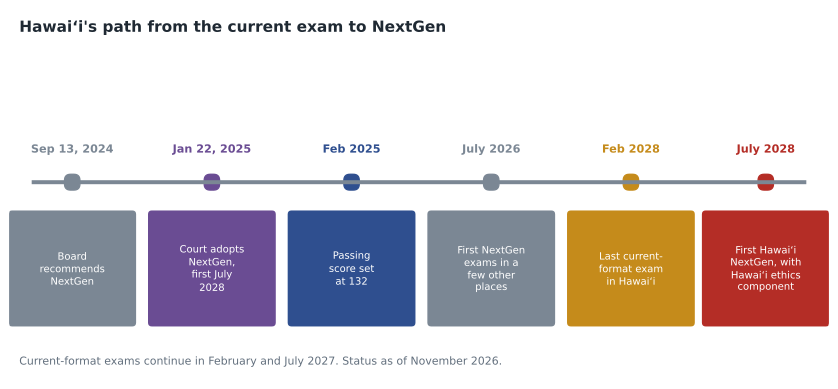
On January 22, 2025, the Hawaiʻi Supreme Court filed an order adopting the NextGen bar examination, with its first administration in Hawaiʻi set for July 2028. The order states that the Board of Examiners will administer the new examination and that the court acted on a recommendation the Board made in a letter dated September 13, 2024. The order is short; it does not set a passing score, describe a Hawaiʻi component or address transferred scores. NCBE announced the decision the next day, January 23, 2025, together with Maine's decision to begin NextGen at the same time.
With that order, Hawaiʻi joined the large group of jurisdictions that plan to move to NextGen. A handful of jurisdictions gave NextGen for the first time in July 2026; most, including Hawaiʻi, plan to begin in 2027 or 2028. NCBE will continue to offer the current examination through February 2028, so Hawaiʻi's last examination in the current format is expected to be the February 2028 examination, and its first NextGen examination will follow in July 2028.
What NextGen is
NextGen is a new examination, not a renamed version of the current one. NCBE designed it after a multi-year study of what newly licensed lawyers actually do. It tests a narrower set of legal subjects, the foundational concepts and principles, together with a set of foundational lawyering skills, and it tests them in integrated ways rather than in separate subject-by-subject tests. The current examination's division into the MBE, the MEE and the MPT disappears.
The content covers eight subjects: business associations, civil procedure, constitutional law, contracts, criminal law and procedure, evidence, real property and torts, with family law joining in July 2028. The skills cover legal research, legal writing, issue spotting and analysis, investigation and evaluation, client counseling and advising, negotiation and dispute resolution, and client relationship and management. NCBE marks some topics within the subjects as ones applicants must know from memory; for others, the needed law may be supplied in the question or task.
The examination takes about a day and a half. NCBE's published structure has three sessions of about three hours each, two on the first day and one on the second. Each session contains standalone multiple-choice questions, including some that ask the applicant to select two correct answers, integrated question sets built around a common fact pattern and mixing short written answers with multiple-choice questions, and a performance task in which the applicant completes a lawyering assignment, sometimes after doing legal research in a supplied library. NCBE reports NextGen scores on a single scale from 500 to 750, with no separate scores for components, and each jurisdiction sets its own passing score on that scale.
| Feature | Current Hawaiʻi exam | NextGen in Hawaiʻi (from July 2028) |
|---|---|---|
| Structure | MBE, MEE, MPT and Hawaiʻi Legal Ethics Examination | Integrated sessions of multiple-choice questions, question sets and performance tasks, plus a Hawaiʻi component |
| Length | Two full days | About a day and a half |
| Score scale | Combined score on a 200-point scale | Single NextGen score from 500 to 750 |
| Passing score | 132 | To be announced |
| Hawaiʻi-specific content | 15 multiple-choice questions on the Hawaiʻi Rules of Professional Conduct | 15 multiple-choice questions on the Hawaiʻi Rules of Professional Conduct, per NCBE |
| Transferred scores accepted | None | None, per NCBE |
What Hawaiʻi's version will include
NCBE maintains a chart of NextGen jurisdictions showing each one's first administration date, whether it will accept transferred NextGen scores and any jurisdiction-specific component. For Hawaiʻi, the chart lists a first administration in July 2028 and a jurisdiction-specific component of fifteen multiple-choice questions on the Hawaiʻi Rules of Professional Conduct, essentially carrying the current Hawaiʻi Legal Ethics Examination into the new system. The chart also notes that Hawaiʻi does not intend to accept transferred NextGen scores, and NCBE's jurisdiction information for Hawaiʻi lists transferred NextGen scores, like transferred UBE and MBE scores, as not accepted.
Several things remain to be announced as of November 2026. Hawaiʻi has not set its NextGen passing score; NCBE's information lists it as to be determined. It has not published the details of how the ethics component will be scored or combined with the NextGen score. And it has not announced whether it will revisit any other admission rule in connection with the change. Applicants who will sit in 2028 or later should watch the Judiciary's announcements and the Board's instructions.
Why the closed door matters
One of NextGen's selling points elsewhere is portability. Most NextGen jurisdictions plan to accept NextGen scores earned in other jurisdictions, so a lawyer who passes in one place may be able to transfer the score to another. Hawaiʻi's decision not to accept transferred NextGen scores means that, for Hawaiʻi, the change will not open a new route in. An applicant who passes NextGen in Oregon or Washington and then moves to Honolulu will still need to sit in Hawaiʻi, as applicants with UBE scores from other states must today.
Whether a Hawaiʻi NextGen score will transfer out to other jurisdictions is a separate question that depends on the receiving jurisdiction's rules and on how Hawaiʻi's version is scored and reported. Because Hawaiʻi will give the national examination plus a local component, other jurisdictions may treat a Hawaiʻi NextGen score as transferable, but no applicant should assume that until the receiving jurisdiction confirms it. Lesson 11 covers mobility in more detail.
Planning on either side of the line
For applicants like Kainoa, sitting in February 2027, the change matters mainly as a deadline. If he does not pass in February 2027, he can sit again in July 2027 or February 2028 in the current format. After February 2028, any retake will be on NextGen, which tests the same subjects in a different way. Marchetti's advice to anyone with a choice is to aim to finish in the current format rather than straddle the change: 'Switching formats in the middle means relearning the test, not just the law.'
For applicants like Hōkū, who will graduate in 2029, the planning is different. They should expect NextGen, choose law school courses that cover all of the NextGen subjects, including business associations and family law, and take courses in legal research, writing and practice skills, which NextGen tests directly. They should also read the Hawaiʻi Rules of Professional Conduct alongside the Model Rules in their professional responsibility course, since the Hawaiʻi component will test the Hawaiʻi version. And because Hawaiʻi will not accept scores from elsewhere, anyone who wants to practice in Hawaiʻi should plan to sit in Hawaiʻi from the start.
Worked problem
Hōkū's plan
Hōkū is a first-year student at an ABA-accredited mainland law school, expecting to graduate in May 2029. She wants to practice in Hilo. What should she plan for?
Show solution
- Her first chance to sit after graduation is July 2029, after NextGen begins in Hawaiʻi in July 2028.
- She should expect the NextGen format and Hawaiʻi's fifteen-question ethics component.
- She should take courses covering all the NextGen subjects, including business associations and family law, and practical skills courses.
- She should take the MPRE no earlier than two years before her bar examination, which in her case means no earlier than July 2027.
- She should plan to sit in Hawaiʻi, since a NextGen score from another jurisdiction will not transfer in.
Answer: Hōkū should prepare for NextGen with the Hawaiʻi ethics component, take the MPRE within the two-year window and sit in Hawaiʻi.
Common mistakes
MistakeNextGen will let Hawaiʻi accept scores from other states.
InsteadNCBE's chart notes that Hawaiʻi does not intend to accept transferred NextGen scores.
MistakeHawaiʻi has set its NextGen passing score.
InsteadAs of November 2026, the passing score is to be determined.
MistakeNextGen keeps the MBE, MEE and MPT.
InsteadNextGen replaces them with integrated sessions of multiple-choice questions, question sets and performance tasks.
MistakeAn applicant sitting in 2027 should prepare for NextGen.
InsteadHawaiʻi gives the current format through February 2028; NextGen begins in July 2028.
Preparing now for a NextGen examination
Students who will sit NextGen, like Hōkū, can prepare in law school in ways that candidates for the current examination never needed to. NextGen tests foundational legal skills alongside foundational concepts and principles, and NCBE has published the content scope well in advance. A student who reads it early can choose courses and experiences that match it.
Marchetti gives Hōkū three suggestions. First, take the subjects on NextGen's list during law school rather than learning them for the first time during bar study. Second, look for courses and clinics that practice the skills NextGen tests: legal research and writing, client counseling, negotiation and the kind of fact investigation that a performance task rewards. Third, use NCBE's own study aids and sample questions as they are released, because they show how the new question formats work. 'Commercial courses will adapt,' Marchetti tells her, 'but NCBE's samples are the closest you will get to the real thing.'
| Year | Step for a student who expects to sit NextGen in Hawaiʻi |
|---|---|
| First year | Read NCBE's NextGen content scope; note which subjects are required courses at your school |
| Second year | Choose electives that cover the remaining NextGen subjects; take a skills course or clinic |
| Third year | Take the MPRE within Hawaiʻi's window; file the Hawaiʻi application on time; plan bar study |
| After graduation | Study with NextGen materials and practice the Hawaiʻi ethics component on the Hawaiʻi rules |
A candidate caught by the change
The hardest planning problem belongs to candidates who sit the current examination near the end of its life. A candidate who sits in February 2028 and does not pass cannot retake the same examination, because July 2028 will be Hawaiʻi's first NextGen administration. He or she will have to prepare for a different format within a few months.
Worked problem
Retaking after the change
A candidate sits the February 2028 Hawaiʻi examination, the last in the current format, and falls a few points short. She wants to sit again as soon as possible. What should she expect, and how should she plan?
Show solution
- Her next opportunity in Hawaiʻi is July 2028, the first NextGen administration.
- Her February 2028 score cannot be carried into the new examination, because Hawaiʻi grades each examination as a whole and does not accept transferred or partial scores.
- She should study the NextGen content scope and question formats at once, since they differ from the MBE, MEE and MPT she prepared for.
- Her knowledge of the Hawaiʻi Rules of Professional Conduct will still help, because the Hawaiʻi ethics component continues.
Answer: She should plan for a new format, using NCBE's NextGen materials, while building on what she already knows.
For candidates who expect to sit in the last current-format administrations, the lesson is to aim to pass on the first attempt, with a margin. Marchetti tells the study group that a candidate who is unsure of being ready in February 2028 should think carefully about whether to sit then or wait and prepare directly for NextGen in July 2028. 'Either choice can be right,' she says. 'What is not right is drifting into February without deciding.'
Watching for announcements
Because the supreme court's 2025 order left several details open, candidates who will sit NextGen in Hawaiʻi should watch for later announcements from the court and the Board: the NextGen passing score, the format and timing of the Hawaiʻi ethics component, any changes to filing deadlines and fees, and the testing arrangements in Honolulu. The Judiciary posts notices and orders on its website, and NCBE updates its jurisdiction information when a jurisdiction announces a decision. Marchetti tells Hōkū to check both sources at the start of each semester and to rely on nothing she reads secondhand until she has confirmed it on an official page.
Summary and key terms
- The supreme court adopted NextGen on January 22, 2025, with the first Hawaiʻi administration in July 2028.
- The current format is expected to continue through February 2028.
- NextGen tests eight subjects, with family law joining in July 2028, and seven lawyering skills, scored on a 500 to 750 scale.
- Hawaiʻi's version will include fifteen multiple-choice questions on the Hawaiʻi Rules of Professional Conduct, per NCBE.
- Hawaiʻi does not intend to accept transferred NextGen scores, and its NextGen passing score is still to be announced.
- NextGen bar examination
- NCBE's new bar examination, testing foundational legal concepts and lawyering skills in integrated sessions.
- Integrated question set
- A NextGen item built around one fact pattern, mixing multiple-choice and short written answers.
- Performance task
- A NextGen assignment in which the applicant completes a lawyering task, sometimes after legal research in a supplied library.
- Jurisdiction-specific component
- A test of local law or rules that a jurisdiction adds to the national examination.
Lesson quiz · 5 questions
Score 60% or more to complete this lesson.
Create a free account to save your progress, take quizzes and earn a certificate.