
BAR-212 · Lesson 3 of 12 · 18 min
Character and fitness and the MPRE
▶ Video coming soon A video version of this lesson is on the way.
Kainoa's application asked a question he had not expected to answer: whether he had ever been cited for anything other than a minor traffic violation. In his second year of college he had been cited for having an open container at a beach park in Hilo. He paid a small fine and forgot about it. 'It is so minor,' he says. 'Do I really need to list it?' Marchetti does not hesitate. 'If the question asks for it, you list it. The citation will not keep you out. Leaving it off might. Character and fitness reviewers see small mistakes every day. What they cannot accept is an applicant who decides on his own which questions to answer honestly.'
This lesson covers the two requirements that test whether an applicant is fit to practice, as distinct from whether the applicant knows the law: the character and fitness review and the Multistate Professional Responsibility Examination (MPRE). Both are required by RSCH Rule 1.3, and both trip up applicants every year for reasons that have nothing to do with how hard they studied.
The character and fitness standard
The Hawaiʻi Supreme Court admits only applicants who show the character and fitness to practice law. The standard itself is set by Rule 1 of the Rules of the Supreme Court, and the Board of Examiners applies it in the first instance. The question is not whether an applicant has a perfect record but whether the applicant's past conduct shows that he or she can be trusted to meet the duties a lawyer owes to clients, courts and the public: honesty, diligence, respect for the law and the ability to handle other people's money and secrets.
Section 2.6 of the Board's Rules of Procedure lists the factors the Board considers. Adverse factors include unlawful conduct, academic misconduct, making false statements or concealing material facts, including relevant and material omissions in the application itself, misconduct in employment, acts involving dishonesty or fraud, abuse of legal process, neglect of financial responsibilities, violation of a court order, and evidence of mental or emotional conditions or substance use that currently impairs the ability to practice. Mitigating factors include the applicant's age at the time of the conduct, how recent the conduct was, its seriousness, the circumstances, evidence of rehabilitation, positive social contributions since the conduct, and the applicant's candor in the admissions process.
The last mitigating factor deserves emphasis. Candor in the admissions process is both a factor in the applicant's favor and, when missing, one of the most serious adverse factors on the list. A minor offense honestly disclosed rarely causes a problem; the same offense concealed and discovered by an investigator can lead to a recommendation of denial because the concealment is itself evidence of dishonesty, and it happened during the admissions process, when the applicant knew honesty was being tested.
| Adverse factors | Mitigating factors |
|---|---|
| Unlawful conduct | Age at the time of the conduct |
| False statements or relevant and material omissions | How recent the conduct was |
| Academic or employment misconduct | Seriousness and circumstances of the conduct |
| Dishonesty, fraud or abuse of legal process | Evidence of rehabilitation |
| Neglect of financial responsibilities | Positive social contributions since the conduct |
| Violation of a court order | Candor in the admissions process |
How the review works
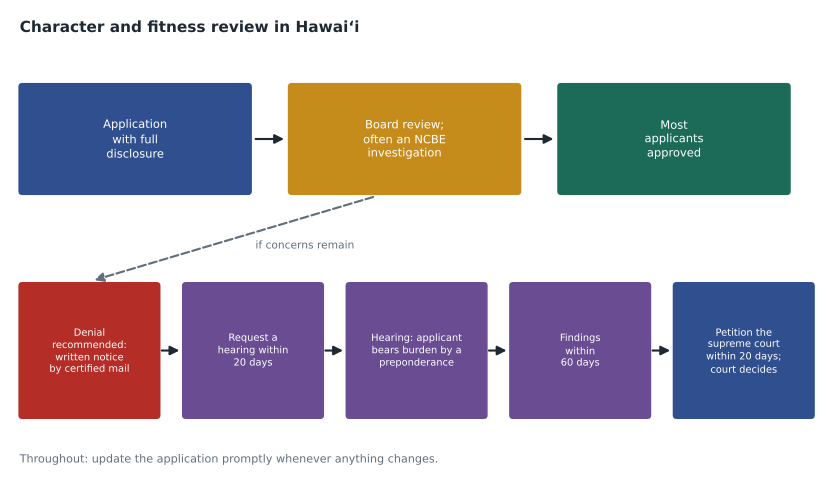
After an application is filed, the Board's staff reviews it, and for many application types NCBE conducts an investigation on the Board's behalf. NCBE's investigators verify the information in the application, contact the schools, employers and courts the applicant lists, and obtain records. NCBE advises applicants to watch their email, their NCBE account and text messages for investigators' requests, because a slow response delays the whole file. The Board makes the final decision and may ask for more information or an interview.
Most applications are approved without any hearing. When the Board or its Applications Review Committee concludes that an applicant has not shown the required character and fitness, the Board's Rules of Procedure set out a process. The clerk sends the applicant written notice of the recommendation of denial and its grounds by certified mail. Under section 2.12(a), the applicant may request a hearing within 20 days after receiving the notice. At the hearing, under section 4.1(g), the applicant bears the burden of proving character and fitness by a preponderance of the evidence. The hearing panel's findings are due within 60 days after the hearing, and an applicant who disagrees may petition the supreme court for review within 20 days after service of the findings, under section 4.4. The supreme court decides.
Common issues and how to handle them
Marchetti groups the issues she sees most often into four categories. The first is minor criminal and traffic matters: underage drinking citations, open container violations, disorderly conduct charges dismissed years ago. These rarely matter if disclosed with records and a brief, factual explanation. The second is academic matters, such as a plagiarism finding in college or a disciplinary note in law school. These matter more, because they involve honesty, but an applicant who discloses fully, explains what happened without minimizing it and shows how he or she has acted since can usually overcome them.
The third category is financial: defaulted student loans, unpaid judgments, accounts in collection, unfiled tax returns. The Board's concern is not debt itself, which many applicants carry, but neglect of financial responsibility. An applicant with a payment plan, records of contact with creditors and an explanation of how the problem arose is in a far better position than one who ignored the debts. The fourth category is mental health and substance use. Hawaiʻi's factors focus on conditions that currently impair the ability to practice, and many jurisdictions, along with the ABA, have moved away from broad questions about past diagnosis or treatment. Applicants with questions in this area should read the current questions carefully, answer exactly what is asked and, if they need help, contact the Attorneys and Judges Assistance Program, which offers confidential support.
Across all four categories, the same rules apply. Answer every question completely. Attach the records. Explain briefly and factually, without excuses. Show what has changed. And update the application if anything new happens before admission. Marchetti adds one more: 'If you are not sure whether something must be disclosed, disclose it. The worst result of over-disclosing is a follow-up question.'
Worked problem
Kainoa's open container citation
Kainoa was cited at nineteen for an open container in a Hilo beach park. He paid a fine of a few dozen dollars. The application asks whether he has ever been cited, arrested, charged or convicted for any violation other than a minor traffic violation. What should he do?
Show solution
- Read the question: it asks about any violation other than a minor traffic violation, and an open container citation is not a traffic violation.
- Disclose it, with the date, the place and the outcome.
- Attach the court record or receipt showing the fine was paid; if the record is unavailable, say so and explain what he did to try to get it.
- Add one or two factual sentences of explanation, without minimizing it.
- Expect no problem: the conduct was minor, long ago and honestly disclosed, and his age at the time is a mitigating factor.
Answer: He should disclose the citation with records and a short explanation; it is very unlikely to affect his admission, while omitting it could.
The MPRE
The MPRE is a two-hour, sixty-question multiple-choice examination written and administered by NCBE. It tests the law governing lawyers, based mainly on the ABA Model Rules of Professional Conduct and the ABA Model Code of Judicial Conduct, along with generally accepted principles from court decisions. Fifty of the questions are scored, and scores are reported on a scale of 50 to 150. The MPRE is given at Pearson VUE test centers several times a year, and it is a separate examination from the bar examination; it is not part of the two days in Honolulu.
RSCH Rule 1.3(g)(6) requires every applicant to take and pass the MPRE, and NCBE's information lists Hawaiʻi's passing score as 85. The same rule sets a time window with two parts. First, the MPRE must be taken no earlier than two years before the Hawaiʻi bar examination the applicant passes. Second, the score must be officially reported to the Board no later than one year after the applicant is notified of passing the bar examination. An applicant who passed the MPRE three years before the bar examination must take it again, no matter how high the earlier score.
Two practical points follow. The first is timing. Most students take the MPRE during law school, often in the second or third year. For Hawaiʻi, the third year is the safer choice for anyone who might delay the bar examination, because a score from early in the second year could fall outside the two-year window if the student sits a year after graduation. The second is the difference between the MPRE and the Hawaiʻi Legal Ethics Examination. The MPRE tests the Model Rules; the Hawaiʻi ethics examination, given on the first morning of the bar examination, tests the Hawaiʻi Rules of Professional Conduct. The rules overlap heavily, but they are not identical, and Lesson 10 covers the differences that matter.
For applicants who failed the MPRE on a first attempt, the remedy is simply to take it again; there is no limit on attempts in Hawaiʻi's rule, and only the passing score within the window counts. Applicants who need testing accommodations request them from NCBE for the MPRE, separately from any accommodation request to the Board for the bar examination.
Common mistakes
MistakeA minor citation does not need to be disclosed if it was long ago.
InsteadIf the question asks for it, disclose it; candor is itself a factor, and omissions are an adverse factor.
MistakeAny passing MPRE score counts, however old.
InsteadThe MPRE must be taken no earlier than two years before the bar examination, and the score must be reported within one year after notice of passing.
MistakeAt a character hearing, the Board must prove the applicant is unfit.
InsteadUnder section 4.1(g) the applicant bears the burden by a preponderance of the evidence.
MistakeThe MPRE and the Hawaiʻi ethics examination test the same rules.
InsteadThe MPRE tests the ABA Model Rules; the Hawaiʻi Legal Ethics Examination tests the Hawaiʻi Rules of Professional Conduct.
Writing a disclosure explanation
Most applicants with something to disclose worry about the wrong thing. They worry about the event itself, a citation at nineteen, a late payment, a dismissed case, when the reviewers are usually more interested in how the applicant describes it now. A good explanation does four things. It states the facts plainly and completely, with dates, places and outcomes. It attaches or identifies the documents that confirm those facts. It explains, briefly and without excuses, what the applicant has learned or changed since. And it is consistent with every other part of the application and with the public record.
Marchetti gives the group a model structure that fits on half a page. The first paragraph says what happened, when and where. The second gives the outcome: a fine paid, a case dismissed, a debt repaid, with dates. The third says what the applicant did afterward. 'Three short paragraphs,' she says. 'Not a confession and not a defense. Reviewers read hundreds of these. The ones that worry them are vague, defensive or inconsistent with the record.'
Worked problem
Two versions of the same explanation
An applicant was cited for driving without insurance during her second year of college. She paid the fine, bought insurance and has had no further problems. Version A says: 'I had a minor traffic issue in college that was resolved.' Version B gives the date, the county, the citation, the fine, the date it was paid and the date she bought insurance, and says she has carried insurance continuously since. Which is better, and why?
Show solution
- Version A is vague. It does not say what the citation was, and a reviewer who finds the record may think the applicant was minimizing it.
- Version B states the facts completely, matches the public record and shows what changed.
- Version B also lets the reviewer close the question without asking for more information, which saves time for everyone.
Answer: Version B is better because it is complete, verifiable and consistent with the record.
After you file
Filing is not the end of an applicant's duty of candor. Circumstances can change between filing and admission: a new job, a new address, a new citation, a lawsuit, a change in finances. Applicants should read the application's instructions on updating answers and follow them promptly. An applicant who learns that an earlier answer was incomplete should correct it at once rather than hope it goes unnoticed. In character and fitness review, a late but voluntary correction is treated very differently from an omission the reviewers find on their own.
Applicants should also respond quickly to any request from the Board or NCBE for more information, and keep copies of everything they send. Delays in answering are one of the most common reasons an otherwise routine file is not complete in time for the examination results.
Summary and key terms
- The Board weighs adverse and mitigating factors listed in section 2.6 of its Rules of Procedure; candor is central.
- NCBE investigates many applications for the Board, but the Board and the supreme court decide.
- An applicant recommended for denial may request a hearing within 20 days and bears the burden by a preponderance of the evidence.
- Hawaiʻi requires an MPRE score of 85, taken no earlier than two years before the bar examination.
- The MPRE score must be reported no later than one year after notice of passing the bar examination.
- Character and fitness
- The requirement that an applicant show the honesty, responsibility and judgment needed to practice law.
- Preponderance of the evidence
- The standard of proof met when something is more likely true than not.
- MPRE
- The Multistate Professional Responsibility Examination, NCBE's test on the law governing lawyers, scored from 50 to 150.
- Rehabilitation
- Evidence that an applicant has changed since past misconduct, such as treatment, restitution or a sustained record of responsible conduct.
Lesson quiz · 5 questions
Score 60% or more to complete this lesson.
Create a free account to save your progress, take quizzes and earn a certificate.