
BAR-235 · Lesson 1 of 12 · 21 min
Becoming a lawyer in North Dakota
▶ Video coming soon A video version of this lesson is on the way.
Jonas Fjelstad joined Hollis Marchetti's Tuesday study group in September 2026 with a map of North Dakota taped to the wall behind his desk. He grew up in Williston, in Williams County, where his father has spent twenty-five years as a lease operator on Bakken wells and his mother runs the family hardware store. He finished his JD in May 2026 at the state's law school in Grand Forks and now works as a law clerk at a four-lawyer firm in Dickinson that does mineral title work, farm and ranch estates, car crashes and divorces. He is sitting the North Dakota bar exam on February 23 and 24, 2027, in Bismarck.
'I picked February on purpose,' he told the group at his first session. 'The firm had a title backlog this summer and offered to pay for my bar course if I stayed through August. And February 2027 is the last time North Dakota gives the old Uniform Bar Examination. After that it is the NextGen exam.' Hollis wrote two words on her screen: last chance. 'That is the most important fact about your exam,' she said. 'If it goes well, you never think about NextGen again. If it does not, your retake is a different test.'
This course follows the sessions Hollis built for Jonas. The first six lessons cover admission: who admits North Dakota lawyers and how the pieces fit together, eligibility and the filing calendar, character and fitness and the MPRE, the Uniform Bar Examination and its 260 passing score, the move to the NextGen exam in July 2027 and its 610 passing score, and how North Dakota law shows up on an exam that does not test North Dakota law directly. Lessons 7 through 10 cover the North Dakota law a new lawyer meets in the first year of practice: the courts and civil procedure, torts and claims against public bodies, oil, gas and mineral law, and family law and probate. Lesson 11 covers score transfer, admission on motion and the duties that begin the day a new lawyer is licensed. Lesson 12 is a capstone with original practice problems and an exam-day plan.
The North Dakota Supreme Court admits lawyers
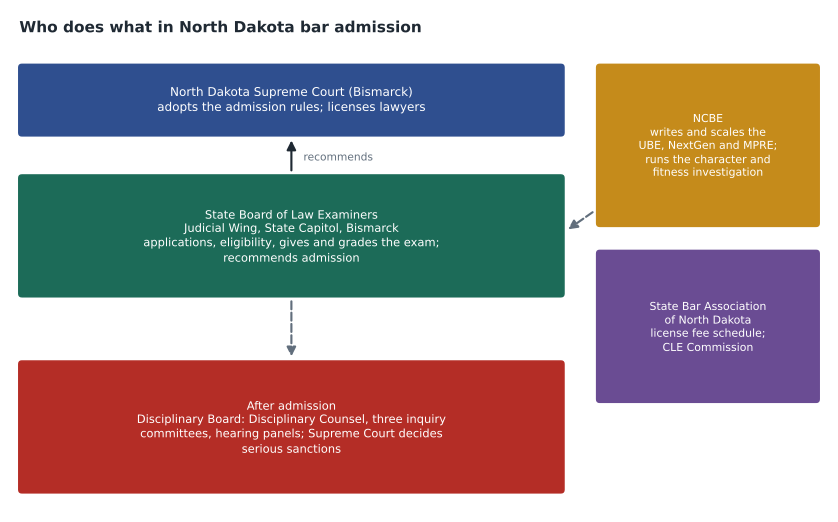
In North Dakota, as in every state, the power to decide who may practice law belongs to the state's highest court. The North Dakota Supreme Court sits in Bismarck. It has five justices, elected in nonpartisan elections to ten-year terms that are staggered so that one seat comes up every two years. The chief justice is chosen by the justices and the district judges for a five-year term. The Court licenses lawyers, adopts the rules that govern admission and practice, and has the final word on lawyer discipline.
The Court acts through boards it appoints. The one an applicant deals with is the State Board of Law Examiners, whose office is in the Judicial Wing of the State Capitol at 600 East Boulevard Avenue in Bismarck. The Board processes applications, decides eligibility, administers and grades the bar exam, evaluates applications for admission by transferred score and by motion, and recommends applicants to the Court for admission. The Board's office answers questions by phone and email, but its guides on the court system's website are where the binding details live, and Hollis made Jonas download every guide that applied to him on the first night.
The national pieces
Three national bodies also matter. The National Conference of Bar Examiners, NCBE, writes the components of the Uniform Bar Examination, scales the scores and transfers them to other jurisdictions. NCBE also writes and scores the MPRE, the ethics exam that every applicant must pass. And NCBE conducts the character and fitness investigation for North Dakota applicants: the applicant completes the application online through NCBE, pays NCBE an investigation fee, and NCBE gathers the records and references that the Board uses to decide whether the applicant has the character and fitness to practice. The Board, not NCBE, makes every final decision.
The American Bar Association matters for one reason at the admission stage: North Dakota requires a JD or equivalent degree from a law school approved or provisionally approved by the ABA. Graduates of law schools outside the United States are not eligible to sit for the exam on the strength of that degree. Jonas's school is ABA-approved, so this was never a question for him, but Hollis pointed out that other members of the group, including Ngozi, who qualified in Nigeria, would face a very different path in North Dakota than they do in New York.
The State Bar Association and the Disciplinary Board
Once admitted, a North Dakota lawyer deals with two more bodies. The State Bar Association of North Dakota is the statewide bar association. It adopted the schedule of annual license fees that lawyers pay, and a fixed portion of every license fee, 75 dollars under section 27-12-04 of the North Dakota Century Code, goes to fund lawyer discipline. The Association also runs the Commission for Continuing Legal Education, which receives the compliance reports lawyers file every three years.
The Disciplinary Board of the Supreme Court investigates complaints about lawyer conduct. It was created in 1965 and has eleven unpaid members appointed by the Court: eight lawyers, one from each judicial district, and three nonlawyers. Complaints go first to the Office of Disciplinary Counsel, which screens and investigates them, and then to one of three inquiry committees, Southeast, Northeast and West. Serious cases go to hearing panels and ultimately to the Supreme Court. Lesson 11 covers this system along with trust accounts, the professional liability insurance disclosure on the annual license and CLE.
Three ways in
There are three routes to a North Dakota license, and the rest of the course is organized around them. The first, and the one Jonas is taking, is admission by examination: apply to the Board, pass character and fitness, earn an MPRE score of at least 85 and pass the bar exam with a score of at least 260 on the Uniform Bar Examination or, from July 2027, 610 on the NextGen exam. The second is admission by transferred test score: a person who earned a passing Uniform Bar Examination or NextGen score in another jurisdiction can apply to North Dakota on that score within the time limits the Board sets. The third is admission on motion: a lawyer who has actively practiced elsewhere for at least four of the past five years can apply without taking any exam.
| Route | Who uses it | Key North Dakota requirement |
|---|---|---|
| Examination | New graduates such as Jonas | UBE 260 (through February 2027) or NextGen 610 (from July 2027); MPRE 85 |
| Transferred score | People who tested in another UBE or NextGen jurisdiction | UBE 260 or NextGen 610, filed within the Board's time limits |
| Motion | Experienced lawyers licensed elsewhere | Active practice for four of the past five years |
Every route requires character and fitness review and the MPRE, and every route requires the JD from an ABA-approved law school. The routes differ in what substitutes for the exam. That difference is why North Dakota's adoption of the Uniform Bar Examination in the first place, and its adoption of the NextGen exam that replaces it, matter so much: a score earned in North Dakota can be carried to most other states, and a score earned in most other states can be carried here.
A small bar with a big footprint
North Dakota's bar is small. The July 2025 bar exam, given in Bismarck, had 63 takers, and 41 passed, an overall pass rate of 65 percent. First-time takers passed at 72 percent. Of those 63 takers, 46 were graduates of the state's law school, and 28 of them passed. The Board announced the results on Wednesday, September 10, 2025. A February exam is smaller still, and that size has a practical consequence that Lesson 2 explains: the Board gives a February exam only if at least 17 applicants apply.
The work is not small. Jonas's firm in Dickinson spends much of its time on mineral title, the business of tracing who owns the oil and gas under a tract of land through a century of deeds, probates, leases and court orders. The western part of the state sits on the Bakken and Three Forks formations, and the oil boom that began in the late 2000s turned title examination, lease disputes, surface damage claims and pooling hearings into everyday work for lawyers in towns of a few thousand people. Eastern North Dakota is farm country along the Red River, and its lawyers spend their days on farm estates, real estate, family law and small business. Lesson 9 covers the oil, gas and mineral law that makes western practice distinctive.
'Half the deeds I read were signed by somebody's great-grandparents,' Jonas said. 'And every one of them matters, because if a mineral interest was reserved in 1938 and nobody did anything with it, the Dormant Mineral Act might have moved it to the surface owner.' Hollis said they would get to that. 'First you have to get licensed.'
Why the uniform exam changes how you study
Because North Dakota uses the Uniform Bar Examination, Jonas's exam does not test North Dakota law. The Multistate Bar Examination, the Multistate Essay Examination and the Multistate Performance Test are written by NCBE for every jurisdiction that uses them and are graded against general principles of American law. North Dakota has no state-specific component: no separate North Dakota essay, no local law course and no state law test to complete before admission. NCBE's jurisdiction chart for North Dakota marks the jurisdiction-specific requirement 'No' for the current exam, for the NextGen exam and for score transfer.
That shapes the whole study plan. Jonas will learn the majority rules and the rules NCBE tells examinees it tests, even where North Dakota law differs, because the graders will apply the general rule. He must also be careful not to import North Dakota rules into his exam answers. North Dakota law will matter the day after he is licensed, and the second half of this course covers it for that reason. Lesson 6 explains how to handle the gap between the exam's general rules and North Dakota's own rules, and when the North Dakota rule is a trap on the exam.
What a North Dakota study plan looks like
Hollis gave Jonas a calendar that worked backward from February 23. The legacy exam is two days. On the first day, applicants write the Multistate Performance Test in the morning and the Multistate Essay Examination in the afternoon. On the second day, they take the 200 multiple-choice questions of the Multistate Bar Examination. Jonas's plan set aside roughly ten weeks of full study, with the firm's blessing, from mid-December through the exam, and built in daily MBE practice, two timed essays a week and a performance test every weekend. Lesson 4 explains the scoring that drives that allocation.
His plan also had an administrative track, and Hollis insisted it come first. The application was due October 1, 2026, to avoid a late fee. He needed transcripts sent directly from every degree-granting school he had attended, the law school's copy of his application, the official JD transcript, signed original petition and release forms, a color photograph and a check, because the Board does not accept credit cards. He had to answer every question on the NCBE character and fitness application, including the questions about two speeding tickets he received in college. Lessons 2 and 3 cover all of it.
Worked problem
Which route fits?
Three people ask Hollis how to become North Dakota lawyers. Ana passed the Uniform Bar Examination in Minnesota in July 2025 with a 271 and has not practiced. Dev graduated from an ABA-approved school in May 2026 and has never taken a bar exam. Lucia has practiced law in Montana for six years. Which route does each use?
Show solution
- Ana has a passing UBE score from another jurisdiction, so she can apply by transferred score, provided she files within the Board's time limit for applicants who have not been practicing.
- Dev has no score and no practice, so he must apply by examination.
- Lucia has actively practiced for at least four of the past five years, so she can apply on motion without taking an exam.
- All three need character and fitness approval and a qualifying MPRE score.
Answer: Ana: transferred score. Dev: examination. Lucia: motion. Each still needs character and fitness review and the MPRE.
Common mistakes
MistakeThe State Board of Law Examiners admits North Dakota lawyers.
InsteadThe Board processes applications and recommends admission; the North Dakota Supreme Court admits lawyers.
MistakeNorth Dakota tests its own law on a state essay day.
InsteadNorth Dakota has no state-specific component; the exam is the Uniform Bar Examination, and from July 2027 the NextGen exam.
MistakeNCBE decides whether an applicant has the character and fitness to practice.
InsteadNCBE investigates; the Board makes the final decision.
MistakeA graduate of a foreign law school can sit the North Dakota exam on that degree.
InsteadNorth Dakota requires a JD or equivalent from an ABA-approved or provisionally approved law school.
MistakeFebruary and July exams are always given.
InsteadThe February exam is given only if at least 17 applicants apply.
Practice problems
Work each problem on paper first, then reveal the answer to check.
How many justices sit on the North Dakota Supreme Court, and how long are their terms?
Show answer
Five justices, elected to staggered ten-year terms.
Where is the State Board of Law Examiners located?
Show answer
In the Judicial Wing of the State Capitol, 600 East Boulevard Avenue, Bismarck.
Who conducts the character and fitness investigation for North Dakota applicants?
Show answer
NCBE investigates; the Board decides.
What portion of the annual license fee funds lawyer discipline?
Show answer
75 dollars, under N.D.C.C. section 27-12-04.
When is North Dakota's last legacy Uniform Bar Examination?
Show answer
February 2027; the NextGen exam begins in July 2027.
Summary and key terms
- The North Dakota Supreme Court admits and regulates lawyers; the State Board of Law Examiners processes applications and gives the exam.
- NCBE writes the exam and the MPRE and conducts the character and fitness investigation; the Board makes final decisions.
- Three routes: examination, transferred UBE or NextGen score, and motion after four of the past five years of practice.
- North Dakota has no state-specific component; the exam does not test North Dakota law.
- February 2027 is the last legacy UBE in North Dakota; the NextGen exam begins in July 2027.
- After admission, the State Bar Association of North Dakota and the Disciplinary Board govern license fees, CLE reporting and discipline.
- State Board of Law Examiners
- The board appointed by the North Dakota Supreme Court that processes applications, gives the exam and recommends admission.
- Uniform Bar Examination
- The NCBE exam made up of the MBE, MEE and MPT, whose scores can be transferred among jurisdictions.
- admission on motion
- Admission without examination based on active practice elsewhere.
- jurisdiction-specific component
- A state law course or test some jurisdictions add to a uniform exam; North Dakota has none.
- Disciplinary Board
- The board of the North Dakota Supreme Court that investigates and prosecutes lawyer misconduct.
Lesson quiz · 5 questions
Score 60% or more to complete this lesson.
Create a free account to save your progress, take quizzes and earn a certificate.