
BAR-235 · Lesson 11 of 12 · 20 min
Score transfer, admission on motion and practice after admission in North Dakota
▶ Video coming soon A video version of this lesson is on the way.
The firm's newest hire would not need to take a bar exam at all. Hanne Lindgaard, a hypothetical lawyer who had practiced in Montana for seven years, was moving to Dickinson to join the firm's oil and gas group, and the partners asked Jonas to put together her application for admission on motion. At the same time, a classmate of his who had passed the July 2025 UBE in Minnesota asked him how to get licensed in North Dakota on that score. Hollis used both requests to frame the eleventh session: the two ways into North Dakota without sitting the North Dakota exam, and the duties every new North Dakota lawyer takes on the day of admission.
This lesson covers admission by transferred UBE, NextGen or MBE score, admission on motion based on practice, temporary appearances by out-of-state lawyers and, after admission, the annual license, CLE, the Rules of Professional Conduct on trust accounts and insurance disclosure and the lawyer discipline system.
Admission by transferred score
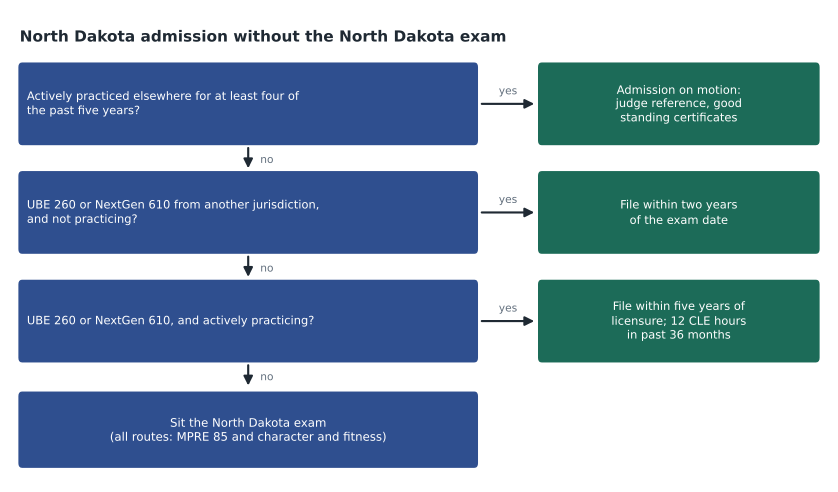
North Dakota admits applicants on a score earned elsewhere. The Board's page on reciprocity based on test scores sets the requirements. The applicant must be at least 18, hold a JD or equivalent from an ABA-approved or provisionally approved law school, have a scaled MPRE score of 85 or above within seven years of filing the application and have one of the following: a scaled score of 260 or more on the Uniform Bar Examination, or 610 or more on the NextGen exam, taken in another jurisdiction. No jurisdiction-specific requirement applies.
The Board's page also describes a path for an applicant who took a non-UBE essay exam together with the MBE in another jurisdiction: an MBE scaled score of 150 or more earned at the same time as the essay exam, plus admission to the bar of the jurisdiction where the MBE was taken. NCBE's chart lists North Dakota as not accepting transferred MBE scores, which reflects the fact that a bare MBE score is not enough; the MBE route requires the applicant to have passed and been admitted elsewhere. An applicant considering it should confirm the details with the Board.
There is an attempts limit. An applicant who has failed six or more UBE, NextGen or MBE attempts may not be admitted by test score.
Time limits on transferred scores
The timing rule depends on whether the applicant has been practicing. An applicant who has not been actively practicing law must get the score proof and a completed application to the Board within two years of the exam date. An applicant who has been actively practicing law, to an extent the Board finds demonstrates competency, has five years from the date of licensure in the other jurisdiction, and the application must include verification of 12 hours of approved CLE, including one hour of ethics or professional responsibility, completed within the 36 months before applying.
| Applicant | Score needed | Deadline to file | Extra requirement |
|---|---|---|---|
| Not actively practicing | UBE 260 or NextGen 610 | Within two years of the exam date | None beyond MPRE and character and fitness |
| Actively practicing | UBE 260 or NextGen 610 | Within five years of licensure | 12 CLE hours, including 1 ethics, in the past 36 months |
| MBE path | MBE 150 with an essay exam | Confirm with the Board | Admission in the jurisdiction where the MBE was taken |
Jonas's classmate had passed in Minnesota in July 2025 with a 272 and had not practiced since, because she had been clerking for a federal judge. Hollis asked the group whether clerking counts as actively practicing law. Nobody was sure, which was the right answer: the Board decides what practice demonstrates competency, and an applicant in a gray area should ask before relying on the five-year window. Treating herself as a nonpracticing applicant, the classmate needed her application and score in Bismarck by July 2027.
Admission on motion
A lawyer who has actively practiced law in another jurisdiction for at least four of the past five years may apply for admission on motion, according to NCBE's jurisdiction chart. The Board's separate page on reciprocity based on practice sets out the detailed requirements, including any education and reciprocity conditions, and should be read before filing.
The Board's FAQ lists what motion applicants must supply in addition to the general application: evidence of the required CLE, a judge reference who can attest to the applicant's character and fitness, and certificates of admission, good standing and disciplinary history from every state court in which the applicant has been admitted. The FAQ notes that motion and score transfer applications usually take four to seven months and may take longer.
For Hanne, that meant certificates from the Montana Supreme Court and the federal court in Montana, a CLE transcript, a reference from a Montana district judge before whom she had tried a royalty case, her MPRE score report sent directly from NCBE and a complete NCBE character and fitness application. Jonas built a checklist from the Board's FAQ list of common delays and made sure each item was ordered the first week.
Practicing temporarily
A lawyer licensed elsewhere who needs to appear in a single North Dakota case does not need to be admitted; the lawyer can seek permission to appear pro hac vice in association with a North Dakota lawyer. The Board's FAQ states that the pro hac vice motion fee is 380 dollars, payable only by check or money order to the State Board of Law Examiners. Pro hac vice admission is case-specific and does not authorize general practice in North Dakota.
The annual license
Every North Dakota lawyer must hold an annual license to practice. The Board's FAQ lists a fee schedule adopted by the State Bar Association: 325 dollars for lawyers admitted one year or less, 350 dollars for lawyers admitted more than one but less than five years, 380 dollars for lawyers admitted five years or more and 200 dollars for lawyers admitted after September of the current year. Under section 27-12-04 of the Century Code, 75 dollars of each license fee funds the lawyer discipline system. Fee schedules can change, so new lawyers should confirm the current amount when they renew.
The annual license is also where lawyers make two certifications required by Rule 1.15 of the North Dakota Rules of Professional Conduct, discussed below: compliance with the trust account rules and disclosure of professional liability insurance.
Continuing legal education
The North Dakota Rules for Continuing Legal Education require every licensed lawyer to complete at least 36 hours of approved CLE in each three-year reporting period. At least three of those hours must address ethics or professional responsibility, which the rule defines to include topics such as racial and ethnic diversity, gender equity, disability access and eliminating bias in the profession.
A new lawyer's first reporting period begins on July 1 after initial licensure and ends on June 30 three years later. The lawyer must file a report of compliance by July 30 after the period ends, on the Commission's form, with a fee of up to 50 dollars payable to the State Bar Association of North Dakota's Commission for Continuing Legal Education. If Jonas is admitted in the spring of 2027, his first period begins July 1, 2027, and ends June 30, 2030, with his report due July 30, 2030.
Trust accounts under Rule 1.15
North Dakota's Rule 1.15 is titled Safekeeping Property and Professional Liability Insurance Disclosure. Client and third-party funds must be held in interest-bearing trust accounts at eligible, insured institutions approved by the Disciplinary Board. Nominal amounts, and funds held only for a short time, go into a pooled trust account whose interest is paid to the North Dakota Bar Foundation. Other client funds go into a separate account for the client, with interest to the client, or into a pooled account with subaccounting that credits each client's interest. In choosing, the lawyer weighs the interest the funds could earn, the cost of administering the account and the bank's ability to calculate interest on individual accounts.
Advance fees and expenses go into trust and are withdrawn only as earned or incurred. A lawyer may accept card or electronic payments of unearned fees into the operating account temporarily but must move them promptly to trust. Disputed funds stay in trust, and the undisputed portion is distributed promptly. Records must be kept on a current basis and preserved for at least six years after the representation ends. Every withdrawal must be signed or directed by a lawyer authorized by the firm.
The overdraft rule is strict. A bank may hold lawyer trust accounts only if it agrees to report to the Disciplinary Board whenever a properly payable instrument is presented against insufficient funds, whether or not it is honored. For a dishonored instrument, the report goes out at the same time as the notice of dishonor; for one paid despite insufficient funds, within five banking days. The Board's FAQ adds that all overdrafts must be reported regardless of cause.
Insurance disclosure
Rule 1.15 also requires each lawyer, on the annual license, to certify whether he or she represents private clients, whether he or she carries professional liability insurance and intends to keep it for the next 12 months, and the name of the insurer and policy number. A lawyer whose coverage lapses or ends must notify the clerk in writing within 30 days, unless the policy is renewed or replaced without a substantial gap. The information is available to the public on request. North Dakota does not require malpractice insurance, but it requires lawyers to tell the public whether they have it.
Other North Dakota rule differences
North Dakota's rules follow the ABA Model Rules closely, with a few structural differences. North Dakota has a Rule 1.19 on files, papers and property related to a representation, which has no Model Rule counterpart. Its Rule 4.5 addresses inadvertent transmission of documents, a subject the Model Rules handle in Rule 4.4(b). And its Rules 2.2 and 2.3 correspond to Model Rules 2.3 and 2.4, on evaluations for third persons and lawyers serving as third-party neutrals.
Lawyer discipline
Complaints about North Dakota lawyers go to the Office of Disciplinary Counsel, which screens them, dismisses those that do not allege misconduct and investigates the rest. After investigation, a complaint goes to one of three inquiry committees of the State Bar, Southeast, Northeast or West. An inquiry committee may dismiss the complaint, issue an admonition, approve probation with the lawyer's consent or direct Disciplinary Counsel to begin formal proceedings.
Formal proceedings begin with a petition for discipline when there is probable cause to believe the lawyer committed misconduct warranting a public reprimand, suspension or disbarment. The chair of the Disciplinary Board appoints a hearing panel, which takes evidence and makes findings. A panel can dismiss, impose consent probation or issue a reprimand, and those orders can be reviewed by the Supreme Court on petition. Recommendations of more serious discipline go to the Supreme Court, which decides. The North Dakota Standards for Imposing Lawyer Sanctions guide the choice of sanction.
Worked problem
Transferred score timing
A hypothetical graduate, Ola, passed the UBE in Montana in February 2025 with a 266 and has worked since then as a legislative policy analyst, not practicing law. In October 2026 he decides to seek a North Dakota license on that score. His MPRE score of 90 is from August 2023. Can he use the score?
Show solution
- Ola is not actively practicing, so he must file within two years of the exam date, by February 2027.
- His 266 exceeds North Dakota's 260.
- His MPRE score of 90 is above 85 and within seven years of filing.
- He must also complete the NCBE character and fitness application and meet the other requirements.
Answer: Yes, if his application and score proof reach the Board by February 2027; after that, the two-year window closes.
Common mistakes
MistakeA transferred UBE score never expires.
InsteadNonpracticing applicants have two years from the exam date; practicing applicants five years from licensure with 12 recent CLE hours.
MistakeNorth Dakota accepts a bare MBE score from another state.
InsteadThe MBE path requires a 150 with an essay exam and admission where the MBE was taken; confirm with the Board.
MistakeNorth Dakota lawyers need 45 CLE hours every three years.
InsteadThe current rule requires 36 hours, including 3 of ethics, per three-year period.
MistakeNorth Dakota requires lawyers to carry malpractice insurance.
InsteadIt requires disclosure of whether they carry it, on the annual license.
MistakeOnly the Supreme Court can issue any discipline.
InsteadInquiry committees can issue admonitions and hearing panels can reprimand; the Court decides serious sanctions.
Practice problems
Work each problem on paper first, then reveal the answer to check.
What practice is required for North Dakota admission on motion?
Show answer
Active practice for at least four of the past five years.
How long does a nonpracticing applicant have to transfer a UBE score?
Show answer
Two years from the exam date.
How many CLE hours does North Dakota require, and how many in ethics?
Show answer
36 hours per three-year period, including 3 in ethics or professional responsibility.
When must a bank report a paid trust account overdraft?
Show answer
Within five banking days.
Where does interest on pooled trust accounts go?
Show answer
To the North Dakota Bar Foundation.
Summary and key terms
- Transferred scores: UBE 260 or NextGen 610, MPRE 85 within seven years; two years from the exam if not practicing, five years from licensure with 12 recent CLE hours if practicing.
- An MBE path requires an MBE of 150 with an essay exam and admission where taken; six failed attempts bar test-score admission.
- Admission on motion requires active practice for four of the past five years, a judge reference and certificates of good standing.
- CLE: 36 hours per three-year period, 3 in ethics; first period begins July 1 after licensure; report due July 30.
- Rule 1.15: interest-bearing trust accounts at approved banks, overdraft reporting, six-year records and an annual insurance disclosure.
- Discipline runs through Disciplinary Counsel, three inquiry committees, hearing panels and the Supreme Court.
- admission by transferred score
- Admission based on a UBE or NextGen score earned in another jurisdiction.
- pro hac vice
- Permission for an out-of-state lawyer to appear in a single case.
- reporting period
- The three-year CLE period ending June 30.
- overdraft notification
- A bank's required report to the Disciplinary Board of a trust account presented against insufficient funds.
- admonition
- A private sanction an inquiry committee may impose.
Lesson quiz · 5 questions
Score 60% or more to complete this lesson.
Create a free account to save your progress, take quizzes and earn a certificate.