
BAR-235 · Lesson 4 of 12 · 21 min
The North Dakota bar exam: the UBE, scoring and the 260 passing score
▶ Video coming soon A video version of this lesson is on the way.
At the fourth session, Hollis put a single number on the screen: 260. 'That is the whole target,' she said. 'Not a 260 on the essays and a 260 on the multiple choice. One number, built from three pieces, on a scale that runs to 400.' Jonas had heard the number for three years. He had never seen how it was built, and he wanted to know how much of it he could earn on the essays, which he liked, to make up for the multiple choice, which he did not.
This lesson covers the format of the Uniform Bar Examination that North Dakota gives through February 2027, how its three components are weighted and scaled, what the 260 passing score means, the subjects tested, how North Dakota grades and releases results, and what a UBE score earned in North Dakota is worth elsewhere.
The two days
North Dakota gives the exam over two days in Bismarck: the last Tuesday and Wednesday of February or July. For Jonas, that means Tuesday, February 23, and Wednesday, February 24, 2027.
| Day and session | Component | What it contains | Time |
|---|---|---|---|
| Tuesday morning | Multistate Performance Test (MPT) | Two tasks, each with a File and a Library | Three hours (90 minutes per task) |
| Tuesday afternoon | Multistate Essay Examination (MEE) | Six essay questions | Three hours (about 30 minutes each) |
| Wednesday morning | Multistate Bar Examination (MBE) | 100 multiple-choice questions | Three hours |
| Wednesday afternoon | Multistate Bar Examination (MBE) | 100 multiple-choice questions | Three hours |
The MBE has 200 questions, of which 175 are scored and 25 are unscored pretest questions mixed in with the rest. Examinees cannot tell which are which, so every question gets full effort. The MEE has six questions, each meant to take about 30 minutes, and examinees can allocate their three hours among them as they choose. The MPT has two 90-minute tasks; each gives the examinee a File of facts and documents and a Library of cases and statutes, and asks for a lawyering product such as a memo, a brief, a letter or a contract provision.
Weighting
The three components are combined with fixed weights. The MBE counts for 50 percent of the total score, the MEE for 30 percent and the MPT for 20 percent. Together the written components, MEE and MPT, are half the score.
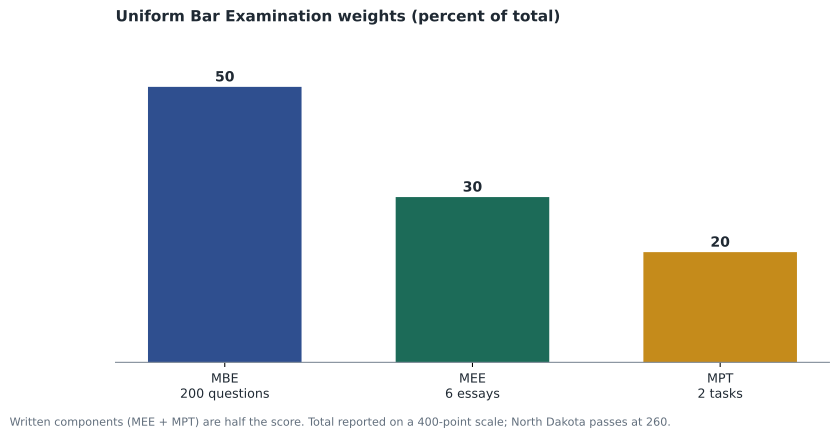
That answered Jonas's question, at least in part. His essays and performance tests together are worth exactly as much as his multiple choice. A strong written score can carry a weaker MBE, and the reverse is also true. But neither half can be neglected, because each is worth half the outcome.
Scaling
The scores are not simply added. NCBE first converts each examinee's raw MBE score, the number of scored questions answered correctly, into a scaled MBE score through equating, a statistical process that adjusts for differences in difficulty between exams. A scaled MBE score means the same thing whether it was earned in a hard February or an easy July. Scaled MBE scores range roughly from 40 to 200 in practice.
The written scores are then scaled to the MBE. Graders assign raw scores to each MEE and MPT answer. Those raw scores are converted to the same scale as the MBE, so that the distribution of written scores in the jurisdiction matches the distribution of its MBE scores. This step is what makes written scores comparable across administrations even though the essay questions and graders change. The scaled MBE and scaled written scores are combined with the 50, 30, 20 weights and reported as a total UBE score on a scale of 400.
The practical effect is that a written score is relative. An answer is not graded against a fixed standard of perfection; it is placed among the other answers in North Dakota on that exam. The adoption announcement for NextGen noted that local graders would continue to score the written portions, as they do for the UBE. Jonas's essays will be read by North Dakota graders who are reading the other North Dakota answers on the same question.
What 260 means
North Dakota's passing score is 260 on the 400-point UBE scale. Each UBE jurisdiction sets its own passing score, and they range from 260 to as high as 280. North Dakota is at the low end of that range, along with several other jurisdictions. A 260 is roughly what an examinee earns with a scaled MBE score around 130 and a comparable written score, but because the two halves are averaged, many combinations reach it.
| Scaled MBE (half of total) | Scaled written (half of total) | Approximate total | Result in North Dakota |
|---|---|---|---|
| 140 | 120 | About 260 | Pass |
| 130 | 130 | About 260 | Pass |
| 125 | 133 | About 258 | Fail |
| 120 | 145 | About 265 | Pass |
Hollis cautioned the group that the table is illustrative. The real arithmetic uses the scaled scores NCBE and the Board calculate, but the lesson is accurate: the total is close to the sum of a scaled MBE score and a scaled written score, each on a 200-point basis. A point on the scaled MBE is worth about the same as a point on the scaled written component. An examinee who knows his MBE practice scores sit around 125 knows he needs a written score in the mid-130s.
The subjects
The MBE tests seven subjects: Civil Procedure, Constitutional Law, Contracts, Criminal Law and Procedure, Evidence, Real Property and Torts. The MEE can test those seven plus Business Associations. Beginning with the July 2026 exam, NCBE removed four subjects from the MEE: Conflict of Laws, Family Law, Trusts and Estates, and Secured Transactions. Jonas's February 2027 exam will therefore not include an essay on those four subjects, even though NCBE's released MEE questions from earlier years still include them.
'Which is funny,' Jonas said, 'because half of what I do at work is probate and divorce.' Hollis said that was exactly the point of the second half of the course. The exam tests what NCBE decided every new lawyer should know. North Dakota practice tests what North Dakota lawyers actually do, and Lesson 10 covers North Dakota family law and probate for that reason.
The MPT is subject-neutral. Its Library supplies the law, which may be invented for the task, and the examinee is graded on lawyering skill: following instructions, sorting relevant from irrelevant facts, applying the law provided and writing in the requested form. For Jonas, who reads title documents all day, the MPT's File felt familiar.
How the score is released
The Board announces results by news release on the court system's website and notifies applicants. For the July 2025 exam, the Board released results on Wednesday, September 10, 2025, about six weeks after the exam. February results typically come in the spring. Passing applicants who have met every other requirement are recommended to the Supreme Court for admission. North Dakota then admits new lawyers, who take the oath and receive their licenses.
An applicant who fails receives his or her score and can use it to plan. Because North Dakota's last legacy exam is February 2027, an applicant who fails that exam will retake on the NextGen exam in July 2027. The scores do not combine across the two exams, and preparation for NextGen differs. Lesson 5 covers what that means.
What the score is worth elsewhere
A UBE score is portable. An examinee who earns a 260 or more in North Dakota can transfer the score to another UBE jurisdiction whose passing score it meets, within that jurisdiction's time limit. A 260 is enough for some jurisdictions and not for those that require 266, 270 or more. Jonas earned his score, if he earns it, for North Dakota. But he noted that Minnesota and Montana, his firm's neighbors, also accept transferred scores, and that a score high enough to meet their thresholds would give him options.
The reverse is also true. An examinee who passed the UBE in another jurisdiction with at least a 260 can apply for admission in North Dakota by transferred score, as long as the application and score proof reach the Board within two years of the exam date for an applicant who has not been practicing, or within five years of licensure for one who has been practicing, with 12 hours of recent CLE. Lesson 11 covers those rules.
Building the study plan from the weights
Hollis turned the weights into a schedule. Because the MBE is half the score and tests seven subjects, Jonas would do MBE questions every study day, mixing subjects to build the endurance of 200 questions. Because the MEE is 30 percent and comes in six questions, he would write two timed essays a week from the eight current MEE subjects and grade each against NCBE's analyses. Because the MPT is 20 percent but only two tasks, he would do one timed MPT each weekend. He would review his weakest subjects twice as often as his strongest.
How MEE answers are graded
Graders in each jurisdiction grade MEE answers using NCBE's grading materials, which identify the issues each question raises and the analysis expected. Graders calibrate on sample answers before grading and rank answers relative to one another on a raw scale. They reward identifying the issues, stating the correct rule and applying it to the facts; they give little credit for a recital of rules that are not applied. A well-organized answer with headings for each call of the question is easier to grade and tends to receive full credit for what it contains.
Hollis gave Jonas three rules for every MEE answer. Answer the questions in the order asked, with a heading for each. State the rule in a sentence or two before applying it. And reach a conclusion on every call, even a tentative one, because a grader cannot award points for a conclusion that is not there.
How MPT answers are graded
MPT graders look first at whether the examinee followed the task memo: the right document type, the right audience, the right tone and the right issues. A persuasive brief written as an objective memo loses points regardless of its analysis. They then look at the use of the Library: whether the examinee extracted the rules from the cases and statutes provided, synthesized them where the cases differ and applied them to the facts in the File. Outside law is not rewarded. Hollis told Jonas to spend the first 30 to 35 minutes of each task reading and outlining, and the rest writing.
Using released questions
NCBE sells past MEE and MPT questions with point sheets and analyses, and makes some MBE questions available through its study aids. These are the best practice materials because they show how NCBE frames issues. Two cautions apply to Jonas's exam. First, released MEE questions from before July 2026 include the four subjects that are no longer tested; he should skip those or treat them as practice for practice, not for the exam. Second, older questions may reflect law that has changed since they were written, so the analyses must be read with an eye to the current rule.
Score expectations
Hollis asked Jonas what his practice scores looked like. His MBE practice sets were averaging about 62 percent correct in November, and his essays were graded by a tutor as solid but uneven. She told him that many examinees who pass are in the low to mid 60s in percentage correct on realistic MBE practice by the end of study, and that the written half rewards steady, complete answers more than brilliant ones. The goal for December and January was not perfection; it was to raise both halves by a few points each.
Worked problem
Reading a score report
A hypothetical examinee, Astrid, receives a North Dakota score report showing a scaled MBE score of 128 and a scaled written score of 129. Did she pass, and where should she focus if she must retake?
Show solution
- The total is approximately the scaled MBE plus the scaled written score: about 257.
- North Dakota requires 260, so she did not pass.
- Her two halves are nearly equal, so neither is the obvious weak point; three points spread across either half would have passed.
- If she retakes in July 2027, she will take the NextGen exam, which uses a different format and scale, so the score itself does not carry over.
Answer: Astrid did not pass, at about 257; she should plan for the NextGen format and rebuild both multiple-choice and written skills, since neither half was clearly weaker.
Common mistakes
MistakeEach component must separately reach a passing level.
InsteadOnly the total counts; strong written scores can offset a weaker MBE, and vice versa.
MistakeNorth Dakota requires a 266 like many neighbors.
InsteadNorth Dakota's UBE passing score is 260.
MistakeThe February 2027 MEE can test Family Law and Trusts and Estates.
InsteadNCBE removed those subjects, along with Conflict of Laws and Secured Transactions, from July 2026.
MistakeEvery MBE question is scored.
InsteadOf 200 questions, 175 are scored and 25 are unscored pretest questions.
MistakeA February 2027 score can be combined with a July 2027 retake.
InsteadJuly 2027 is the NextGen exam; legacy and NextGen scores do not combine.
Practice problems
Work each problem on paper first, then reveal the answer to check.
What are the weights of the three UBE components?
Show answer
MBE 50 percent, MEE 30 percent, MPT 20 percent.
What is North Dakota's passing UBE score?
Show answer
260 on a 400-point scale.
How many MBE questions are scored?
Show answer
175 of 200.
Which four subjects were removed from the MEE in July 2026?
Show answer
Conflict of Laws, Family Law, Trusts and Estates, and Secured Transactions.
When did the Board release July 2025 results?
Show answer
Wednesday, September 10, 2025.
Summary and key terms
- The UBE is two days: MPT and MEE on Tuesday, the 200-question MBE on Wednesday.
- Weights: MBE 50 percent, MEE 30 percent, MPT 20 percent; written scores are scaled to the MBE.
- North Dakota's passing score is 260 of 400; only the total matters.
- From July 2026 the MEE tests eight subjects; Family Law and Trusts and Estates are among the four removed.
- Results are announced by the Board; passing applicants who meet every requirement are recommended for admission.
- UBE scores are portable to and from other UBE jurisdictions within time limits.
- scaled score
- A score adjusted by equating so it means the same across administrations.
- equating
- The statistical process NCBE uses to adjust MBE scores for differences in difficulty.
- pretest questions
- Unscored MBE questions being tried out for future exams.
- MPT File and Library
- The facts and documents, and the law, given to the examinee for a performance task.
- portability
- The ability to transfer a UBE score to other jurisdictions.
Lesson quiz · 5 questions
Score 60% or more to complete this lesson.
Create a free account to save your progress, take quizzes and earn a certificate.