
BAR-235 · Lesson 10 of 12 · 21 min
North Dakota family law and probate
▶ Video coming soon A video version of this lesson is on the way.
Two files landed on Jonas's desk in the same week in October. In one, a couple who had farmed together near Hettinger for 22 years were divorcing, and the husband wanted to know whether his wife could be awarded alimony for the rest of her life. In the other, a widow in Dickinson had learned that her late husband's will left the ranch to his children from his first marriage and left her a pickup and a savings account. 'Neither of these is on my exam,' Jonas said. 'NCBE took Family Law and Trusts and Estates off the MEE this year.' Hollis said that made them perfect for this course: the exam would not teach them to him, and his clients would not wait.
This lesson covers North Dakota divorce: grounds, residency, equitable distribution of property and the Ruff-Fischer guidelines, spousal support and its duration limits, parenting rights and responsibilities, relocation and child support. It then covers North Dakota's Uniform Probate Code: wills, intestacy, the elective share and the basics of probate administration.
Grounds and residency
Section 14-05-03 of the Century Code lists seven grounds for divorce: adultery, extreme cruelty, willful desertion, willful neglect, abuse of alcohol or controlled substances, conviction of a felony, and irreconcilable differences. Under section 14-05-09, desertion, neglect and habitual intemperance must continue for one year before they become a ground. Irreconcilable differences, the ground used in nearly every North Dakota divorce, are defined in section 14-05-09.1 as substantial reasons for not continuing the marriage that make it appear the marriage should be dissolved. The court decides whether they exist.
Residency is a requirement, not a ground. Under section 14-05-17, the plaintiff must have been a good faith resident of North Dakota for six months immediately before filing, or, if not, for six months immediately before the decree is entered. North Dakota has no separate waiting period after filing, apart from the time any contested case takes.
Equitable distribution
North Dakota divides property by equitable distribution under section 14-05-24. The court makes an equitable distribution of the property and debts of the parties. All property of either spouse is part of the marital estate subject to distribution, whatever its source and however it is titled. North Dakota does not set aside separate property first, as many states do; instead, the source of an asset, such as an inheritance or land a spouse owned before the marriage, is a factor the court weighs in deciding what is equitable.
The weighing follows the Ruff-Fischer guidelines, named for two Supreme Court decisions from the 1950s and 1960s and applied in nearly every North Dakota property division since. The court considers the respective ages of the parties, their earning abilities, the duration of the marriage and the conduct of the parties during it, their station in life, their circumstances and necessities, their health and physical condition, and their financial circumstances as shown by the property owned at the time, its value and its income-producing capacity, and whether it was accumulated before or after the marriage. A long marriage generally points toward an equal division; a short one may justify returning to each spouse what he or she brought in. The district court must explain its reasoning, and the Supreme Court reviews the division for clear error.
The statute also fixes a valuation date. Property is valued as of a date the parties agree on; if they do not agree, the valuation date is 60 days before the initially scheduled trial date, adjusted if a substantial change in value occurs afterward. And under section 14-05-24(3), the court may redistribute property and debts after judgment if a party failed to disclose them or failed to comply with the property distribution order.
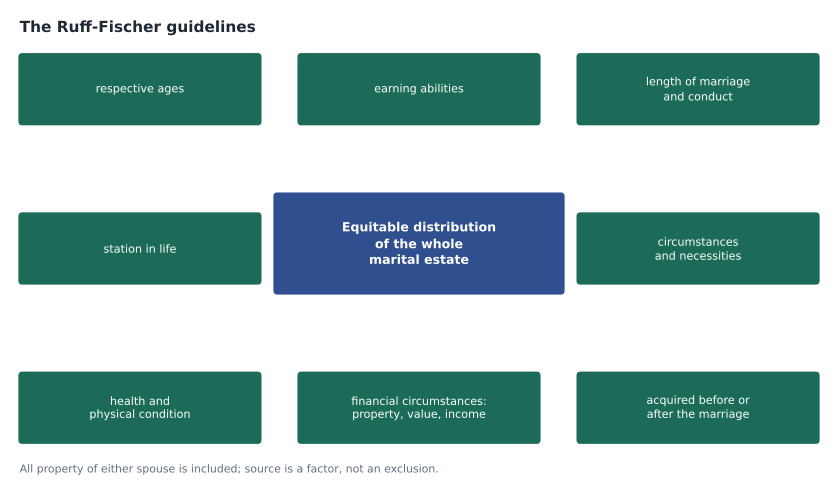
For the Hettinger farm couple, the guidelines pointed toward a roughly equal division. The marriage lasted 22 years, both had worked the operation and the land had been acquired during the marriage, except for one quarter section the husband inherited from his father. That inherited quarter was still in the marital estate, but its source was a factor that could justify awarding it to the husband with an offsetting award to the wife from other property.
Spousal support
Spousal support in North Dakota is governed by section 14-05-24.1, which limits how long support may last. The court may award support only for a limited time. Permanent spousal support is not allowed. The court must find that the spouse seeking support lacks sufficient means to meet reasonable needs, considering the standard of living established during the marriage, and that the other spouse can pay without undue hardship.
The statute names three types. Rehabilitative support is meant to restore the recipient's independence or increase earning capacity, for example through education or training. General term support is for a spouse who cannot be rehabilitated or become self-supporting. Lump sum support is awarded as part of the marital property or through an adjusted property distribution. The factors track the Ruff-Fischer guidelines: age, earning ability, duration of the marriage, conduct during the marriage, station in life, circumstances and necessities, health and financial circumstances, including property.
The duration limits are the distinctive part. Length of the marriage runs from the wedding to service of the summons. Unless the court makes written findings justifying a deviation, support may not last longer than a set percentage of the length of the marriage.
| Length of marriage | Maximum duration of support |
|---|---|
| Less than 5 years | 50 percent of the length of the marriage |
| 5 to 10 years | 60 percent |
| 10 to 15 years | 70 percent |
| 15 to 20 years | 80 percent |
| 20 years or more | As agreed by the parties or set by the court for a limited time |
Support ends on the recipient's remarriage or either party's death, unless the parties agree otherwise. It also ends if the court finds the recipient has been habitually cohabiting with another person in a relationship analogous to marriage for one year or more. There is a rebuttable presumption that support ends when the paying spouse reaches full Social Security retirement age. Rehabilitative support during its rehabilitative period and general term support may be modified on a material change in circumstances; lump sum support cannot be modified once the judgment is entered, and the parties may limit modification by written agreement.
Jonas had his answer for the Hettinger husband. A 22-year marriage falls in the last category, so the duration is set by agreement or by the court for a limited time, not by a percentage. But support cannot be permanent, and the presumption that it ends at the husband's full Social Security retirement age would apply unless rebutted.
Parenting rights and responsibilities
North Dakota uses its own vocabulary for custody. The parenting plan allocates primary residential responsibility, the parent with whom the child lives most of the time, decision-making responsibility for major decisions such as education and health care, and parenting time for the other parent. Courts may award equal residential responsibility. Every decision is governed by the best interests and welfare of the child, and section 14-09-06.2 lists the factors the court must consider, which include the love and emotional ties between the parents and child, each parent's ability to provide care and guidance, the child's developmental needs, the stability of each home, each parent's willingness to support the child's relationship with the other parent, the mental and physical health of the parents as it affects the child, evidence of domestic violence and, in appropriate cases, the child's preference.
Relocation out of state has its own statute. Under section 14-09-07, a parent with primary residential responsibility who wants to move a child to another state needs either the other parent's consent, if that parent has parenting time, or a court order. No order is needed if the other parent has not exercised parenting time for a year or has moved to another state more than 50 miles away. In deciding whether to permit the move, courts apply the factors developed in the Supreme Court's Stout and Hawkinson decisions: the prospective advantages of the move for the parent and child, the integrity of the moving parent's reasons, the integrity of the other parent's reasons for opposing it, and the potential negative effect on the child's relationship with the other parent, including whether a realistic parenting time schedule can preserve it.
Child support
Child support in North Dakota is set under guidelines adopted by administrative rule. The guidelines start from the paying parent's net income and produce a presumptively correct amount, which the court may depart from only with findings that a listed criterion applies. A new lawyer should work from the current guidelines and the state's calculation tools for every case rather than from memory, because the schedules are updated periodically.
Probate: the Uniform Probate Code
North Dakota adopted the Uniform Probate Code, codified in Title 30.1 of the Century Code. The section numbers carry the Uniform Probate Code's numbers in parentheses, so section 30.1-05-01 is the Code's section 2-202 on the elective share. That makes national commentary and decisions from other UPC states useful in North Dakota practice.
The Code's structure is familiar to anyone who has studied it. A will must generally be in writing, signed by the testator and signed by two witnesses, and the North Dakota version also recognizes a holographic will, one whose signature and material portions are in the testator's handwriting. When a person dies without a will, the intestacy provisions give the surviving spouse a large share, often the whole estate where all the decedent's descendants are also the spouse's descendants. Probate may be informal, handled by the registrar without notice or a hearing, or formal, supervised by the court, and an estate can move between the two.
The elective share
The widow in Dickinson had a remedy. Under section 30.1-05-01, the surviving spouse of a decedent who died domiciled in North Dakota may elect to take 50 percent of the augmented estate. The augmented estate is broader than the probate estate: it includes the decedent's probate estate, certain nonprobate transfers to others, nonprobate transfers to the surviving spouse and the surviving spouse's own property and nonprobate transfers to others, all as defined in the following sections. Including the survivor's own property prevents a spouse who already holds a large share of the couple's wealth from taking more.
North Dakota's version differs from the current Uniform Probate Code, which phases in the elective share by the length of the marriage and applies it to a marital-property portion of the augmented estate. North Dakota's statute simply gives 50 percent of the augmented estate, without a schedule tied to years of marriage. It also provides a supplemental amount: if the surviving spouse's own assets and the elective share together fall below 75,000 dollars, the survivor is entitled to the difference. The homestead allowance, exempt property and family allowance are in addition to the elective share and are not charged against it.
The election has a deadline. Under section 30.1-05-05, the surviving spouse must file a petition for the elective share in court and mail or deliver a copy to the personal representative within nine months after the decedent's death or within six months after the will is probated, whichever is later. Within the nine months, the spouse may petition for an extension for cause. Jonas calendared both dates the day the file arrived.
Worked problem
Spousal support duration
Hypothetical spouses Elin and Sander married on June 1, 2015. Sander served the divorce summons on June 1, 2026. Elin seeks rehabilitative support while she finishes a nursing degree. If the court awards support and makes no deviation findings, how long can it last?
Show solution
- The length of the marriage runs from the wedding to service of the summons: 11 years.
- A marriage of 10 to 15 years falls in the 70 percent category under 14-05-24.1.
- 70 percent of 11 years is 7.7 years.
- Support must be for a limited time, and rehabilitative support can be modified during its rehabilitative period on a material change in circumstances.
Answer: Support can last no longer than about 7.7 years without written findings justifying a deviation.
Common mistakes
MistakeNorth Dakota sets aside each spouse's separate property before dividing the rest.
InsteadAll property is in the marital estate; source is a Ruff-Fischer factor, not an exclusion.
MistakeA court can award permanent spousal support after a long marriage.
InsteadSection 14-05-24.1 prohibits permanent support; support is for a limited time.
MistakeA parent with primary residential responsibility may always move out of state.
InsteadConsent or a court order is generally required under 14-09-07.
MistakeNorth Dakota's elective share is phased in by years of marriage.
InsteadIt is 50 percent of the augmented estate, with a 75,000 dollar supplemental amount.
MistakeThe elective share petition is due within one year after death.
InsteadIt is due within nine months after death or six months after probate, whichever is later.
Practice problems
Work each problem on paper first, then reveal the answer to check.
What residency does a North Dakota divorce require?
Show answer
Six months of good faith residence before filing or before the decree.
What guidelines govern property division?
Show answer
The Ruff-Fischer guidelines.
How long may support last after a 7-year marriage, absent deviation findings?
Show answer
Up to 60 percent of 7 years, or 4.2 years.
Which factors govern out-of-state relocation?
Show answer
The Stout-Hawkinson factors, under 14-09-07.
What share may a North Dakota surviving spouse elect?
Show answer
50 percent of the augmented estate.
Summary and key terms
- Seven grounds for divorce; irreconcilable differences is the usual one. Residency: six months.
- Equitable distribution of the whole marital estate under the Ruff-Fischer guidelines; valuation 60 days before trial absent agreement.
- Spousal support is limited in time, never permanent, capped by percentages of the marriage length, and presumptively ends at full Social Security retirement age.
- Parenting plans allocate primary residential responsibility, decision-making responsibility and parenting time by the child's best interests.
- Out-of-state moves require consent or a court order, judged under the Stout-Hawkinson factors.
- Probate follows the Uniform Probate Code in Title 30.1; the elective share is 50 percent of the augmented estate, petitioned within nine months of death or six months of probate.
- equitable distribution
- Division of the marital estate in a way the court finds fair, not necessarily equal.
- Ruff-Fischer guidelines
- The North Dakota factors for dividing property and setting spousal support.
- primary residential responsibility
- North Dakota's term for the parent with whom the child primarily lives.
- augmented estate
- The broad base for the elective share, including probate and nonprobate transfers and the survivor's own property.
- rehabilitative support
- Spousal support meant to restore the recipient's independence or earning capacity.
Lesson quiz · 5 questions
Score 60% or more to complete this lesson.
Create a free account to save your progress, take quizzes and earn a certificate.