
BAR-235 · Lesson 3 of 12 · 21 min
Character and fitness and the MPRE
▶ Video coming soon A video version of this lesson is on the way.
The question that worried Jonas was not on the bar exam. It was on the character and fitness application, and it asked about every charge, citation or arrest in his adult life, including matters that were dismissed or expunged. He had two speeding tickets from college and one night in 2021 when a campus officer wrote him a citation for having an open can of beer in a car he was not driving. The citation was dismissed. 'It is nothing,' he said. Hollis said it was nothing only if he disclosed it.
This lesson covers how North Dakota decides whether an applicant has the character and fitness to practice law, what the application asks and how to answer it, the role of NCBE, debts and other financial issues, and the MPRE score and timing rules.
The standard
Every applicant for admission in North Dakota, by exam, transferred score or motion, must satisfy the Board that he or she has the character and fitness to practice law. The question is forward-looking: whether the applicant can be trusted to meet the duties a lawyer owes to clients, courts and the public. Honesty, financial responsibility, respect for the law and the ability to meet deadlines and obligations are the usual measures. A past mistake does not disqualify an applicant by itself. What the Board weighs is what the conduct shows about the applicant now, how long ago it happened, what the applicant has done since, and, above all, whether the applicant has been candid about it.
NCBE investigates; the Board decides
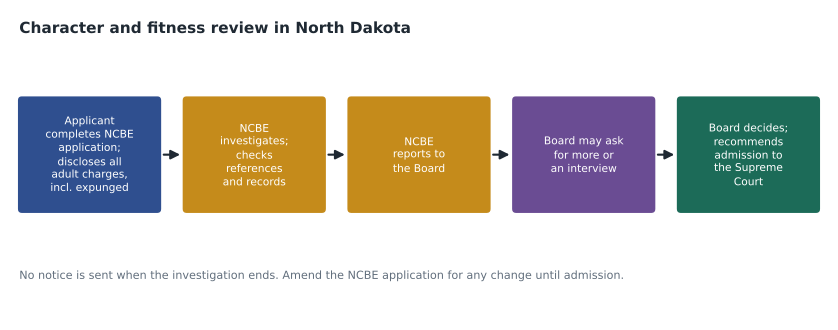
North Dakota uses NCBE to conduct its character and fitness investigations. The applicant fills out NCBE's online application, which asks for a complete history: every residence with dates, every job, every school, all bar applications elsewhere, any discipline as a student or professional, any criminal charge, any civil lawsuit, debts and defaults, and other matters. NCBE verifies the answers, contacts references and employers and collects records, then reports to the Board. The Board makes every eligibility decision and may require an applicant to appear for an interview. Neither NCBE nor the Board sends a notice when the investigation is complete; an applicant learns the result when the Board recommends admission or asks for more.
Criminal history: disclose everything
The Board's guides are blunt. Applicants must disclose all adult charges, including those that were expunged, and must upload the officer's report, the complaint and the disposition for each one. The FAQ adds the Board's general advice: when in doubt, self-disclosure is the best policy. An applicant who leaves out a dismissed citation because it was dismissed has made a choice the Board treats as a candor problem, and candor problems are far more serious than old citations.
For Jonas, this meant three entries. For each speeding ticket, he needed the court's record of the citation and how it was resolved. For the open container citation, he needed the officer's report, the citation and the dismissal. He wrote to the municipal court and the county clerk in August, which turned out to be wise, because one of the records came from a court that had moved to a new records system and took five weeks to answer.
Civil lawsuits
Civil matters must be disclosed as the questions require, with the complaint and the final disposition uploaded. A lawsuit in which the applicant was a plaintiff over a car accident, a small claims case against a landlord and a collection case against the applicant all count if the question asks about them. Hollis reminded the group that collection cases often surprise people: a medical bill sent to collections, then to a lawsuit, then to a default judgment the applicant never saw.
Debts and financial responsibility
The FAQ addresses financial issues directly. Applicants with debt or credit problems must include an affidavit explaining the situation. An applicant with unresolved debts, such as accounts in collection or unpaid judgments, must file an affidavit describing a plan to resolve them, and the Board may request a full credit report. Student loans in repayment or in a recognized deferment are not the problem; defaulted accounts, ignored judgments and unexplained patterns of nonpayment are.
The reason is not that poor people cannot be lawyers. It is that lawyers handle other people's money in trust accounts, and the Board looks for evidence that an applicant manages obligations responsibly or has a credible plan to do so. An applicant who has fallen behind and says so, with a plan and a record of payments under it, is in a very different position from one who hides the debt.
References
The application asks for references, and the FAQ advises applicants to tell their references that NCBE or the Board may contact them and to remind them to respond promptly. A reference who does not answer delays the file. Motion applicants have a specific reference requirement: a judge who can attest to the applicant's character and fitness. A lawyer who does not practice before judges should use a judge who knows him or her personally or socially, and a lawyer who knows no judge should use an attorney, preferably one who has been on the other side of a case.
Candor is the whole game
Hollis spent the second half of the session on the questions that trip people up. A question asks about any charge 'whether or not' it resulted in a conviction: dismissed matters are included. A question asks about any school discipline: academic integrity warnings count even if no formal sanction followed. A question asks about any termination or resignation in lieu of termination: a job left after a dispute with a manager may need explanation. A question asks about any prior bar application: an applicant who applied to another state and withdrew must say so.
The common thread is that the applicant does not get to decide what matters. The Board does. The applicant's job is to answer the question that was asked, completely and accurately, and to attach the records. An applicant who is unsure whether something falls within a question should disclose it with an explanation. The worst outcome of overdisclosure is a short follow-up letter. The worst outcome of underdisclosure is a finding that the applicant was not candid, which can delay or deny admission and follows the applicant to every other jurisdiction where he or she applies.
Keeping the file current
The duty to disclose continues until admission. Any change in address, employment or background must be reported by amending the application in the NCBE account. If Jonas got a speeding ticket on the way to Bismarck in February, he would need to amend his application to report it. If he changed jobs, he would update his employment history. The same duty applies to motion and transferred-score applicants while their applications are pending, which the Board's FAQ says usually takes four to seven months.
The MPRE
The Multistate Professional Responsibility Examination is NCBE's 60-question multiple-choice exam on the law governing lawyers, based mainly on the ABA Model Rules of Professional Conduct and the Model Code of Judicial Conduct. It is given several times a year at testing centers and is scored on a scale from 50 to 150. Each jurisdiction sets its own passing score.
North Dakota requires a scaled MPRE score of 85, one of the higher passing scores in the country. NCBE's chart lists 85 for North Dakota, and the Board's guides repeat it. The score report must be sent by NCBE directly to the Board. An applicant who has already taken the MPRE lists the date on the application. An applicant who has not yet taken it lists the month and year he or she plans to sit and requests that NCBE send the score to North Dakota.
| Applicant type | MPRE score | Timing rule stated by the Board |
|---|---|---|
| Exam applicant | 85 | Score received within five years of filing the application (February guide) |
| Transferred UBE, NextGen or MBE score applicant | 85 | Score within seven years of filing the application (score transfer page) |
| Motion applicant | 85 | Check the current motion guide |
The Board's published guides state the timing rule differently for different applicants. The February exam guide says the score must be 85 or higher and received within five years of filing the application. The page on admission by transferred score says the MPRE scaled score must be within seven years of filing. An applicant whose MPRE is more than a few years old should confirm the rule that applies with the Board rather than guessing between them. Jonas had no such problem: he scored 91 in March 2026, in the spring of his third year, and asked NCBE to send it to North Dakota.
When to take the MPRE
North Dakota allows the MPRE to be taken before or after the bar exam, but admission cannot be completed until the score is in. Hollis's advice was to take it during law school, as Jonas did, right after a professional responsibility course and well away from bar study. An applicant who passes the bar exam but has not passed the MPRE waits for admission until a qualifying score arrives. For an applicant transferring a score from another state, the MPRE often turns out to be the oldest document in the file and the one most likely to run into a timing limit.
Interviews
The Board may require an applicant to appear for an interview. An interview is not a finding against the applicant; it is the Board's way of hearing directly about something in the file. An applicant called for an interview should review the application, bring documents that show rehabilitation or repayment, and answer questions directly. Many applicants who are interviewed are admitted.
Mental health and conduct questions
Bar applications in many states once asked broad questions about any mental health treatment, and applicants avoided counseling for fear of having to disclose it. National bodies, including the ABA, have urged jurisdictions to focus on conduct rather than diagnosis or treatment. Hollis told the group to read North Dakota's current application questions exactly as written and to answer only what they ask, no more and no less. Seeking help for stress, anxiety or depression during law school is not misconduct, and an applicant who is unsure how a question applies to his or her history should contact the Board or a lawyer who advises bar applicants before answering, rather than guess.
Student conduct and academic records
The application also asks about discipline and academic problems at every school the applicant attended. A warning for plagiarism, probation for poor grades or a housing violation in a residence hall can fall within the question, depending on its wording. Because the Board receives the law school's copy of the applicant's law school application and the official transcripts, an inconsistency between those records and the bar application is easy to spot. The safe practice is to request one's own student conduct file from each school before completing the application and to answer from the records, not from memory.
Traffic matters
Traffic citations are the most common items on North Dakota applications, and the questions are usually broad enough to include them. Jonas asked whether every parking ticket counted. Hollis told him to read the question: if it asks about traffic violations other than parking, parking tickets are excluded; if it asks about any citation, they are not. Where a question covers minor traffic matters, a short list with dates, locations and dispositions, supported by records where available, is enough. The Board is looking for patterns, such as repeated license suspensions or driving under the influence, not a single speeding ticket.
Timing the review
Character and fitness review runs at the same time as bar preparation. NCBE begins its investigation when the online application is complete, and the Board's recommendation can come only after the investigation ends and the applicant has passed the exam and met the MPRE requirement. An applicant who files early and answers requests promptly is far more likely to be admitted soon after results are released. An applicant whose file is still open when results come out simply waits.
Worked problem
Disclosure
Rolf, a hypothetical applicant, was charged with minor in possession of alcohol at 19. The charge was dismissed after a diversion program, and the record was later sealed. The North Dakota application asks about any charge, including expunged matters. Rolf thinks a sealed juvenile-era record does not count. What should he do?
Show solution
- At 19, Rolf was an adult for most purposes, and the charge was an adult charge.
- The Board's guides require disclosure of all adult charges, including expunged ones, with the officer's report, complaint and disposition.
- The dismissal and diversion help him; they show the matter was minor and resolved.
- Omitting it would create a candor problem far worse than the charge.
Answer: Rolf should disclose the charge, the diversion and the dismissal, upload the records he can obtain and explain any he cannot.
Common mistakes
MistakeDismissed or expunged charges need not be disclosed.
InsteadNorth Dakota requires disclosure of all adult charges, including expunged ones, with records.
MistakeNCBE decides whether an applicant is admitted.
InsteadNCBE investigates; the Board decides and may require an interview.
MistakeNorth Dakota accepts the national minimum MPRE score of 75.
InsteadNorth Dakota requires 85.
MistakeAn applicant will be told when the investigation is complete.
InsteadNo confirmation is sent; the investigation is final only when the applicant is recommended for admission.
MistakeUnpaid debts automatically disqualify an applicant.
InsteadThe Board asks for an affidavit and a plan; candor and a credible plan matter most.
Practice problems
Work each problem on paper first, then reveal the answer to check.
What MPRE score does North Dakota require?
Show answer
85.
Must an applicant disclose an expunged adult charge?
Show answer
Yes, with the officer's report, complaint and disposition.
What must an applicant with unresolved debts file?
Show answer
An affidavit describing the debts and a plan to resolve them; the Board may request a credit report.
Whom should a motion applicant use as a judge reference if he or she knows no judge?
Show answer
An attorney familiar with the applicant, preferably one who has been opposing counsel.
How does an applicant report a change after filing?
Show answer
By amending the application in the NCBE account.
Summary and key terms
- Character and fitness asks whether the applicant can be trusted to meet a lawyer's duties now.
- NCBE investigates; the Board decides and may interview the applicant.
- Disclose all adult charges, including expunged ones, and civil matters the questions cover, with records.
- Debt problems require an affidavit and a resolution plan; the Board may request a credit report.
- The MPRE score required is 85; the Board's guides state a five-year rule for exam applicants and a seven-year rule for score transfer applicants.
- The duty to update continues until admission.
- character and fitness
- The qualities of honesty, responsibility and respect for law required for admission.
- candor
- Complete and accurate disclosure on the application, the most important factor in review.
- MPRE
- NCBE's 60-question exam on the law governing lawyers, scored from 50 to 150.
- affidavit of debt
- A sworn explanation of financial problems and a plan to resolve them.
- expunged record
- A record sealed or erased by court order, which must still be disclosed in North Dakota.
Lesson quiz · 5 questions
Score 60% or more to complete this lesson.
Create a free account to save your progress, take quizzes and earn a certificate.