
BAR-239 · Lesson 1 of 12 · 21 min
Becoming a lawyer in Pennsylvania
▶ Video coming soon A video version of this lesson is on the way.
Gwendolyn Pirozzi, who has answered to Wren since her grandmother gave her the nickname, grew up in Scranton, in Lackawanna County, two blocks from the house where her grandmother still lives. She finished her JD in May 2026 at an ABA-approved Pennsylvania law school and planned to sit the July 2026 exam, but in the spring her grandmother had a fall and a long recovery, and Wren decided to move the exam back one sitting. She filed for the February 2027 Pennsylvania exam in October and spends her days as a law clerk at a small Scranton firm that handles car-accident claims, a steady stream of family law matters and some defense work for a township and a school district. She joined Hollis Marchetti's study group in the fall because a classmate told her it was the only group that treated the state rules as seriously as the exam itself.
Hollis welcomed her by asking a question she asks every new member: 'Who decides whether you become a Pennsylvania lawyer?' Wren answered that the Board of Law Examiners did. Hollis said that was the answer she hears most often, and that it is close but not quite right. 'The Board runs the process. The Supreme Court of Pennsylvania decides. If you hold that distinction in your head, half of the rules you are about to read will make sense.'
This course follows the sessions Hollis built with Wren over the fall. The first six lessons cover admission: who admits Pennsylvania lawyers, who is eligible, the filing calendar and fees, character and fitness and the MPRE, the Uniform Bar Examination and its passing score of 270, the planned move to the NextGen exam in July 2028, and how Pennsylvania law fits around a national exam that does not test it. Lessons 7 through 10 cover Pennsylvania law a new lawyer meets in the first year of practice: the courts and civil procedure, tort law and immunity, family law and estates, and the Pennsylvania Rules of Professional Conduct. Lesson 11 covers score transfer, admission on motion and life after admission, and Lesson 12 is a capstone with original practice problems and an exam-day plan.
The Supreme Court of Pennsylvania admits lawyers
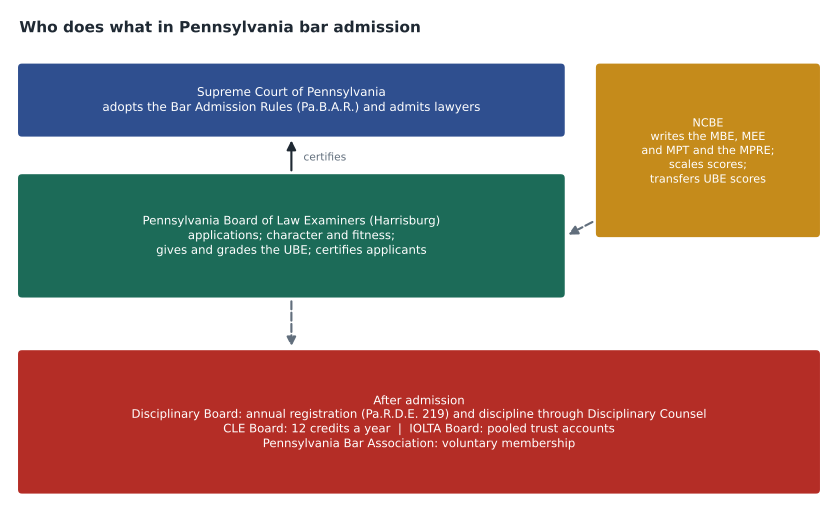
The Pennsylvania Constitution gives the Supreme Court of Pennsylvania the power to prescribe general rules governing practice, procedure and the conduct of all courts, and the admission to the bar and the practice of law fall within that power. The Court has seven justices, sits in Harrisburg, Philadelphia and Pittsburgh, and exercises its power over admission through the Pennsylvania Bar Admission Rules, cited as Pa.B.A.R. Those rules set the education requirement, the bar examination, the MPRE requirement, the character and fitness standard, admission by transferred score and admission on motion. When a Pennsylvania candidate reads that the passing score is 270 or that the MPRE score is 75, the source of that number is a rule or an order of the Supreme Court.
The rules are numbered in groups. The rules in the 200 series govern admission to the bar generally. Rule 203 covers admission by bar examination, Rule 204 admission by reciprocity, which is Pennsylvania's form of admission on motion, Rule 205 foreign-educated applicants and Rule 206 admission by a transferred Uniform Bar Examination score. The 300 series contains rules for limited forms of practice, such as licenses for in-house counsel and foreign legal consultants and the rules allowing certified law students to appear under supervision. Each rule has notes and committee comments that explain how the Board reads it, and the Board publishes interpretive guidance on its website, pabarexam.org.
The Court also adopts the rules that govern lawyers after admission. The Pennsylvania Rules of Professional Conduct follow the numbering of the ABA Model Rules but differ in several places, as Lesson 10 explains. The Pennsylvania Rules of Disciplinary Enforcement, cited as Pa.R.D.E., set up the Disciplinary Board and the annual registration every lawyer must complete. The Pennsylvania Rules for Continuing Legal Education set the CLE requirement. A candidate meets all three sets of rules on the day of admission.
The Pennsylvania Board of Law Examiners
The Court does not run the admission process itself. It acts through the Pennsylvania Board of Law Examiners, whose office is at 601 Commonwealth Avenue in Harrisburg and whose website is pabarexam.org. The Board receives applications, decides whether applicants meet the education and filing requirements, investigates character and fitness, administers and grades the bar examination, handles applications for admission by transferred score and on motion, and certifies to the Court the applicants who have met every requirement. Applications are filed online through the Board's system, and the Board communicates with applicants through that system and by email.
Pennsylvania does not use NCBE's character and fitness investigation service. NCBE's jurisdiction page tells applicants to contact the Pennsylvania Board for filing instructions, and the investigation is done by the Board itself. A Pennsylvania candidate who hears from friends in other states about completing an NCBE character report will not do that for Pennsylvania. Wren had already learned this when she filed. 'Everything went to Harrisburg,' she said. 'NCBE only appeared when I registered for the MPRE.'
NCBE's part
The National Conference of Bar Examiners writes the exams Pennsylvania uses. Pennsylvania has given the Uniform Bar Examination since July 2022, and NCBE prepares its three parts: the Multistate Bar Examination, the Multistate Essay Examination and the Multistate Performance Test. NCBE scores the multiple-choice questions and scales the written scores that Pennsylvania's graders produce, so that a Pennsylvania UBE score means the same thing as a UBE score earned in any other UBE jurisdiction. NCBE also writes and administers the Multistate Professional Responsibility Examination, the ethics exam every Pennsylvania applicant must pass with a scaled score of at least 75.
Candidates deal with NCBE directly for an NCBE account number, MPRE registration, score reports and transfers of a UBE score to another jurisdiction. That last service matters to Pennsylvania candidates because of geography. Many Pennsylvania lawyers practice in a region that includes New Jersey, New York, Delaware, Maryland, Ohio or West Virginia, and several of those jurisdictions accept transferred UBE scores. Lesson 11 returns to score transfer.
The bodies that regulate practice
After admission, a Pennsylvania lawyer deals with three bodies created by the Supreme Court. The Disciplinary Board of the Supreme Court of Pennsylvania runs annual registration, keeps the roll of attorneys and, through the Office of Disciplinary Counsel, investigates and prosecutes complaints of misconduct. Only the Supreme Court can suspend or disbar a lawyer. The Pennsylvania Continuing Legal Education Board administers the CLE requirement. The Pennsylvania IOLTA Board oversees the program under which interest on pooled client trust accounts funds civil legal aid.
Pennsylvania does not have an integrated bar. The Pennsylvania Bar Association is a voluntary association, and so are the county bar associations, such as the Philadelphia Bar Association and the Allegheny County Bar Association. A Pennsylvania lawyer is not required to join any of them, although many do for practice materials, committees and networking. This is a common point of confusion for candidates who come from states such as Missouri or Texas, where every licensed lawyer must belong to the state bar. In Pennsylvania the license comes from the Supreme Court and is maintained through the Disciplinary Board, and membership in the Pennsylvania Bar Association is a separate choice.
Three ways in
Pennsylvania admits lawyers in three main ways. The first is admission by examination under Rule 203: the applicant meets the education requirement, files an application, passes character and fitness review, passes the Uniform Bar Examination in Pennsylvania with a score of at least 270 and passes the MPRE with at least 75. Wren is taking this route, and it is the route most new graduates take.
The second is admission by a transferred UBE score under Rule 206. An applicant who earned a qualifying UBE score in another jurisdiction can ask Pennsylvania to accept it instead of sitting the exam again, so long as the score is no more than 30 months old when the application is filed and meets Pennsylvania's minimum. From September 1, 2026, Pennsylvania accepts transferred scores from either the current UBE or the NextGen UBE. The applicant must still satisfy the education requirement, pass character and fitness review and file a passing MPRE score.
The third is admission by reciprocity under Rule 204. A lawyer admitted in a state that gives Pennsylvania lawyers reciprocal treatment, who has practiced for a majority of the time for five of the last seven years and meets the other conditions of the rule, can be admitted without a bar exam. Lesson 11 covers both alternative routes in detail.
Pennsylvania also offers narrower licenses for lawyers already licensed elsewhere, such as limited admission for in-house counsel and for lawyers working in defender and legal services programs, and a license for foreign legal consultants. Those are outside the main path for a new graduate.
The order of the steps
Wren listed the steps she had taken and the ones still ahead, and Hollis wrote them on the shared screen. Wren had finished her JD at an ABA-approved school in May 2026. She had sat the MPRE in August 2025, between her second and third years, and received a scaled score of 101, comfortably above Pennsylvania's 75. She had filed her application for the February 2027 exam before the October 30 first filing deadline, answered the character and fitness questions and arranged for her law school to certify her degree. Ahead of her were the exam itself on February 23 and 24, 2027, the release of results in the spring, certification by the Board, a motion for admission and the oath.
Hollis pointed out that Pennsylvania is relaxed about the MPRE's timing. NCBE's chart for Pennsylvania shows no time limit on when the MPRE score must have been earned, so a candidate who passed the MPRE years earlier can still use the score, and a candidate who has not yet taken it can do so before or after the bar exam. Admission cannot be completed until the score is on file. Many candidates take the MPRE in law school to have it out of the way, as Wren did, but nothing in the Pennsylvania rules requires that order.
'The one thing you cannot move,' Wren said, 'is the filing deadline. I set three reminders for October 30 and still filed a week early because I did not trust myself.' Hollis said that was exactly the right instinct. Lesson 2 explains why the deadline matters so much and what happens to a candidate who misses it.
How Pennsylvania law fits in
The Uniform Bar Examination tests general law. It does not test Pennsylvania's own rules, and an answer on the exam should follow the generally accepted rule unless the question supplies a different one. Unlike some UBE jurisdictions, Pennsylvania has no separate jurisdiction-specific component: there is no Pennsylvania law course and no Pennsylvania law test that a candidate must pass before admission. NCBE's jurisdiction page lists Pennsylvania's answer to the jurisdiction-component question as no, for both the current UBE and the NextGen exam.
That makes Pennsylvania law something a new lawyer learns in practice rather than for admission. Pennsylvania law differs from the general rules in ways that matter. It uses a modified comparative negligence rule that bars a plaintiff who is more at fault than the defendants, and since the Fair Share Act of 2011 it makes most defendants liable only for their own share of damages unless they are at least 60 percent at fault. It lets drivers choose between full tort and limited tort insurance, which changes what an injured person can recover. It caps damages against the Commonwealth and local agencies, and in October 2026 the Supreme Court upheld the cap against the Commonwealth again. It requires fact pleading. Its business registration statute was the subject of the 2023 Supreme Court decision in Mallory v. Norfolk Southern Railway. Later lessons cover each of these.
Worked problem
Mapping the authority
A friend tells a Pennsylvania candidate that she must pass a Pennsylvania law test after the bar exam, that NCBE will investigate her character, and that she must join the Pennsylvania Bar Association to practice. Which of these statements are right?
Show solution
- NCBE lists no jurisdiction-specific component for Pennsylvania, so there is no Pennsylvania law test to pass.
- Character and fitness is investigated by the Pennsylvania Board of Law Examiners, not by NCBE.
- The Pennsylvania Bar Association is voluntary; the license comes from the Supreme Court, and the lawyer registers annually with the Disciplinary Board.
- The requirements she must meet are the Rule 203 education requirement, a UBE score of 270, an MPRE score of 75 and character and fitness approval.
Answer: All three statements are wrong. She needs a passing UBE score, a passing MPRE score, character and fitness approval and admission by the Supreme Court; she does not need a Pennsylvania law test or membership in a voluntary bar association.
Common mistakes
MistakeThe Board of Law Examiners admits lawyers in Pennsylvania.
InsteadThe Supreme Court of Pennsylvania admits lawyers; the Board administers the process and certifies applicants.
MistakePennsylvania has an integrated, mandatory state bar.
InsteadThe Pennsylvania Bar Association is voluntary; registration is with the Disciplinary Board.
MistakeNCBE investigates character and fitness for Pennsylvania.
InsteadThe Pennsylvania Board does its own investigation.
MistakePennsylvania requires a state law course or test before admission.
InsteadPennsylvania has no jurisdiction-specific component.
MistakeThe MPRE must be taken before the bar exam.
InsteadPennsylvania sets no order and no time limit; the score must be on file before admission.
Practice problems
Work each problem on paper first, then reveal the answer to check.
Which body adopts the Pennsylvania Bar Admission Rules?
Show answer
The Supreme Court of Pennsylvania.
Which rule governs admission by bar examination, and which governs admission by a transferred UBE score?
Show answer
Rule 203 and Rule 206.
Since when has Pennsylvania given the Uniform Bar Examination?
Show answer
Since July 2022.
What MPRE scaled score does Pennsylvania require?
Show answer
75.
Which body runs annual registration and lawyer discipline?
Show answer
The Disciplinary Board of the Supreme Court of Pennsylvania, with the Office of Disciplinary Counsel.
Summary and key terms
- The Supreme Court of Pennsylvania admits lawyers through the Pennsylvania Bar Admission Rules.
- The Board of Law Examiners in Harrisburg handles applications, character and fitness, the exam and certification.
- NCBE writes the UBE components and the MPRE; Pennsylvania has used the UBE since July 2022.
- The three main routes are examination (Rule 203), transferred UBE score (Rule 206) and reciprocity (Rule 204).
- Pennsylvania has no jurisdiction-specific component and no integrated bar.
- After admission, the Disciplinary Board, the CLE Board and the IOLTA Board regulate practice.
- Pa.B.A.R.
- The Pennsylvania Bar Admission Rules adopted by the Supreme Court of Pennsylvania.
- Pennsylvania Board of Law Examiners
- The body that administers admission, investigates character and fitness and certifies applicants to the Court.
- admission by reciprocity
- Pennsylvania's form of admission on motion under Rule 204.
- Disciplinary Board
- The Supreme Court's board that runs attorney registration and, through Disciplinary Counsel, discipline.
- voluntary bar
- A bar association a lawyer may choose to join, such as the Pennsylvania Bar Association.
Lesson quiz · 5 questions
Score 60% or more to complete this lesson.
Create a free account to save your progress, take quizzes and earn a certificate.