
BAR-239 · Lesson 7 of 12 · 20 min
Pennsylvania courts, civil procedure and personal jurisdiction
▶ Video coming soon A video version of this lesson is on the way.
The first pleading Wren saw at the firm was not a complaint but a set of preliminary objections. A defendant's insurer had filed them in a car-accident case, arguing that the firm's complaint was vague and that one count failed to state a claim. Her supervising attorney handed her the objections and said, 'In federal court this would be a motion to dismiss. Here it is a demurrer, and it is the first fight in almost every case. Read Rules 1019 and 1028 tonight.' She did, and brought her notes to the group. Hollis said that the two rules together explain more about Pennsylvania civil practice than any other two pages.
This lesson describes Pennsylvania's courts and how judges are chosen, the features of Pennsylvania civil procedure that most often surprise lawyers trained on the federal rules, and Pennsylvania's place in the law of personal jurisdiction after Mallory v. Norfolk Southern Railway Co.
The unified judicial system
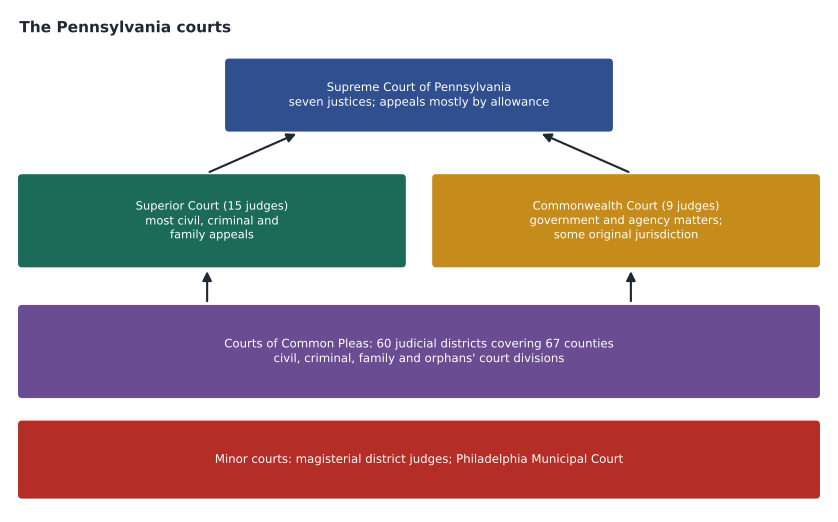
The Pennsylvania Constitution creates a unified judicial system under the supervision of the Supreme Court. At the top is the Supreme Court of Pennsylvania, with seven justices. It hears appeals mainly by allowance, a discretionary grant similar to certiorari, and it has direct appellate jurisdiction in a short list of matters, such as appeals from death sentences. It also supervises the entire system and adopts the rules of procedure, evidence and practice.
Pennsylvania has two intermediate appellate courts, an unusual arrangement. The Superior Court, with fifteen judges, hears most appeals from the trial courts in civil, criminal and family matters. The Commonwealth Court, with nine judges, hears appeals in cases involving the Commonwealth, local governments and regulatory agencies, and it also acts as a trial court in some cases brought by or against the Commonwealth. A new lawyer must know which intermediate court an appeal goes to; an appeal filed in the wrong court can be transferred, but the mistake costs time.
The general trial courts are the Courts of Common Pleas, organized into judicial districts that generally follow county lines, with some districts covering more than one county. Pennsylvania has 67 counties and 60 judicial districts. Each Court of Common Pleas hears civil, criminal, family and orphans' court matters, the last covering estates, trusts and guardianships, usually in separate divisions. Below them are the minor courts: magisterial district judges throughout the state, who hear small civil claims, landlord-tenant cases, traffic and summary offenses and preliminary matters in criminal cases, and the Philadelphia Municipal Court. Magisterial district judges need not be lawyers.
Electing judges
Pennsylvania elects its judges. Judges of the Supreme Court, the Superior Court, the Commonwealth Court and the Courts of Common Pleas are first chosen in partisan elections held in odd-numbered years, and they serve ten-year terms. At the end of a term, a judge may stand for retention in a yes-or-no election without a party label. Magisterial district judges and Philadelphia Municipal Court judges serve six-year terms. Vacancies between elections may be filled by the governor with the consent of the Senate, until the next election. Judges must retire at age 75 and may then serve as senior judges with the Supreme Court's approval.
Statewide judicial races, especially for the Supreme Court, draw heavy spending and attention. In November 2025, three Supreme Court justices stood for retention, and voters retained all three. Hollis mentioned the election only to make a practical point: Pennsylvania lawyers appear before judges who have run for office, and the Code of Judicial Conduct and the Rules of Professional Conduct both contain rules about lawyers' contributions to and conduct in judicial campaigns.
Starting a case
A Pennsylvania civil action may be started by filing either a praecipe for a writ of summons or a complaint. The writ of summons is a short document that commences the action and tolls the statute of limitations without stating the claim. A plaintiff who files a writ must then serve it and later file a complaint, and the defendant may file a praecipe requiring the plaintiff to do so. Lawyers use writs when the limitations period is about to run and the facts are not yet complete. A complaint must begin with a notice to defend in the form the rules prescribe, telling the defendant that a response is due within twenty days and where to find legal help.
Fact pleading
Pennsylvania is a fact-pleading state. Rule 1019(a) requires that the material facts on which a cause of action or defense is based be stated in a concise and summary form. Pennsylvania courts read the rule to require enough facts to inform the opposing party of the claim and to allow a defense to be prepared, which is more than the federal standard of a short and plain statement showing entitlement to relief. Allegations of fraud or mistake must be pleaded with particularity, and a claim based on a writing must attach the writing or explain why it is not attached. Each pleading must be verified by the party, a feature that also surprises lawyers from federal practice.
Preliminary objections
A defendant attacks a complaint by preliminary objections under Rule 1028, rather than by a motion to dismiss. The grounds include lack of jurisdiction over the subject matter or the person, improper venue, improper service, failure of a pleading to conform to law or rule, insufficient specificity, legal insufficiency of a pleading, which Pennsylvania lawyers still call a demurrer, and other grounds listed in the rule. A demurrer admits the well-pleaded facts for the purpose of the objection and asks whether the law allows recovery on them. If the court sustains objections, it usually allows the plaintiff to amend.
Affirmative defenses work differently too. Under Rule 1030, defenses such as the statute of limitations, release, immunity from suit and comparative negligence are pleaded under the heading New Matter in the answer, and the plaintiff must reply to New Matter or risk having its allegations deemed admitted. Wren's supervising attorney called it the trap that catches every lawyer from another state once.
Professional liability and compulsory arbitration
In an action for professional negligence against a licensed professional, such as a physician, a lawyer or an engineer, the plaintiff's attorney must file a certificate of merit under Rule 1042.3, generally within sixty days after filing the complaint, stating that an appropriate licensed professional has supplied a written statement that there is a reasonable probability the care fell below accepted standards, or that expert testimony is unnecessary. Failure to file can lead to a judgment of non pros against the plaintiff.
Many smaller civil cases go first to compulsory arbitration. Under the Judicial Code, each Court of Common Pleas may by local rule require arbitration of cases in which the amount in controversy is no more than a limit set by the court, up to 50,000 dollars. The arbitrators are panels of local lawyers, the hearing is informal and the award can be appealed for a new trial in the Court of Common Pleas. Many personal injury cases with modest damages are resolved in arbitration, and new lawyers often try their first cases there.
Venue
Venue is governed by the Rules of Civil Procedure. In an action against an individual, venue generally lies in a county where the individual may be served, where the cause of action arose or where a transaction or occurrence out of which the cause of action arose took place. For a corporation or similar entity, Rule 2179 adds counties where it has its registered office or principal place of business and counties where it regularly conducts business. Venue in Philadelphia, which has a reputation for larger verdicts, has long been contested.
Medical malpractice venue changed recently. From 2003, a special rule required medical professional liability actions to be brought only in the county where the care was provided. By order of August 25, 2022, effective January 1, 2023, the Supreme Court rescinded that rule, so that medical professionals are subject to the same venue rules as other defendants. The order directed a reexamination after two years, and by order of February 18, 2026 the Court removed that reexamination provision, leaving the general rules in place.
Limitations
Pennsylvania's statute of limitations for personal injury, wrongful death and many other tort actions is two years under section 5524 of the Judicial Code. Contract actions generally have four years under section 5525. The discovery rule can delay the start of the period where the injury or its cause could not reasonably have been discovered. Claims against government agencies have an additional notice requirement, covered in Lesson 8.
Post-trial practice and appeals
Pennsylvania requires post-trial motions to preserve issues for appeal. Under Rule 227.1, post-trial motions must be filed within ten days after the verdict or decision, and issues not raised are waived. After judgment is entered, the notice of appeal is due within thirty days under the Rules of Appellate Procedure. The trial judge may then order the appellant to file a concise statement of the errors complained of on appeal under Appellate Rule 1925(b), and issues not included in the statement are waived. Missing either step has ended many appeals before they began.
Personal jurisdiction and Mallory
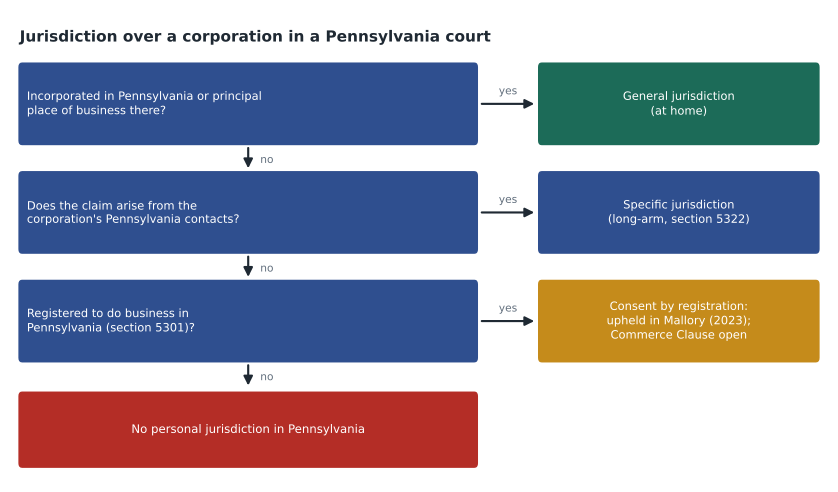
Pennsylvania's long-arm statute, section 5322 of the Judicial Code, extends specific jurisdiction to the limits of due process. Pennsylvania is unusual in another respect. Section 5301 provides that a foreign corporation's qualification to do business in Pennsylvania, by registering with the Department of State, is a basis for general personal jurisdiction, and the registration statute tells registering corporations so. Pennsylvania courts may therefore exercise jurisdiction over a registered foreign corporation on any claim, including one with no connection to Pennsylvania.
In Mallory v. Norfolk Southern Railway Co., 600 U.S. 122 (2023), the Supreme Court of the United States held, five to four, that the Due Process Clause did not prevent Pennsylvania from exercising jurisdiction under that scheme over a Virginia railroad sued in Philadelphia by a former employee who lived in Virginia and claimed injuries in Ohio and Virginia. Justice Gorsuch's opinion relied on Pennsylvania Fire Insurance Co. v. Gold Issue Mining and Milling Co., a 1917 decision upholding jurisdiction based on consent by registration. Justice Alito, who joined most of the opinion, wrote separately that the scheme might violate the dormant Commerce Clause, an issue the Court did not decide.
On remand the railroad raised the Commerce Clause argument. The trial court overruled its preliminary objections, the Superior Court declined to review that ruling and the Supreme Court of Pennsylvania declined allowance of appeal. The railroad then petitioned the Supreme Court of the United States, which denied review on October 5, 2026. The Commerce Clause question therefore remains open, and the scheme continues to operate. For a Pennsylvania lawyer, the practical result is that a corporation registered to do business in Pennsylvania can be sued in Pennsylvania on claims arising anywhere, subject to venue rules, forum non conveniens and any later ruling on the Commerce Clause.
Worked problem
Objections and jurisdiction
A Scranton resident injured in a Delaware warehouse sues a Delaware company in the Court of Common Pleas of Lackawanna County. The company is registered to do business in Pennsylvania and has a distribution center in Lackawanna County. The complaint alleges only that the company was negligent and caused injuries. The company files preliminary objections.
Show solution
- Jurisdiction: the company is registered in Pennsylvania, so section 5301 supplies general jurisdiction, which Mallory held consistent with due process.
- Venue: under Rule 2179, venue lies in a county where the company regularly conducts business, which includes Lackawanna County.
- Pleading: a complaint alleging only negligence and injury lacks the material facts Rule 1019(a) requires, so an objection for insufficient specificity or a demurrer is likely to be sustained.
- The court is likely to allow the plaintiff to amend.
Answer: Jurisdiction and venue are proper, but the complaint must be amended to plead the material facts of the negligence and the injuries.
Common mistakes
MistakePennsylvania has one intermediate appellate court.
InsteadIt has two: the Superior Court and the Commonwealth Court.
MistakeA Pennsylvania defendant files a motion to dismiss.
InsteadThe defendant files preliminary objections, including a demurrer.
MistakeAffirmative defenses go in the answer like any other denial.
InsteadThey are pleaded as New Matter, and the plaintiff must reply.
MistakeMallory decided that consent-by-registration is constitutional in every respect.
InsteadIt rejected the due process challenge; the dormant Commerce Clause question remains open.
MistakeMedical malpractice cases must be filed where the care was given.
InsteadThat special venue rule was rescinded effective January 1, 2023.
Practice problems
Work each problem on paper first, then reveal the answer to check.
Which court hears appeals in cases involving state and local government?
Show answer
The Commonwealth Court.
How long are the terms of Pennsylvania appellate and Common Pleas judges?
Show answer
Ten years, followed by retention elections.
Within what time must post-trial motions be filed?
Show answer
Ten days after the verdict or decision.
What is the limitations period for most personal injury actions?
Show answer
Two years.
What did the Supreme Court of the United States do with Norfolk Southern's petition in October 2026?
Show answer
It denied review on October 5, 2026.
Summary and key terms
- The Supreme Court (seven justices) supervises a unified system with the Superior and Commonwealth Courts, Common Pleas courts and minor courts.
- Judges are elected in partisan elections to ten-year terms, then retained by yes-or-no votes; retirement is at 75.
- Pennsylvania requires fact pleading and verified pleadings; defendants file preliminary objections; affirmative defenses go in New Matter.
- Professional negligence claims need a certificate of merit; many small cases go to compulsory arbitration.
- The special medical malpractice venue rule was rescinded from January 1, 2023.
- Registration supplies general jurisdiction under section 5301; Mallory upheld it on due process grounds, and review of the Commerce Clause issue was denied in October 2026.
- preliminary objections
- Pennsylvania's pleading used to challenge a complaint, including a demurrer.
- demurrer
- A preliminary objection asserting that the facts pleaded do not state a claim.
- New Matter
- The part of an answer in which affirmative defenses are pleaded.
- certificate of merit
- A filing required in professional negligence actions stating that a qualified professional supports the claim.
- consent by registration
- General jurisdiction over a foreign corporation based on its registration to do business in the state.
Lesson quiz · 5 questions
Score 60% or more to complete this lesson.
Create a free account to save your progress, take quizzes and earn a certificate.