
BAR-239 · Lesson 2 of 12 · 21 min
Eligibility, education, application deadlines and fees
▶ Video coming soon A video version of this lesson is on the way.
Wren's firm had hired a second law clerk in September, a graduate of a law school in another state who was still deciding where to sit. Over coffee he asked Wren whether Pennsylvania would let him sit in February if he filed in November. She did not know the answer, and she brought the question to the group. Hollis said it was the right question to ask early, because in bar admission the calendar decides more outcomes than the exam does. 'Nobody fails Pennsylvania by a point because of a late form,' she said. 'They simply do not sit. And that costs more than a point.'
This lesson covers who is eligible to sit the Pennsylvania bar examination, what education the rules require, the filing deadlines and fees for the February and July exams, and the practical steps that make an application complete.
The education requirement
Rule 203 sets the education requirement for admission by examination. An applicant must have an undergraduate degree from an accredited college or university, or an education the Board considers equivalent, and must have completed the study of law at and received a Bachelor of Laws or Juris Doctor degree from a law school that was accredited at the time the applicant matriculated or graduated. In the Pennsylvania rules, an accredited law school means one approved by the American Bar Association. The rule states the law degree requirement without exception for graduates of accredited schools, and a law degree from an ABA-approved school is the ordinary route for a new graduate.
Graduates of law schools in other states that are not ABA-approved can still qualify, but only by a narrower path. Under Rule 203, such a graduate must be a member of the bar of a reciprocal state in good standing and must show that, within the seven years before filing, the applicant spent five years practicing law in a reciprocal state, teaching full time at an accredited law school or serving on active duty as a judge advocate. In other words, a graduate of a non-ABA school can take the Pennsylvania bar exam only after becoming an experienced lawyer elsewhere.
Foreign-educated applicants are governed by Rule 205. NCBE's chart for Pennsylvania summarizes the rule this way: a foreign law graduate may be admitted by examination after completing additional education at an ABA-approved law school and after having practiced law in a foreign jurisdiction, and an LLM or other graduate law degree from an ABA-approved school does not by itself make a foreign graduate eligible. Foreign-educated lawyers should read Rule 205 and the Board's guidance closely before relying on any summary, including this one, because the details of the qualifying coursework and practice are specific.
| Applicant | Can sit the Pennsylvania exam? | Source |
|---|---|---|
| JD from an ABA-approved school | Yes, if the other requirements are met | Rule 203 |
| JD from a non-ABA school in another state | Only after admission in a reciprocal state and five of the last seven years of practice, teaching or judge advocate service | Rule 203 |
| Foreign law graduate | Only with additional ABA-school education and foreign practice; an LLM alone is not enough | Rule 205 |
| Lawyer disbarred or suspended elsewhere at filing | No | Rule 203 |
Good standing elsewhere
An applicant who is already admitted in another jurisdiction must submit certificates of good standing from every jurisdiction where the applicant is admitted. An applicant who is disbarred or suspended for disciplinary reasons in any jurisdiction at the time of filing is not eligible to sit. These requirements rarely affect a new graduate, but they matter for experienced lawyers who choose the exam route instead of reciprocity, for example because they practice in a state Pennsylvania does not treat as reciprocal.
The filing calendar
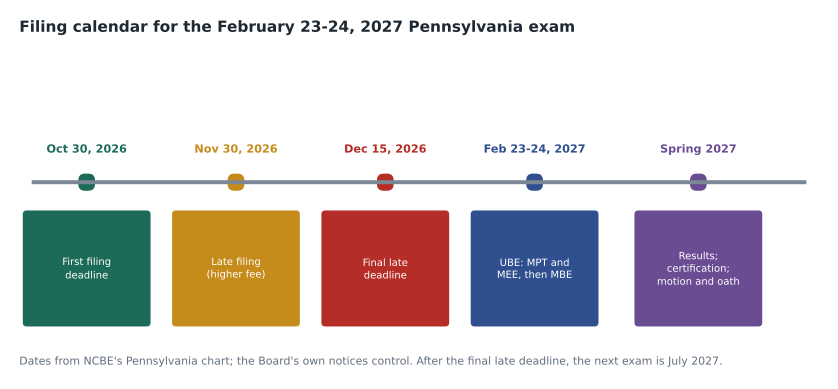
Pennsylvania gives the bar examination twice a year, in late February and late July, on the dates NCBE sets for the Uniform Bar Examination. The February 2027 exam falls on Tuesday, February 23 and Wednesday, February 24, 2027. Day one is the Multistate Performance Test and the Multistate Essay Examination; day two is the Multistate Bar Examination. The July 2027 exam falls on July 27 and 28, 2027.
For each exam, the Board sets a first filing deadline and later late filing deadlines. NCBE's chart for Pennsylvania lists, for the February 2027 exam, a first filing deadline of October 30, 2026 and late filing deadlines running to November 30 and December 15, 2026. For the July 2026 exam the first filing deadline was March 31, 2026, with late filing deadlines on April 30 and May 15. Filing late is allowed until the final late deadline, but late filing costs more and leaves less time for the character and fitness review. After the final late deadline, the applicant must wait for the next exam.
Hollis gave Wren's colleague the honest answer. In November he could still file a late application for February 2027, provided he met the education requirement and filed before the final late deadline, and he would pay more for the privilege. If he waited past December 15, February was gone. He decided to file that week.
Fees
NCBE's chart lists a Pennsylvania bar examination fee of 750 dollars for first-time takers, for attorney applicants and for repeaters, and a separate fee of 115 dollars for applicants approved to use a laptop. Applications filed after the first deadline carry additional late fees on the Board's schedule. Admission by transferred UBE score costs 750 dollars and admission by reciprocity under Rule 204 costs 1,325 dollars on NCBE's chart. Fees change, and the Board's own fee schedule controls, so a candidate should check the Board's website at the time of filing rather than relying on any chart.
Applicants also pay NCBE separately for the MPRE, and they pay for any score report or score transfer they request from NCBE. Those fees are set by NCBE, not by the Board.
The filing fees are only part of the cost of sitting. Most candidates also pay for a commercial bar review course, for travel and a hotel near the test site for two nights, and for time away from work. Wren's firm gave her the two exam days and the Monday before as paid leave and let her move to four-day weeks for the last month, which is a common arrangement for law clerks who are studying. Hollis encouraged the group to ask employers about such arrangements in writing in the fall, because a vague promise made in September is easy to forget in January. A candidate who plans the money and the time as carefully as the deadlines arrives at the exam with one less thing to worry about.
A complete application
An application is filed online through the Board's system. The Board's instructions say what must be submitted, and when, for an application to count as filed; supporting documents, such as the law school's certification of the degree and any certificates of good standing, follow on the schedule the Board sets. A candidate should read those instructions before the deadline week, not during it. The character and fitness questions are part of the application, and the Board can ask follow-up questions or request records during its review.
Wren described the parts of her application that had taken the longest. The questions about past addresses and employment required her to reconstruct every job she had held since college, including a summer at a garden center and two years of part-time work at a pharmacy. The question about traffic and court matters required the dates and outcomes of a speeding ticket she had paid in 2019. The financial questions asked about student loans and any defaults. None of it was difficult, she said, but all of it was slow, and she was glad she had started two weeks before the deadline rather than two days.
Hollis added a practical point. The application asks for information that other bodies may already have, such as the law school's records and the applicant's credit history, and the Board may compare them. A candidate who answers from memory and misremembers a date is not penalized for an honest mistake, but a candidate who leaves out an awkward fact and is found out later has a much bigger problem. Lesson 3 explains why.
Testing accommodations and laptops
Applicants with a disability may request testing accommodations from the Board, with supporting documentation from a qualified professional. Requests take time to review, and an applicant should file them with the application or as early as the Board's instructions allow. Accommodations for the bar exam are separate from accommodations for the MPRE, which are requested from NCBE.
Most candidates write the MEE and MPT on a laptop using the exam software the Board specifies. The laptop fee is paid with the application, and the Board's instructions tell candidates when and how to register and test the software. A candidate who does not register by the Board's deadline may have to write by hand.
Repeat takers
A candidate who does not pass files a new application for a later exam and pays the fee again. NCBE's chart lists the same fee for repeaters as for first-time takers. The Board's instructions for repeat applicants say what must be resubmitted, and in every case the applicant must update the information in the application, including any new employment, addresses, court matters or financial changes since the last filing.
Because Pennsylvania gives the UBE, a repeat taker's earlier UBE score stays on record with NCBE. That matters for score transfer: a candidate who passes in Pennsylvania on a second attempt can transfer the passing score, not the earlier one, to another UBE jurisdiction within that jurisdiction's time limit.
February or July
Most new graduates sit in July, a few weeks after graduation, because bar review courses are built around that calendar and because employers expect it. Pennsylvania's February exam is the same exam, scored on the same scale, with the same passing score and the same portability. February takers tend to fall into a few groups: graduates who finished law school in December, candidates like Wren who moved the exam back for personal reasons, repeat takers and experienced lawyers from other states who choose the exam route. Pass rates for February exams are usually lower than for July nationally, mainly because the February group includes more repeat takers, not because the exam is harder.
Wren had worried that February would look odd to employers. Hollis told her that most Pennsylvania firms see February takers every year and care more about the result than the month. The practical difference, she said, is that a February candidate usually studies while working. That changes the study plan, which Lesson 12 addresses, but it does not change anything in the rules.
A filing checklist
Hollis gave the group a checklist she has refined over fifteen years. It is not an official list, but it follows the order in which the pieces of a Pennsylvania application tend to arrive.
First, gather the history before opening the application: every address since a set age or date the application specifies, every employer with dates and a contact, every school attended, and every traffic, criminal, civil or administrative matter, with court names, dates and outcomes. Second, request any records that take time, such as court dispositions for old matters or a driving record from another state. Third, confirm with the law school how and when it will certify the degree to the Board. Fourth, decide about a laptop and any testing accommodations, since each has its own requirements. Fifth, file before the first deadline if at all possible and save a copy of everything submitted. Sixth, calendar the Board's later deadlines for supporting documents and watch the Board's system and email for follow-up questions.
'The checklist is boring,' Hollis said, 'and it is the reason my candidates sit the exam they planned to sit.' Wren's colleague printed it.
Worked problem
The colleague's choice
On November 20, 2026, a graduate of an ABA-approved law school in Ohio asks whether he can still sit the February 2027 Pennsylvania exam, and what it will cost.
Show solution
- He meets the Rule 203 education requirement with a JD from an ABA-approved school.
- The first filing deadline of October 30, 2026 has passed, but the late filing deadlines run to November 30 and December 15, 2026.
- If he files before the final late deadline, he can sit, paying the examination fee plus the late fee on the Board's schedule.
- He should request a laptop and any accommodations at the same time.
Answer: He can still sit in February 2027 if he files a complete late application before December 15, 2026 and pays the late fee; after that date he must wait for July 2027.
Common mistakes
MistakeAny law school graduate can sit the Pennsylvania exam.
InsteadGraduates of non-ABA schools in other states must first be admitted in a reciprocal state and have five of the last seven years of practice.
MistakeAn LLM from an ABA-approved school makes a foreign lawyer eligible.
InsteadRule 205 requires more; an LLM alone does not make a foreign graduate eligible.
MistakeMissing the first filing deadline means waiting for the next exam.
InsteadLate filing is allowed, at a higher fee, until the final late deadline.
MistakeThe Board sets the MPRE fee.
InsteadNCBE sets and collects MPRE and score transfer fees.
MistakeA repeat taker's earlier application carries over unchanged.
InsteadA repeat taker files a new application and must update the information since the last filing.
Practice problems
Work each problem on paper first, then reveal the answer to check.
What law degree does Rule 203 require for an ordinary applicant?
Show answer
A JD or LLB from a law school accredited (ABA-approved) at matriculation or graduation.
What was the first filing deadline for the February 2027 Pennsylvania exam?
Show answer
October 30, 2026.
On which days is the February 2027 exam given?
Show answer
Tuesday, February 23 and Wednesday, February 24, 2027.
What examination fee does NCBE's chart list for Pennsylvania?
Show answer
750 dollars, with a 115 dollar laptop fee.
Can a lawyer suspended elsewhere for discipline sit the Pennsylvania exam?
Show answer
No, not while suspended or disbarred at the time of filing.
Summary and key terms
- Rule 203 requires an accredited undergraduate degree and a law degree from an ABA-approved school.
- Non-ABA graduates of other states need reciprocal-state admission and five of the last seven years of practice; foreign graduates follow Rule 205.
- For February 2027 the first deadline was October 30, 2026, with late deadlines to November 30 and December 15, 2026.
- NCBE's chart lists a 750 dollar exam fee, a 115 dollar laptop fee, 750 dollars for score transfer and 1,325 dollars for reciprocity.
- Applications are filed online; character and fitness questions are part of the application.
- Accommodations and laptop registration have their own deadlines; repeaters reapply and update.
- first filing deadline
- The earliest and cheapest deadline to apply for a given exam.
- late filing deadline
- A later deadline that allows filing at a higher fee.
- accredited law school
- In the Pennsylvania rules, a law school approved by the American Bar Association.
- Rule 205
- The Pennsylvania rule governing foreign-educated applicants.
- certificate of good standing
- A statement from another jurisdiction that the applicant is admitted and not under discipline.
Lesson quiz · 5 questions
Score 60% or more to complete this lesson.
Create a free account to save your progress, take quizzes and earn a certificate.