
BAR-239 · Lesson 12 of 12 · 22 min
Capstone: Pennsylvania practice questions and an exam-day plan
▶ Video coming soon A video version of this lesson is on the way.
The last session of the fall was a working session. Hollis gave Wren three Pennsylvania problems she had written for the group, each built from the kind of file a first-year Pennsylvania lawyer might see, and asked her to answer them in IRAC form: issue, rule, application, conclusion. 'None of this is on the February exam,' Hollis said. 'All of it is in your first year of practice. And the method is the same method you will use on every essay in February.' Then they built Wren's plan for the last twelve weeks before February 23, 2027 and for the two exam days themselves.
This lesson contains three original practice problems on Pennsylvania law with model answers, a short set of review questions across the course, a twelve-week study plan for a working February candidate and an exam-day plan. The problems are hypotheticals written for this course, not released bar exam questions.
Problem one: the delivery van and the borough sidewalk
Facts. On March 10, 2026, Elias Yoder, a resident of Lancaster County, was walking on a sidewalk owned and maintained by a borough when he stepped into a deep hole the borough had known about for months. He stumbled into the street and was struck by a delivery van driven by an employee of a regional delivery company, which is incorporated in Delaware, has its principal place of business in Maryland and is registered to do business in Pennsylvania. Yoder was looking at his phone. His medical expenses and lost wages total 90,000 dollars, and he has a permanent limp. He comes to a lawyer on September 2, 2026. His own auto policy, under which he is a named insured, carries the limited tort option. A jury could reasonably find Yoder 25 percent at fault, the borough 35 percent and the driver 40 percent.
Issues. What must the lawyer do immediately? Can Yoder recover from the borough, and how much? How is liability shared between the borough and the company? Does the limited tort election affect his recovery? Where may he sue the company?
Rule and application: notice. Under section 5522 of the Judicial Code, a person who intends to sue a local agency must file a written statement of the claim with the agency within six months after the cause of action accrues. The accident occurred on March 10, 2026, so the six-month period ended on September 10, 2026. The lawyer must prepare and serve the written notice on the borough at once, within about a week of the first meeting. If the notice is late, the claim against the borough is at serious risk; a court may excuse a late notice only for reasonable excuse or where the borough had actual or constructive notice of the incident, and a lawyer should not count on either. The two-year limitations period under section 5524 runs to March 10, 2028.
Rule and application: immunity. Under the Political Subdivision Tort Claims Act, a local agency is immune except for negligent acts within the listed exceptions. The sidewalks exception covers a dangerous condition of sidewalks within the rights-of-way of streets owned by the local agency, where the agency had actual or constructive notice of the condition in time to protect against it and the condition created a reasonably foreseeable risk of the kind of injury that occurred. The borough owned and maintained the sidewalk and knew of the hole for months, so the exception likely applies. Recovery against the borough is capped at 500,000 dollars per occurrence, well above any likely award here.
Rule and application: comparative fault and the Fair Share Act. Under section 7102(a), Yoder's 25 percent is not greater than the defendants' combined 75 percent, so he recovers, with his damages reduced by 25 percent. Under section 7102(a.1), each defendant is liable only for its share unless it is at least 60 percent at fault or an exception applies. Neither the borough at 35 percent nor the driver at 40 percent reaches 60 percent, and no exception applies, so each pays its proportionate share of the reduced award. The company is liable for its driver's negligence within the scope of employment.
Rule and application: limited tort. The limited tort election under section 1705 of the Vehicle Code bars recovery of noneconomic damages unless the injury is a serious injury or an exception applies. Yoder was a pedestrian, but he is a named insured who elected limited tort, and Pennsylvania courts generally apply the election to the insured's claims arising from a motor vehicle accident, including as a pedestrian, so his claim against the van's driver and the company is likely subject to it as to pain and suffering. A permanent limp may qualify as a serious impairment of a body function or a permanent serious disfigurement, a question usually for the jury. The limited tort election does not limit his claim against the borough arising from the sidewalk defect, which is not a claim for injury from the maintenance or use of a motor vehicle. The lawyer should research both points before advising the client.
Rule and application: jurisdiction and venue. The company is registered to do business in Pennsylvania, so section 5301 supplies general jurisdiction, which Mallory v. Norfolk Southern (2023) held consistent with due process. Here the claim also arises from the company's Pennsylvania conduct, so specific jurisdiction exists in any event. Venue lies in Lancaster County, where the cause of action arose, and in any county where the company regularly conducts business.
Conclusion. File the section 5522 notice on the borough immediately; sue both defendants in the Court of Common Pleas of Lancaster County before March 10, 2028; expect recovery reduced by Yoder's share of fault, with the borough and the company each paying its own share; and prepare to prove serious injury for noneconomic damages against the company.
Problem two: a divorce and an estate
Facts. Celia and Martin Vukovich married in 2009 and separated on July 1, 2025. Celia owned a rental duplex before the marriage, worth 200,000 dollars then and 340,000 dollars now; Martin managed and repaired it during the marriage. Martin inherited 80,000 dollars from his aunt in 2020 and kept it in a separate account. They signed no premarital agreement. Martin had an affair in 2024. On November 15, 2026, Celia files for divorce under section 3301(d). Martin's mother, Dolores, who lived in Pennsylvania, died intestate on October 1, 2026, survived by Martin, his sister and no spouse, leaving a probate estate of 400,000 dollars.
Issues. Can Celia obtain a no-fault divorce now? What is marital property? What role does the affair play? Who takes Dolores's estate, and what tax applies?
Model answer. Under section 3301(d), a divorce may be granted on irretrievable breakdown after the parties have lived separate and apart for at least one year; separated on July 1, 2025, they had lived apart for more than a year when Celia filed, so the ground is available, and if Martin denies the breakdown the court decides after a hearing. Under section 3501, Celia's duplex is nonmarital because she owned it before the marriage, but its increase in value during the marriage, 140,000 dollars, is generally marital property, and Martin's work on it supports including it; Martin's 2020 inheritance is excluded as property acquired by inheritance, kept in a separate account, although any increase in its value during the marriage is generally marital. Under section 3502, the court divides the marital property equitably considering the statutory factors and without regard to marital misconduct, so the affair is irrelevant to the division, though it may bear on alimony. Dolores died without a spouse, so under section 2103 her estate passes to her issue, Martin and his sister, in equal shares of 200,000 dollars each; each share is a lineal transfer taxed at 4.5 percent, discounted by 5 percent if paid within three months and delinquent after nine months. Martin's inheritance from his mother, received after separation and by inheritance, is not marital property.
Problem three: a new client and a corporate defendant
Facts. In January 2029, Wren, now a solo practitioner without malpractice insurance, meets Farrah Amadi, a new client from Erie, who was injured in Ohio by a product made by a Texas corporation that is registered to do business in Pennsylvania. Amadi has never been to Ohio for any other reason. Wren agrees on a one-third contingent fee in a handshake deal and plans to refer half of the work, and half of the fee, to a lawyer in another firm without telling Amadi.
Model answer. Jurisdiction: because the corporation is registered in Pennsylvania, section 5301 supplies general jurisdiction on any claim, and Mallory upheld that against a due process challenge; the dormant Commerce Clause question remains undecided after certiorari was denied in October 2026, so Wren should expect the defendant to raise it and should research developments. Ethics: a contingent fee agreement must be in writing under Rule 1.5(c), stating the percentages and the treatment of expenses, so the handshake deal must be put in writing; under Rule 1.4(c), Wren must tell Amadi in writing that she lacks the minimum professional liability insurance; and under Rule 1.5(e), the fee may be divided with the other lawyer only if Amadi is advised of and does not object to the participation of both lawyers, so the plan to divide the fee without telling her violates the rule. Limitations: Pennsylvania's two-year period applies in a Pennsylvania court subject to its borrowing statute, which applies the shorter period of the place where the claim accrued, so Wren should check Ohio's limitations period as well.
Review questions across the course
Hollis ended the problems with a round of rapid questions. Who admits Pennsylvania lawyers? The Supreme Court. What is the passing score for February 2027? 270. What MPRE score is required, and is there a time limit? 75, with no time limit on NCBE's chart. When does Pennsylvania give its first NextGen exam? July 2028. Does Pennsylvania have a state law component? No. How long may a transferred UBE score be? No more than 30 months old. How many years of practice does reciprocity require? Five of the last seven, or more than three of five for UBE takers. How many CLE credits each year? Twelve, two of them ethics, professionalism or substance abuse.
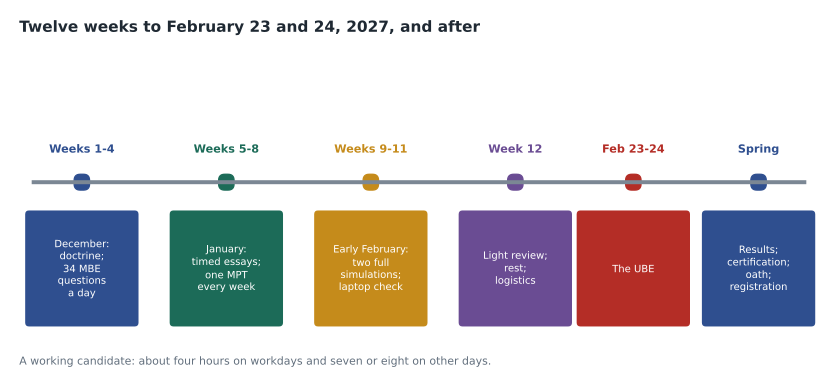
A twelve-week plan for a working candidate
Wren works four days a week from January, so her plan assumes about four hours of study on workdays and seven or eight on other days. Weeks one through four, in December, are for doctrine: finishing the bar review lectures on the seven MBE subjects and business associations, writing a one-page outline of each subject and doing 34 MBE questions every day, timed, with every wrong answer reviewed. Weeks five through eight, in January, shift to writing: two timed MEE essays on each study day, one full MPT every week under 90-minute conditions and continued daily MBE practice in mixed sets. Weeks nine through eleven, in early February, include two full simulated exams on Saturdays, one written day and one MBE day, a final laptop software check and a review of every essay grader's comments. Week twelve is light review, sleep and logistics.
Hollis added three rules. Do not learn new law in the last week. Do not read Pennsylvania practice materials after mid-January. And protect sleep, because the score on day two depends on the sleep before day one.
The exam-day plan
The night before. Pack admission materials and identification as the Board's instructions require, the approved laptop and charger, and only the items the instructions permit, leaving everything prohibited at home or in the car. Confirm the route to the test site and the arrival time. Eat a normal dinner and go to bed at the usual time.
Day one, Tuesday, February 23, 2027. In the morning MPT session, read each task memo first and treat it as the grading guide; spend roughly 40 minutes reading and organizing and 50 minutes writing on each task, and move to the second task on time. In the afternoon MEE session, give each of the six questions 30 minutes: read the call, outline the issues in two minutes, write in IRAC paragraphs with headings and move on at the half hour whatever the state of the answer.
Day two, Wednesday, February 24, 2027. In each three-hour MBE session, pace at about 1.8 minutes per question, checking the clock every 25 questions; answer every question, since there is no penalty for wrong answers; and leave a few minutes at the end to check that every answer is recorded. Do not discuss questions at lunch.
After the exam. Rest. Then complete the remaining tasks: watch the Board's system for results in the spring, keep the MPRE score on file, answer any final character and fitness questions and plan the oath. Once admitted, register with the Disciplinary Board, open a trust account at an approved institution if needed, confirm the CLE compliance group and schedule Bridge the Gap.
Wren wrote the plan on a single sheet and taped it above her desk. 'It looks smaller on paper,' she said. Hollis told her that was the point.
Worked problem
Pacing the written day
On day one, a candidate finishes the first MPT task in 105 minutes and has 75 minutes for the second. On the MEE, she spends 45 minutes on the first essay because she knows the subject well. What should she change?
Show solution
- Each MPT task is worth 10 percent of the total; spending 105 minutes on one leaves the other underdeveloped.
- She should stop the first task at about 90 minutes even if it is unfinished and give the second its full time.
- Each MEE question is worth about 5 percent; 15 extra minutes on one essay comes from another.
- She should move on at 30 minutes on every essay, because a complete answer to each question earns more than a perfect answer to one.
Answer: Keep to 90 minutes per MPT task and 30 minutes per essay; equal time protects the total score.
Common mistakes
MistakePractice problems on Pennsylvania law will help on the February MEE.
InsteadThe MEE tests general law; Pennsylvania problems prepare for practice and train the IRAC method.
MistakeThe six-month notice can wait until suit is filed.
InsteadIt must be served within six months of the injury.
MistakeMarital misconduct affects equitable distribution.
InsteadDivision is without regard to marital misconduct.
MistakeA referral fee can be split without telling the client.
InsteadPennsylvania Rule 1.5(e) requires that the client be advised and not object.
MistakeMore time on a strong essay always raises the score.
InsteadEqual time across questions protects the total.
Practice problems
Work each problem on paper first, then reveal the answer to check.
By when must Yoder's lawyer serve notice on the borough?
Show answer
By September 10, 2026, six months after the March 10, 2026 accident.
How is the increase in value of premarital property treated in Pennsylvania?
Show answer
Generally as marital property.
What must Wren give Amadi in writing?
Show answer
The contingent fee agreement and the disclosure that she lacks minimum malpractice insurance.
How long should a candidate spend on each MPT task?
Show answer
About 90 minutes.
What are the dates of the February 2027 exam?
Show answer
Tuesday, February 23 and Wednesday, February 24, 2027.
Summary and key terms
- Pennsylvania problems use the same IRAC method as MEE essays.
- Government claims require six-month notice; the immunity exceptions and caps define recovery.
- Comparative fault, the Fair Share Act and limited tort shape every injury case.
- Marital property, misconduct, intestacy and inheritance tax interact in family and estate files.
- Jurisdiction by registration, written fee agreements, insurance disclosure and fee division rules govern new matters.
- A twelve-week plan and strict timing on exam day protect the 270 total.
- IRAC
- Issue, rule, application and conclusion: a method for organizing legal analysis.
- simulated exam
- A full practice exam taken under real timing.
- borrowing statute
- A statute applying another jurisdiction's shorter limitations period to a claim that accrued there.
- sidewalks exception
- The Political Subdivision Tort Claims Act exception for dangerous conditions of agency-owned sidewalks.
- pacing
- Dividing exam time evenly so every question receives an answer.
Lesson quiz · 5 questions
Score 60% or more to complete this lesson.
Create a free account to save your progress, take quizzes and earn a certificate.