
BAR-239 · Lesson 5 of 12 · 21 min
Exam changes: the move to NextGen in July 2028
▶ Video coming soon A video version of this lesson is on the way.
In September 2026 the newspapers were full of the first NextGen bar exam. Missouri and several other jurisdictions had given it in July, and NCBE had released the first results. Wren's grandmother cut out an article and left it on her kitchen table with a note: is this yours? It was not. Pennsylvania had chosen to wait. Wren brought the clipping to the group, and Hollis used it to explain the timeline. 'You are sitting the exam lawyers have taken in Pennsylvania since 2022,' she said. 'The new one is coming, but not for you, unless something goes very wrong for a long time.'
This lesson explains Pennsylvania's path from its own exam to the Uniform Bar Examination and then to the NextGen exam, what the NextGen exam is, what the transition means for candidates who sit before July 2028, and how Pennsylvania handles transferred scores from both versions during the transition.
From a Pennsylvania exam to the UBE
For decades Pennsylvania gave its own bar exam, combining the MBE with essay questions on Pennsylvania law and a performance test. The Supreme Court of Pennsylvania then approved a move to the Uniform Bar Examination, and the first Pennsylvania UBE was given in July 2022. The change gave Pennsylvania candidates a portable score that other UBE jurisdictions accept, which matters in a region where many lawyers practice across state lines. It also ended the testing of Pennsylvania law on the bar exam, which is why Pennsylvania now has no state law component, as Lesson 6 explains.
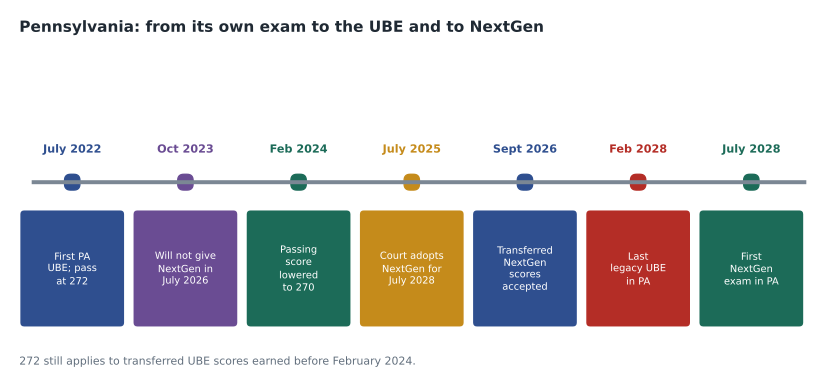
The first UBE administrations came with an adjustment. Pennsylvania set its passing score at 272 when it adopted the UBE. By an order of December 27, 2023, the Court lowered it to 270, effective with the February 2024 exam, while keeping 272 for applications relying on earlier UBE scores.
Waiting on NextGen
NCBE spent several years designing a new exam, based on a national study of the work newly licensed lawyers actually do. It announced that the NextGen bar exam would first be offered in July 2026, and that the current UBE would remain available during a transition period. In October 2023, the Board of Law Examiners announced, with the Court's approval, that Pennsylvania would not give the NextGen exam in July 2026. The Board said it would continue to study the new exam as NCBE released more information about its content and administration.
Pennsylvania's decision to wait reflected a common caution. A new exam brings new costs, such as training graders, changing test sites and software and preparing candidates and law schools. Jurisdictions that waited could see how the first administrations went before committing. By the time Pennsylvania decided, NCBE had published sample questions, a content scope and details of the administration.
The July 2025 decision
On July 3, 2025, the Board announced that the Supreme Court had adopted the NextGen Uniform Bar Examination, with the first Pennsylvania administration in July 2028. NCBE published its own release the same week, noting that Pennsylvania had used the UBE since 2022 and would keep the portability of a uniform score. The Court's announcement explained that the new exam runs about nine hours over a day and a half, compared with about twelve hours over two days for the current exam, covers nine foundational areas of law and seven lawyering skills, and uses integrated question sets built around realistic scenarios.
The order set three dates that matter to Pennsylvania candidates. The last legacy UBE in Pennsylvania will be given in February 2028. The first NextGen exam in Pennsylvania will be given in July 2028. And from September 1, 2026, Pennsylvania accepts transferred scores from either the legacy UBE or the NextGen UBE under Rule 206. NCBE's jurisdiction page lists 620 as Pennsylvania's minimum NextGen score; Pennsylvania's own July 2025 announcement said the minimum NextGen score had yet to be announced. A candidate relying on a NextGen score should confirm the current minimum with the Board.
What the NextGen exam is
The NextGen exam is a different kind of test. Rather than separate multiple-choice, essay and performance components, it mixes question types throughout. There are stand-alone multiple-choice questions, integrated question sets built around a single set of facts, sometimes with legal resources supplied, and performance tasks that ask candidates to complete lawyering work with a file and library. Legal ethics is tested alongside other subjects rather than only on the MPRE.
NCBE describes the exam as testing foundational concepts and principles in nine areas: business associations, civil procedure, constitutional law, contract law, criminal law, evidence, family law, real property and torts, along with foundational lawyering skills in seven areas, including legal research, legal writing, issue spotting and analysis, investigation and evaluation, client counseling and advising, negotiation and dispute resolution, and client relationship and management. The exam tests a narrower body of memorized law than the current UBE, with more weight on applying it.
NextGen scores are reported on a new scale, not the 400-point UBE scale, and jurisdictions set passing scores on that scale. Missouri, for example, which gave NextGen in July 2026, set its passing score at 610. A NextGen score and a legacy UBE score cannot be compared by simple arithmetic, and jurisdictions that accept both during the transition set separate minimums for each.
| Feature | Legacy UBE (Pennsylvania through February 2028) | NextGen (Pennsylvania from July 2028) |
|---|---|---|
| Length | About 12 hours over two days | About 9 hours over a day and a half |
| Parts | MBE, MEE and MPT as separate components | Mixed multiple-choice, integrated sets and performance tasks |
| Subjects | Seven MBE subjects; MEE adds business associations | Nine foundational areas, including family law, plus seven skills |
| Ethics | MPRE only | Integrated in the exam; the MPRE still required by Pennsylvania rules unless they change |
| Score scale | 400 points; Pennsylvania passes at 270 | New scale; NCBE lists 620 for Pennsylvania transfers |
One question in the table is open. NextGen tests ethics, but Pennsylvania's rules still require the MPRE, and nothing in the July 2025 announcement changed that. Candidates should assume the MPRE remains required unless the Court changes the rule.
What the transition means for candidates
For a candidate like Wren, sitting in February 2027, the transition changes nothing about the exam she takes. She sits the legacy UBE, scored on the 400-point scale, and needs 270. If she passes, her legacy score can be transferred to other jurisdictions under their rules for the time they allow. Many NextGen jurisdictions continue to accept legacy UBE scores for a period, but each sets its own policy, and some may stop accepting legacy scores after a date. A candidate who expects to transfer a legacy score later should check the receiving jurisdiction's policy early.
For a candidate who does not pass in February 2027, the legacy exam remains available in July 2027, February 2028 and no later. A candidate who has not passed by February 2028 will sit the NextGen exam in July 2028 or later and should plan a different kind of preparation, since the question types change. Hollis said that was the most important practical consequence. 'Nobody wants to learn a new exam after failing the old one,' she said. 'If you are going to sit the legacy exam, give it everything while it is still here.'
For law students who will graduate in May 2028 or later, the question is simple: they will sit NextGen. Pennsylvania law schools have been adjusting their bar preparation programs, and commercial courses offer NextGen preparation. Students planning to graduate in December 2027 face a choice between February 2028, the last legacy exam, and July 2028, the first NextGen exam.
Transferred scores during the transition
From September 1, 2026, a candidate who earned a NextGen score in another jurisdiction can apply under Rule 206 to transfer it to Pennsylvania, if it meets Pennsylvania's minimum and the other requirements. That gives Pennsylvania access to candidates from the first NextGen jurisdictions, such as Missouri, before Pennsylvania gives the exam itself. A Missouri lawyer who passed NextGen in July 2026 with a score above Pennsylvania's minimum could, for example, seek admission in Pennsylvania by transferred score within the 30-month window, satisfying the education, character and fitness and MPRE requirements.
Legacy UBE scores remain transferable to Pennsylvania on the same terms as before: at least 270 for scores from February 2024 on, at least 272 for earlier scores, and no more than 30 months old at filing. Lesson 11 covers the transfer rules in more detail.
Watching for further changes
Rules change, and the transition is still under way. The Board posts announcements on pabarexam.org, and NCBE keeps a page showing each jurisdiction's NextGen plans and score policies. Before relying on any date or number in this lesson, a candidate should check both. Hollis had the group bookmark the two pages and check them at the start of each month. 'The dates in an order rarely move,' she said, 'but the details around them often do.'
What stays the same
The exam is changing; the rest of admission is not. The education requirement in Rule 203, the character and fitness standard, the MPRE requirement and its score of 75, the filing calendar with first and late deadlines, the Board's role and the Court's power to admit all continue through the transition. Admission by transferred score and by reciprocity also continue, with the change that NextGen scores now count for transfer. A candidate who learns the admission process for the legacy exam learns it for the NextGen exam too.
Pennsylvania law also stays outside the exam. NextGen, like the legacy UBE, is a national exam that does not test any one state's rules, and Pennsylvania's July 2025 announcement did not add a state law component. Unless the Court adds one, Pennsylvania law will remain something new lawyers learn in practice, through CLE and through the materials discussed in Lesson 6.
Choosing where to sit during the transition
Some candidates can choose among jurisdictions, especially those who expect to practice in a region that crosses state lines. During the transition, the choice includes the format of the exam as well as the location. A candidate who prefers the familiar legacy format can sit it in Pennsylvania through February 2028. A candidate who has prepared for NextGen, perhaps because a law school course was built around it, may prefer a jurisdiction already giving NextGen and then transfer the score to Pennsylvania under Rule 206, which accepts NextGen scores from September 2026.
Hollis warned against overthinking the choice. The exam a candidate sits matters less than where the candidate intends to practice and whether the score will be accepted there. A candidate who will practice in Philadelphia and nowhere else should sit in Pennsylvania and not worry about the format debate. A candidate who expects to work in Pennsylvania and New Jersey, or Pennsylvania and Ohio, should check each jurisdiction's policy on legacy and NextGen scores before choosing, because a score that one accepts the other may not.
Preparing for NextGen later
Candidates who will sit NextGen in Pennsylvania in 2028 or later can start with NCBE's own materials. NCBE publishes descriptions of the content scope, sample questions of each type and tutorials on the exam interface. Commercial bar review companies have built NextGen courses, and many law schools have added NextGen-style practice to their academic support programs. The skills the new exam tests, such as reading a file closely, finding the relevant authority and writing a focused document under time pressure, are the same skills the MPT tests now, so legacy candidates who practice the MPT well are learning something useful for the future as well.
'The new exam will reward the same habits the old one rewards,' Hollis told the group. 'Read the question that was asked, use the facts you were given, and finish on time.'
Worked problem
Which exam, which score?
Three people ask about Pennsylvania in November 2026. Ana will graduate in December 2027. Ben failed the February 2027 Pennsylvania exam and plans to retake in July 2027. Cleo passed the NextGen exam in Missouri in July 2026 with a score above 620 and wants to practice in Pittsburgh.
Show solution
- Ana can sit the last legacy exam in February 2028 or the first NextGen exam in July 2028.
- Ben's July 2027 retake is still the legacy UBE, so his preparation can build on what he has done.
- Pennsylvania accepts transferred NextGen scores from September 1, 2026, so Cleo can apply under Rule 206 within 30 months of her exam.
- Cleo must still meet the education, character and fitness and MPRE requirements, and should confirm the current NextGen minimum with the Board.
Answer: Ana chooses between February and July 2028; Ben retakes the legacy UBE; Cleo can apply to transfer her NextGen score.
Common mistakes
MistakePennsylvania gave the NextGen exam in July 2026.
InsteadPennsylvania chose to wait; its first NextGen exam is July 2028.
MistakeThe February 2027 Pennsylvania exam is the NextGen exam.
InsteadIt is the legacy UBE, scored on the 400-point scale with a passing score of 270.
MistakePennsylvania will not accept NextGen scores until 2028.
InsteadIt accepts transferred NextGen scores from September 1, 2026.
MistakeNextGen means the MPRE is no longer required in Pennsylvania.
InsteadThe MPRE remains required unless the Court changes the rule.
MistakeA legacy score and a NextGen score can be compared directly.
InsteadThey are on different scales with separate minimums.
Practice problems
Work each problem on paper first, then reveal the answer to check.
When did Pennsylvania first give the UBE?
Show answer
July 2022.
When will Pennsylvania give its last legacy UBE and first NextGen exam?
Show answer
February 2028 and July 2028.
When did the Court adopt NextGen for Pennsylvania?
Show answer
The adoption was announced July 3, 2025.
From when does Pennsylvania accept transferred NextGen scores?
Show answer
September 1, 2026.
About how long is the NextGen exam?
Show answer
About nine hours over a day and a half.
Summary and key terms
- Pennsylvania moved from its own exam to the UBE in July 2022.
- In October 2023 it decided not to give NextGen in July 2026; in July 2025 it adopted NextGen for July 2028.
- The last legacy UBE in Pennsylvania is February 2028; the first NextGen exam is July 2028.
- Pennsylvania accepts transferred NextGen scores from September 1, 2026; NCBE lists a 620 minimum, which candidates should confirm.
- NextGen mixes question types, covers nine foundational areas and seven skills, and uses a new score scale.
- Candidates sitting before July 2028 take the legacy exam and should check transfer policies of other jurisdictions.
- legacy UBE
- The current Uniform Bar Examination of MBE, MEE and MPT, given in Pennsylvania through February 2028.
- NextGen UBE
- NCBE's new bar exam, first given nationally in July 2026 and in Pennsylvania from July 2028.
- integrated question set
- A group of NextGen questions built around one scenario, sometimes with legal resources supplied.
- performance task
- A NextGen task requiring lawyering work with a supplied file and library.
- transition period
- The years during which jurisdictions give or accept both the legacy and NextGen exams.
Lesson quiz · 5 questions
Score 60% or more to complete this lesson.
Create a free account to save your progress, take quizzes and earn a certificate.